Quick Verdict: The Civic Hybrid Sport Touring Nails the Everyday Commute
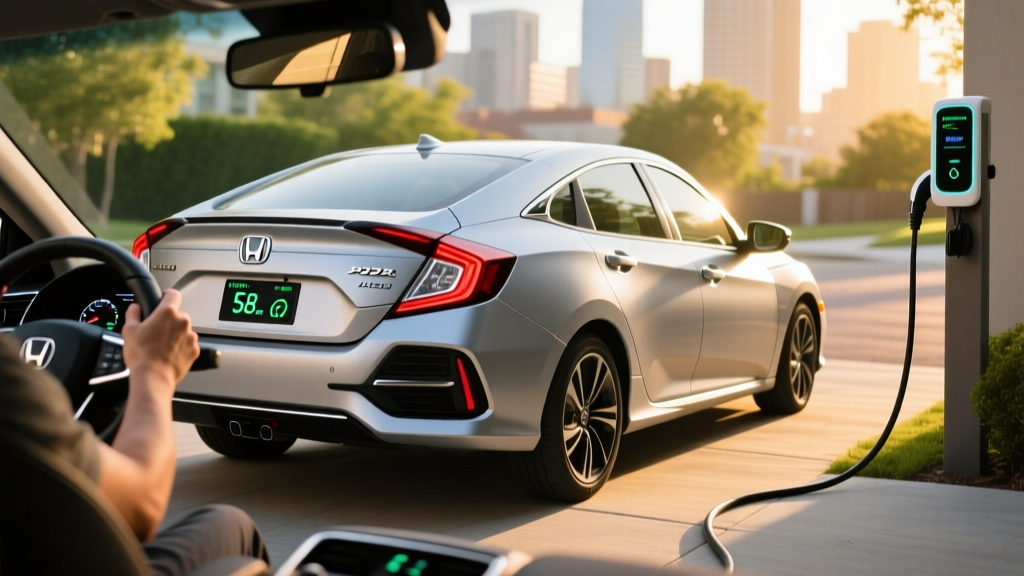
The 2026 Honda Civic Sport Touring Hybrid Sedan occupies a precise niche: buyers who want electrified efficiency without plugging in, premium features without a luxury badge price, and a proven powertrain backed by one of the industry's strongest hybrid warranties. With an EPA-estimated 49 MPG combined and a 200-horsepower two-motor hybrid system, this top-trim Civic delivers real-world fuel savings that frequently exceed its sticker numbers in city driving — while asking nothing more of you than filling up at any gas station.
This is a conventional hybrid (HEV), not a plug-in. You will never search for a charger or manage an electric-only range. The trade-off is that it doesn't qualify for the federal §30D EV tax credit. But at a starting MSRP around $31,450, the math works through fuel savings alone for most drivers.
HEV vs. PHEV: What the Civic Sport Touring Hybrid Actually Is
Conventional Hybrid (HEV) — This Car: The Civic Sport Touring Hybrid uses a small lithium-ion battery (roughly 1.1 kWh usable) charged exclusively by the gasoline engine and regenerative braking. You never plug it in. The electric motor assists the engine and can drive the wheels alone at low speeds for brief distances, but there is no meaningful electric-only range. Think of it as a gas car that's 30-40% more efficient.
Plug-in Hybrid (PHEV) — Not This Car: A PHEV like the Toyota Prius Prime or Hyundai Tucson PHEV carries a much larger battery (typically 12-18 kWh), offers 25-45 miles of electric-only driving, and must be plugged in to realize its full efficiency benefit. PHEVs can qualify for the §30D federal tax credit if they meet battery-sourcing and MSRP requirements.
The Civic Sport Touring Hybrid is firmly in the HEV camp. If you want plug-in capability from Honda, you'd need to look at the discontinued Clarity PHEV (no longer in production) or wait for Honda's next-generation PHEV offerings. For now, the Civic Hybrid's strength is simplicity: no charging infrastructure needed, no range management, just excellent fuel economy.
Fuel Economy: EPA Numbers and Real-World MPG
| Driving Cycle | EPA Estimate | Real-World Expectation |
|---|---|---|
| City | 50 MPG | 52–56 MPG (hybrids excel in stop-and-go) |
| Highway | 47 MPG | 43–46 MPG (less regen benefit at steady speed) |
| Combined | 49 MPG | 47–52 MPG depending on driving mix |
Source: fueleconomy.gov
Honda's two-motor hybrid system is engineered to exploit city driving conditions where regenerative braking recaptures energy at every stoplight and the electric motor handles low-speed propulsion without engaging the gasoline engine. In mixed suburban commuting with frequent stops, owners regularly report exceeding the EPA city estimate. On long highway stretches at 75+ MPH, expect a slight drop below the EPA highway figure — the 2.0-liter Atkinson-cycle engine runs more often at sustained speeds.
Total Range: With a 12.4-gallon fuel tank and 49 MPG combined, the Civic Sport Touring Hybrid delivers approximately 607 miles of total range between fill-ups. In city-heavy driving, that number can stretch past 650 miles.
Powertrain and Performance Specs
| Specification | 2026 Civic Sport Touring Hybrid |
|---|---|
| Engine | 2.0L DOHC Atkinson-cycle 4-cylinder |
| Hybrid System | Two-motor (traction + generator) |
| Combined Horsepower | 200 hp |
| Combined Torque | 232 lb-ft (motor peak) |
| Transmission | e-CVT (no traditional gears) |
| Drivetrain | FWD |
| 0–60 MPH | ~7.2 seconds |
| Battery Type | Lithium-ion (approx. 1.1 kWh usable) |
| Fuel Tank | 12.4 gallons |
| EPA Combined MPG | 49 MPG |
| Cargo Volume | 14.8 cu ft (trunk) |
| Base MSRP (Sport Touring Hybrid) | $31,450 |
The fourth-generation two-motor hybrid system is the same architecture found in the Accord Hybrid and CR-V Hybrid, tuned here for the Civic's lighter chassis. The result is a car that feels genuinely quick off the line — the electric motor's 232 lb-ft of torque is available instantly, making the Civic Hybrid more responsive than most turbocharged gas competitors in the 0-30 MPH range. The e-CVT eliminates shift shock entirely, and the gasoline engine engages so smoothly that most drivers won't notice the transition.
Pricing, Trims, and Tax Credit Eligibility
The 2026 Honda Civic Hybrid is offered in two trims:
- Sport Hybrid: ~$28,950 MSRP — cloth/leatherette seats, 7-inch touchscreen, Honda Sensing suite
- Sport Touring Hybrid: ~$31,450 MSRP — leather seats, 9-inch touchscreen with wireless Apple CarPlay/Android Auto, Bose 12-speaker audio, wireless phone charging, heated front seats, low-speed braking control
Federal Tax Credit: The Civic Sport Touring Hybrid does not qualify for the §30D Clean Vehicle Credit. Under current IRS rules, only plug-in electric vehicles (BEVs and PHEVs with at least 7 kWh of battery capacity) are eligible. As a conventional HEV with a ~1.1 kWh battery, the Civic Hybrid falls outside the program.
State Incentives: A handful of states offer rebates or HOV lane access for conventional hybrids, though these programs are shrinking as states redirect funds toward BEVs. Check your state's energy office or DMV for current hybrid-specific incentives.
At $31,450, the Sport Touring Hybrid commands roughly $2,500 over the Sport Hybrid trim. The premium buys meaningful comfort and technology upgrades — the Bose system, leather interior, and larger infotainment screen are the most tangible. For buyers cross-shopping against the Toyota Corolla Hybrid ($23,500 base) or Hyundai Elantra Hybrid ($26,250 base), the Civic's pricing reflects its position as a near-premium compact.
Battery Warranty, Reliability, and Replacement Cost
Honda Hybrid Battery Warranty:
- Duration: 8 years / 100,000 miles (10 years / 150,000 miles in CARB states including CA, CT, MA, ME, MD, NJ, NY, OR, RI, VT, WA)
- Coverage: Defects and capacity loss below a defined threshold
- Hybrid System Components: Covered under the same 8yr/100k warranty (power control unit, electric motors, e-CVT)
Honda's hybrid battery track record is strong. The lithium-ion pack in the Civic Hybrid is small and conservatively managed — it rarely cycles through deep discharge/charge events, which significantly extends cell life. Real-world data from earlier Honda hybrid models (Insight, Accord Hybrid) shows battery packs routinely lasting 150,000–200,000+ miles before any measurable capacity loss.
Replacement cost if out of warranty: A new OEM hybrid battery pack for the Civic Hybrid runs approximately $2,000–$3,500 installed at a dealership. Third-party reconditioned packs are available for $1,000–$1,800. Given the small pack size and conservative usage profile, full replacement is uncommon within the vehicle's typical ownership life.
For reliability benchmarks, IIHS has historically rated the Civic lineup as a Top Safety Pick, and Honda's hybrid powertrain carries a reputation built over two decades of Insight and Accord Hybrid production.
Who Should Choose the Civic Sport Touring Hybrid?
Choose the Civic Sport Touring Hybrid if:
- You want 49+ MPG without ever plugging in or thinking about charging
- Your daily commute is under 50 miles and mostly city/suburban driving
- You don't have access to home or workplace charging (apartment dwellers, street parkers)
- You want near-luxury features (Bose audio, leather, wireless CarPlay) under $33,000
- You plan to own the car 8-12 years and want proven hybrid reliability
Consider a PHEV instead if:
- You have home Level 2 charging and a commute under 30 miles (a PHEV could run electric-only daily)
- You want federal tax credit eligibility (§30D — requires battery ≥7 kWh and meeting sourcing rules)
- You drive very few miles annually and want to minimize gasoline use entirely on weekdays
Consider a full EV (BEV) instead if:
- You have reliable home charging and your daily driving is under 250 miles
- You want zero tailpipe emissions and minimal maintenance (no oil changes, no gas engine)
- You qualify for the full $7,500 §30D credit, which narrows the price gap significantly
Pros and Cons at a Glance
Pros
- 49 MPG combined EPA; real-world city driving often exceeds 52 MPG
- 200 hp and instant electric torque — quicker than most gas compacts
- 607-mile total range eliminates any range concern
- No charging infrastructure needed — works for apartment dwellers
- 8yr/100k hybrid battery warranty (10yr/150k in CARB states)
- Sport Touring trim includes premium features (Bose, leather, wireless CarPlay)
- Honda Sensing safety suite standard on all trims
Cons
- No federal tax credit eligibility (HEV, not PHEV/BEV)
- FWD only — no AWD option for snow-belt buyers
- Higher MSRP than Corolla Hybrid and Elantra Hybrid base trims
- Small trunk (14.8 cu ft) due to battery packaging
- Not a plug-in — cannot drive on electric-only for meaningful distance
- Road noise on coarse pavement is noticeable at highway speeds
Frequently Asked Questions
How many MPG does the Honda Civic Sport Touring Hybrid get?
The EPA rates the 2026 Civic Sport Touring Hybrid at 50 MPG city, 47 MPG highway, and 49 MPG combined. In real-world city and suburban driving, many owners report 52-56 MPG thanks to aggressive regenerative braking. Highway-only driving at 75+ MPH typically yields 43-46 MPG.
Does the Civic Hybrid need to be plugged in?
No. The Civic Sport Touring Hybrid is a conventional hybrid (HEV). Its small lithium-ion battery is charged by the gasoline engine and regenerative braking. You simply fill the gas tank as you would with any conventional car.
How far can the Civic Hybrid drive on electric power alone?
Not far — typically under 1 mile at low speeds (under 25 MPH). The hybrid system uses the electric motor primarily to assist the gasoline engine and recapture braking energy, not to provide standalone electric driving. If you want 25-45 miles of electric-only range, you need a plug-in hybrid (PHEV).
Is the hybrid battery reliable and what does replacement cost?
Honda's hybrid batteries have a strong longevity track record, routinely lasting 150,000+ miles. The battery is covered by an 8-year/100,000-mile warranty (10 years/150,000 miles in CARB states). Out-of-warranty replacement runs approximately $2,000–$3,500 for a new OEM pack, or $1,000–$1,800 for a reconditioned unit.
Does the Civic Hybrid qualify for any tax credit?
No federal tax credit. The §30D Clean Vehicle Credit requires a plug-in vehicle with at least 7 kWh of battery capacity. The Civic Hybrid's ~1.1 kWh pack doesn't qualify. Some states may offer minor hybrid incentives — check your state energy office.
How does the Civic Hybrid compare to the Toyota Corolla Hybrid?
The Corolla Hybrid offers comparable fuel economy (52 MPG combined) at a lower starting price (~$23,500). However, the Civic Sport Touring Hybrid delivers more power (200 hp vs. 138 hp), a more premium interior, a larger infotainment system, and more engaging driving dynamics. The price gap (~$8,000) reflects the Civic's near-premium positioning.
Is the Civic Hybrid good for highway road trips?
Yes. With 607 miles of total range, you'll stop for fuel less often than in most gas cars. Highway MPG drops to around 43-46 in real-world 75 MPH driving, but the large tank and consistent efficiency make it an excellent road-trip companion. The Honda Sensing suite with adaptive cruise control and lane-keeping reduces fatigue on long drives.