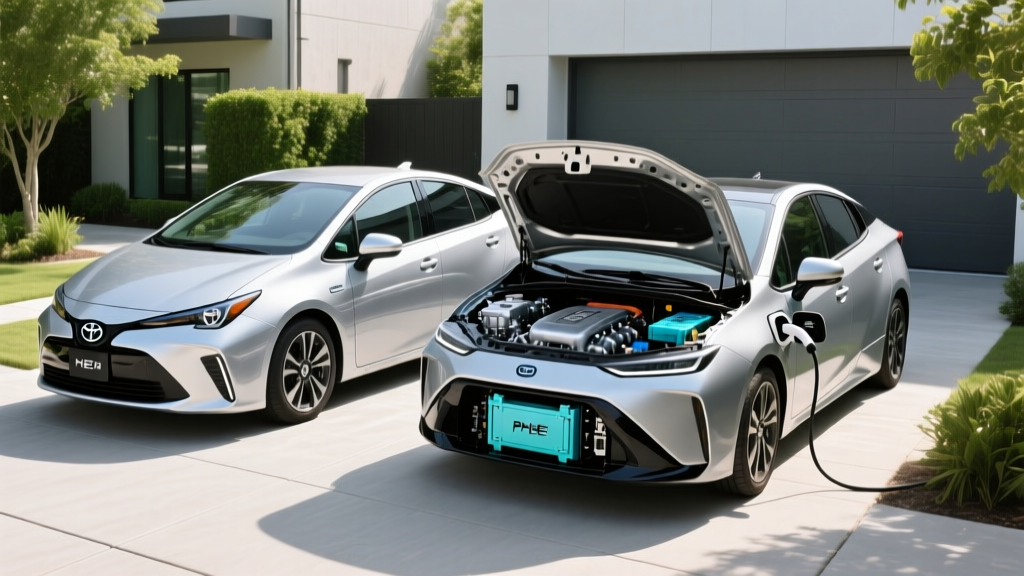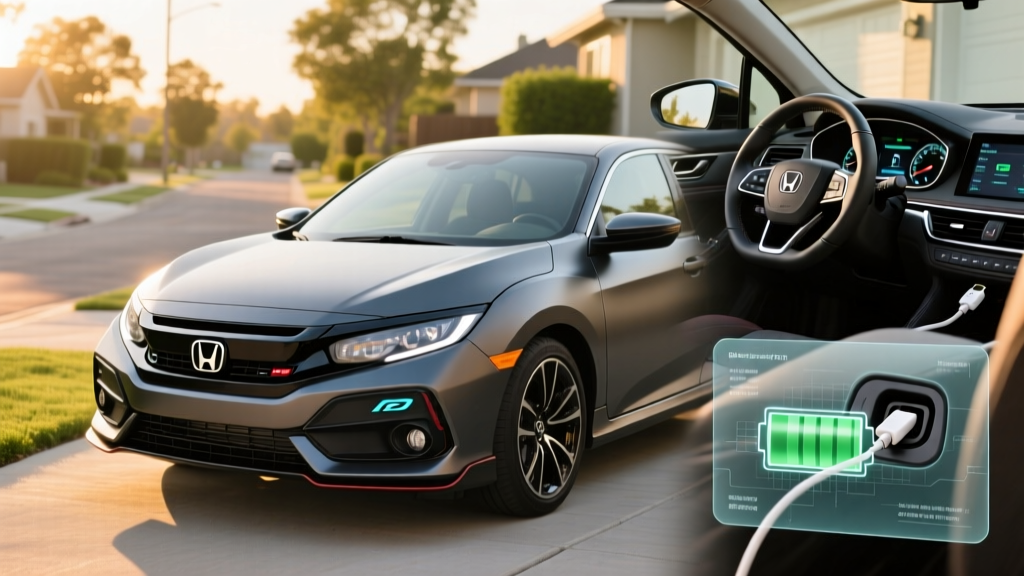
The 2026 Honda Civic Sport Hybrid Touring sits at the top of the Civic hybrid lineup, blending a 200-horsepower two-motor hybrid system with the premium features buyers expect from a Touring trim. It is a conventional hybrid (HEV) — not a plug-in — meaning it never needs to be plugged in and generates all its electric assist internally through regenerative braking and engine-driven generation. For buyers cross-shopping electrified compacts, the Civic Sport Hybrid Touring delivers near-EV efficiency in city driving without any charging infrastructure requirement.
This guide covers the exact EPA fuel economy figures, powertrain specifications, real-world MPG expectations, battery warranty details, pricing, tax credit eligibility, and a clear decision framework for whether this hybrid, a PHEV, or a full BEV is the right fit.
HEV vs PHEV: Where the Civic Sport Hybrid Fits
Before diving into specs, it is critical to understand what the Civic Sport Hybrid Touring is — and what it is not. Honda does not currently offer a plug-in hybrid (PHEV) version of the Civic in the US market. The Civic Hybrid is a conventional HEV.
| Feature | Conventional Hybrid (HEV) | Plug-In Hybrid (PHEV) |
|---|---|---|
| Plug-in charging required? | No — self-charging via regen & engine | Yes — plug in for EV-only range |
| Electric-only driving | Very limited (low-speed, short distance) | 20-50 miles typical on battery alone |
| Battery size | ~1.0 kWh (small buffer) | 10-20 kWh (large pack) |
| Federal tax credit (§30D) | Not eligible | Up to $7,500 if criteria met |
| Best for | No home charging, high-mileage commuters | Home chargers, short daily commutes |
| Example | Honda Civic Sport Hybrid Touring | Toyota Prius Prime, Hyundai Tucson PHEV |
The Civic Sport Hybrid Touring is engineered for drivers who want maximum fuel efficiency without altering their refueling habits. You fill it with regular unleaded and drive — the hybrid system handles the rest.
EPA Fuel Economy and Real-World MPG
The 2026 Honda Civic Sport Hybrid Touring carries an EPA-estimated 50 MPG combined, with a 51 MPG city and 47 MPG highway rating, according to fueleconomy.gov. These are among the highest combined ratings in the compact segment.
| Driving Cycle | EPA Estimate | Real-World Expectation |
|---|---|---|
| City | 51 MPG | 52-56 MPG (hybrids often exceed EPA in stop-and-go) |
| Highway | 47 MPG | 42-45 MPG (sustained 75+ mph reduces regen benefit) |
| Combined | 50 MPG | 47-52 MPG depending on driving mix |
Conventional hybrids like the Civic excel in city driving, where regenerative braking recaptures kinetic energy during frequent stops and the electric motor handles low-speed propulsion. On the highway, the gasoline engine does most of the work, which is why highway MPG drops slightly. In cold weather (below 30°F), expect a 5-10% reduction as the engine runs more frequently to provide cabin heat and maintain battery temperature.
With a 12.4-gallon fuel tank, the Civic Sport Hybrid Touring delivers approximately 620 miles of total range at the EPA combined figure — enough for most drivers to visit a gas station only once every two to three weeks.
Powertrain: 200 HP Two-Motor Hybrid System
The Civic Sport Hybrid Touring uses Honda's fourth-generation two-motor hybrid system, which pairs a 2.0-liter Atkinson-cycle four-cylinder engine with two electric motors and an electronically controlled continuously variable transmission (e-CVT).
| Specification | Detail |
|---|---|
| Engine | 2.0L DOHC Atkinson-cycle 4-cylinder |
| Engine output | 146 hp / 134 lb-ft torque |
| Electric motor output | 184 hp / 232 lb-ft torque |
| Combined system output | 200 hp / 232 lb-ft torque |
| Transmission | e-CVT (no traditional gears) |
| Drivetrain | Front-wheel drive |
| 0-60 mph (est.) | ~7.2 seconds |
| Hybrid battery | Lithium-ion, ~1.0 kWh usable |
| Fuel type | Regular unleaded (87 octane) |
The e-CVT in this system is not a belt-and-pulley CVT like older designs. Instead, it uses the two motors as a power-split device, creating a direct and responsive feel. The electric motor's 232 lb-ft of torque is available from zero RPM, which gives the Civic Sport Hybrid Touring strong initial acceleration that feels quicker than its 0-60 time suggests. In EV mode, the car can operate on electric power alone at low speeds for short distances — typically under 1 mile in parking lots or residential streets — but this is not a meaningful electric-only range for commuting.
Pricing, Trims, and Tax Credit Eligibility
The 2026 Honda Civic Sport Hybrid Touring carries an MSRP of approximately $32,450, including destination charges. This positions it as the most expensive Civic hybrid trim but still undercuts many competitors in the electrified compact segment.
| Trim | MSRP (incl. destination) | Key Features |
|---|---|---|
| Civic Sport Hybrid | ~$29,850 | Hybrid powertrain, 18" wheels, sport styling |
| Civic Sport Hybrid Touring | ~$32,450 | Leather, Bose audio, wireless CarPlay/Android Auto, Honda Sensing suite, navigation |
Federal Tax Credit Status
The Honda Civic Sport Hybrid Touring does not qualify for the federal §30D clean vehicle tax credit. Under current IRS rules, the §30D credit of up to $7,500 applies only to plug-in electric vehicles (BEVs and PHEVs) that meet battery capacity, critical mineral sourcing, and battery component requirements. Conventional hybrids like the Civic HEV are excluded.
Some states offer their own incentives for hybrid purchases, but these vary widely by jurisdiction. Check your state's energy office or department of revenue for current programs. A tax professional can confirm eligibility for any applicable credits.
Battery Warranty, Reliability, and Replacement Cost
Honda Hybrid Battery Warranty: 8 years / 100,000 miles (10 years / 150,000 miles in CARB states including California, New York, Massachusetts, and others adopting California emissions standards). This covers defects and capacity loss below a functional threshold.
Honda's hybrid battery warranty is competitive and aligns with the industry standard for conventional hybrids. The lithium-ion hybrid battery in the Civic is small (~1.0 kWh usable) and operates within a narrow state-of-charge window — typically between 20% and 80% — which significantly reduces degradation compared to full EV batteries that cycle through wider ranges.
Real-World Battery Longevity
Honda's two-motor hybrid system has been in production since 2014 (Accord Hybrid), with the current-generation system debuting in 2023 on the Accord and CR-V hybrids. Data from high-mileage fleet and consumer use suggests these batteries routinely exceed 150,000 miles without significant capacity loss. The battery management system's conservative charge window and active thermal management contribute to this longevity.
Battery Replacement Cost
If replacement is needed outside warranty, a Honda Civic hybrid battery pack typically costs between $2,000 and $4,000 for the part, plus $500-$1,000 in labor, based on current dealer and independent hybrid specialist pricing. However, given the small battery size and conservative management, out-of-warranty replacement is uncommon. Many hybrid owners never replace the battery over the vehicle's full lifespan.
For broader reliability context, Honda consistently ranks in the top third of brands in IIHS safety ratings, and the Civic has historically been one of the most dependable compact cars on the road. The hybrid powertrain adds complexity (two motors, power electronics, battery) but eliminates the traditional automatic transmission, which is itself a common failure point in gas-only vehicles.
Touring Trim: What the Premium Package Adds
The Sport Hybrid Touring trim justifies its ~$2,600 premium over the base Sport Hybrid with a meaningful equipment upgrade:
- Interior: Leather-trimmed seats, heated front and rear seats, heated steering wheel, 10.2-inch digital instrument cluster, wireless Apple CarPlay and Android Auto
- Audio: Bose premium sound system with 12 speakers
- Navigation: Embedded GPS navigation with real-time traffic
- Lighting: LED headlights with auto high-beam, LED fog lights
- Safety (Honda Sensing): Adaptive cruise control with low-speed follow, lane-keeping assist, road departure mitigation, collision mitigation braking, traffic sign recognition, blind spot monitoring with rear cross-traffic alert
- Wheels: 18-inch alloy wheels in gloss black
The Honda Sensing suite provides Level 2 driver assistance per SAE classification — it supports steering and speed control but requires the driver to remain fully engaged and monitoring the road at all times. It is not autonomous driving.
Hybrid vs PHEV vs EV: Which Powertrain Fits You?
Choose the Civic Sport Hybrid Touring (HEV) if:
- You lack access to home or workplace charging
- You drive a mix of city and highway miles with no predictable daily distance
- You want maximum fuel savings without changing your refueling behavior
- You take frequent long road trips where charging infrastructure is sparse
- Your budget is under $35,000
Choose a PHEV (e.g., Toyota Prius Prime, Hyundai Tucson PHEV) if:
- You can install a Level 2 home charger or have reliable workplace charging
- Your daily commute is under 40 miles round-trip (covers most PHEV electric-only range)
- You want electric-only driving for daily errands but gas flexibility for road trips
- You may qualify for the §30D federal tax credit (up to $7,500, subject to MSRP caps, income limits, and battery sourcing rules)
Choose a full BEV (e.g., Chevrolet Equinox EV, Hyundai Ioniq 5) if:
- You have reliable home Level 2 charging
- Your daily driving is predictable and within the vehicle's real-world range
- You want to eliminate gasoline costs entirely and minimize maintenance
- You qualify for federal/state EV incentives that offset the higher purchase price
The Civic Sport Hybrid Touring occupies a specific niche: it is the most practical electrified choice for drivers who cannot or do not want to plug in. Its 50 MPG combined rating cuts fuel costs roughly in half compared to a typical 28-MPG gas compact, saving an estimated $600-$800 per year at 15,000 miles driven annually and $3.50/gallon fuel prices.
Pros and Cons at a Glance
Pros
- 50 MPG combined EPA — among the best in the compact class
- 200 hp provides confident acceleration and passing power
- No charging required — works with existing gas station infrastructure
- Touring trim includes premium features (Bose, leather, full safety suite)
- Strong battery warranty (8yr/100k mi, 10yr/150k mi CARB states)
- Regular 87-octane fuel keeps per-fill cost low
Cons
- No federal tax credit eligibility (HEV, not PHEV/BEV)
- Highway MPG drops to ~42-45 real-world at sustained high speeds
- Front-wheel drive only — no AWD option unlike some competitors
- EV-only operation limited to very low speeds and short distances
- Touring trim pushes MSRP above $32,000 for a compact sedan
Frequently Asked Questions
How many MPG does the Honda Civic Sport Hybrid Touring get?
The EPA rates the 2026 Civic Sport Hybrid Touring at 51 MPG city, 47 MPG highway, and 50 MPG combined. In real-world city driving with frequent stops, many owners report exceeding the city estimate, reaching 52-56 MPG. Highway driving at 75+ mph typically yields 42-45 MPG.
Does the Civic Hybrid need to be plugged in?
No. The Civic Sport Hybrid Touring is a conventional hybrid (HEV). It charges its small lithium-ion battery through regenerative braking and the gasoline engine. You never plug it in — simply refuel with regular 87-octane gasoline.
Does the Honda Civic Sport Hybrid Touring qualify for a tax credit?
It does not qualify for the federal §30D clean vehicle credit, which is reserved for plug-in vehicles (BEVs and PHEVs). Some states may offer separate hybrid incentives — check your state's energy or revenue department for current programs.
How long will the hybrid battery last and what does replacement cost?
Honda covers the hybrid battery for 8 years/100,000 miles (10 years/150,000 miles in CARB states). Real-world data from Honda's hybrid fleet suggests these batteries routinely exceed 150,000 miles. Out-of-warranty replacement costs approximately $2,500-$5,000 including labor, though full replacement is uncommon.
Is the Civic Sport Hybrid Touring better than a gas-only Civic?
For most buyers, yes. The hybrid delivers 200 hp (vs. 158 hp for the 2.0L gas model) and 50 MPG combined (vs. ~33 MPG combined for the gas Civic). The hybrid costs approximately $2,000-$3,000 more upfront but typically pays for itself in fuel savings within 3-4 years at average mileage, while also providing stronger acceleration.
How far can the Civic Hybrid drive on electric power alone?
Less than 1 mile at very low speeds (under 25 mph). This is not a plug-in hybrid — it cannot sustain electric-only driving for commutes or errands. The electric motor assists the gasoline engine during acceleration and handles low-speed maneuvers, but the engine is always available and frequently active.
Does the Civic Hybrid have all-wheel drive?
No. The 2026 Civic Sport Hybrid Touring is front-wheel drive only. If AWD is a priority in a hybrid compact, consider the Toyota Prius AWD (available on select trims) or the Subaru Crosstrek Hybrid.