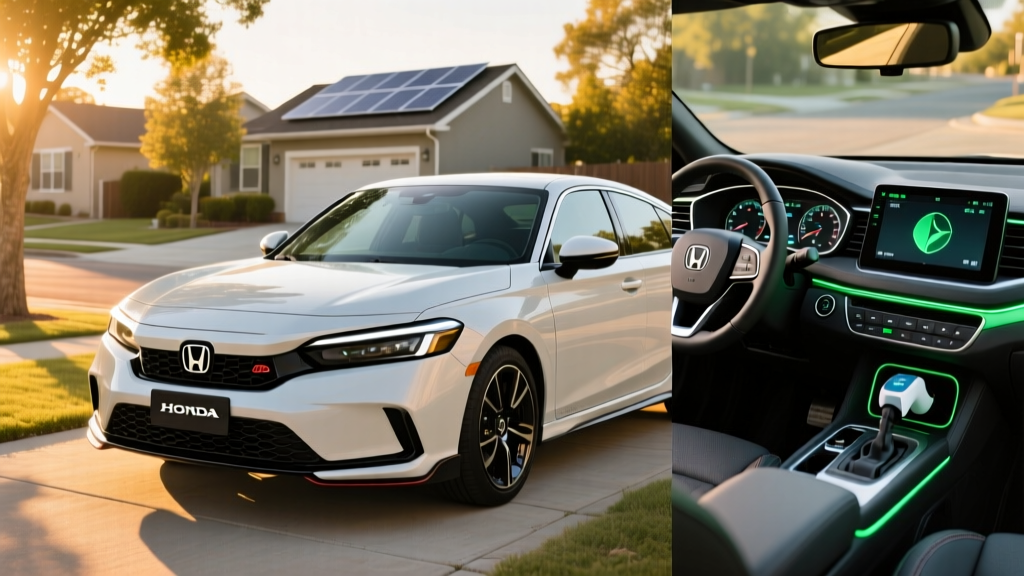
The Honda Civic Sport Hybrid occupies a narrow but compelling lane in the compact-car market: it delivers genuine hybrid efficiency without the price premium, plug-in complexity, or range anxiety that still accompanies full electric vehicles. For the 2026 model year, Honda continues to refine its two-motor hybrid system in the Civic lineup, and the Sport Hybrid trim sits at the intersection of efficiency, value, and everyday practicality.
This guide breaks down everything that matters to a research-driven buyer — EPA fuel economy, real-world MPG behavior, the hybrid powertrain, battery warranty and replacement costs, tax-credit eligibility, and who should choose this HEV over a PHEV or a battery-electric vehicle (BEV).
2026 Honda Civic Sport Hybrid: Quick Specs at a Glance
| Specification | 2026 Civic Sport Hybrid |
|---|---|
| Powertrain Type | Conventional Hybrid (HEV) — no plug-in |
| Engine | 2.0L Atkinson-cycle 4-cylinder |
| Electric Motors | Dual-motor hybrid system |
| Combined Horsepower | 200 hp |
| Combined Torque | 232 lb-ft (motor peak) |
| Transmission | e-CVT (direct-drive with lock-up clutch) |
| EPA City MPG | 50 MPG |
| EPA Highway MPG | 47 MPG |
| EPA Combined MPG | 49 MPG |
| Drivetrain | Front-wheel drive |
| 0–60 mph | ~7.2 seconds (est.) |
| Hybrid Battery | Lithium-ion, ~1.1 kWh (self-charging) |
| Starting MSRP (Sedan) | ~$30,850 |
| Hybrid Battery Warranty | 8 years / 100,000 miles (10 yr/150k in CARB states) |
HEV vs. PHEV vs. BEV: Where Does the Civic Sport Hybrid Fit?
Before diving into fuel economy, it is critical to understand what the Civic Sport Hybrid is — and what it is not.
- HEV (Hybrid Electric Vehicle): The Civic Sport Hybrid is a conventional HEV. It uses a small lithium-ion battery that recharges through regenerative braking and the gasoline engine. You never plug it in. The battery assists the engine and enables brief electric-only driving at low speeds, but it cannot be charged from an external source.
- PHEV (Plug-in Hybrid Electric Vehicle): A PHEV has a larger battery (typically 10–20 kWh) that you plug in to recharge, giving 25–50 miles of electric-only range before the gas engine kicks in. Honda does not currently offer a Civic PHEV in the US market. The closest Honda PHEV is the Clarity Plug-in Hybrid (discontinued) or the larger CR-V Hybrid, which is also an HEV, not a PHEV.
- BEV (Battery Electric Vehicle): A full EV like the Honda Prologue or Tesla Model 3 runs entirely on electricity, requires plug-in charging, and has zero tailpipe emissions. BEVs have higher upfront costs but lower per-mile energy expenses and qualify for federal tax credits that HEVs do not.
If you are cross-shopping the Civic Sport Hybrid against a PHEV or BEV, the decision framework below will help.
Choose the Civic Sport Hybrid (HEV) if: You want 45–50+ MPG without changing your fueling habits, you lack access to home or workplace charging, you want a lower purchase price, and you drive a mix of city and highway miles.
Choose a PHEV if: You have reliable home charging, your daily commute is under 30–40 miles, and you want electric-only driving for errands with a gas backup for road trips.
Choose a BEV if: You have Level 2 home charging, your daily driving is predictable, you want the lowest per-mile fuel cost, and you are ready to plan around public charging on longer trips.
Fuel Economy: EPA Ratings and Real-World MPG
The 2026 Honda Civic Sport Hybrid sedan carries EPA ratings of 50 MPG city / 47 MPG highway / 49 MPG combined, according to fueleconomy.gov. These are strong numbers for the compact sedan class, and they reflect Honda's two-motor hybrid architecture, which favors electric-motor propulsion in city driving where efficiency gains are largest.
| Driving Condition | EPA Rating | Real-World Expectation |
|---|---|---|
| City | 50 MPG | 48–55 MPG (hybrids often exceed EPA in stop-and-go) |
| Highway | 47 MPG | 42–46 MPG (aerodynamic drag reduces hybrid advantage at speed) |
| Combined | 49 MPG | 45–50 MPG |
| Cold Weather (below 32°F) | — | 40–44 MPG (engine runs more for cabin heat and battery warm-up) |
Why Hybrids Often Beat EPA in the City
Unlike gasoline-only cars, hybrids like the Civic Sport Hybrid capture kinetic energy during braking through regenerative braking, converting it back into battery energy. In heavy traffic with frequent stops, the electric motors handle more of the propulsion load, and the gasoline engine shuts off entirely at stops. This is the opposite of a conventional car, which idles and wastes fuel. Owners who drive primarily in urban environments frequently report 50–55 MPG in warm weather — slightly above the EPA city figure.
On the highway, however, the story changes. At sustained speeds above 65 mph, the gasoline engine does most of the work, and the hybrid system's advantage shrinks. Expect highway fuel economy to land in the low-to-mid 40s, which is still excellent but below the city rating.
Cold-Weather MPG Loss
In winter conditions, the Civic Sport Hybrid's fuel economy drops noticeably. The engine must run more frequently to provide cabin heat (hybrids lack the waste heat that conventional engines produce abundantly) and to keep the hybrid battery at optimal operating temperature. Expect a 10–15% reduction in combined MPG during sustained cold-weather driving. This is normal for all hybrids and is not a defect.
Powertrain Deep Dive: How Honda's Two-Motor System Works
The Civic Sport Hybrid uses Honda's fourth-generation two-motor hybrid system, pairing a 2.0-liter Atkinson-cycle four-cylinder engine with two electric motors and a lithium-ion battery pack. Combined system output is 200 horsepower, with peak electric motor torque of 232 lb-ft available from near-zero RPM.
Here is how the system operates across different driving scenarios:
- EV Drive: At low speeds and light loads, the propulsion motor drives the wheels using battery energy alone. The engine is off. This mode covers gentle acceleration from a stop and low-speed cruising — typically up to about 1–2 miles in ideal conditions before the battery depletes and the engine restarts.
- Hybrid Drive: Under moderate acceleration or when the battery depletes, the gasoline engine starts and powers a generator motor, which in turn supplies electricity to the propulsion motor. The engine does not directly drive the wheels in this mode — it acts as an onboard generator.
- Engine Drive: At steady highway speeds, a lock-up clutch engages, connecting the gasoline engine directly to the front wheels. This is more efficient than the generator pathway at sustained cruising RPM.
- Regenerative Braking: During deceleration and braking, the propulsion motor reverses direction, acting as a generator to slow the car and recharge the battery. Paddle shifters on the steering wheel allow the driver to select from multiple regen levels.
The e-CVT in this system is not a traditional belt-and-pulley CVT. It is a direct-drive unit with a single fixed gear ratio, connected through the lock-up clutch for highway cruising. This eliminates the "rubber band" feel that older CVTs are known for and provides linear, predictable acceleration.
Pricing, Tax Credits, and Total Cost of Ownership
The 2026 Honda Civic Sport Hybrid sedan starts at approximately $30,850 (MSRP including destination). This positions it roughly $1,500–$2,000 above a comparably equipped Civic Sport Touring with the conventional turbocharged 1.5L engine, but the fuel savings close that gap quickly.
Federal Tax Credit Eligibility
Does the Civic Sport Hybrid qualify for the federal EV tax credit? No. Under current IRS §30D rules, the federal Clean Vehicle Credit (up to $7,500) applies only to plug-in electric vehicles — BEVs and PHEVs with a minimum battery capacity of 7 kWh and external charging capability. The Civic Sport Hybrid is a conventional HEV with a small (~1.1 kWh) self-charging battery and does not meet the plug-in requirement.
For the latest eligibility rules, including MSRP caps, buyer income limits, and battery-sourcing requirements for qualifying PHEVs and BEVs, consult the IRS Clean Vehicle Credit page.
Five-Year Fuel Cost Comparison
Assuming 15,000 miles per year and $3.50/gallon regular unleaded:
| Vehicle | EPA Combined | Annual Fuel Cost | 5-Year Fuel Cost |
|---|---|---|---|
| Civic Sport Hybrid (HEV) | 49 MPG | ~$1,071 | ~$5,357 |
| Civic Sport 1.5T (Gas) | 33 MPG | ~$1,591 | ~$7,955 |
| Comparable BEV (120 MPGe) | 120 MPGe | ~$575 (electricity) | ~$2,875 |
Over five years, the Civic Sport Hybrid saves approximately $2,600 in fuel compared to its gasoline counterpart — enough to offset the hybrid premium within the first three years of ownership. A BEV saves more, but requires home charging infrastructure and carries a higher purchase price.
Battery Warranty, Lifespan, and Replacement Cost
Hybrid Battery Warranty: Honda covers the Civic Sport Hybrid's lithium-ion battery pack for 8 years or 100,000 miles, whichever comes first. In states that follow California Air Resources Board (CARB) emissions standards — including California, New York, Massachusetts, and several others — the warranty extends to 10 years or 150,000 miles.
The warranty covers battery capacity loss below a specified threshold (typically 60–70% of original capacity) and any manufacturing defects.
How Long Will the Hybrid Battery Last?
Honda's hybrid battery packs are designed to last the life of the vehicle under normal use. Real-world data from earlier Honda hybrid models (Insight, Accord Hybrid) shows that lithium-ion hybrid batteries routinely exceed 150,000–200,000 miles before significant degradation. Because the battery in an HEV is small and never deeply discharged (the system maintains a buffer, typically operating between 20% and 80% state of charge), it experiences far less stress than a BEV battery.
The key degradation factor is heat. Owners in extremely hot climates (Arizona, Texas, Nevada) may see slightly faster capacity loss over 10+ years, but complete battery failure before 100,000 miles is uncommon.
Battery Replacement Cost
If the hybrid battery does require replacement outside of warranty, expect to pay between $2,000 and $4,000 for a new OEM battery pack, including labor. Third-party refurbished batteries are available for $1,000–$2,000. This is significantly less than a BEV battery replacement ($7,000–$20,000+) because the HEV battery is much smaller.
Reliability and Safety Ratings
Honda's hybrid powertrain has a strong reliability track record. The two-motor system has fewer moving parts than a conventional automatic transmission (no torque converter, no multi-speed gear sets), and the regenerative braking system reduces wear on the friction brakes — owners often report original brake pads lasting 80,000+ miles.
The Civic consistently earns top safety marks. Refer to the NHTSA vehicle safety page and IIHS ratings for the latest crash-test results. The Civic typically earns the IIHS Top Safety Pick designation and a 5-star overall NHTSA rating. Honda Sensing — the brand's suite of driver-assistance features including adaptive cruise control, lane-keeping assist, and automatic emergency braking — is standard on the Sport Hybrid trim.
Note: Honda Sensing is an SAE Level 2 driver-assistance system. It requires continuous driver supervision and does not provide autonomous or self-driving capability.
Pros, Cons, and the Bottom Line
Pros
- 49 MPG combined EPA; frequently exceeds city rating in real-world stop-and-go driving
- 200 hp provides confident acceleration for a compact hybrid
- No plug-in charging required — zero lifestyle adjustment from a gas car
- Strong reliability history; low brake wear from regen
- Honda Sensing ADAS standard
- Hybrid premium pays for itself in ~3 years via fuel savings
- Generous battery warranty (8 yr/100k or 10 yr/150k in CARB states)
Cons
- No federal tax credit (HEVs are ineligible under §30D)
- Highway MPG drops to low 40s — less advantage over gas cars at sustained speed
- No electric-only commuting capability (unlike a PHEV)
- Cold-weather MPG penalty of 10–15%
- FWD only — no all-wheel-drive option on the Civic Hybrid
- Slightly higher initial MSRP vs. gas-only Civic Sport
Who Should Buy the Civic Sport Hybrid — and Who Shouldn't
The Civic Sport Hybrid is best suited for drivers who:
- Commute in mixed city/highway conditions and want maximum fuel economy without plugging in
- Live in apartments or homes without the ability to install a Level 2 charger, making a PHEV or BEV impractical
- Want a proven, low-maintenance powertrain with strong resale value
- Drive 12,000–20,000 miles per year, where fuel savings compound quickly
It is less ideal for drivers who:
- Have short, predictable commutes under 30 miles and access to home charging — a PHEV or BEV would eliminate most gasoline use
- Want all-wheel drive — consider the Toyota Prius AWD or a compact hybrid SUV instead
- Prioritize maximum acceleration or sporty handling over efficiency
Frequently Asked Questions
How many MPG does the Honda Civic Sport Hybrid get?
The 2026 Civic Sport Hybrid is EPA-rated at 50 MPG city, 47 MPG highway, and 49 MPG combined. Real-world city driving often yields 50–55 MPG in warm weather. Highway driving typically returns 42–46 MPG, and cold-weather combined MPG drops to roughly 40–44 MPG.
Does the Civic Sport Hybrid need to be plugged in?
No. The Civic Sport Hybrid is a conventional HEV. Its small lithium-ion battery recharges through regenerative braking and the gasoline engine. There is no plug, no charging cable, and no need for any external power source. You fuel it like any other gasoline car.
How far can the Civic Sport Hybrid drive on electric power alone?
Very short distances — typically under 1–2 miles at low speeds (under 30 mph) in EV Drive mode. The battery is too small (~1.1 kWh) to provide meaningful electric-only range. If electric-only commuting is a priority, you need a PHEV with a larger battery (10–20 kWh) or a full BEV.
Is the Honda Civic Hybrid reliable?
Yes. Honda's two-motor hybrid system has been in production since 2014 (Accord Hybrid) and has demonstrated strong long-term reliability. The system eliminates the conventional transmission, reducing mechanical failure points. The hybrid battery is warrantied for 8 years/100,000 miles (10 years/150,000 miles in CARB states), and real-world data shows batteries regularly lasting 150,000+ miles.
What does it cost to replace the Civic Hybrid battery?
Out-of-warranty replacement runs approximately $2,000–$4,000 for a new OEM battery, or $1,000–$2,000 for a refurbished unit. Given the battery's typical lifespan of 150,000–200,000+ miles, most owners will never need a replacement.
Does the Honda Civic Sport Hybrid qualify for any tax credit?
No. The federal Clean Vehicle Credit (IRS §30D) applies only to plug-in vehicles (PHEVs and BEVs) with a battery capacity of at least 7 kWh and external charging capability. The Civic Sport Hybrid is a conventional HEV and does not qualify. Some states offer separate incentives for hybrid purchases — check your state's energy or DMV website for current programs.
Hybrid vs. PHEV vs. EV — which should I choose?
If you cannot charge at home, the Civic Sport Hybrid (HEV) is the practical choice — no infrastructure needed, excellent MPG. If you can install a Level 2 home charger and your daily drive is under 40 miles, a PHEV lets you commute on electricity while keeping a gas engine for road trips. If you have home charging, a predictable commute, and want the lowest operating cost, a BEV eliminates gasoline entirely but requires planning for longer trips.