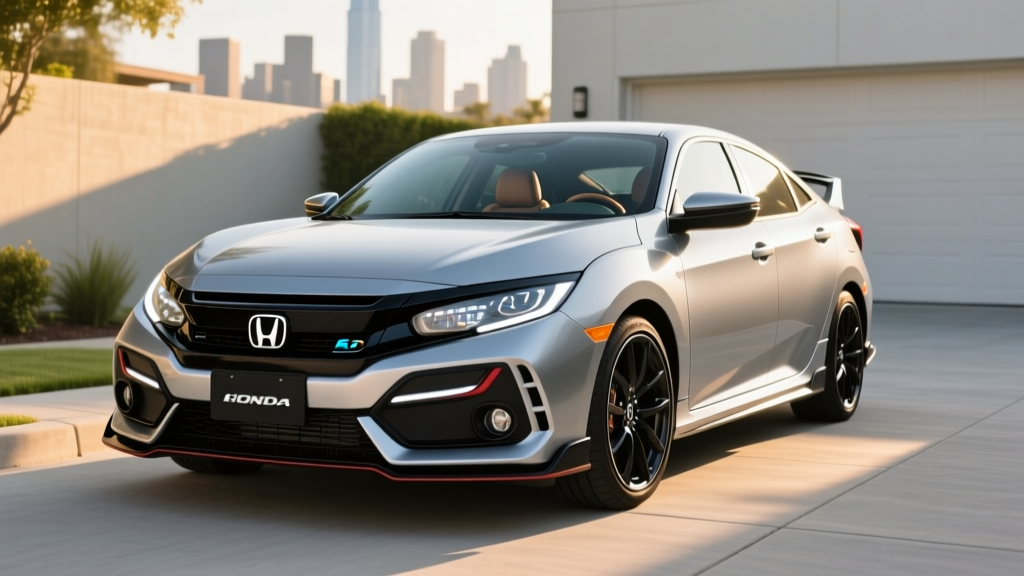
The Honda Civic has been a compact-car staple for decades, but the 2025 Honda Civic Sport Hybrid represents a meaningful pivot for buyers who want electric-car-like efficiency without ever plugging in. Honda's fourth-generation two-motor hybrid system pairs a 2.0-liter Atkinson-cycle engine with dual electric motors for a combined 200 horsepower and an EPA-estimated 50 MPG combined. That puts it squarely in competition with the Toyota Corolla Hybrid, Hyundai Elantra Hybrid, and Kia Niro — but with a sportier chassis and Honda's reputation for long-term reliability.
For buyers weighing a conventional hybrid against a plug-in hybrid or full battery-electric vehicle, the Civic Sport Hybrid occupies a specific niche: maximum efficiency with zero lifestyle change. No charging cables, no range planning, no home electrical upgrades. In this guide, we break down the real-world fuel economy, powertrain details, ownership costs, battery longevity, and where this hybrid fits in the broader electrification landscape.
2025 Honda Civic Sport Hybrid: Key Specs at a Glance
| Specification | Value |
|---|---|
| Powertrain Type | Conventional Hybrid (HEV) — no plug-in |
| Engine | 2.0L DOHC Atkinson-cycle 4-cylinder |
| Electric Motors | Dual-motor hybrid system |
| Combined Horsepower | 200 hp |
| Combined Torque | 232 lb-ft (electric motor) |
| Transmission | e-CVT (direct drive) |
| EPA Fuel Economy | 50 city / 47 highway / 49 combined MPG |
| Fuel Tank Capacity | 10.6 gallons |
| Total Driving Range | ~519 miles (EPA est.) |
| 0–60 mph (est.) | ~7.2 seconds |
| Drivetrain | Front-wheel drive |
| Base MSRP (Sport Hybrid) | ~$29,845 (incl. destination) |
| Hybrid Battery Warranty | 8 years / 100,000 miles (10 yr/150k in CARB states) |
Note: The Civic Sport Hybrid is a sedan. Honda also offers the Civic Hybrid in Sport Touring trim for approximately $32,845, adding leather, Bose audio, and Honda Sensing 2.0 enhancements. Pricing reflects 2025 model-year MSRP including destination charges. Always confirm current pricing with your local dealer.
Fuel Economy: EPA Ratings vs. Real-World MPG
The headline number for the 2025 Civic Sport Hybrid is its EPA rating. According to fueleconomy.gov, the Civic Hybrid achieves:
| Driving Condition | EPA MPG |
|---|---|
| City | 50 MPG |
| Highway | 47 MPG |
| Combined | 49 MPG |
What makes these numbers particularly interesting is the city-biased efficiency profile. Unlike gas-only cars that get worse mileage in stop-and-go traffic, the Civic Hybrid actually excels in urban driving. Here's why: at low speeds, the car runs primarily on its electric motors, with the gasoline engine acting as a generator to recharge the small hybrid battery. The engine only directly drives the wheels at higher, steady-state cruising speeds via a lock-up clutch.
Real-World Expectations
In mixed real-world driving, owners and independent testers consistently report 48–52 MPG in suburban and city-heavy commutes. Highway-only trips at 75+ mph tend to drop to 42–45 MPG, as aerodynamic drag increases and the engine takes on more direct-drive duty. Cold weather (below 35°F) can reduce fuel economy by 5–10% due to increased engine warm-up time and cabin heating demands — though this penalty is far smaller than the 20–30% range loss a full EV experiences in the same conditions.
How the Hybrid Powertrain Works
Honda's fourth-generation two-motor hybrid system is fundamentally different from the planetary-gear setups Toyota uses or the parallel-hybrid designs from Hyundai/Kia. Here's the architecture:
- Propulsion Motor: The primary drive motor delivers 181 hp and 232 lb-ft of torque directly to the front wheels. This is the motor you feel during acceleration — it provides instant, linear torque from zero RPM, giving the Civic Hybrid its surprisingly punchy off-the-line feel.
- Generator Motor: A second, smaller motor is connected to the 2.0L gasoline engine. Its job is to generate electricity that either feeds the propulsion motor or charges the hybrid battery pack.
- 2.0L Atkinson-Cycle Engine: Producing 146 hp on its own, this engine is optimized for thermal efficiency rather than peak power. At cruising speeds (typically above 45 mph), a lock-up clutch engages to connect the engine directly to the wheels, bypassing the electric motors for maximum highway efficiency.
- Lithium-Ion Battery Pack: A compact battery (approximately 1.1 kWh usable capacity) stores energy captured from regenerative braking and the generator motor. This battery is small by design — it's meant for short bursts of electric-only driving and energy buffering, not extended EV-mode range.
The result is a car that drives like an EV around town (smooth, quiet, instant torque) and like an efficient gas car on the highway. The e-CVT isn't a traditional belt-and-pulley CVT — it's a direct-drive system with fixed gear ratios, so there's none of the "rubber band" drone associated with older CVTs.
HEV vs. PHEV vs. Full EV: Which Is Right for You?
The 2025 Civic Sport Hybrid is a conventional hybrid (HEV). It cannot be plugged in and has no meaningful electric-only range (roughly 1–2 miles at very low speeds). This distinction matters because buyers sometimes confuse HEVs with plug-in hybrids (PHEVs) or battery-electric vehicles (BEVs). Here's how they compare:
| Factor | HEV (Civic Hybrid) | PHEV (e.g., Toyota Prius Prime) | BEV (e.g., Tesla Model 3) |
|---|---|---|---|
| Plug-in Required? | No | Yes (for EV range) | Yes (always) |
| Electric-Only Range | ~1–2 mi (low speed) | 25–44 mi typical | 250–360+ mi |
| Home Charging Needed? | No | Recommended (Level 2) | Essential (Level 2) |
| Fuel/Charging Cost (15k mi/yr) | ~$900–$1,050/yr | ~$400–$800/yr | ~$450–$750/yr |
| Federal Tax Credit (§30D) | Not eligible | Up to $7,500 (if eligible) | Up to $7,500 (if eligible) |
| Maintenance Complexity | Low (engine + hybrid system) | Moderate (two full powertrains) | Lowest (no engine) |
| Upfront Price Premium | +$1,000–$1,500 vs gas | +$4,000–$7,000 vs gas | +$5,000–$15,000 vs gas |
| Best For | No home charging, simplicity | Short commute + home charger | Home charging + low running cost |
Choose the Civic Sport Hybrid (HEV) if you rent or lack home charging access, want a simple ownership experience, drive a mix of city and highway miles, and value proven reliability over maximum electrification.
Choose a PHEV if you have a garage or driveway for a Level 2 charger, your daily commute is under 40 miles round-trip (so you can drive mostly on electricity), and you want the option of gas-free weekday driving with road-trip flexibility on weekends.
Choose a full BEV if you have reliable home charging, want the lowest per-mile fuel cost, are ready to plan longer road trips around DC fast-charging stops, and want to eliminate oil changes and engine maintenance entirely.
Pricing, Trims, and Tax Credit Eligibility
The 2025 Honda Civic Hybrid is available in two trims:
- Sport Hybrid: Starting at approximately $29,845 (including $1,095 destination). Standard features include a 7-inch touchscreen, wireless Apple CarPlay/Android Auto, Honda Sensing safety suite, 18-inch alloy wheels, and dual-zone climate control.
- Sport Touring Hybrid: Starting at approximately $32,845. Adds leather-trimmed seats, Bose premium audio, 9-inch touchscreen with wireless CarPlay, heated front seats, wireless phone charging, and low-speed braking control.
Federal Tax Credit Status
The Civic Sport Hybrid does not qualify for the federal §30D Clean Vehicle Credit. Under current IRS rules, only plug-in electric vehicles (PHEVs and BEVs) with a minimum battery capacity of 7 kWh are eligible. As a conventional hybrid with a ~1.1 kWh battery, the Civic Hybrid falls outside this requirement.
Some states offer their own incentives for hybrid vehicles, though these are increasingly rare as state programs shift toward plug-in vehicles. Check your state's energy office or department of environmental quality for current programs. A few states historically offered $250–$500 rebates for high-MPG hybrids, but availability varies and programs change annually.
For buyers interested in the $7,500 federal credit, a PHEV like the Toyota Prius Prime or a BEV like the Chevrolet Equinox EV would be necessary — and even then, eligibility depends on your modified adjusted gross income, the vehicle's MSRP (capped at $55,000 for sedans), and battery component/critical mineral sourcing requirements. Consult IRS.gov §30D guidelines or a tax professional for your specific situation.
Battery Longevity, Warranty, and Replacement Costs
Hybrid battery anxiety is one of the most common concerns we hear from first-time hybrid buyers. Here's what the data shows for Honda's system:
How Long Do Honda Hybrid Batteries Last?
Honda's hybrid battery packs are engineered for the life of the vehicle. Based on long-term data from earlier-generation Civic and Insight Hybrids, most Honda hybrid batteries show minimal degradation — typically losing 5–10% capacity over 150,000+ miles. The battery is small (~1.1 kWh), operates in a narrow state-of-charge window (roughly 40–80%), and is thermally managed by the cabin HVAC system. These factors dramatically reduce stress compared to a full EV battery that cycles through deep charge/discharge ranges daily.
Honda's hybrid batteries in the third-generation system (used in the Accord Hybrid and earlier Civic generations) have shown excellent longevity, with widespread reports of 200,000+ mile service life without replacement. The fourth-generation system in the 2025 model uses updated lithium-ion cells with improved energy density, but the fundamental protective operating strategy remains the same.
Battery Replacement Cost
If a hybrid battery does fail outside of warranty, replacement costs for Honda's hybrid systems typically range from $2,000 to $4,000 (parts and labor) at a dealership. Independent hybrid specialists may offer refurbished or reconditioned packs for $1,200–$2,500. Given the battery's track record and warranty coverage, this is a low-probability expense — but it's worth budgeting awareness for buyers planning to keep the vehicle past the 100,000-mile mark.
Reliability, Safety, and Ownership Costs
Honda's hybrid powertrain has earned strong reliability marks across multiple model lines. The Civic platform itself benefits from decades of refinement, and the hybrid system adds components (electric motors, power electronics) that have fewer moving parts than a conventional automatic transmission.
Maintenance Comparison: Hybrid vs. Gas-Only Civic
One common misconception is that hybrids cost more to maintain because of their added complexity. In practice, the Civic Hybrid's maintenance profile is comparable to — and in some areas lighter than — the gas-only Civic:
- Oil changes: Same interval (every 7,500–10,000 miles with synthetic). The engine runs less in city driving, potentially extending oil life.
- Brake pads: Last significantly longer thanks to regenerative braking, which handles most deceleration. Many hybrid owners report 80,000–100,000+ miles on original brake pads.
- Transmission: The e-CVT direct-drive system has no belts, no torque converter, and no traditional transmission fluid changes on Honda's schedule.
- 12V battery: Same replacement cycle as any car (every 3–5 years). The hybrid system's high-voltage battery is separate and does not replace the conventional 12V battery.
Safety Ratings
The 2025 Civic Hybrid carries the same structural safety credentials as the broader Civic lineup. The Civic has historically earned top marks from both the NHTSA (5-star overall) and IIHS (Top Safety Pick+). The Honda Sensing suite — standard on all Hybrid trims — includes adaptive cruise control, lane-keeping assist, forward collision warning with automatic emergency braking, road departure mitigation, and traffic sign recognition.
5-Year Ownership Cost Snapshot
| Cost Category | Civic Sport Hybrid | Civic Sport (Gas, 1.5T) |
|---|---|---|
| Fuel (75,000 mi) | ~$4,875 (49 MPG, $3.18/gal) | ~$7,330 (33 MPG, $3.18/gal) |
| Maintenance (est.) | ~$2,200 | ~$2,600 |
| Insurance (avg.) | ~$7,500 | ~$7,200 |
| Purchase Price (MSRP) | ~$29,845 | ~$27,445 |
| 5-Year Fuel + Maintenance Savings | Hybrid saves ~$2,855 | |
| Net Premium After Savings | ~$0–$455 (hybrid premium nearly recouped) | |
The hybrid's $2,400 MSRP premium over the gas Civic Sport is nearly entirely offset by fuel and maintenance savings within five years — and the gap widens further if gas prices rise. For buyers who plan to own the car for 8–10 years, the hybrid becomes the clear financial winner.
Who Should Buy the 2025 Civic Sport Hybrid?
- 49 MPG combined — among the best in the compact class
- 200 hp provides genuinely quick acceleration
- No charging infrastructure required
- Smooth, EV-like driving feel around town
- Strong resale value and Honda reliability record
- 519-mile total range between fill-ups
- Comprehensive Honda Sensing safety suite standard
- No federal tax credit eligibility (HEV)
- Highway MPG drops to low 40s at sustained 75+ mph
- Only FWD — no AWD option (unlike Toyota Corolla Hybrid)
- Rear visibility slightly reduced by hybrid battery packaging
- Base price ~$2,400 more than gas Civic Sport
- No spare tire — tire inflation kit only
The 2025 Honda Civic Sport Hybrid is the right choice if:
- You live in an apartment or condo without charging access and want maximum efficiency without lifestyle changes
- Your commute involves a mix of city and suburban driving where the hybrid system shines
- You plan to keep the car for 5+ years, allowing the fuel savings to fully offset the purchase premium
- You want the driving refinement of an electric motor (smooth, quiet, instant torque) without range planning
- You value Honda's long-term reliability and strong resale value
Consider a PHEV or full EV instead if you have home charging access, a short commute that could be fully electric, or a strong preference for minimizing tailpipe emissions on daily drives.
Frequently Asked Questions
How many MPG does the 2025 Honda Civic Sport Hybrid get?
The EPA rates the Civic Sport Hybrid at 50 MPG city, 47 MPG highway, and 49 MPG combined. In real-world driving, expect 48–52 MPG in city and suburban conditions and 42–45 MPG on sustained highway trips above 70 mph. Cold weather may reduce these figures by 5–10%.
Does the Civic Hybrid need to be plugged in?
No. The Civic Sport Hybrid is a conventional hybrid (HEV). Its battery recharges through regenerative braking and the onboard gasoline engine. There is no plug, no charging cable, and no need for any home electrical upgrades. You simply fill it with gasoline like any other car.
Is the Civic Hybrid reliable? What about battery replacement?
Honda's hybrid systems have demonstrated excellent long-term reliability. The hybrid battery is covered by an 8-year/100,000-mile warranty (10 years/150,000 miles in CARB states). Based on historical data, most Honda hybrid batteries last 200,000+ miles. Out-of-warranty replacement costs $2,000–$4,000 if ever needed, but this is uncommon.
Does the 2025 Civic Hybrid qualify for any tax credits?
No. The federal §30D Clean Vehicle Credit applies only to plug-in vehicles (PHEVs and BEVs) with at least 7 kWh of battery capacity. The Civic Hybrid's ~1.1 kWh battery does not qualify. Some states may offer small incentives for high-MPG hybrids — check your state's energy office for current programs.
How does the Civic Hybrid compare to the Toyota Corolla Hybrid?
The Corolla Hybrid offers slightly lower combined MPG (approximately 50 MPG combined for FWD) but is available with all-wheel drive — something the Civic Hybrid does not offer. The Civic Hybrid produces more horsepower (200 hp vs. 138 hp for the Corolla) and delivers a more engaging driving experience. Both carry excellent reliability reputations and similar warranty coverage.
What's the difference between the Civic Hybrid and a plug-in hybrid like the Prius Prime?
A PHEV like the Toyota Prius Prime offers 25–44 miles of electric-only range and can be plugged in to charge. The Civic Hybrid cannot be plugged in and offers only 1–2 miles of low-speed electric assist. The PHEV approach is ideal if you have home charging and a short commute; the Civic Hybrid is ideal if you want simplicity with no charging requirements.
Can the Civic Hybrid run on electric power alone?
Only at very low speeds (under ~25 mph) for approximately 1–2 miles. The hybrid battery is too small to sustain electric-only driving at highway speeds or for meaningful distances. The system is designed for electric assist and regenerative efficiency, not electric-only range.
Sources: EPA fuel economy data from fueleconomy.gov, Honda Newsroom official specifications, IRS §30D guidelines at irs.gov. Pricing and specifications reflect the 2025 model year and are subject to change. Verify current figures with Honda or your local dealer.