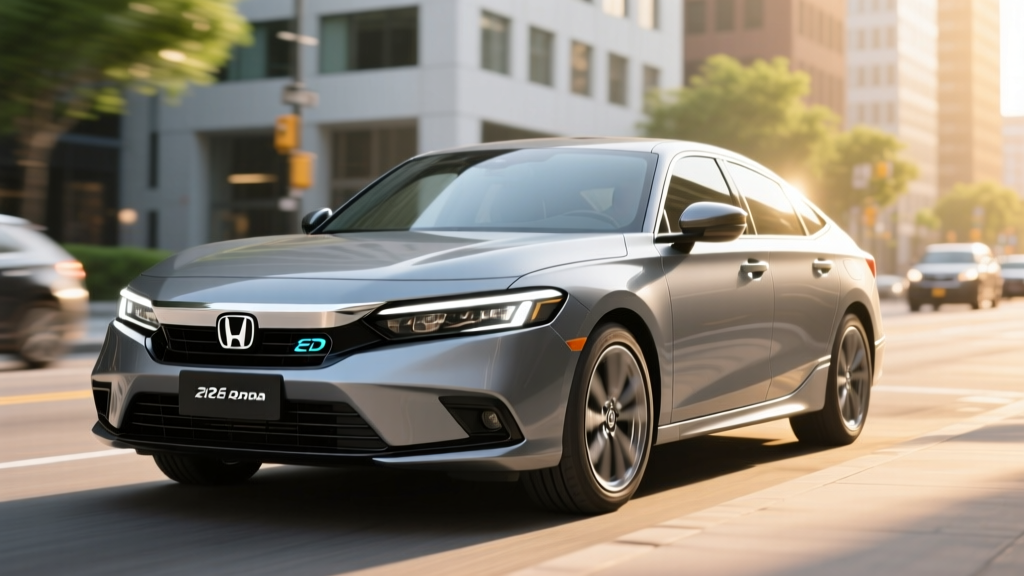
The Honda Civic Hybrid has carved out a distinct niche in the compact sedan segment: it pairs genuine fuel efficiency with the kind of driving dynamics Honda is known for. The 2026 Civic Hybrid Sedan continues this formula with a two-motor hybrid system, a refined interior, and EPA-rated fuel economy that lands at 50 MPG combined. But spec sheets only tell part of the story. This guide examines what you'll actually experience at the pump, how the powertrain behaves in daily driving, and whether this conventional hybrid (HEV) makes more sense for your situation than a plug-in hybrid or full battery-electric vehicle.
HEV vs. PHEV: What the Civic Hybrid Actually Is
Before digging into specs, it's essential to clarify what the Civic Hybrid is — and what it isn't. The Civic Hybrid is a conventional hybrid electric vehicle (HEV). It has no plug, no charging port, and no electric-only driving mode of meaningful distance. It generates all its electrical energy internally through regenerative braking and its gasoline engine.
HEV vs. PHEV vs. BEV — Quick Reference
| Feature | HEV (Civic Hybrid) | PHEV (e.g., Toyota Prius Prime) | BEV (e.g., Tesla Model 3) |
|---|---|---|---|
| Plug-in charging | No | Yes (Level 1/2) | Yes (Level 1/2/DC) |
| Electric-only range | ~1 mi at low speed | 25–45 mi typical | 250–360 mi |
| Battery size | ~1.0 kWh | 13–18 kWh | 50–82 kWh |
| Gasoline engine | Yes (primary) | Yes (backup) | None |
| Federal tax credit (§30D) | Not eligible | Up to $7,500 (if eligible) | Up to $7,500 (if eligible) |
| Home charger needed | No | Recommended | Essential |
If you're comparing the Civic Hybrid to plug-in alternatives like the Toyota Prius Prime, the tradeoff is straightforward: the Civic Hybrid sacrifices electric-only commuting range in exchange for a lower purchase price, no charging infrastructure requirement, and a simpler ownership experience. You fuel it exactly like a gas car — you just visit the station far less often.
Powertrain and Performance Specs
Honda's fourth-generation two-motor hybrid system powers the 2026 Civic Hybrid. The setup pairs a 2.0-liter Atkinson-cycle four-cylinder engine with two electric motors — one functioning primarily as a generator and the other as the drive motor. Combined system output is 200 horsepower and 232 lb-ft of torque, delivered through an electronically controlled continuously variable transmission (e-CVT).
| Specification | 2026 Civic Hybrid Sedan |
|---|---|
| Powertrain | 2.0L 4-cyl Atkinson + 2-motor hybrid (HEV) |
| Combined horsepower | 200 hp |
| Combined torque | 232 lb-ft |
| Transmission | e-CVT |
| 0–60 mph | ~7.2 seconds (est.) |
| Drivetrain | Front-wheel drive |
| Hybrid battery | ~1.0 kWh lithium-ion |
| Fuel tank | 10.6 gallons |
| Base MSRP (Sport Hybrid) | $29,845 |
The 232 lb-ft of torque is available almost immediately from the electric drive motor, which gives the Civic Hybrid a responsive, punchy feel in city driving that belies its efficiency focus. The engine primarily acts as a generator at lower speeds, with the electric motor handling propulsion. At highway cruising speeds, a lock-up clutch allows the engine to directly drive the wheels for optimal efficiency. This is a series-parallel hybrid architecture — more sophisticated than a simple belt-driven mild hybrid system.
Fuel Economy: EPA Ratings vs. Real-World MPG
The headline number for the 2026 Civic Hybrid Sedan is its EPA-rated fuel economy. According to fueleconomy.gov, the Civic Hybrid Sport sedan achieves:
| Driving Condition | EPA Rating | Real-World Expectation |
|---|---|---|
| City | 50 MPG | 48–55 MPG |
| Highway | 47 MPG | 42–47 MPG |
| Combined | 49 MPG | 45–52 MPG |
Why real-world MPG may differ: Hybrids tend to exceed their EPA city ratings in stop-and-go traffic because regenerative braking recovers energy that a conventional car wastes as heat. Conversely, sustained highway driving at 75–80 mph reduces the hybrid advantage because the electric motor contributes less at constant high speed. In cold weather (below 35°F), expect a 5–10% reduction as the engine runs more frequently to provide cabin heat and maintain battery temperature.
With a 10.6-gallon fuel tank and 49 MPG combined, the Civic Hybrid delivers a practical driving range of approximately 500–520 miles per tank under mixed driving conditions. Owners who drive predominantly in the city may see that figure stretch closer to 550 miles.
Pricing, Trims, and Tax Credit Eligibility
The 2026 Civic Hybrid Sedan is available in two trims:
- Sport Hybrid: $29,845 MSRP (includes destination)
- Sport Touring Hybrid: $32,845 MSRP (includes destination)
The Sport Touring adds leather-trimmed seats, a Bose premium audio system, wireless phone charging, a 9-inch touchscreen with wireless Apple CarPlay and Android Auto, and Honda's low-speed braking control. Both trims come standard with the Honda Sensing suite of driver-assistance features, including adaptive cruise control, lane-keeping assist, and automatic emergency braking.
Federal Tax Credit: Not Eligible
The Civic Hybrid is a conventional HEV, not a plug-in vehicle. Under IRS §30D rules, the federal clean vehicle credit (up to $7,500) applies only to battery electric vehicles (BEVs) and plug-in hybrids (PHEVs) that meet battery-sourcing, critical-mineral, MSRP cap, and buyer income requirements. The Civic Hybrid does not qualify for this credit — nor does any conventional hybrid.
Some states offer separate incentives for hybrid vehicles, but these vary widely by jurisdiction. Check your state's energy office or department of environmental quality for current programs.
The absence of a federal tax credit is a real cost consideration. A PHEV like the Toyota Prius Prime (starting around $33,445) may qualify for up to $3,750–$7,500 in federal credits depending on sourcing compliance and buyer eligibility, partially closing the price gap. However, the Civic Hybrid's lower base price and zero charging-infrastructure cost often make it the more economical choice for buyers without reliable home or workplace charging access.
Battery Warranty, Reliability, and Replacement Cost
Honda Hybrid Battery Warranty
- Hybrid battery: 8 years / 100,000 miles (10 years / 150,000 miles in CARB states including CA, NY, MA, and others)
- Hybrid system components: 8 years / 100,000 miles
- Limited vehicle warranty: 3 years / 36,000 miles
- Powertrain warranty: 5 years / 60,000 miles
Honda's hybrid battery warranty is competitive and, in CARB-emission states, extends to 10 years or 150,000 miles — a meaningful advantage for high-mileage drivers. The lithium-ion hybrid battery in the Civic is relatively small (~1.0 kWh), which means it operates within a narrow state-of-charge window managed by the vehicle's battery management system. This shallow-cycling approach significantly reduces degradation compared to the deeper cycles a BEV or PHEV battery undergoes.
Reliability track record: Honda's hybrid systems have proven durable in real-world use. The current-generation two-motor system has been deployed across the Accord Hybrid, CR-V Hybrid, and Civic Hybrid with no widespread battery-failure pattern. According to IIHS, the Civic continues to earn strong crash-test ratings, adding to the ownership-security picture.
Battery replacement cost: If the hybrid battery does require replacement outside of warranty, expect a dealer-installed replacement to cost between $2,000 and $4,000 depending on labor rates. Independent hybrid-battery specialists can sometimes refurbish or replace individual modules for $1,000–$2,000. Given the battery's small size and shallow-cycling design, full replacement is uncommon within the first 150,000 miles.
How the Civic Hybrid Compares: HEV vs. PHEV vs. EV
Choosing between a conventional hybrid, a plug-in hybrid, and a full battery-electric vehicle comes down to three factors: your charging access, your daily mileage, and your budget tolerance for upfront cost versus operating cost.
Which Powertrain Fits You?
Choose the Civic Hybrid (HEV) if:
- You don't have access to home or workplace charging (apartment, street parking, no 240V outlet)
- You want maximum fuel efficiency with zero behavior change — just fill up and go
- Your budget is under $33,000 and you don't want to navigate tax-credit eligibility rules
- You drive 15,000+ miles/year and want 500+ miles between fuel stops
Choose a PHEV (e.g., Prius Prime) if:
- You have reliable Level 2 home charging and a commute under 40 miles
- You want to drive mostly electric on weekdays but take gas-free road trips on weekends
- You qualify for the §30D federal tax credit, offsetting the higher MSRP
Choose a BEV (e.g., Tesla Model 3, Hyundai Ioniq 6) if:
- You have home charging and your daily driving is under 250 miles
- You want to eliminate gasoline entirely and minimize maintenance (no oil changes, no engine)
- You qualify for the full $7,500 federal credit via point-of-sale transfer
- You're comfortable planning around DC fast-charging on road trips
For buyers who rent, live in condos without charging infrastructure, or frequently drive in rural areas with sparse charging networks, the Civic Hybrid offers the strongest efficiency-per-dollar proposition. You capture roughly 70–80% of a BEV's energy-cost savings (through reduced fuel consumption) while retaining 100% of a gas car's refueling convenience.
Driving Impressions and Ownership Practicalities
The Civic Hybrid's two-motor system operates in three modes without driver intervention: EV Drive (electric motor only, at low speeds and light loads), Hybrid Drive (engine generates electricity for the drive motor), and Engine Drive (engine directly powers the wheels via lock-up clutch at highway cruising). The transitions are nearly imperceptible — you'll rarely notice when the engine engages or disengages.
Regenerative braking is moderate. The Civic Hybrid offers steering-wheel-mounted paddle selectors to adjust regen intensity, but it does not provide true one-pedal driving like a BEV. This is intentional: Honda tunes the brake feel to mimic a conventional car, which reduces the learning curve for first-time hybrid owners.
Cargo space in the sedan is 14.8 cubic feet, slightly reduced from the non-hybrid Civic's trunk due to the hybrid battery placement beneath the rear seats. In practice, the difference is minimal and doesn't compromise the trunk's usability for daily errands or luggage.
Pros
- 49 MPG combined — among the best in the compact sedan segment
- 200 hp provides confident acceleration for merging and passing
- No plug, no charging infrastructure required
- 500+ mile range per tank
- Honda Sensing ADAS standard on all trims
- Strong IIHS safety ratings
Cons
- No federal tax credit eligibility (HEV)
- No AWD option (FWD only)
- e-CVT drone under hard acceleration (common to all CVT hybrids)
- Slightly less trunk space than gas Civic
- Sport Touring trim pushes past $33K
- No DC fast charging (not applicable to HEV)
Frequently Asked Questions
How many MPG does the 2026 Civic Hybrid get?
The EPA rates the Civic Hybrid Sedan at 50 MPG city, 47 MPG highway, and 49 MPG combined. In real-world driving, city-heavy commuters often see 50–55 MPG thanks to regenerative braking, while highway-dominant drivers at 75+ mph may see 42–47 MPG. Cold weather reduces efficiency by roughly 5–10%.
Does the Civic Hybrid need to be plugged in?
No. The Civic Hybrid is a conventional HEV. It charges its small lithium-ion battery internally through regenerative braking and the gasoline engine. There is no charging port, and you never need to plug it in. You simply refuel at a gas station — just less frequently than a non-hybrid vehicle.
Does the Civic Hybrid qualify for any federal tax credit?
No. Under current IRS §30D rules, only plug-in hybrids (PHEVs) and battery electric vehicles (BEVs) are eligible for the federal clean vehicle credit. Conventional hybrids like the Civic Hybrid do not qualify. Some states may offer separate hybrid incentives — check your local programs.
How long will the Civic Hybrid battery last, and what does replacement cost?
Honda warranties the hybrid battery for 8 years/100,000 miles (10 years/150,000 miles in CARB states). Based on Honda's track record with similar hybrid systems in the Accord and Insight, the battery typically lasts well beyond 150,000 miles. If replacement is needed out of warranty, expect $2,000–$4,000 at a dealer, or $1,000–$2,000 through an independent hybrid specialist.
How does the Civic Hybrid compare to the Toyota Prius?
The Prius (conventional HEV) achieves up to 57 MPG combined but produces only 194 hp and has a more polarizing design. The Civic Hybrid trades 7–8 MPG for a more engaging driving experience, 200 hp, and a conventional sedan silhouette. If maximum fuel economy is your sole priority, the Prius wins. If you value driving dynamics and interior refinement alongside strong efficiency, the Civic Hybrid is the stronger pick.
Is the Civic Hybrid good for road trips?
Yes. With a 10.6-gallon tank and 47 MPG highway, you can expect roughly 490–500 miles of highway range before refueling. The e-CVT keeps engine noise reasonable at cruising speed, and the Honda Sensing adaptive cruise control reduces fatigue on long drives. Unlike a BEV, there's no charging planning required — you refuel in five minutes at any gas station.