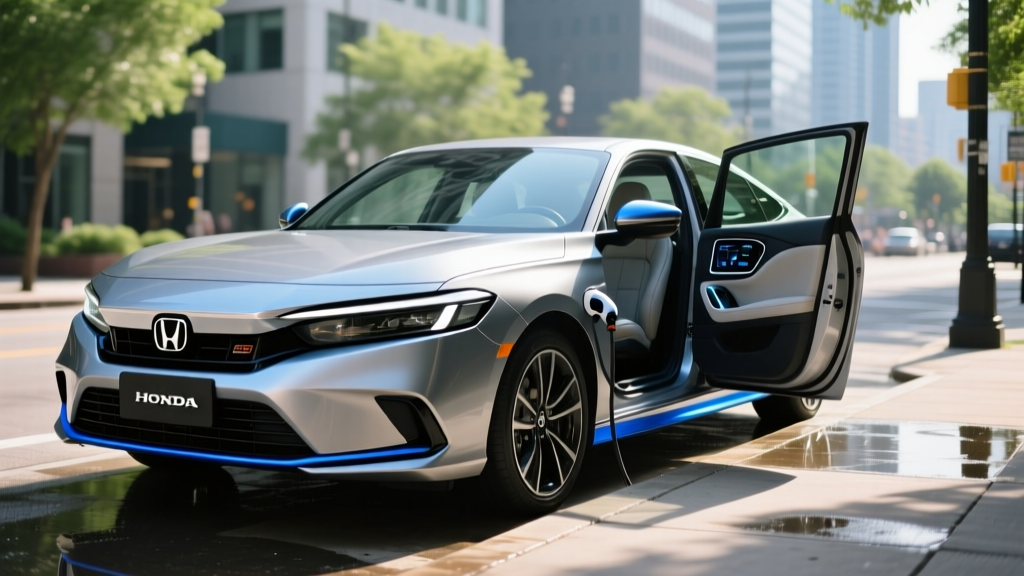
The Honda Civic Hybrid occupies a specific niche that's increasingly hard to find: a compact sedan that pairs genuine driving engagement with exceptional fuel efficiency — no plug required. For 2026, Honda continues with the two-motor hybrid system introduced for the Civic's latest generation, delivering 200 combined horsepower and EPA ratings that crack 50 MPG in city driving. If you've been searching for civic hybrid hp figures alongside real-world efficiency data, this guide covers every number that matters.
Unlike plug-in hybrids (PHEVs) such as the Toyota Prius Prime, the Civic Hybrid is a conventional hybrid electric vehicle (HEV). It charges its small battery through regenerative braking and the gasoline engine — you never plug it in. That distinction shapes everything about ownership: no home charger needed, no electric-only range to manage, and no federal EV tax credit eligibility.
2026 Civic Hybrid Powertrain: Where the 200 HP Comes From
The Civic Hybrid uses Honda's two-motor hybrid system, which pairs a 2.0-liter Atkinson-cycle four-cylinder engine with two electric motors integrated into the transmission assembly. Here's how the output breaks down:
| Component | Specification |
|---|---|
| Engine | 2.0L Atkinson-cycle 4-cylinder |
| Engine Output | 143 hp / 134 lb-ft torque |
| Electric Motor Output | 184 hp / 232 lb-ft torque |
| Combined System Output | 200 hp / 232 lb-ft torque |
| Transmission | e-CVT (direct-drive with lock-up clutch) |
| Drivetrain | Front-wheel drive |
| 0-60 mph | ~6.7 seconds (est.) |
The system operates primarily in electric-drive mode at low and moderate speeds, with the gasoline engine acting as a generator to feed the drive motor. At highway speeds, a lock-up clutch engages to connect the engine directly to the wheels for improved efficiency. This is fundamentally different from the Toyota Hybrid System's planetary gearset approach — and it gives the Civic Hybrid a more direct, EV-like feel during acceleration.
The 200 combined horsepower figure places the Civic Hybrid ahead of the base 2.0L Civic (158 hp) and close to the 1.5T turbo model (180 hp), but with dramatically better fuel economy. The 232 lb-ft of torque — available immediately from the electric motor — makes the hybrid feel quicker off the line than either gas-only Civic variant.
Fuel Economy: EPA Ratings and Real-World MPG
The Civic Hybrid's headline number is its city fuel economy, where hybrid systems shine brightest. Regenerative braking recaptures energy in stop-and-go traffic, and the engine shuts off at stops entirely.
| Trim | City MPG | Highway MPG | Combined MPG |
|---|---|---|---|
| Sport Hybrid | 50 | 47 | 49 |
| Sport Touring Hybrid | 50 | 47 | 49 |
Source: fueleconomy.gov
In mixed driving, the Civic Hybrid routinely meets or slightly exceeds its EPA combined rating of 49 MPG — particularly in warm weather and urban-heavy commutes. Real-world testing by automotive publications has documented figures between 47 and 54 MPG depending on conditions.
Expect lower numbers (42-45 MPG) during sustained highway driving at 75+ mph, in cold weather (below 40°F), or on hilly terrain. Unlike a full EV, there's no dramatic cold-weather range cliff, but the engine runs more frequently in winter to maintain cabin heat and battery temperature.
For comparison, the gas-only 2026 Civic 2.0L achieves 31/40/34 MPG (city/highway/combined), and the 1.5T manages 33/42/36. The hybrid's 49 combined rating represents a roughly 37-44% improvement over gas-only variants — a substantial gap that compounds meaningfully over years of ownership.
HEV vs PHEV vs Full EV: Which Powertrain Fits You?
The Civic Hybrid is a conventional HEV — not a plug-in hybrid. Understanding this distinction is essential before comparing it to PHEVs like the Toyota Prius Prime or full battery-electric vehicles like the Chevrolet Bolt EV.
| Factor | HEV (Civic Hybrid) | PHEV (e.g., Prius Prime) | BEV (e.g., Bolt EV) |
|---|---|---|---|
| Plug-in Required? | No | Yes (Level 1/2) | Yes (Level 1/2/DC) |
| Electric-Only Range | None (EV assist only) | ~40 miles | 250+ miles |
| Fuel/Charging Infra | Gas stations only | Gas + home outlet/charger | Home charger + public DC |
| Federal Tax Credit | Not eligible | Up to $7,500 (§30D) | Up to $7,500 (§30D) |
| Annual Fuel Cost* | ~$1,100 | ~$700 (with home charging) | ~$550 (with home charging) |
| Upfront Price Premium | +$1,500-$2,500 vs gas | +$4,000-$6,000 vs gas | +$5,000-$10,000 vs gas |
*Annual fuel cost estimates based on 12,000 miles/year and national average fuel/electricity prices. Your actual costs will vary.
- You don't have access to home charging (apartment, street parking, no garage)
- You want maximum fuel efficiency with zero behavioral change — just fill up and drive
- Your budget is under $32,000 and you want a well-equipped compact sedan
- You drive in a region with limited public charging infrastructure
- You have reliable Level 2 home charging and a short commute (under 40 miles)
- You want to eliminate gasoline for daily driving
- You qualify for the full §30D federal tax credit and want to offset a higher purchase price
Pricing, Trims, and Tax Credit Eligibility
The 2026 Honda Civic Hybrid is available in two trims: Sport Hybrid and Sport Touring Hybrid. Both share the same 200 hp powertrain and 49 MPG combined rating.
| Trim | MSRP (incl. destination) | Key Features |
|---|---|---|
| Sport Hybrid | ~$30,650 | 18" alloy wheels, 7" touchscreen, wireless CarPlay/Android Auto, Honda Sensing suite |
| Sport Touring Hybrid | ~$34,250 | 9" touchscreen, Bose 12-speaker audio, wireless charging, leather-trimmed seats, navigation, heated rear seats |
The Civic Hybrid is a conventional HEV, not a plug-in vehicle. Under IRS §30D rules, only plug-in electric vehicles (PHEVs and BEVs) with sufficient battery capacity qualify for the federal clean vehicle credit. The Civic Hybrid does not qualify for any federal tax credit.
Some states offer rebates or HOV lane access for conventional hybrids — check your state's energy office or DMV for local programs. These vary by jurisdiction and change frequently.
Despite the lack of a federal credit, the Civic Hybrid's modest price premium over gas-only trims (roughly $1,500-$2,500) typically pays for itself through fuel savings within 2-3 years for average drivers. At 12,000 miles per year and $3.40/gallon, a driver switching from the gas Civic (34 combined MPG) to the Hybrid (49 combined) saves approximately $370 annually in fuel costs.
Battery Warranty, Lifespan, and Replacement Costs
Hybrid battery longevity is one of the most common concerns among first-time hybrid buyers. The Civic Hybrid uses a lithium-ion battery pack — significantly smaller than an EV battery (roughly 1-2 kWh vs. 60-80 kWh in a BEV) — that operates within a narrow state-of-charge window managed by the vehicle's thermal and charge management systems.
- Coverage: 8 years / 100,000 miles (10 years / 150,000 miles in CARB states including CA, NY, MA, and others)
- What's covered: Battery capacity loss below functional threshold, hybrid system components including the inverter and electric motors
- Real-world lifespan: Honda's hybrid batteries in the Accord and Insight have demonstrated reliable operation well past 150,000 miles in taxi and fleet service
Because the hybrid battery is small and never deeply discharged (the system keeps it between roughly 40-80% state of charge), degradation is minimal compared to full EV batteries. Most hybrid batteries outlast the vehicle's useful life. In the event a replacement is needed out of warranty, expect costs in the range of $2,000-$4,000 for the battery pack itself, plus labor — though third-party refurbished options are increasingly available at lower cost.
The rest of the hybrid powertrain — the electric motors, inverter, and e-CVT — carries the same 8-year/100,000-mile warranty. Honda's e-CVT design has no belts, bands, or friction clutches to wear, and long-term reliability data from the Accord Hybrid and CR-V Hybrid (which share this architecture) is strong.
Driving Impressions and Practical Ownership Notes
The Civic Hybrid's 200 hp and 232 lb-ft of electric motor torque deliver a driving experience that feels more responsive than the EPA numbers suggest. The electric motor's instant torque fill masks the Atkinson-cycle engine's inherent low-end weakness, and the system transitions between EV, hybrid, and engine-direct modes smoothly — most drivers won't notice the handoffs.
The Sport Touring Hybrid trim adds adaptive dampers (on some model years) and a more aggressive throttle map in Sport mode, making this one of the most engaging hybrid sedans in its class. The e-CVT avoids the rubber-band drone associated with older Toyota hybrid systems thanks to the lock-up clutch at highway speeds.
Practical considerations for owners:
- Fuel tank: 12.4 gallons, yielding a theoretical range of ~607 miles at the 49 MPG combined rating
- Cargo space: 14.8 cu ft trunk — identical to the gas Civic sedan (the hybrid battery is packaged under the rear seats)
- Towing: Not rated for towing (consistent with the Civic platform)
- Maintenance: Standard Honda maintenance schedule; no hybrid-specific service items beyond periodic inverter coolant checks
- Insurance: Typically 5-10% higher than the gas Civic due to higher replacement cost for hybrid components
Pros, Cons, and Final Verdict
- 200 hp with 49 MPG combined — best power-to-efficiency ratio in the compact class
- No plug-in required; zero behavioral change from a gas car
- Strong electric-motor torque makes it feel quicker than 200 hp suggests
- 8-yr/100,000-mi hybrid battery warranty (10 yr in CARB states)
- Full Honda Sensing ADAS suite standard on all trims
- Competitive pricing starting around $30,650
- No federal tax credit eligibility (HEV, not PHEV)
- Not available with all-wheel drive
- Only two trims offered (Sport, Sport Touring) — no base hybrid option
- Highway MPG drops noticeably at sustained 75+ mph speeds
- Slightly higher insurance cost vs gas Civic
Frequently Asked Questions
How many MPG does the 2026 Civic Hybrid get?
The EPA rates the Civic Hybrid at 50 MPG city, 47 MPG highway, and 49 MPG combined. Real-world results typically fall between 45-54 MPG depending on driving conditions, with city-heavy commutes yielding the best numbers and sustained high-speed highway driving producing the lowest.
Does the Civic Hybrid need to be plugged in?
No. The Civic Hybrid is a conventional HEV. Its small lithium-ion battery charges exclusively through regenerative braking and the gasoline engine. You never plug it in — simply refuel at any gas station as you would with a standard Civic.
How much horsepower does the Civic Hybrid have?
The 2026 Civic Hybrid produces a combined system output of 200 horsepower and 232 lb-ft of torque. The 2.0L gasoline engine contributes 143 hp, while the electric drive motor produces 184 hp. These don't simply add together because peak outputs occur at different RPM ranges — the combined 200 hp figure represents the system's maximum usable output.
Does the Civic Hybrid qualify for any tax credit?
No. Under current IRS §30D rules, only plug-in electric vehicles (PHEVs and BEVs) qualify for the federal clean vehicle credit. The Civic Hybrid, as a conventional HEV, is not eligible. Some states may offer minor incentives for hybrids — check your state energy office for details.
Is the Civic Hybrid reliable? What about battery replacement cost?
Honda's two-motor hybrid system has an excellent reliability track record across the Accord Hybrid, CR-V Hybrid, and previous Insight models. The hybrid battery is warranted for 8 years/100,000 miles (10 years/150,000 miles in CARB states) and is designed to last the vehicle's lifetime. If replacement is needed out of warranty, expect $2,000-$4,000 for the battery pack.
How does the Civic Hybrid compare to the Toyota Prius?
The Prius (196 hp, 57 MPG combined with FWD) offers slightly better fuel economy but comparable power. The Civic Hybrid trades a few MPG for a more engaging driving experience, a conventional sedan trunk (vs. the Prius hatchback), and Honda's interior design. If maximum efficiency is your sole priority, the Prius edges ahead. If you want a hybrid that doesn't feel like a compromise, the Civic Hybrid is the stronger pick.
Should I buy the Civic Hybrid or a full EV?
Choose the Civic Hybrid if you lack home charging access, frequently take long road trips, live in a region with sparse public charging, or want to minimize upfront cost. Choose a full EV (like the Hyundai Ioniq 6 or Tesla Model 3) if you have Level 2 home charging, commute under 250 miles round-trip, want to eliminate gasoline entirely, and can leverage the $7,500 federal tax credit to offset a higher purchase price.