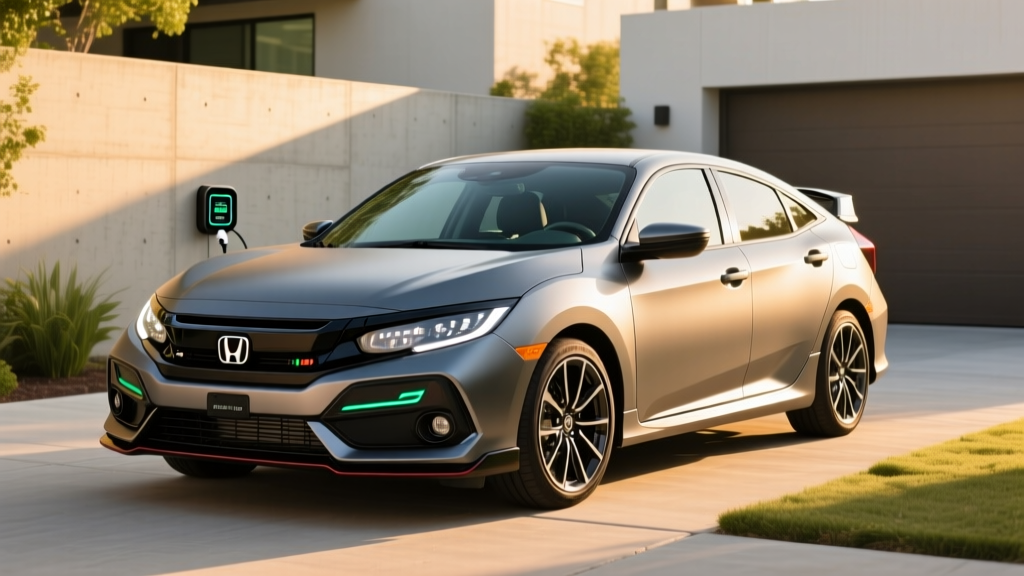
The 2026 Honda Civic Hybrid Hatchback Sport Touring occupies a precise niche: a premium compact hatchback that delivers hybrid-level efficiency without requiring a plug, a charging routine, or any change in driving habits. For buyers weighing a conventional hybrid (HEV) against a plug-in hybrid (PHEV) or a full battery-electric vehicle (BEV), the Civic Hybrid Hatchback Sport Touring makes a compelling case for simplicity paired with genuine fuel savings.
This guide covers the Sport Touring trim specifically — the top-of-the-line hatchback hybrid — with exact EPA figures, real-world efficiency data, powertrain details, battery warranty terms, pricing, and tax credit context so you can make a spec-driven purchase decision.
HEV vs PHEV vs EV: Where the Civic Hybrid Fits
Before examining the numbers, it's essential to clarify what the Civic Hybrid Hatchback is — and what it isn't. Honda's Civic Hybrid uses a conventional hybrid (HEV) powertrain. It does not plug in. There is no charging port, no electric-only driving mode of meaningful distance, and no battery large enough to require external charging. The system captures energy through regenerative braking and the gasoline engine to charge a small lithium-ion battery that assists the motor.
HEV vs PHEV vs BEV — Quick Reference
| Feature | HEV (Civic Hybrid) | PHEV (e.g., Toyota Prius Prime) | BEV (e.g., Chevy Bolt EV) |
|---|---|---|---|
| Plugs in? | No | Yes | Yes |
| Electric-only range | ~1 mi (low-speed assist) | 25–45 mi typical | 200–350+ mi |
| Fuel required? | Yes | Yes (when battery depletes) | No |
| Home charging needed? | No | Recommended (Level 2) | Essential |
| Federal tax credit (§30D) | Not eligible | Up to $7,500 (if eligible) | Up to $7,500 (if eligible) |
The Civic Hybrid is an HEV. It never needs to be plugged in and does not qualify for the federal §30D new clean vehicle credit.
Fuel Economy: EPA Ratings and Real-World MPG
The headline number for the 2026 Honda Civic Hybrid Hatchback Sport Touring is its EPA-rated fuel economy. According to fueleconomy.gov, the Civic Hybrid achieves:
| Cycle | EPA MPG |
|---|---|
| City | 50 MPG |
| Highway | 45 MPG |
| Combined | 49 MPG |
Real-World MPG: What Owners Actually See
Honda's two-motor hybrid system excels in stop-and-go city driving, where regenerative braking and electric-motor assist do the heavy lifting. In real-world mixed driving, owners commonly report 47–52 MPG combined, with city-heavy commutes occasionally exceeding the EPA city estimate. Highway-only driving at 75+ mph may drop to the low-to-mid 40s, as the gasoline engine carries more of the load at sustained speed.
Cold weather affects hybrids less dramatically than EVs, but expect a 3–5 MPG reduction in winter due to increased engine idling for cabin heat and reduced battery efficiency at low temperatures. This is modest compared to the 20–30% range loss a BEV experiences in freezing conditions.
Powertrain: Two-Motor Hybrid System Specs
The Civic Hybrid Hatchback Sport Touring uses Honda's fourth-generation two-motor hybrid system, paired with a 2.0-liter Atkinson-cycle four-cylinder engine. Unlike some hybrid systems that use a traditional transmission, Honda's system primarily drives the wheels through the electric traction motor, with the gasoline engine acting as a generator at most speeds and engaging directly only at highway cruising.
| Specification | Value |
|---|---|
| Engine | 2.0L DOHC Atkinson-cycle 4-cylinder |
| Combined System Horsepower | 200 hp |
| Combined System Torque | 232 lb-ft (motor torque) |
| 0–60 mph | ~7.3 seconds |
| Drivetrain | Front-wheel drive (FWD) |
| Transmission | e-CVT (single-speed direct drive, no traditional gears) |
| Hybrid Battery | Lithium-ion, ~1.0 kWh (small buffer, not plug-in) |
| Cargo Volume (rear seats up) | 24.5 cu ft |
| Cargo Volume (rear seats folded) | ~71 cu ft |
The 200-hp combined output makes the Civic Hybrid Hatchback Sport Touring meaningfully quicker than the non-hybrid Civic Hatchback Sport Touring (which produces 180 hp from its 1.5L turbo). The electric motor's instant torque delivery gives it strong low-speed responsiveness — a noticeable advantage in city merging and passing situations.
Sport Touring Trim: What You Get for the Price
The Sport Touring is the top trim in the Civic Hybrid Hatchback lineup. For the 2026 model year, it includes features that justify its position at the top of the range:
- Honda Sensing suite: Adaptive cruise control, lane-keeping assist, collision mitigation braking, traffic sign recognition, and blind-spot monitoring
- 9-inch touchscreen with wireless Apple CarPlay and Android Auto
- Bose premium audio system (12 speakers)
- Wireless phone charging pad
- Leather-trimmed seats with heated front seats and heated steering wheel
- Power moonroof
- 18-inch alloy wheels in gloss black finish
- LED headlights and taillights
- Dual-zone automatic climate control
- Smart entry with walk-away auto lock
| Pricing | MSRP |
|---|---|
| Civic Hybrid Hatchback Sport Touring (FWD) | $34,450 (est.) |
| Destination & delivery | $1,095 |
| Total MSRP | ~$35,545 |
Pricing is based on Honda's announced 2026 MSRP. Final dealer pricing may vary. Always verify current pricing on Honda's official site.
Tax Credits and Incentives: What Applies to This HEV
This is where many buyers get confused. The Honda Civic Hybrid Hatchback Sport Touring is a conventional hybrid (HEV), not a plug-in hybrid or battery-electric vehicle. Under current IRS §30D rules, the federal new clean vehicle credit of up to $7,500 applies only to BEVs and PHEVs that meet battery sourcing, MSRP caps, and buyer income limits. The Civic Hybrid does not qualify for the §30D federal tax credit.
However, the Civic Hybrid's lower purchase price compared to a PHEV or BEV — combined with its 49 MPG combined efficiency — often results in a lower total cost of ownership over five years even without a tax credit. The fuel savings versus a comparable gas-only compact hatchback (typically 30–33 MPG combined) can amount to $500–$700 per year at 15,000 miles driven annually and $3.50/gallon fuel prices.
Battery Warranty, Reliability, and Replacement Cost
Hybrid battery longevity is consistently the top concern among first-time hybrid buyers. Honda backs the Civic Hybrid's lithium-ion battery pack with a robust warranty:
Honda Hybrid Battery Warranty
- Duration: 8 years / 100,000 miles (whichever comes first)
- Extended in CARB states: 10 years / 150,000 miles in states that follow California Air Resources Board emissions standards (CA, CO, CT, DE, ME, MD, MA, NJ, NM, NY, OR, RI, VT, WA, and others adopting CARB rules)
- Coverage: Defects and capacity loss below a defined threshold
- Hybrid system components: Also covered under the 8-year/100,000-mile powertrain warranty
Reliability Track Record
Honda's hybrid systems have been in production since the early 2000s (Insight, then Accord Hybrid, CR-V Hybrid, and now Civic Hybrid). The fourth-generation two-motor system used in the current Civic Hybrid has proven durable in real-world use. Unlike early nickel-metal hydride (NiMH) packs that degraded noticeably after 100,000 miles, modern lithium-ion hybrid batteries are designed to last the life of the vehicle under normal use.
According to reliability data tracked by IIHS and owner surveys, the Civic Hybrid platform has no systemic battery failure patterns. The small battery (~1.0 kWh) undergoes shallow charge/discharge cycles — it never fully depletes or fully charges — which dramatically extends cell life compared to a BEV's deep-cycle usage.
Battery Replacement Cost
If the hybrid battery does fail outside of warranty, replacement cost for the Civic Hybrid's lithium-ion pack is estimated at $2,500–$4,000 (parts and labor) at a Honda dealership. This is significantly less than a BEV battery replacement ($8,000–$20,000+) because the pack is small and accessible. Independent hybrid specialists may offer refurbished packs for $1,500–$2,500.
Who Should Choose the Civic Hybrid Hatchback Sport Touring?
Decision Framework: Is This the Right Electrified Vehicle for You?
Choose the Civic Hybrid Hatchback Sport Touring if:
- You want 49 MPG combined without installing a home charger or changing your fueling routine
- You live in an apartment or lack reliable access to plug-in charging
- You take regular road trips and don't want to plan around charging stops
- You want a premium compact hatchback with strong cargo versatility (24.5 cu ft behind rear seats)
- You prioritize low cost of ownership over zero tailpipe emissions
Consider a PHEV instead if:
- You have home charging access and a commute under 40 miles round-trip (you could drive mostly electric)
- You want partial electric driving and qualify for the §30D federal credit
Consider a full BEV instead if:
- You have reliable Level 2 home charging
- Your daily driving is under 200 miles and you want zero tailpipe emissions
- You want to eliminate fuel costs entirely and qualify for federal/state EV incentives
Pros and Cons: Civic Hybrid Hatchback Sport Touring
✅ Pros
- 49 MPG combined EPA — real-world often exceeds this in city driving
- 200 hp combined — quickest Civic Hatchback in the lineup
- No plug-in charging required — fuel like a normal gas car
- Sport Touring trim is fully loaded: Bose, leather, moonroof, Honda Sensing
- 24.5 cu ft cargo space with hatchback versatility
- 8-year/100,000-mile hybrid battery warranty (10 yr in CARB states)
- Lower purchase price than comparable PHEVs and BEVs
❌ Cons
- No federal §30D tax credit eligibility (HEV, not PHEV/BEV)
- FWD only — no all-wheel-drive option (unlike some hybrid competitors)
- No meaningful electric-only driving range
- Premium Sport Touring trim pushes price near $35,500
- Highway MPG drops to ~45 at sustained 75+ mph speeds
- Smaller hybrid battery means regen braking feel can be less aggressive than some competitors
Frequently Asked Questions
How many MPG does the 2026 Honda Civic Hybrid Hatchback Sport Touring get?
The EPA rates it at 50 MPG city, 45 MPG highway, and 49 MPG combined. In real-world mixed driving, most owners report 47–52 MPG, with city-heavy routes often exceeding the EPA city estimate thanks to the two-motor hybrid system's regenerative braking efficiency.
Does the Civic Hybrid Hatchback plug in?
No. The Civic Hybrid is a conventional hybrid (HEV). It charges its small lithium-ion battery through regenerative braking and the gasoline engine. There is no charging port and no need to plug in at any point.
How far can it drive on electric power alone?
Effectively less than one mile at very low speeds (under 25 mph in light-throttle conditions). The battery is approximately 1.0 kWh — far too small for meaningful electric-only range. The electric motor assists the gasoline engine continuously, but the engine remains the primary energy source. If electric-only commuting is a priority, a PHEV like the Toyota Prius Prime (44 miles electric-only) is a better fit.
Does the Civic Hybrid qualify for any federal tax credit?
No. Under current IRS §30D rules, the federal new clean vehicle credit is limited to plug-in electric vehicles (BEVs and PHEVs) that meet battery sourcing, MSRP caps, and income requirements. Conventional hybrids do not qualify. Some states may offer separate efficiency incentives — check your local jurisdiction.
Is the hybrid battery reliable, and what does replacement cost?
Honda's lithium-ion hybrid battery is covered for 8 years/100,000 miles (10 years/150,000 miles in CARB states). The pack uses shallow charge cycles that minimize degradation, and there are no widespread failure reports for this generation. Out-of-warranty replacement is estimated at $2,500–$4,000 at a dealer — far less than a BEV battery replacement.
How does the Civic Hybrid compare to the Toyota Prius?
The Toyota Prius (conventional hybrid) achieves up to 57 MPG combined in its LE trim but offers less cargo space and a lower-power powertrain (196 hp). The Civic Hybrid Hatchback Sport Touring trades a few MPG for more power, a more premium interior, and greater hatchback cargo versatility. The Prius Prime (PHEV) offers 44 miles of electric-only range and may qualify for the §30D credit, but requires plug-in access to realize its efficiency advantage.
Is the Sport Touring worth the premium over the Sport Hybrid trim?
The Sport trim starts approximately $4,000–$5,000 lower than the Sport Touring. The Sport Touring adds leather seats, Bose audio, a moonroof, wireless charging, and additional driver-assist features. If you value these amenities and plan to keep the car 5+ years, the Sport Touring's premium package holds value well. If you're budget-focused, the Sport Hybrid delivers identical MPG and powertrain performance at a lower price.
Final Assessment: A No-Compromise Efficiency Play
The 2026 Honda Civic Hybrid Hatchback Sport Touring doesn't try to be an EV. It doesn't need a charger, doesn't promise electric-only commuting, and doesn't chase a tax credit it can't claim. What it does is deliver 49 MPG combined with 200 horsepower, a fully equipped premium interior, and hatchback practicality — all without asking the owner to change a single habit.
For buyers without home charging access, frequent road-trippers, and anyone who wants hybrid efficiency without the complexity of plug-in ownership, the Civic Hybrid Hatchback Sport Touring is one of the most complete packages in the compact segment. The fuel savings versus a gas-only competitor pay for the hybrid premium within a few years, and the 8-year battery warranty provides long-term peace of mind. If your situation supports plug-in charging and you want partial electric driving, a PHEV may offer additional savings — but for pure, no-plug efficiency, this Civic is hard to beat.