Quick Verdict: The Civic Hybrid Hatchback Is the Practical Daily Driver
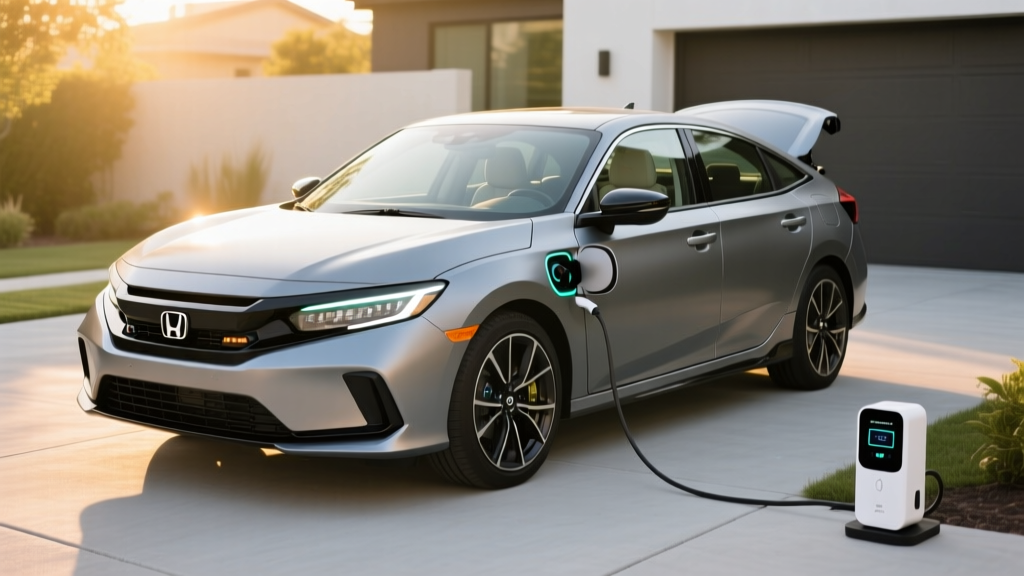
The 2025 Honda Civic Hybrid Hatchback is not a plug-in vehicle, and that's exactly the point. As a conventional hybrid electric vehicle (HEV), it requires zero lifestyle changes—no charging cables, no home electrical upgrades, no range math. You fill it with gas, and it returns up to 50 MPG combined according to the EPA, making it one of the most fuel-efficient non-plug-in vehicles sold in the United States.
Honda introduced the hybrid powertrain to the Civic Hatchback for the 2025 model year, pairing a 2.0-liter four-cylinder engine with two electric motors. The result is a combined 200 horsepower and 232 lb-ft of torque—figures that make this the quickest non-Si, non-Type-R Civic Hatchback in the lineup. It's also the most efficient.
| Spec | 2025 Civic Hybrid Hatchback |
|---|---|
| Powertrain | 2.0L Atkinson-cycle I-4 + 2 electric motors |
| Combined Output | 200 hp / 232 lb-ft torque |
| Transmission | e-CVT (direct drive) |
| EPA Fuel Economy | 50 city / 47 highway / 50 combined MPG |
| Fuel Tank | 10.6 gallons |
| Estimated Total Range | ~530 miles |
| Drivetrain | Front-wheel drive |
| 0–60 mph | ~6.9 seconds (est.) |
| Hybrid Battery Warranty | 8 years / 100,000 miles |
| Starting MSRP (Sport Hybrid) | $31,450 |
HEV vs PHEV vs EV: Where the Civic Hybrid Fits
Before evaluating fuel economy, it's critical to understand what the 2025 Civic Hybrid Hatchback is—and what it is not.
| Category | HEV (Civic Hybrid) | PHEV (e.g., Toyota Prius Prime) | BEV (e.g., Chevy Bolt EV) |
|---|---|---|---|
| Plugs in? | No | Yes (Level 1 or 2) | Yes (Level 1, 2, or DC fast) |
| Electric-only range | None (motor assists engine) | ~25–44 miles | 200–350+ miles |
| Gas engine | Yes (primary power) | Yes (backup after battery depletes) | None |
| Fuel cost per mile | ~$0.07 at 50 MPG | ~$0.03 electric / ~$0.08 gas | ~$0.04 electric (home) |
| Home charging needed? | No | Recommended for full benefit | Required |
| Federal tax credit (§30D) | Not eligible | Up to $7,500 (if eligible) | Up to $7,500 (if eligible) |
The Civic Hybrid is a conventional HEV. Its small lithium-ion battery (approximately 1.0 kWh usable capacity) recharges exclusively through regenerative braking and the gas engine. You never plug it in. The electric motors assist the gas engine during acceleration and enable brief electric-only creeping at low speeds, but there is no meaningful electric-only driving range.
If you want to drive 30+ miles on electricity before the engine engages, you need a PHEV like the Toyota Prius Prime or a full BEV. The Civic Hybrid is for buyers who want maximum fuel efficiency with zero charging infrastructure requirements.
How Many MPG Does the Civic Hybrid Hatchback Get?
| Driving Condition | EPA Rating | Real-World Expectation |
|---|---|---|
| City | 50 MPG | 48–54 MPG (hybrids often exceed EPA in stop-and-go) |
| Highway | 47 MPG | 42–46 MPG (sustained 70+ mph reduces regen benefit) |
| Combined | 50 MPG | 45–50 MPG depending on driving mix |
The EPA rates the 2025 Civic Hybrid Hatchback at 50/47/50 MPG (city/highway/combined). These are strong numbers, but the real-world story is more nuanced.
City driving favors hybrids. The regenerative braking system recaptures energy during deceleration, and the electric motor handles low-speed propulsion where gas engines are least efficient. In moderate-temperature city driving with mixed traffic, many Civic Hybrid owners report 52–55 MPG on routes with frequent stops.
Highway driving reveals the limitation. At sustained speeds above 65 mph, the electric motor provides minimal assistance. The 2.0L Atkinson-cycle engine carries the load alone, and aerodynamic drag increases with the square of velocity. Expect 42–46 MPG on flat interstate stretches at 70–75 mph. Cold weather (below 40°F) compounds this: the engine runs longer to heat the cabin and maintain battery temperature, dropping observed highway economy to 38–42 MPG.
Total range is approximately 530 miles on the 10.6-gallon fuel tank under mixed conditions. On a purely highway road trip in summer, expect closer to 460–490 miles before refueling.
Powertrain Performance: 200 HP From a Hybrid
Honda's fourth-generation two-motor hybrid system is shared across the Accord Hybrid and CR-V Hybrid, but tuned for the Civic's lighter platform. The setup pairs:
- 2.0-liter Atkinson-cycle inline-4: Produces approximately 143 hp and 134 lb-ft on its own, optimized for thermal efficiency rather than peak output
- Two electric motors: Combined output of approximately 184 hp and 232 lb-ft of torque, with one motor primarily driving the wheels and the other functioning as a generator
- System combined output: 200 hp and 232 lb-ft of torque
The e-CVT transmission uses a direct-drive architecture rather than a traditional belt-and-pulley CVT. At low speeds, the electric motor drives the wheels directly (with the engine acting as a generator). At highway speeds, a lockup clutch connects the engine directly to the drive wheels, eliminating conversion losses.
Acceleration to 60 mph takes approximately 6.9 seconds—roughly 1.5 seconds quicker than the standard 2.0L non-hybrid Civic Hatchback. The electric motor's instant torque delivery makes the car feel responsive from a stop, and passing maneuvers on two-lane roads are confident. This is not a performance car, but it's not sluggish either.
Pricing, Trims, and Tax Credit Eligibility
The 2025 Civic Hybrid Hatchback is offered in two trims:
- Sport Hybrid: $31,450 MSRP (including destination)
- Sport Touring Hybrid: $34,450 MSRP (adds leather, Bose audio, navigation, wireless charging, and Honda Sensing suite upgrades)
Federal tax credit: The Civic Hybrid Hatchback does not qualify for the IRS §30D New Clean Vehicle Credit. That credit applies exclusively to plug-in electric vehicles (BEVs and PHEVs) with at least 7 kWh of battery capacity and meeting critical-mineral and battery-component sourcing requirements. The Civic Hybrid's ~1.0 kWh battery is far below the 7 kWh threshold, and as an HEV, it is categorically excluded from §30D.
State incentives: A handful of states offer rebates or reduced registration fees for hybrid vehicles, but these programs are inconsistent and frequently change. Check your state's energy or environmental agency website for current availability. Do not assume a hybrid qualifies for the same incentives as a PHEV or BEV.
Price comparison context: The non-hybrid 2025 Civic Hatchback Sport starts at $28,950, making the hybrid powertrain a $2,500 upcharge. At 50 MPG combined versus 33 MPG combined for the gas model, the hybrid saves approximately $550 per year in fuel costs (assuming 12,000 miles/year and $3.50/gallon regular). The payback period is roughly 4.5 years before considering the hybrid's stronger acceleration and lower emissions.
Battery Warranty, Reliability, and Replacement Cost
Honda Hybrid Battery Warranty: 8 years or 100,000 miles (whichever comes first) in most states. In California Air Resources Board (CARB) states—including CA, CT, ME, MD, MA, NJ, NY, OR, RI, VT, and WA—the hybrid battery is covered for 10 years or 150,000 miles under emissions warranty provisions.
What's covered: Battery capacity loss below a functional threshold (typically below ~70% state of health) or complete failure. Normal gradual capacity loss that doesn't impair vehicle operation is not covered.
The Civic Hybrid's lithium-ion battery pack is small (~1.0 kWh usable) compared to a PHEV (13–18 kWh) or BEV (60–100 kWh). Smaller batteries experience less thermal stress and fewer deep charge cycles, which contributes to longevity. Honda's hybrid systems in the Accord and Insight have demonstrated strong real-world durability, with many examples exceeding 150,000 miles on the original battery.
Battery replacement cost: If the hybrid battery fails outside of warranty, expect a dealer replacement to cost between $2,000 and $4,000 (parts and labor). Independent hybrid specialists may offer refurbished battery packs for $1,200–$2,000. For context, this is dramatically cheaper than a BEV battery replacement ($8,000–$20,000+), reflecting the Civic Hybrid's small battery size.
Overall reliability: Honda's hybrid powertrain has a mature track record. The e-CVT design has no belts, chains, or clutch packs to wear. The gasoline engine operates under lighter loads than in a non-hybrid application, which can extend its service life. IIHS has rated the 2025 Civic Hatchback with top marks in crashworthiness, and Honda Sensing (standard on all trims) provides forward collision warning, automatic emergency braking, lane keeping assist, and adaptive cruise control.
Who Should Choose the Civic Hybrid Hatchback?
Choose the Civic Hybrid Hatchback if:
- You want 45–50+ MPG without installing a home charger or changing your refueling habits
- You live in an apartment or condo without charging access and a PHEV/BEV isn't practical
- You drive a mix of city and highway miles and want low fuel costs year-round
- You want a hatchback's cargo versatility (26.2 cu ft behind rear seats) with strong fuel economy
- You want quicker acceleration than the base Civic without stepping to the turbocharged Si
Consider a PHEV or BEV instead if:
- You have home charging access and want to drive 25–40+ miles on electricity daily (PHEV)
- You want zero tailpipe emissions and access to the $7,500 federal tax credit (BEV, if eligible)
- Your daily commute is under 40 miles round-trip and you rarely take road trips over 300 miles (BEV)
- You want to minimize long-term fuel spending and your electricity rates are low (BEV)
Stick with the gas Civic Hatchback if:
- Your annual mileage is under 8,000 miles (the hybrid's fuel savings won't offset the $2,500 upcharge within a reasonable timeframe)
- You prioritize the lowest possible purchase price over operating costs
- You plan to keep the car for fewer than 4 years
Pros and Cons
Pros
- 50 MPG combined EPA—class-leading for a non-plug-in compact hatchback
- 200 hp and 232 lb-ft: quickest Civic Hatchback below Si/Type R
- No plug-in charging required; zero lifestyle adjustment
- Hatchback cargo space (26.2 cu ft) adds practicality over sedan
- Strong reliability history from Honda's hybrid systems
- Honda Sensing ADAS suite standard on all trims
Cons
- No federal tax credit eligibility (§30D requires plug-in vehicles)
- Highway MPG drops to 42–46 in real-world sustained-speed driving
- FWD only—no AWD option unlike the Toyota Prius or Mazda3
- $2,500 upcharge over gas Civic Hatchback Sport requires ~4.5-year payback
- Small battery means no electric-only driving range to speak of
- Sport Touring trim at $34,450 approaches compact luxury pricing
Frequently Asked Questions
Does the 2025 Honda Civic Hybrid Hatchback need to be plugged in?
No. The Civic Hybrid is a conventional HEV, not a plug-in hybrid. Its battery recharges through regenerative braking and the gasoline engine. You refuel it exactly like a standard gas car—at any gas station, with regular unleaded.
How far can the Civic Hybrid go on a full tank?
Approximately 530 miles under EPA combined driving conditions (50 MPG × 10.6-gallon tank). On a highway-dominant road trip at 70+ mph, expect 460–490 miles before the fuel light illuminates.
Is the Civic Hybrid Hatchback reliable?
Honda's hybrid powertrain has a proven track record across the Accord, CR-V, and previous Insight models. The e-CVT has fewer wear components than a traditional automatic, and the small hybrid battery operates under moderate stress. With routine maintenance, 150,000+ miles on the original powertrain is realistic.
What does it cost to replace the hybrid battery?
Dealer replacement runs $2,000–$4,000. Independent hybrid shops may offer refurbished units for $1,200–$2,000. The battery is warrantied for 8 years/100,000 miles (10 years/150,000 miles in CARB states), so most owners will never pay out of pocket.
Does the Civic Hybrid qualify for any tax credit?
No federal tax credit is available. The IRS §30D New Clean Vehicle Credit requires a plug-in vehicle (PHEV or BEV) with at least 7 kWh of battery capacity. The Civic Hybrid's ~1.0 kWh battery and HEV configuration make it ineligible. Some states may offer minor hybrid incentives, but these are not guaranteed.
Civic Hybrid vs Toyota Prius: which is better?
The Prius (57 MPG combined, FWD) is more efficient but lower in horsepower (194 hp combined) and is a liftback, not a hatchback with a traditional cargo area. The Civic Hybrid offers more cargo space (26.2 vs 20.3 cu ft), stronger acceleration, and a more conventional driving feel. If pure MPG is your priority, the Prius wins. If you want a more engaging drive with hatchback utility, the Civic Hybrid is the stronger pick.
Can I get AWD on the Civic Hybrid Hatchback?
No. The 2025 Civic Hybrid Hatchback is front-wheel drive only. If all-wheel drive is essential, the Toyota Prius AWD (54 MPG combined) or the Mazda3 Hybrid (not yet available in the U.S. as of 2025) are alternatives to monitor.