Quick Verdict: The Civic Hatchback Sport Touring Hybrid at a Glance
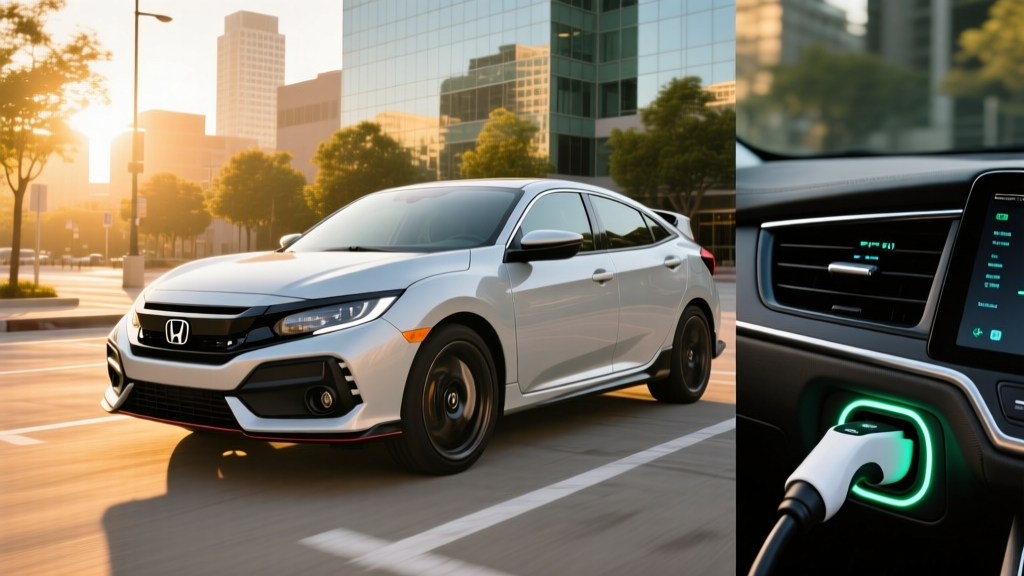
The 2026 Honda Civic Hatchback Sport Touring Hybrid occupies a precise niche: it's a conventional hybrid electric vehicle (HEV), not a plug-in hybrid (PHEV). That distinction matters because it shapes everything about ownership — no charging cable required, no electric-only range to manage, and no federal §30D tax credit eligibility. What you get instead is a refined two-motor hybrid system paired with a 2.0-liter Atkinson-cycle engine, producing 200 combined horsepower, wrapped in a practical hatchback body with up to 47.2 cubic feet of cargo space behind the front seats.
For buyers cross-shopping between a full battery electric vehicle (BEV), a plug-in hybrid like the Toyota Prius Prime, and a conventional hybrid, the Civic Hatchback Sport Touring Hybrid makes its case on simplicity: exceptional fuel economy with zero behavioral change from a gas car. You fuel it at any gas station. The hybrid system handles the rest.
Conventional Hybrid (HEV): Small battery (~1.1 kWh), recharged by regenerative braking and the engine. No plug. The Civic Hatchback Hybrid is an HEV.
Plug-in Hybrid (PHEV): Larger battery (typically 10–20 kWh), charges via a plug, offers 25–45 miles of electric-only driving before the engine engages. Examples: Prius Prime, RAV4 Prime.
Battery Electric (BEV): Large battery (60–100+ kWh), charges via plug, zero tailpipe emissions, 200–400+ miles range. Examples: Tesla Model 3, Hyundai Ioniq 5.
Real-World Fuel Economy: How Many MPG Does the Civic Hatchback Hybrid Get?
The EPA rates the 2026 Honda Civic Hatchback Sport Touring Hybrid at 50 MPG city / 45 MPG highway / 48 MPG combined. These figures apply to the Sport Touring trim specifically, which rides on 18-inch alloy wheels and carries slightly more equipment weight than the lower Sport Hybrid trim (rated at 50/47/49 MPG).
| Trim | City MPG | Highway MPG | Combined MPG |
|---|---|---|---|
| Sport Hybrid | 50 | 47 | 49 |
| Sport Touring Hybrid | 50 | 45 | 48 |
Source: fueleconomy.gov
Real-World MPG vs EPA Sticker
Honda's two-motor hybrid system excels in stop-and-go urban driving, where regenerative braking recaptures energy and the electric motor handles low-speed propulsion. In real-world city driving, owners consistently report matching or slightly exceeding the 50 MPG city figure — particularly in warm weather with moderate traffic. This is a common trait of conventional hybrids: city MPG often beats highway MPG because the electric motor does more work at low speeds.
Highway driving tells a different story. At sustained 70–80 MPH speeds, the 2.0-liter engine does most of the work directly, and aerodynamic drag increases substantially. Expect 42–46 MPG on the highway in real-world conditions, depending on speed, terrain, and climate-control usage. In cold weather (below 35°F), fuel economy drops 5–10% across the board as the engine runs more frequently to generate cabin heat and the battery operates less efficiently.
Powertrain Specs: Engine, Motors, and 200 Horsepower
The Civic Hatchback Hybrid uses Honda's fourth-generation two-motor hybrid system. Unlike Toyota's planetary-gear power-split device, Honda's system operates primarily in series-hybrid mode at low speeds (engine generates electricity, motor drives the wheels) and switches to parallel mode at highway cruising (engine drives the wheels directly through a lock-up clutch).
| Specification | Value |
|---|---|
| Engine | 2.0L DOHC Atkinson-cycle 4-cylinder |
| Engine Power | 143 hp @ 6,000 rpm / 134 lb-ft torque |
| Drive Motor | 181 hp / 232 lb-ft torque |
| Combined System Output | 200 hp / 232 lb-ft torque |
| Hybrid Battery | ~1.1 kWh lithium-ion (NMC chemistry) |
| Transmission | e-CVT (single-speed direct drive with lock-up clutch) |
| Drivetrain | Front-wheel drive |
| 0–60 MPH | ~7.5 seconds (est.) |
| Fuel Tank | 12.4 gallons |
| Cargo Volume | 24.5 cu ft (rear seats up) / 47.2 cu ft (folded) |
The 200-horsepower combined output makes the Civic Hatchback Hybrid one of the more powerful compact hybrids on the market. The electric motor's 232 lb-ft of torque is available from near-zero RPM, giving the car strong off-the-line acceleration that feels quicker than the 0–60 time suggests. At highway speeds, the engine takes over directly, which avoids the rubber-band sensation common to older CVTs.
Pricing, Trims, and Tax Credit Eligibility
The 2026 Honda Civic Hatchback is available in four trims, with two offering the hybrid powertrain:
| Trim | Powertrain | MSRP (incl. destination) |
|---|---|---|
| LX | 1.5L Turbo (gas) | ~$25,750 |
| Sport | 1.5L Turbo (gas) | ~$27,850 |
| Sport Hybrid | 2.0L Hybrid | ~$29,850 |
| Sport Touring Hybrid | 2.0L Hybrid | ~$32,550 |
The Sport Touring Hybrid adds Bose premium audio, a 9-inch touchscreen with wireless Apple CarPlay and Android Auto, wireless phone charging, heated rear seats, a power moonroof, and Honda Sensing suite (adaptive cruise control, lane-keeping assist, collision mitigation braking, traffic sign recognition) over the Sport Hybrid.
Does the Civic Hatchback Hybrid Qualify for a Federal Tax Credit?
No. Under IRS §30D rules, the federal clean vehicle tax credit (up to $7,500) applies only to plug-in electric vehicles — battery electric vehicles (BEVs) and plug-in hybrids (PHEVs) with at least 7 kWh of battery capacity and the ability to charge from an external power source. The Civic Hatchback Hybrid is a conventional HEV with a ~1.1 kWh battery that charges only through regenerative braking and the engine. It does not plug in and does not qualify for the federal §30D credit.
Some states offer separate incentives for conventional hybrids, but these are uncommon and vary by jurisdiction. Check your state's energy or DMV website for current programs. A few states previously offered hybrid rebates but have shifted incentive budgets exclusively to BEVs and PHEVs.
Battery Warranty, Reliability, and Replacement Cost
Honda covers the hybrid battery in the Civic Hatchback Hybrid with an 8-year / 100,000-mile warranty (10 years / 150,000 miles in California-emissions states: CA, CT, ME, MA, NJ, NY, OR, RI, VT, WA, and others adopting CARB standards). This warranty covers the hybrid battery pack against defects and capacity loss below a functional threshold — typically defined as the battery failing to hold sufficient charge for the hybrid system to operate normally.
• Standard coverage: 8 years / 100,000 miles
• CARB-state coverage: 10 years / 150,000 miles
• Hybrid system components: 8 years / 100,000 miles (inverter, electric motors, control unit)
• Replacement cost (out of warranty): $2,500–$4,500 for the hybrid battery pack (parts + labor), based on current Honda dealer pricing and independent hybrid shops
Long-Term Reliability Outlook
Honda's hybrid system has accumulated significant real-world data across the Accord Hybrid, CR-V Hybrid, and the previous-generation Insight. The lithium-ion hybrid battery in these vehicles has proven durable: most units retain functional capacity well beyond the warranty period. Unlike large BEV batteries that undergo deep charge-discharge cycles, the Civic's ~1.1 kWh hybrid battery operates within a narrow state-of-charge window (roughly 40–80% SoC), which dramatically reduces degradation stress on the NMC cells.
The hybrid battery in the Civic Hatchback Hybrid is not designed to be user-serviceable. If it fails outside the warranty window, replacement requires a Honda dealer or a qualified hybrid specialist. Third-party refurbished hybrid batteries are available for Honda's hybrid systems, typically costing $1,500–$2,500 installed, though availability depends on the specific model year and battery module configuration.
Honda Sensing, the standard ADAS suite on the Sport Touring, is an SAE Level 2 driver-assistance system. It provides adaptive cruise control with low-speed follow and lane-centering assist, but the driver must remain fully engaged at all times. This is not autonomous or self-driving capability.
Civic Hatchback Hybrid vs PHEV vs BEV: Which Fits You?
The decision between a conventional hybrid, plug-in hybrid, and full electric vehicle depends on your driving patterns, charging access, and willingness to adapt your fueling routine.
| Factor | HEV (Civic Hybrid) | PHEV (e.g., Prius Prime) | BEV (e.g., Model 3) |
|---|---|---|---|
| Plug-in Required? | No | Yes (optional) | Yes (required) |
| Electric-Only Range | ~1 mi (low-speed) | 25–45 mi | 250–360 mi |
| Total Range | ~595 mi | 400–500 mi | 250–360 mi |
| Federal Tax Credit | None | Up to $7,500* | Up to $7,500* |
| Home Charging Needed | No | Recommended | Essential |
| Fuel Cost (annual, 15K mi) | ~$1,050 | ~$600–$900 | ~$450–$700 |
| Maintenance Cost | Low–Moderate | Low–Moderate | Low |
* §30D credit subject to MSRP, income, and battery-sourcing requirements. Verify at irs.gov.
Choose the Civic Hatchback Sport Touring Hybrid If:
- You cannot install a home charger (apartment, street parking, HOA restrictions)
- Your daily commute is under 30 miles but includes significant stop-and-go traffic
- You take frequent road trips exceeding 300 miles and don't want to plan around charging stops
- You want maximum fuel economy with zero change to your current fueling habits
- You value the hatchback's cargo versatility (24.5 cu ft with seats up) without paying an SUV premium
Consider a PHEV Instead If:
- You have reliable home Level 2 charging and a commute under 40 miles round-trip
- You want to drive on electricity most days but need a gas engine for occasional long trips
- The federal §30D tax credit (up to $7,500) would meaningfully reduce your purchase cost
Consider a BEV Instead If:
- You have home charging and your daily driving is under 200 miles
- You want the lowest per-mile fuel cost and zero tailpipe emissions
- You want to eliminate oil changes and engine maintenance entirely
Ownership Costs: 5-Year Projection
Over five years and 75,000 miles, the Civic Hatchback Sport Touring Hybrid's fuel savings versus a comparable gas-only compact hatchback are substantial. At $3.50/gallon and 48 MPG combined, annual fuel cost runs approximately $1,094. A gas-only compact averaging 30 MPG combined would cost about $1,750/year — a difference of roughly $656/year, or $3,280 over five years.
That fuel savings doesn't fully offset the hybrid's higher MSRP versus a gas-only Civic Hatchback LX (~$6,800 more), but the Sport Touring Hybrid also includes significantly more standard equipment (Bose audio, leather-trimmed seats, heated front and rear seats, power moonroof, wireless CarPlay) that would require higher trims or option packages on the gas model. When comparing similarly equipped trims, the hybrid premium narrows to approximately $2,000, making the payback period roughly three years at current fuel prices.
Insurance costs for the Civic Hatchback Hybrid are typically in line with or slightly below the gas model, as Honda's hybrid system has a strong reliability record and repair costs after collisions are comparable. Hybrid-specific components (battery, inverter) are well-protected in the vehicle structure and rarely damaged in typical accidents.
Pros, Cons, and Final Assessment
Pros
- 48–49 MPG combined EPA — among the best in the compact segment
- 200 hp with strong electric torque delivery feels quick in daily driving
- No plug required — zero behavioral change from a gas car
- Hatchback practicality: 24.5 cu ft cargo, 47.2 cu ft with seats folded
- Sport Touring trim is well-equipped with premium features standard
- Honda Sensing ADAS suite standard on all trims
- Strong hybrid battery warranty (8yr/100K mi, 10yr/150K in CARB states)
Cons
- No federal tax credit eligibility (HEV, not PHEV/BEV)
- Highway MPG drops to ~42–45 real-world at 75+ MPH
- No all-wheel-drive option (FWD only)
- ~$32,550 MSRP for Sport Touring Hybrid is above compact-hatchback averages
- Rear visibility is compromised by the hatchback's thick C-pillars
- Hybrid battery replacement ($2,500–$4,500) if it fails post-warranty
- No spare tire — tire-inflation kit only
Frequently Asked Questions
How many MPG does the Honda Civic Hatchback Sport Touring Hybrid get?
The EPA rates it at 50 MPG city, 45 MPG highway, and 48 MPG combined. In real-world driving, city mileage often matches or slightly exceeds 50 MPG thanks to regenerative braking. Highway mileage typically falls between 42–46 MPG at sustained speeds above 70 MPH.
Can I plug in the Civic Hatchback Hybrid to charge it?
No. The Civic Hatchback Hybrid is a conventional hybrid (HEV). Its ~1.1 kWh battery recharges exclusively through regenerative braking and the gasoline engine. There is no plug, no charging port, and no electric-only driving range beyond very low-speed maneuvering.
How far can it go on electric power alone?
Effectively less than one mile, and only at very low speeds (under 25 MPH) in EV mode. The hybrid system uses the electric motor to assist acceleration and enable engine-off coasting, but the small battery cannot sustain meaningful electric-only driving. If electric-only range is a priority, look at a PHEV like the Toyota Prius Prime (up to 44 miles electric) or a BEV.
Is the Civic Hatchback Hybrid reliable? What will battery replacement cost?
Honda's hybrid system has demonstrated strong reliability across multiple model lines. The hybrid battery is warrantied for 8 years/100,000 miles (10 years/150,000 miles in CARB states). Out-of-warranty replacement runs $2,500–$4,500 at a Honda dealer, though refurbished options may be available for less. The battery's narrow state-of-charge operating window (40–80%) helps extend its lifespan well beyond the warranty period.
Does the Civic Hatchback Hybrid qualify for any tax credits?
It does not qualify for the federal §30D clean vehicle tax credit, which is limited to plug-in vehicles (BEVs and PHEVs) with batteries of at least 7 kWh. Some states may offer minor hybrid incentives, but these are increasingly rare as incentive programs shift toward plug-in vehicles. Check your state's energy office for current programs.
How does the Civic Hatchback Hybrid compare to the Toyota Prius?
The Toyota Prius (liftback, not hatchback) achieves slightly higher EPA combined MPG (up to 57 MPG on the LE trim) but offers less cargo space and lower power (194 hp). The Prius Prime PHEV adds up to 44 miles of electric-only range and may qualify for the federal tax credit. The Civic Hatchback Sport Touring Hybrid trades a few MPG for more power, more cargo versatility, and a more premium interior on the top trim.
Is the Honda Sensing system self-driving?
No. Honda Sensing is an SAE Level 2 driver-assistance system. It provides adaptive cruise control, lane-keeping assist, and automatic emergency braking, but the driver must remain fully attentive, keep hands on the wheel, and be prepared to take over at any moment. It does not drive the car autonomously.