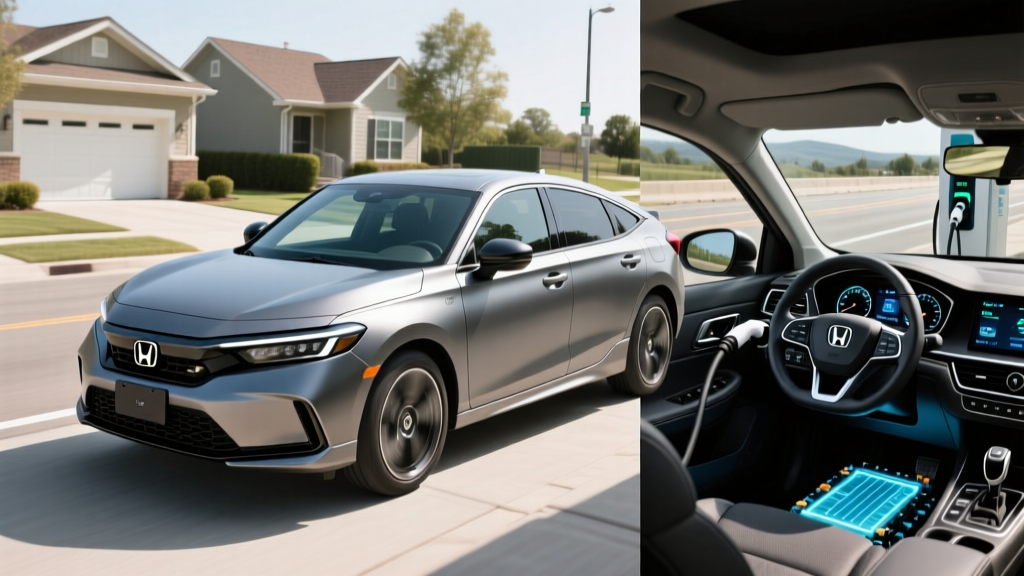
The 2025 Honda Civic Hatchback Hybrid lands at the intersection of practicality and efficiency that few compact cars can match. With EPA ratings reaching 50 MPG combined and a starting price near $30,000, it's a serious contender for buyers who want electrified efficiency without the range anxiety or charging logistics of a full battery-electric vehicle. But how do those EPA numbers hold up in real-world driving, and where does this hybrid fit in a market increasingly crowded with PHEVs and EVs?
We've analyzed the powertrain data, cross-referenced EPA figures with owner-reported fuel economy, and broken down the total ownership picture to help you decide if the Civic Hatchback Hybrid is the right electrified choice for your garage.
HEV vs PHEV: What the Civic Hatchback Hybrid Actually Is
First, a critical distinction. The 2025 Honda Civic Hatchback Hybrid is a conventional hybrid electric vehicle (HEV), not a plug-in hybrid (PHEV). This means:
| Feature | HEV (Civic Hatchback Hybrid) | PHEV (e.g., Toyota Prius Prime) |
|---|---|---|
| Plug-in charging required? | No — self-charging via regenerative braking and engine | Yes — plug in for electric-only miles |
| Electric-only range | None (motor assists engine; EV mode at very low speeds only) | Typically 25–44 miles |
| Battery size | ~1.0 kWh (small, assists engine) | 10–18 kWh (larger, enables EV driving) |
| Federal tax credit (§30D) | Not eligible | Up to $7,500 if eligible |
| Best for | Drivers without home charging access who want better MPG | Drivers with home charging who want short commutes on electricity |
The Civic Hatchback Hybrid uses a small lithium-ion battery pack paired with Honda's two-motor hybrid system. You never plug it in. The battery charges through regenerative braking and the gasoline engine. If you need plug-in capability with 30+ miles of electric-only range, you'll want to look at PHEVs like the Toyota Prius Prime or a full BEV.
Fuel Economy: EPA Ratings vs Real-World MPG
The headline number is strong. Here's the full EPA breakdown for the 2025 Civic Hatchback Hybrid by trim, sourced from fueleconomy.gov:
| Trim | City MPG | Highway MPG | Combined MPG | Annual Fuel Cost* |
|---|---|---|---|---|
| Sport Hybrid | 50 | 45 | 48 | $1,250 |
| Sport Touring Hybrid | 50 | 45 | 48 | $1,250 |
*Based on 15,000 miles/year at $3.50/gallon regular unleaded. Your costs will vary with local fuel prices and driving patterns.
Real-World MPG: What Owners Actually Report
EPA numbers are a baseline, not a guarantee. Honda's two-motor hybrid system excels in stop-and-go city driving, where the electric motor handles low-speed propulsion and the engine acts primarily as a generator. This is why the city rating (50 MPG) exceeds the highway rating (45 MPG) — the opposite of most gas-only cars.
In real-world conditions:
- City/commute driving: Many owners report matching or slightly exceeding the 50 MPG city figure, especially in moderate climates. The hybrid system recaptures significant energy through regen braking.
- Sustained highway driving (70–80 mph): Expect 40–44 MPG. At higher speeds, aerodynamic drag dominates and the engine drives the wheels directly, reducing the hybrid system's advantage.
- Cold weather (below 35°F): Plan for a 5–10% fuel economy drop. The engine runs more frequently to provide cabin heat and maintain battery temperature, reducing time spent in EV-assist mode.
- Combined real-world average: Owner-reported data on Fuelly and similar platforms clusters around 44–48 MPG combined, which is consistent with the EPA estimate and notably strong for the segment.
Annual fuel savings vs. gas-only Civic: The non-hybrid 2025 Civic Hatchback (2.0L, CVT) rates at 33 MPG combined. At 15,000 miles/year and $3.50/gallon, the hybrid saves approximately $630 per year in fuel costs — roughly $3,150 over five years.
Powertrain: How Honda's Two-Motor Hybrid System Works
| Specification | 2025 Civic Hatchback Hybrid |
|---|---|
| Engine | 2.0L Atkinson-cycle 4-cylinder |
| Hybrid System | Two-motor (drive motor + generator motor) |
| Combined System Output | 200 hp / 232 lb-ft torque |
| Transmission | e-CVT (no traditional gears; direct drive clutch at highway speed) |
| Drivetrain | Front-wheel drive |
| 0–60 mph | ~7.3 seconds (est.) |
| Battery Type | Lithium-ion (~1.0 kWh) |
| Fuel Tank | 10.6 gallons |
| Total Range | ~509 miles (at 48 MPG combined) |
| Fuel Type | Regular unleaded (87 octane) |
Honda's e:HEV system is one of the more sophisticated hybrid setups in the compact segment. Unlike Toyota's planetary-gear power-split device, Honda uses a series-dominant architecture: the 2.0L engine primarily drives a generator motor that produces electricity, which then powers the drive motor connected to the wheels. At steady highway speeds (roughly 55+ mph), a lock-up clutch connects the engine directly to the wheels for efficiency.
The result is 200 combined horsepower and an impressive 232 lb-ft of torque available from the drive motor — giving the Civic Hatchback Hybrid notably stronger acceleration feel than its gas-only sibling (158 hp). The electric motor's instant torque delivery makes it responsive in city driving and confident for highway merging.
Pricing, Trims, and Tax Credit Eligibility
The 2025 Civic Hatchback Hybrid is available in two trims:
| Trim | MSRP (incl. destination) | Key Features |
|---|---|---|
| Sport Hybrid | $29,845 | 18" alloy wheels, 7" touchscreen, wireless Apple CarPlay/Android Auto, Honda Sensing suite, heated front seats |
| Sport Touring Hybrid | $33,045 | 9" touchscreen, Bose 12-speaker audio, wireless charging, leather-trimmed seats, navigation, low-speed braking control |
Federal Tax Credit Status
Because the Civic Hatchback Hybrid is a conventional HEV (not a PHEV or BEV), it does not qualify for the federal §30D Clean Vehicle Credit. That credit — up to $7,500 — applies only to plug-in vehicles meeting battery sourcing, MSRP cap, and buyer income requirements per current IRS rules.
However, some states and local utilities offer rebates or incentives for hybrid purchases. These vary widely by jurisdiction and change frequently. Check your state energy office or utility provider for current programs. Honda also occasionally offers manufacturer incentives — check the Honda website or your local dealer for current lease and finance deals.
Reliability and Hybrid Battery Warranty
Hybrid battery longevity is consistently the top concern among first-time hybrid buyers. Here's what you need to know about the Civic Hatchback Hybrid:
Honda Hybrid Battery Warranty: 8 years / 100,000 miles (10 years / 150,000 miles in CARB states including California, New York, Massachusetts, and others that follow California emissions standards). This covers battery capacity loss below a defined threshold and defects.
Honda's hybrid system has proven durable across multiple model generations. The Insight, Accord Hybrid, and CR-V Hybrid have all used variants of this two-motor architecture with strong long-term reliability records. The lithium-ion battery pack in the Civic Hybrid is small (~1.0 kWh) and operates in a relatively narrow state-of-charge window, which reduces stress and degradation compared to the large packs in full EVs.
Battery Replacement Cost
Out-of-warranty hybrid battery replacement for the Civic Hatchback Hybrid is estimated at $2,000–$3,500 including parts and labor at a Honda dealership. However, failures before 150,000+ miles are uncommon based on historical data from Honda's hybrid lineup. The battery is not a single monolithic unit — individual modules can sometimes be serviced, reducing cost.
For broader vehicle reliability, the Civic nameplate consistently earns strong marks. The IIHS has awarded recent Civic models top safety ratings, and Honda Sensing (adaptive cruise, lane-keeping, collision mitigation) comes standard on every Hybrid trim.
Civic Hatchback Hybrid vs. PHEV vs. Full EV: Which Fits You?
Choose the Civic Hatchback Hybrid (HEV) if:
- You don't have access to home or workplace charging (apartment, street parking)
- You want better fuel economy with zero behavioral change — no plugging in, no route planning
- Your budget is under $35,000 and you want the lowest upfront cost among electrified options
- You regularly drive more than 400 miles between fill-ups and don't want to stop to charge
Choose a PHEV (e.g., Prius Prime, RAV4 Prime) if:
- You have reliable home Level 2 charging and a commute under 40 miles round-trip
- You want to drive most daily miles on electricity but need gas flexibility for road trips
- You qualify for the §30D federal tax credit (up to $7,500), which can make a PHEV price-competitive with an HEV
Choose a full EV (e.g., Chevy Equinox EV, Tesla Model 3) if:
- You have home charging and want to eliminate gas purchases entirely
- Your daily driving is under 250 miles and you're comfortable with public DC fast charging for road trips
- You want the lowest per-mile fuel cost (electricity is typically $0.04–$0.06/mile vs. $0.08–$0.12/mile for a 48 MPG hybrid)
- You want to maximize the §30D tax credit and reduce lifetime maintenance (no oil changes, fewer brake replacements due to regen)
Cargo, Practicality, and Daily Ownership
The hatchback body style is a key reason buyers choose this car over the Civic Sedan Hybrid. With 24.5 cubic feet of cargo space behind the rear seats (and more with seats folded), it competes with small crossovers for utility while delivering better fuel economy and a lower center of gravity.
Ownership practicalities worth noting:
- Maintenance: Honda recommends oil changes every 7,500–10,000 miles. The hybrid system adds no additional routine maintenance — there's no hybrid-specific fluid change or service interval.
- Insurance: Hybrid trims typically carry a modest insurance premium over gas-only models (roughly 3–7% higher), though this varies by insurer and driver profile.
- Brake wear: Regenerative braking reduces wear on the friction brakes. Many Honda hybrid owners report original brake pads lasting 70,000+ miles.
- Resale value: Honda Civics historically hold value well, and hybrid trims are likely to remain in demand as fuel prices fluctuate.
Pros and Cons at a Glance
Pros
- 50/45/48 MPG (city/highway/combined) — among the best in the compact segment
- 200 hp and 232 lb-ft give strong real-world acceleration
- No plug-in required — zero lifestyle adjustment from a gas car
- Hatchback utility with 24.5 cu ft cargo volume
- Honda Sensing safety suite standard on all trims
- 8-year/100,000-mile hybrid battery warranty (10/150k in CARB states)
Cons
- No federal tax credit eligibility (HEV, not PHEV)
- Highway MPG drops to low 40s at 75+ mph
- No all-wheel-drive option (FWD only)
- Only two trims available — limited customization
- Cold-weather fuel economy drops 5–10%
- Sport Touring Hybrid pushes past $33,000 MSRP
Frequently Asked Questions
How many MPG does the 2025 Honda Civic Hatchback Hybrid get?
The EPA rates it at 50 MPG city, 45 MPG highway, and 48 MPG combined. Real-world owners typically report 44–48 MPG combined, with city driving sometimes exceeding the EPA figure and sustained highway driving at 75+ mph yielding low-to-mid 40s.
Does the Civic Hatchback Hybrid need to be plugged in?
No. It is a conventional hybrid (HEV), not a plug-in hybrid. The small lithium-ion battery charges through regenerative braking and the gasoline engine. You fuel it like any other car at a gas station.
How far can it go on electric only?
The Civic Hatchback Hybrid does not have a meaningful electric-only driving range. The electric motor assists the engine and can propel the car at very low speeds (parking lots, stop-and-go traffic) for brief distances, but it is not designed for sustained electric-only driving. If you need 25–40 miles of EV range, consider a PHEV.
Is the hybrid battery reliable and what does replacement cost?
Honda's hybrid battery is covered by an 8-year/100,000-mile warranty (10 years/150,000 miles in CARB states). Based on historical data from Honda's hybrid lineup, battery failures before 150,000 miles are uncommon. Out-of-warranty replacement is estimated at $2,000–$3,500.
Does the 2025 Civic Hatchback Hybrid qualify for any tax credit?
It does not qualify for the federal §30D Clean Vehicle Credit, which is limited to plug-in hybrids and battery-electric vehicles. Some state or utility incentives may apply — check your local programs. The IRS outlines current federal credit rules at irs.gov.
How does it compare to the Toyota Prius?
The Prius (57 MPG combined, FWD) is more fuel-efficient but offers less cargo space and a lower, more polarizing driving position. The Civic Hatchback Hybrid offers more power (200 hp vs. 196 hp for Prius AWD), a more conventional driving feel, and greater rear-seat and cargo versatility. Both are excellent — the choice comes down to whether you prioritize maximum MPG (Prius) or a more engaging, practical hatchback (Civic).
Is there an AWD option?
No. The 2025 Civic Hatchback Hybrid is front-wheel drive only. If all-wheel drive is a priority, the Toyota Prius AWD (54 MPG combined) or a hybrid crossover like the CR-V Hybrid AWD are alternatives.