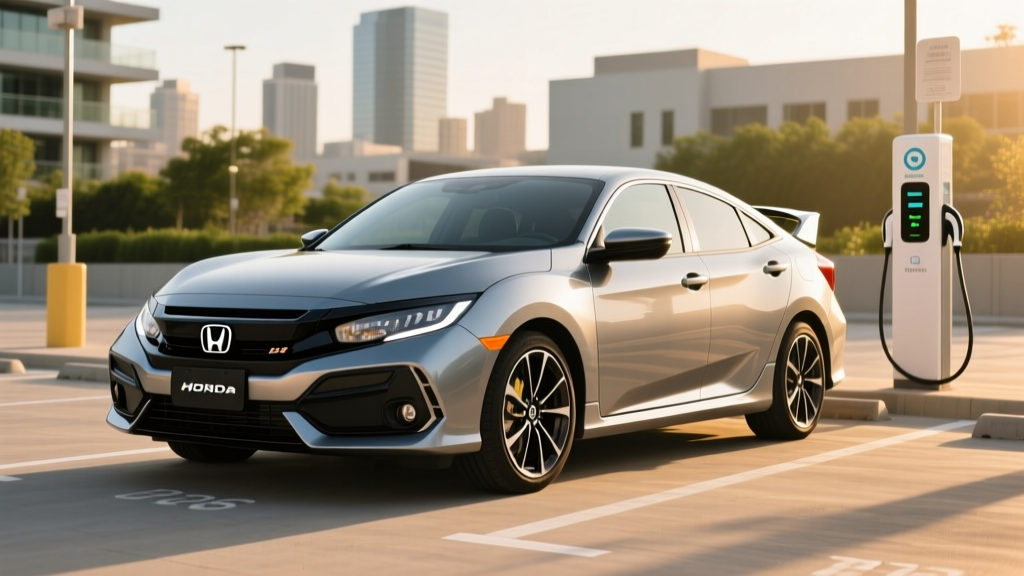
The 2026 Honda Civic Hybrid occupies a narrow but compelling lane: it's a conventional hybrid (HEV) that squeezes nearly 50 MPG combined from a compact sedan without requiring a plug, a charger installation, or a lifestyle change. For buyers weighing the Civic Hybrid against plug-in hybrids like the Toyota Prius Prime or full EVs like the Chevrolet Equinox EV, the decision hinges on daily mileage, charging access, and how much upfront cost you're willing to absorb for lower running expenses.
This guide breaks down the 2026 Civic Hybrid's EPA fuel economy, real-world efficiency, powertrain specs, pricing, battery longevity, and where it fits in the broader electrified-vehicle landscape.
HEV vs PHEV: Where the Civic Hybrid Fits
Before examining specs, it's essential to distinguish the two hybrid architectures buyers commonly confuse:
Conventional Hybrid (HEV) — 2026 Civic Hybrid
- No plug required. The battery recharges via regenerative braking and the gasoline engine.
- Small battery (~1.1 kWh usable). The electric motor assists the engine but cannot drive the car alone for meaningful distances.
- No electric-only range. The motor provides torque fill and low-speed assist, but the engine is always available.
- No federal tax credit. HEVs do not qualify under IRS §30D.
Plug-in Hybrid (PHEV) — e.g., Toyota Prius Prime
- Requires plugging in to access electric-only driving (typically 25–45 miles).
- Larger battery (13–18 kWh). Can DC fast charge on some models.
- Electric-only range covers most daily commutes before the gas engine engages.
- May qualify for partial or full §30D tax credit depending on battery sourcing and MSRP caps.
The 2026 Civic Hybrid is strictly an HEV. If you need electric-only commuting, look at a PHEV or BEV instead. If you want maximum fuel savings with zero behavioral change, the Civic Hybrid's approach is the right fit.
2026 Civic Hybrid Fuel Economy: EPA and Real-World MPG
Honda rates the 2026 Civic Hybrid sedan at 50 MPG city / 47 MPG highway / 49 MPG combined in Sport Touring Hybrid trim, per fueleconomy.gov. The Sport Hybrid trim shares the same powertrain and carries identical EPA estimates.
| Trim | City MPG | Highway MPG | Combined MPG | Fuel Tank (gal) | Total Range (mi) |
|---|---|---|---|---|---|
| Sport Hybrid | 50 | 47 | 49 | 10.6 | ~519 |
| Sport Touring Hybrid | 50 | 47 | 49 | 10.6 | ~519 |
Real-World MPG vs. EPA Sticker
Conventional hybrids often exceed their EPA city rating in stop-and-go traffic because regenerative braking recovers energy that a gas-only car wastes as heat. In mixed suburban driving, owners consistently report 48–53 MPG. On sustained highway trips at 75+ mph, expect the figure to drop to roughly 43–46 MPG as aerodynamic drag dominates and the engine carries more of the load without regen assist.
Cold weather reduces hybrid efficiency by 5–10% due to increased engine idling for cabin heat and reduced battery efficiency at low temperatures. Winter MPG of 42–46 combined is typical in northern climates.
Powertrain and Performance Specs
The 2026 Civic Hybrid uses Honda's two-motor hybrid system paired with a 2.0-liter Atkinson-cycle four-cylinder engine. This is the same architecture introduced for the 2025 model year, replacing the previous 1.5-liter turbo option in hybrid trims.
| Engine | 2.0L Atkinson-cycle DOHC 4-cylinder |
| Engine Output | 143 hp / 134 lb-ft torque |
| Electric Motors | Two-motor hybrid system (drive + generator) |
| Combined System Output | 200 hp / 232 lb-ft torque |
| Transmission | e-CVT (no traditional gears) |
| Drivetrain | Front-wheel drive |
| 0–60 mph | ~6.7 seconds (est.) |
| Hybrid Battery | Lithium-ion, ~1.1 kWh usable |
| Curb Weight | ~3,150 lbs |
The 200-hp combined output makes the Civic Hybrid noticeably quicker than the non-hybrid 2.0L Civic (158 hp) and competitive with the 1.5T turbo trims. The electric motor's instant torque delivery gives strong off-the-line response, and the e-CVT avoids the rubber-band effect common in older Toyota hybrid systems. Honda's system can also run in EV mode for very short, low-speed stretches (under 1 mile, typically in parking lots), but this is not a meaningful electric-only range.
Pricing, Trims, and Tax Credit Eligibility
The 2026 Civic Hybrid is offered in two trims. Pricing below includes Honda's destination charge:
| Trim | MSRP (incl. destination) | Key Features |
|---|---|---|
| Sport Hybrid | $28,950 | 16" alloy wheels, 7" touchscreen, wireless CarPlay/Android Auto, Honda Sensing suite |
| Sport Touring Hybrid | $31,450 | 18" wheels, Bose 12-speaker audio, 9" touchscreen, wireless charging, leather-trimmed seats, heated front seats |
Federal Tax Credit: Not Eligible
Because the Civic Hybrid is a conventional HEV — not a plug-in hybrid or battery-electric vehicle — it does not qualify for the IRS §30D Clean Vehicle Credit. The §30D credit applies exclusively to PHEVs with at least 7 kWh of battery capacity and BEVs, subject to MSRP caps ($55,000 for sedans), buyer income limits, and battery critical-mineral sourcing requirements. Check irs.gov for current-year eligibility rules if you're considering a PHEV alternative.
Some states offer rebates or HOV-lane access for hybrids, but these vary widely by jurisdiction. Check your state's energy or DMV website for current programs.
Battery Warranty, Lifespan, and Replacement Cost
2026 Civic Hybrid — Hybrid Battery Warranty
Coverage: 8 years / 100,000 miles (10 years / 150,000 miles in CARB states including CA, NY, MA, and others)
What's covered: Hybrid battery pack defects and capacity loss below a functional threshold
Expected lifespan: 150,000–200,000+ miles based on Honda's historical hybrid battery data (Insight, Accord Hybrid, CR-V Hybrid)
How Long Will the Battery Last?
Honda's hybrid battery packs have proven durable in real-world use. The lithium-ion pack in the Civic Hybrid is small (~1.1 kWh usable), which means each cell undergoes shallow charge/discharge cycles rather than the deep cycles that stress EV batteries. Shallow cycling significantly extends calendar and cycle life.
Based on data from Honda's earlier hybrid models and industry-wide lithium-ion degradation curves, most Civic Hybrid battery packs should outlast 150,000 miles with minimal capacity loss. Failure before 100,000 miles is uncommon and would be covered under warranty.
Battery Replacement Cost
If replacement is needed out of warranty (typically at 12–15+ years of age), expect to pay $2,000–$3,500 for a new OEM hybrid battery pack including labor. Refurbished or aftermarket packs are available for $1,200–$2,000. This is substantially less than EV traction battery replacement ($8,000–$20,000+) because the Civic Hybrid's pack is small and relatively simple.
Is the Civic Hybrid Reliable?
Honda's two-motor hybrid system has been in production since 2014 (Accord Hybrid) and has undergone multiple generations of refinement. The e-CVT design eliminates traditional transmission components — no clutch packs, torque converters, or gear sets to wear out. The 2.0L Atkinson-cycle engine runs lower stress than a turbocharged equivalent, which historically translates to longer engine life.
The Civic nameplate carries strong long-term reliability data, and the hybrid variant adds proven drivetrain components rather than experimental technology. Routine maintenance is minimal: oil changes at 7,500–10,000-mile intervals, tire rotations, and brake fluid service. Regenerative braking reduces pad and rotor wear, often extending brake service intervals beyond 60,000 miles.
Civic Hybrid vs. PHEV vs. Full EV: Which Fits You?
Choose the Civic Hybrid (HEV) if:
- You lack access to home or workplace charging
- You want 49 MPG without any plug-in routine
- Your budget tops out around $32,000
- You drive 10,000–15,000 miles/year and want low fuel cost without EV range planning
- You take frequent long road trips and don't want to plan around DC fast chargers
Choose a PHEV (e.g., Prius Prime) if:
- You can charge at home nightly (Level 1 or 2)
- Your daily commute is under 40 miles round-trip
- You want electric-only daily driving with gas backup for road trips
- You may qualify for partial §30D credit
Choose a Full EV (e.g., Equinox EV, Model 3) if:
- You have reliable home Level 2 charging
- You want the lowest per-mile fuel cost (~$0.04–0.06/mi on home electricity vs. ~$0.08–0.10/mi in the Civic Hybrid)
- You qualify for the full $7,500 §30D credit
- You want zero tailpipe emissions and minimal maintenance (no oil changes)
5-Year Fuel Cost Comparison
At 15,000 miles/year and $3.50/gallon regular unleaded, the Civic Hybrid at 49 MPG combined costs approximately $1,071/year in fuel. A comparable gas-only Civic (33 MPG combined) costs about $1,591/year. That's a $520 annual savings, or roughly $2,600 over five years — enough to offset the Hybrid's modest price premium over non-hybrid Civic trims.
A full EV charging at $0.13/kWh and averaging 3.5 miles/kWh would cost roughly $557/year — about $514 less than the Civic Hybrid annually. But the EV requires home charging infrastructure ($500–$2,000 for Level 2 installation) and a higher purchase price before incentives.
Driving Impressions and Daily Livability
The 2026 Civic Hybrid drives like a conventional Civic with extra low-end punch. The electric motor fills the torque gap below 2,000 RPM where the Atkinson-cycle engine is weakest, resulting in confident merges and passing. The transition between EV assist, engine-only, and combined modes is seamless — most drivers won't notice the powertrain handoffs without watching the energy-flow display.
Ride quality matches the non-hybrid Civic: composed over bumps, communicative steering, and a cabin that's quiet at cruising speeds. The Sport Touring Hybrid's 18-inch wheels trade a small amount of ride comfort for sharper handling. Cargo space is unchanged from the gas Civic sedan at 14.8 cubic feet — the hybrid battery is packaged under the rear seats without compromising trunk volume or rear legroom.
Honda Sensing (adaptive cruise control, lane-keeping assist, automatic emergency braking, traffic sign recognition) is standard on all trims. This is an SAE Level 2 driver-assistance system, meaning you must keep your hands on the wheel and eyes on the road at all times.
Frequently Asked Questions
How many MPG does the 2026 Honda Civic Hybrid get?
The EPA rates the 2026 Civic Hybrid at 50 MPG city, 47 MPG highway, and 49 MPG combined. Real-world mixed driving typically yields 48–53 MPG, with highway-only trips returning 43–46 MPG at speeds above 75 mph.
Does the Civic Hybrid need to be plugged in?
No. The 2026 Civic Hybrid is a conventional hybrid (HEV). Its small lithium-ion battery recharges through regenerative braking and the gasoline engine. There is no plug, no charging cable, and no electric-only range to manage.
How far can the Civic Hybrid drive on electric power alone?
Effectively zero miles in practical terms. The electric motor can propel the car at very low speeds (under ~20 mph) for short distances in parking lots or heavy traffic, but the engine engages almost immediately under normal acceleration. This is not a plug-in hybrid with usable electric-only range.
Is the hybrid battery reliable, and what does replacement cost?
Honda covers the hybrid battery for 8 years/100,000 miles (10 years/150,000 miles in CARB states). Real-world data from Honda's hybrid lineup suggests these batteries routinely last 150,000–200,000+ miles. Out-of-warranty replacement costs $2,000–$3,500 for an OEM pack.
Does the 2026 Civic Hybrid qualify for a federal tax credit?
No. Federal §30D clean vehicle credits apply only to plug-in hybrids (PHEVs) and battery-electric vehicles (BEVs). The Civic Hybrid is a conventional HEV and is not eligible. Some states may offer separate hybrid incentives — check your state energy office for current programs.
How does the Civic Hybrid compare to the Toyota Prius?
The 2026 Prius (conventional hybrid) is rated at 57 MPG combined — 8 MPG more than the Civic Hybrid. However, the Civic Hybrid offers 200 hp vs. the Prius's 194 hp, a more engaging driving experience, and a sedan trunk vs. the Prius hatchback. If maximum MPG is your sole priority, the Prius wins. If driving dynamics and cabin refinement matter, the Civic Hybrid is the stronger choice.
Should I buy the Civic Hybrid or a full EV?
If you can install a Level 2 home charger and qualify for the $7,500 federal credit, a full EV like the Chevrolet Equinox EV or Tesla Model 3 offers lower per-mile fuel costs and less maintenance. If you live in an apartment without charging access, drive long distances frequently, or prefer a lower purchase price, the Civic Hybrid delivers strong efficiency with zero infrastructure requirements.