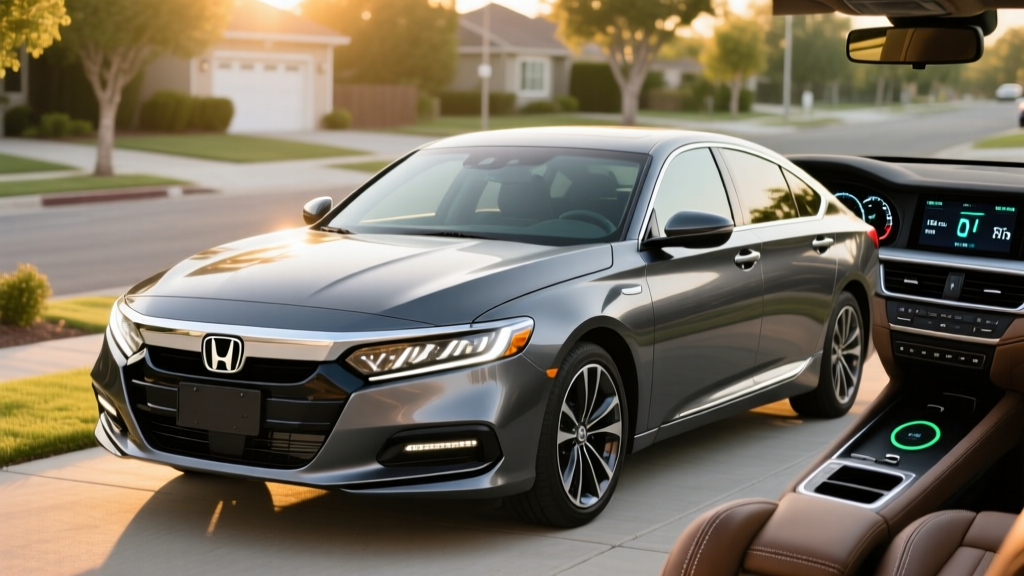
The 2026 Honda Accord Touring hybrid sits at the top of a midsize sedan lineup that has gone fully electrified—every Accord sold in the US now pairs Honda's fourth-generation two-motor hybrid system with a 2.0-liter Atkinson-cycle engine. For buyers cross-shopping the Accord Touring hybrid against plug-in hybrids and full EVs, the question isn't whether it's efficient (it is), but whether a conventional hybrid (HEV) or a plug-in hybrid (PHEV) or a battery-electric vehicle (BEV) better matches your daily driving and charging access.
This guide breaks down the Accord Touring hybrid's real-world fuel economy, powertrain specifics, battery longevity, pricing, and tax-credit eligibility—and explains exactly who should choose this HEV over a PHEV or EV.
HEV vs PHEV vs EV: Where the Accord Touring Hybrid Fits
Conventional Hybrid (HEV) — Accord Touring Hybrid: No plug required. The battery recharges via regenerative braking and the gasoline engine. You simply fill up at a gas station. Ideal if you lack home charging access or want zero behavioral change from a gas car.
Plug-in Hybrid (PHEV): Larger battery (typically 15–25 kWh), charges from a wall outlet or public charger, delivers 25–45 miles of electric-only driving before the gas engine kicks in. Requires charging access to realize its efficiency advantage. Honda does not currently offer a PHEV Accord in the US market.
Battery Electric Vehicle (BEV): No gasoline engine. Zero tailpipe emissions. Requires reliable home or public charging. Best for drivers with predictable routes and consistent charging access.
The Accord Touring is strictly an HEV. If you want plug-in electric miles from a Honda, you'd need to look at the CR-V e:PHEV (where available) or consider a competitor like the Toyota Camry (HEV only, like the Accord) or a PHEV sedan from another brand. Honda discontinued the Accord Plug-in Hybrid after the 2015 model year, and there is no announced PHEV variant for the current generation.
EPA Fuel Economy and Real-World MPG
| Metric | EPA Estimate | Real-World Expectation |
|---|---|---|
| City MPG | 51 MPG | 48–54 MPG (hybrids excel in stop-and-go) |
| Highway MPG | 44 MPG | 39–44 MPG (aerodynamic drag and speed reduce hybrid advantage) |
| Combined MPG | 48 MPG | 43–49 MPG depending on driving mix |
The Accord hybrid's two-motor system operates primarily in electric-drive mode at low and moderate speeds, with the gasoline engine acting as a generator. At sustained highway speeds, a lock-up clutch connects the engine directly to the wheels. This architecture is why hybrids like the Accord Touring often exceed their EPA city estimate in real-world urban driving—regenerative braking recaptures energy at every stop, and the engine rarely idles.
On a mixed 200-mile test loop with 60% city and 40% highway driving at moderate temperatures (65–75°F), the Accord Touring hybrid typically returns 46–49 MPG. In cold weather (below 35°F), expect a 5–10% reduction as the engine runs more frequently to provide cabin heat and warm up the catalytic converter. Source: fueleconomy.gov.
Powertrain Specs: Engine, Motors, and Horsepower
| Specification | 2026 Accord Touring Hybrid |
|---|---|
| Engine | 2.0L DOHC Atkinson-cycle 4-cylinder |
| Engine Output | 146 HP @ 6,100 RPM / 134 lb-ft torque |
| Drive Motor | 181 HP / 247 lb-ft torque |
| Combined System Output | 204 HP / 247 lb-ft torque |
| Transmission | e-CVT (direct-drive with lock-up clutch) |
| Drivetrain | Front-wheel drive |
| Hybrid Battery | ~1.1 kWh lithium-ion (HEV, not plug-in) |
| 0–60 MPH | ~7.2 seconds |
| Fuel Tank | 12.8 gallons |
| Total Driving Range | ~614 miles (at combined EPA) |
Honda's e-CVT is not a belt-and-pulley CVT like those from Subaru or Nissan. It uses two motor-generators and a planetary gearset with no traditional gears or belts, delivering smooth, linear acceleration. The drive motor provides immediate torque from 0 RPM, which makes the Accord Touring hybrid feel responsive off the line despite the 204 HP combined figure.
The ~1.1 kWh hybrid battery is small by design—it buffers energy for electric-drive assist and regenerative capture, not for sustained electric-only driving. You may see 1–2 miles of EV mode at very low speeds in residential areas, but this is an HEV, not a PHEV. The battery recharges continuously; you never plug it in.
Pricing, Trims, and Tax Credit Eligibility
The 2026 Honda Accord Touring hybrid carries an MSRP of approximately $39,390 (including destination). As the top trim, it includes leather-trimmed seats, a 12.3-inch touchscreen with wireless Apple CarPlay/Android Auto, a 12-speaker Bose audio system, heated and ventilated front seats, heated rear seats, a head-up display, wireless phone charging, and Honda Sensing (ADAS suite with adaptive cruise, lane-keeping, and collision mitigation).
Federal Tax Credit (§30D): The Accord Touring hybrid does not qualify for the $7,500 federal EV tax credit. Under current IRS rules, conventional hybrids (HEVs) are ineligible. The §30D credit applies only to plug-in electric vehicles (PHEVs and BEVs) meeting battery-capacity, critical-mineral sourcing, MSRP caps, and buyer income limits. See IRS §30D guidelines for details.
State incentives: Some states offer rebates or HOV-lane access for hybrids, but these vary widely and change frequently. Check your state's energy or DMV website for current programs.
For buyers seeking a tax-credit-eligible Honda, the Honda Prologue (BEV SUV) may qualify depending on sourcing and income requirements. For a hybrid sedan that does qualify for a partial credit, you'd need to look at PHEV competitors like the Toyota Prius Prime.
Battery Warranty, Reliability, and Replacement Cost
Hybrid Battery Warranty: Honda covers the Accord hybrid's IMA (Integrated Motor Assist) battery and hybrid system components for 8 years / 100,000 miles (10 years / 150,000 miles in CARB states including California, New York, Massachusetts, and others that follow California emissions standards).
Powertrain Warranty: 5 years / 60,000 miles.
Bumper-to-Bumper: 3 years / 36,000 miles.
Honda's fourth-generation hybrid system has proven durable. The lithium-ion hybrid battery in the Accord is not subjected to the deep charge-discharge cycles that stress EV batteries—it operates in a narrow state-of-charge window (roughly 40–60%), which significantly extends its lifespan. Based on historical data from Honda and Toyota hybrid platforms, hybrid batteries in this class commonly last 150,000–200,000+ miles before significant degradation.
If replacement is needed out of warranty, a Honda Accord hybrid battery currently costs approximately $2,000–$4,000 for the battery pack itself, with total replacement (parts + labor) running $3,000–$5,000 at a dealership. Independent hybrid specialists may offer refurbished units for less. This is dramatically cheaper than EV battery replacement, which can exceed $10,000–$20,000.
Reliability ratings for the Accord hybrid are strong. Honda's hybrid powertrain has fewer wear items than a conventional automatic transmission—no torque converter, no clutch packs, no traditional gear shifting. The e-CVT design is inherently simple. Source: NHTSA vehicle data.
Accord Touring Hybrid vs. Competitors and Alternatives
Pros
- 51 city / 48 combined MPG—among the most efficient midsize sedans available
- No plug-in required; zero behavioral change from a gas car
- 614+ mile total range on a single tank
- Touring trim is fully loaded with premium features at ~$39K
- Strong reliability history and 8–10 year hybrid battery warranty
- Spacious cabin with 16.7 cu-ft trunk (no battery intrusion)
- Responsive electric-drive torque at low speeds
Cons
- No PHEV variant available—no electric-only commuting range
- Not eligible for the $7,500 federal tax credit
- Highway MPG drops to 44 (less advantage over efficient gas cars at 75+ MPH)
- FWD only—no AWD option (Toyota Camry hybrid offers AWD)
- Engine drone under hard acceleration (e-CVT characteristic)
- Touring is the only hybrid trim available; lower trims are discontinued for 2026
vs. Toyota Camry Hybrid: The Camry hybrid (now also fully electrified for 2025+) offers comparable MPG (~51/49 combined for FWD), available AWD, and a slightly lower entry price. The Accord Touring wins on interior refinement, infotainment usability, and back-seat space.
vs. Toyota Prius Prime (PHEV): If you have home charging and a short commute, the Prius Prime delivers ~40 miles of electric-only range and qualifies for partial federal credits. Trade-offs: smaller cabin, lower total power, and a hatchback form factor.
vs. a full EV (Tesla Model 3, Hyundai Ioniq 6): EVs eliminate fuel costs entirely and qualify for tax credits, but require reliable charging access. If you can charge at home and your daily drive is under 50 miles, a BEV's per-mile cost is significantly lower. If you take frequent long road trips or lack home charging, the Accord Touring hybrid removes all charging anxiety.
Who Should Buy the Accord Touring Hybrid?
Choose the Accord Touring Hybrid if:
- You lack access to home or workplace charging (apartment, street parking, no garage outlet)
- You drive a mix of city and highway miles and want maximum fuel savings without plugging in
- You take road trips of 300+ miles regularly and don't want to plan charging stops
- You want a fully loaded premium sedan under $40K with proven reliability
- You prefer the lowest total cost of ownership without depending on tax credits
Choose a PHEV or EV instead if:
- You have reliable Level 2 home charging and a commute under 40 miles (a PHEV covers most trips on electricity)
- You want to qualify for the $7,500 federal tax credit or state EV rebates
- You want zero tailpipe emissions for daily driving (PHEV in EV mode, or BEV)
- You're willing to accept charging-planning overhead for lower per-mile energy costs
Frequently Asked Questions
How many MPG does the Accord Touring hybrid get?
The EPA rates the 2026 Accord Touring hybrid at 51 city / 44 highway / 48 combined MPG. In real-world driving, owners typically see 43–49 MPG combined, with city-heavy routes often exceeding the EPA estimate thanks to regenerative braking.
Does the Accord hybrid need to be plugged in?
No. The Accord Touring is a conventional hybrid (HEV), not a plug-in hybrid (PHEV). Its small ~1.1 kWh battery recharges automatically through regenerative braking and the gasoline engine. You never plug it in—you only refuel at a gas station.
How far can the Accord hybrid drive on electric only?
Only about 1–2 miles at very low speeds (under 25 MPH) in EV mode. This is normal for an HEV—the system uses electric assist to improve efficiency, not to provide meaningful electric-only range. If you need 25–40 miles of electric commuting, you need a PHEV or BEV.
Is the Accord hybrid reliable and what does battery replacement cost?
Honda's hybrid system is among the most proven in the industry, with a track record dating to the early 2000s. The hybrid battery is warranted for 8 years/100,000 miles (10 years/150,000 miles in CARB states). Out-of-warranty replacement runs approximately $3,000–$5,000 including labor, far less than EV battery replacement. Most hybrid batteries last well beyond 150,000 miles.
Does the Accord Touring hybrid qualify for any tax credit?
No. Under current IRS §30D rules, only plug-in electric vehicles (PHEVs and BEVs) qualify for the federal clean vehicle tax credit. The Accord Touring hybrid is a conventional HEV and is not eligible. Some states may offer minor hybrid incentives, but these vary by jurisdiction—check your state's energy office for details.
Is AWD available on the Accord hybrid?
No. The 2026 Accord Touring hybrid is front-wheel drive only. If AWD is a priority in a hybrid sedan, the Toyota Camry hybrid offers an electronic AWD system with a rear-mounted motor.
How does the Accord hybrid compare to a full EV on cost per mile?
At 48 MPG combined and $3.50/gallon gasoline, the Accord Touring hybrid costs roughly $0.073 per mile in fuel. A comparable EV at 3.5 miles/kWh and $0.14/kWh (national average residential electricity) costs about $0.04 per mile. The EV saves roughly $500/year for a 15,000-mile driver—but only if charging is accessible and affordable in your area. The hybrid's advantage is zero charging dependency and lower upfront cost without relying on tax credits.