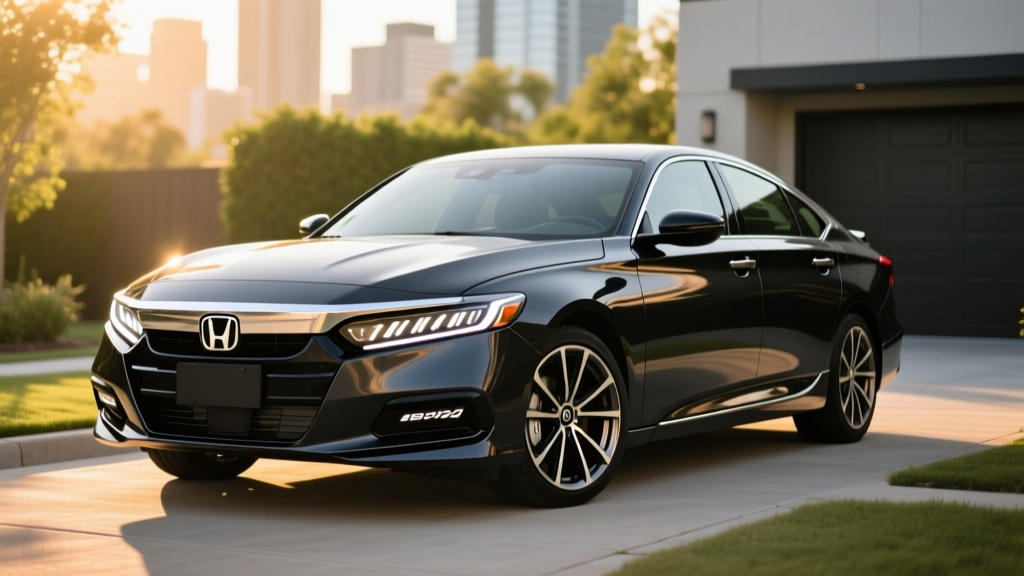
The Honda Accord has been a midsize sedan benchmark for decades, and the hybrid powertrain is now the only one Honda offers in the United States. If you're researching the Accord Sport Hybrid, you're likely weighing its fuel-economy claims against real-world efficiency, long-term battery reliability, and whether a conventional hybrid (HEV) is the right bridge between a gas car and a full battery-electric vehicle (BEV). This guide breaks down the 2026 Accord Sport Hybrid with exact numbers, ownership economics, and the decision framework you need.
What the Accord Sport Hybrid Actually Is: HEV, Not PHEV
A common point of confusion in the Accord lineup is whether it's a plug-in hybrid. It is not. The 2026 Honda Accord Hybrid is a conventional hybrid electric vehicle (HEV) — sometimes called a "self-charging" hybrid, though that term is marketing shorthand. The battery recharges through regenerative braking and the gasoline engine; there is no plug, no charging port, and no electric-only driving range to manage.
HEV vs. PHEV: Quick Distinction
| Feature | HEV (Accord Hybrid) | PHEV (e.g., Toyota Prius Prime) |
|---|---|---|
| Plug-in charging | No — gas only | Yes — Level 1/Level 2 |
| Electric-only range | ~1 mile at low speed | 25–45 miles typical |
| Battery size | ~1.3 kWh (buffer) | 13–18 kWh usable |
| Federal tax credit (§30D) | Not eligible | Up to $7,500 if eligible |
| Home charging needed | No | Recommended for full benefit |
This distinction matters for your purchase decision. If you want electric-only commuting and access to the federal tax credit, you need a PHEV or a BEV. If you want maximum simplicity — fill up with gas, never think about charging, and still get excellent fuel economy — the Accord Sport Hybrid is purpose-built for that use case.
Powertrain Specs: Two-Motor Hybrid System
The Accord Hybrid uses Honda's fourth-generation two-motor hybrid system, which pairs a 2.0-liter Atkinson-cycle four-cylinder engine with two electric motors and an e-CVT (electronically controlled continuously variable transmission). There is no traditional geared transmission and no turbocharger.
| Specification | Value |
|---|---|
| Engine | 2.0L Atkinson-cycle I-4 |
| Combined system output | 204 hp / 247 lb-ft torque |
| Drive motor | 181 hp / 247 lb-ft |
| Generator motor | Starts engine, generates electricity |
| Transmission | e-CVT (no fixed gears) |
| Drivetrain | Front-wheel drive |
| Hybrid battery | ~1.3 kWh lithium-ion (under rear seats) |
| 0–60 mph | ~7.2 seconds |
| Curb weight | ~3,477 lbs |
The two-motor system operates primarily in EV mode at low speeds (the drive motor propels the car), switches to hybrid mode at cruising speeds (engine generates electricity for the drive motor), and engages direct engine drive only at sustained highway speeds via a lock-up clutch. This is why the Accord Hybrid excels in city driving — the electric motor handles stop-and-go, where gasoline engines are least efficient.
Fuel Economy: EPA Ratings and Real-World MPG
The Accord Sport Hybrid carries the same EPA ratings as the rest of the Accord Hybrid lineup. The Sport trim rides on 19-inch wheels, which carry a slight efficiency penalty compared to the 17-inch wheels on the LX and EX-L Hybrid trims.
| Trim | City MPG | Highway MPG | Combined MPG |
|---|---|---|---|
| LX / EX-L Hybrid (17" wheels) | 51 | 44 | 48 |
| Sport / Sport-L Hybrid (19" wheels) | 46 | 41 | 44 |
| Touring Hybrid (19" wheels) | 46 | 41 | 44 |
Source: EPA Fuel Economy
Real-World MPG: What to Actually Expect
Honda's two-motor hybrid system tends to exceed EPA city estimates in moderate-temperature, stop-and-go driving — owners frequently report 48–53 MPG in urban conditions on the Sport trim. Highway efficiency is where you'll see the biggest variance: at 75+ mph on flat interstate, expect 38–42 MPG. In cold weather (below 35°F), the engine runs more often for cabin heat, dropping combined real-world economy to roughly 38–41 MPG. Over a full tank in mixed driving, 42–46 MPG combined is a realistic expectation for the Sport Hybrid.
Pricing and Tax Credit Eligibility
The 2026 Accord Sport Hybrid sits in the middle of the Accord lineup, offering sport-tuned suspension, 19-inch alloy wheels, and a leather-wrapped steering wheel at a price point below the Touring.
| 2026 Accord Hybrid Trim | MSRP (incl. destination) |
|---|---|
| LX Hybrid | ~$30,495 |
| EX-L Hybrid | ~$34,595 |
| Sport Hybrid | ~$33,695 |
| Sport-L Hybrid | ~$35,495 |
| Touring Hybrid | ~$39,995 |
Federal Tax Credit: Not Eligible
The Accord Sport Hybrid is a conventional HEV and does not qualify for the IRS §30D Clean Vehicle Credit. That credit — up to $7,500 — applies only to plug-in electric vehicles (BEVs and PHEVs) that meet battery sourcing, critical mineral, MSRP cap, and buyer income requirements. See the IRS Clean Vehicle Credit page for current eligibility rules. Some states offer separate rebates for hybrids; check your state energy office or the AFDC state incentives database.
Battery Warranty, Reliability, and Replacement Cost
Hybrid battery longevity is consistently the top concern among first-time hybrid buyers. Honda's track record here is strong, and the warranty coverage reflects federal mandates.
Hybrid Battery Warranty
- Standard coverage: 8 years / 100,000 miles (federal minimum)
- CARB states: 10 years / 150,000 miles (CA, CT, CO, ME, MA, NJ, NY, OR, RI, VT, WA, and others adopting California emissions standards)
- What's covered: Battery capacity loss below a defined threshold, cell failure, and hybrid system components including the inverter and drive motor
Honda's hybrid battery packs are small (~1.3 kWh) compared to a PHEV or BEV, which means replacement costs are significantly lower. Based on current parts pricing and labor rates, a hybrid battery replacement out of warranty typically runs $2,000–$3,500 — far below the $8,000–$20,000+ you'd face for a BEV pack. Individual cell modules can sometimes be replaced for less at specialized hybrid repair shops.
Regarding overall reliability: the Accord Hybrid's powertrain has fewer wear components than a conventional gasoline car. There is no traditional automatic transmission (the e-CVT has no belts or clutch packs to wear), regenerative braking reduces pad and rotor wear significantly, and the engine operates under less stress because the electric motor handles low-speed load. Honda's hybrid system has been in production since 2014 across multiple models, and large-scale failure data from fleet and consumer use shows degradation rates well below 10% capacity loss over 150,000 miles.
Driving Experience and Tech
The Sport Hybrid trim adds a sport-tuned suspension with firmer damping, paddle-mounted regenerative braking selectors (four levels of regen deceleration), and a more aggressive exterior treatment. The driving feel is competent rather than thrilling — 204 hp in a 3,477-lb sedan delivers adequate acceleration for merging and passing, but this is an efficiency-first vehicle.
Standard tech on the Sport Hybrid includes:
- 10.2-inch digital instrument cluster with hybrid power flow display
- 7-inch touchscreen with wireless Apple CarPlay and Android Auto
- Honda Sensing suite: adaptive cruise control, lane-keeping assist, collision mitigation braking, road departure mitigation
- Wireless phone charger, heated front seats
The Honda Sensing system is an SAE Level 2 driver-assist system — it provides steering and speed support but requires the driver to remain fully engaged with hands on the wheel and eyes on the road at all times. It is not a self-driving system.
Accord Sport Hybrid vs. Alternatives: Decision Framework
Who Should Choose the Accord Sport Hybrid?
Choose the Accord Sport Hybrid if:
- You want 44+ MPG combined without any change to your fueling routine
- You don't have access to home or workplace charging (apartment, street parking)
- You regularly take long road trips and don't want to plan around charging stops
- You want a proven, low-risk powertrain with strong resale value
- You prefer a midsize sedan with a spacious rear seat and 16.7 cu-ft trunk
Consider a PHEV instead if:
- You can charge at home and want 25–45 miles of electric-only commuting
- Your daily round-trip commute is under 40 miles (a PHEV can eliminate most gas use)
- You want to qualify for the federal §30D tax credit (up to $7,500 on eligible PHEVs)
Consider a full BEV if:
- You can install a Level 2 home charger
- You want zero tailpipe emissions and minimal maintenance (no oil changes, fewer brake replacements)
- Your daily driving is under 250 miles and you're comfortable with public DC fast charging for road trips
- You want to maximize fuel cost savings ($500–$1,200/year vs. a 30 MPG gas car, depending on electricity rates)
Ownership Costs: 5-Year Estimate
| Category | Accord Sport Hybrid (44 MPG) | Comparable Gas Sedan (28 MPG) |
|---|---|---|
| Fuel (75,000 mi @ $3.40/gal avg) | $5,795 | $9,107 |
| Maintenance (oil, brakes, filters) | $2,100 | $2,800 |
| Insurance (avg) | $7,500 | $7,200 |
| Estimated depreciation | $12,000 | $13,500 |
| 5-year total (est.) | ~$27,395 | ~$32,607 |
The Accord Sport Hybrid saves an estimated $5,200 over five years compared to a typical 28 MPG gasoline midsize sedan, driven primarily by fuel savings and slightly lower maintenance (regenerative braking extends pad life by 30–50%). Insurance may run $50–$75/year higher due to the hybrid system's repair complexity, but this varies by carrier and state.
Pros
- 44 MPG combined EPA; real-world city driving often exceeds 48 MPG
- No plug required — zero behavior change from a gas car
- 204 hp with smooth electric low-end torque
- Strong reliability record; e-CVT has no traditional wear components
- Spacious cabin with 16.7 cu-ft trunk (no battery intrusion)
- Excellent Honda Sensing safety suite standard
Cons
- No federal tax credit (HEV not eligible under §30D)
- 19-inch wheels drop 4 MPG combined vs. LX Hybrid trim
- Engine drone under hard acceleration (e-CVT characteristic)
- No all-wheel-drive option
- Smaller touchscreen than competitors (7-inch vs. 12-inch+)
- Not eligible for HOV lane stickers in most states
Frequently Asked Questions
How many MPG does the Accord Sport Hybrid get?
The EPA rates the Accord Sport Hybrid at 46 city / 41 highway / 44 combined MPG. In real-world city driving, many owners consistently achieve 48–53 MPG thanks to the electric motor handling stop-and-go traffic. Highway driving at 75+ mph typically yields 38–42 MPG. Cold weather reduces efficiency by roughly 5–8 MPG combined due to increased engine operation for cabin heat.
Does the Accord Hybrid need to be plugged in?
No. The Accord Hybrid is a conventional HEV. Its small lithium-ion battery recharges exclusively through regenerative braking and the gasoline engine. There is no charging port, no plug, and no electric-only driving mode beyond very low-speed maneuvering (~1 mile at under 25 mph). You fuel it exactly like a regular gas car.
Is the Accord Hybrid reliable, and what does battery replacement cost?
Honda's hybrid system has been in production since 2014 and has a strong reliability record. The hybrid battery is warrantied for 8 years/100,000 miles (10 years/150,000 miles in CARB states). Out-of-warranty replacement typically costs $2,000–$3,500, significantly less than a PHEV or BEV battery. The e-CVT has no belts, clutch packs, or bands to wear, and regenerative braking extends brake pad life substantially.
Does the Accord Sport Hybrid qualify for any tax credit?
The federal §30D Clean Vehicle Credit does not apply to conventional hybrids — only to plug-in vehicles (BEVs and PHEVs) meeting battery sourcing, MSRP, and buyer income requirements. The Accord Sport Hybrid is not eligible. Some states and municipalities offer separate incentives for hybrids; check the Alternative Fuels Data Center for state-specific programs. A tax professional can confirm your eligibility for any local incentives.
Hybrid vs. PHEV vs. EV — which should I choose?
It depends on your charging access and driving pattern. If you can't charge at home and want zero behavior change, the Accord Hybrid (HEV) is ideal — 44 MPG, no plug, no range planning. If you can charge at home and commute under 40 miles daily, a PHEV like the Toyota Prius Prime lets you drive most days on electricity while keeping a gas engine for road trips. If you can install a Level 2 charger, your daily driving is under 250 miles, and you want maximum operating savings and zero tailpipe emissions, a full BEV like the Hyundai Ioniq 6 or Tesla Model 3 offers the lowest cost per mile.
How does the Sport trim affect fuel economy?
The Sport and Sport-L trims use 19-inch wheels and sport-tuned suspension, which reduces EPA combined fuel economy from 48 MPG (LX/EX-L with 17-inch wheels) to 44 MPG. That's a 4 MPG combined penalty, or roughly 50 fewer miles per 13.5-gallon tank. If maximum efficiency is your priority and you don't need the sport appearance, the LX Hybrid offers the best MPG in the lineup at a lower price.