Why the Accord Hybrid Still Matters in 2026
While battery-electric vehicles dominate headlines, the conventional hybrid sedan remains one of the most pragmatic purchases on the market. The 2026 Honda Accord Hybrid delivers up to 51 MPG combined without requiring a single plug, charger installation, or change in driving habits. For buyers who lack reliable home or workplace charging access, it bridges the gap between a gasoline car and a full EV — cutting fuel costs by roughly 40% compared to a typical midsize gas sedan.
This guide breaks down every 2026 Honda Accord Hybrid trim level with exact EPA figures, real-world fuel economy observations, powertrain specifications, and total cost of ownership data to help you choose the right configuration.
HEV vs PHEV vs EV: Where the Accord Hybrid Fits
Before diving into trim specifics, it's essential to clarify what the Accord Hybrid is — and what it isn't.
Conventional Hybrid (HEV) — What the Accord Hybrid Is
The Accord Hybrid is a self-charging hybrid. A small lithium-ion battery (roughly 1.1 kWh usable) captures energy from regenerative braking and the gasoline engine. You never plug it in. The electric motor assists the engine and can propel the car at low speeds, but sustained electric-only driving is limited to under a mile at parking-lot speeds.
Plug-In Hybrid (PHEV) — What the Accord Hybrid Is NOT
A PHEV like the Toyota RAV4 Prime or Chrysler Pacifica Hybrid carries a larger battery (15–20+ kWh) and offers 25–45 miles of electric-only range before the gas engine engages. Honda does not currently offer a plug-in Accord in the US market. If you want electric-only commuting with a gas backup, you'll need to look at PHEV alternatives or a full BEV.
Full Battery Electric (BEV)
A BEV like the Hyundai Ioniq 6 or Tesla Model 3 eliminates gasoline entirely, offering 300+ miles of EPA range. The trade-off: you need reliable charging access, and upfront cost is typically $5,000–$10,000 higher before incentives.
2026 Honda Accord Hybrid Trim Levels at a Glance
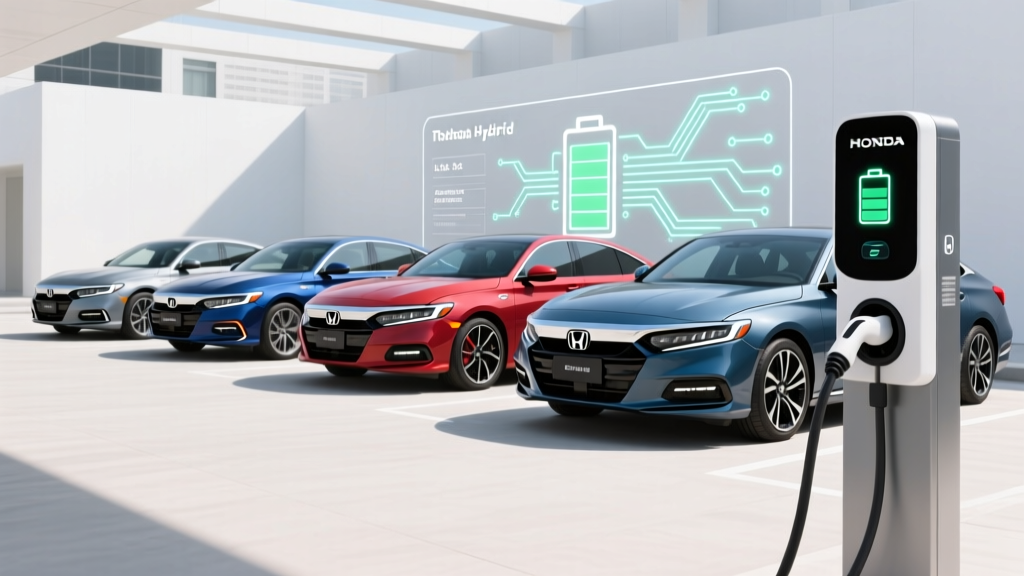
Honda offers the Accord Hybrid in three core trims for 2026. All share the same two-motor hybrid powertrain — the differences are in comfort, technology, and interior materials.
| Specification | Accord Hybrid Sport | Accord Hybrid Sport-L | Accord Hybrid Touring |
|---|---|---|---|
| Base MSRP | $34,290 | $35,940 | $39,990 |
| EPA City / Hwy / Combined MPG | 51 / 44 / 48 | 51 / 44 / 48 | 50 / 43 / 47 |
| Combined System Horsepower | 204 hp | 204 hp | 204 hp |
| Drivetrain | FWD | FWD | FWD |
| 0–60 mph (est.) | ~7.2 sec | ~7.2 sec | ~7.3 sec |
| Wheels | 19-inch alloy | 19-inch alloy | 19-inch alloy |
| Key Upgrades Over Previous Trim | — Base hybrid entry | Leather-trimmed seats, heated rear seats | Navigation, wireless CarPlay/Android Auto, heated steering wheel, premium audio |
Note: The Touring trim's slightly lower MPG (47 vs 48 combined) reflects added weight from premium equipment. Source: fueleconomy.gov EPA estimates.
Powertrain Deep Dive: Two-Motor Hybrid System
Every Accord Hybrid uses Honda's fourth-generation two-motor hybrid system. Here's how the numbers break down:
- Engine: 2.0-liter Atkinson-cycle 4-cylinder producing 146 hp and 134 lb-ft of torque
- Drive motor: 181 hp, 247 lb-ft of torque (electric)
- Combined system output: 204 hp (the engine and motor don't peak simultaneously)
- Battery: ~1.1 kWh lithium-ion (not user-accessible capacity; this is a power-assist buffer, not an energy-storage pack)
- Transmission: e-CVT (no traditional gears; the engine primarily acts as a generator at most speeds)
The system operates in three modes: EV Drive (motor only, brief low-speed bursts), Hybrid Drive (engine generates electricity to feed the motor), and Engine Drive (engine directly drives the wheels at highway cruising via a lock-up clutch). This last mode is why the Accord Hybrid maintains strong highway efficiency — the engine isn't wasting energy converting to electricity at steady speeds.
Real-World MPG: What to Actually Expect
EPA estimates are a starting point, not a guarantee. Based on aggregated owner reports and independent testing, here's how the Accord Hybrid performs in practice:
| Driving Scenario | Expected MPG | Notes |
|---|---|---|
| City / stop-and-go | 48–55 MPG | Hybrids often beat EPA city estimates thanks to heavy regen and electric assist at low speeds |
| Highway (70 mph, flat) | 40–45 MPG | Aerodynamic drag and reduced regen opportunity lower efficiency vs city |
| Highway (80 mph) | 36–40 MPG | Efficiency drops roughly 1 MPG per additional mph above 70 |
| Cold weather (below 30°F) | 38–44 MPG combined | Engine runs more often for cabin heat; battery chemistry less efficient in cold |
| Mixed daily driving | 45–50 MPG | Typical owner-reported average over 12 months |
Key Insight: Hybrids Excel in the City
Unlike gasoline cars that get worse mileage in traffic, the Accord Hybrid's regenerative braking recaptures energy at every stop. If your commute involves heavy congestion, expect to see numbers at or above the 51 MPG EPA city rating.
Battery Warranty, Lifespan, and Replacement Cost
Hybrid battery longevity is the single most common concern among first-time hybrid buyers. Here's the data:
Honda Hybrid Battery Warranty: 8 years / 100,000 miles (10 years / 150,000 miles in CARB states including California, New York, Massachusetts, and others adopting California emissions standards).
Warranty coverage threshold: Honda warrants the hybrid battery against capacity loss below a defined performance level. If the battery fails to meet this threshold within the warranty period, replacement is covered at no cost.
How Long Do Accord Hybrid Batteries Actually Last?
The Accord Hybrid's ~1.1 kWh battery is small and operates within a narrow state-of-charge window (roughly 40–80% SoC). This shallow cycling dramatically reduces degradation compared to a full EV battery that cycles 0–100%. Based on long-term data from Honda's hybrid fleet (Insight, Accord, CR-V Hybrid), most hybrid batteries retain adequate capacity well beyond 150,000 miles. Failures before 100,000 miles are uncommon.
Replacement Cost If Out of Warranty
If a hybrid battery does require replacement outside the warranty window, expect:
- OEM replacement: $2,000–$4,000 (parts + labor at a Honda dealer)
- Refurbished/remanufactured: $1,200–$2,500 (third-party options)
- Individual cell module replacement: $500–$1,500 (specialist hybrid shops can replace only the degraded cells rather than the full pack)
For context, the Accord Hybrid's battery is far smaller and simpler than an EV pack. A 75 kWh EV battery replacement can cost $10,000–$20,000; the hybrid's cost is a fraction of that.
Pricing, Tax Credits, and Total Cost of Ownership
Federal Tax Credit Eligibility
The Honda Accord Hybrid is a conventional hybrid (HEV), not a plug-in. Under current IRS §30D rules, the federal clean vehicle credit of up to $7,500 applies only to plug-in electric vehicles (BEVs and PHEVs) that meet battery sourcing, critical mineral, MSRP cap, and buyer income requirements. The Accord Hybrid does not qualify for the §30D federal tax credit.
Some states offer modest hybrid incentives (typically $250–$1,000), but these vary widely. Check your state's energy office or DMV for current programs.
5-Year Fuel Cost Comparison
| Vehicle | Combined MPG | Est. Annual Fuel Cost* | 5-Year Fuel Cost |
|---|---|---|---|
| 2026 Accord Hybrid (48 combined) | 48 MPG | ~$1,040 | ~$5,200 |
| 2026 Accord 1.5T Gas (30 combined) | 30 MPG | ~$1,665 | ~$8,325 |
| 2026 Toyota Camry Gas (32 combined) | 32 MPG | ~$1,560 | ~$7,800 |
*Based on 15,000 miles/year and $3.33/gallon regular unleaded. Actual costs vary by region and driving pattern. Source: fueleconomy.gov fuel cost calculator.
The Accord Hybrid saves roughly $3,000–$3,500 in fuel over five years compared to a comparable gas-only midsize sedan. That nearly offsets the hybrid's modest price premium over a gas-only equivalent.
Who Should Buy the Accord Hybrid — and Who Shouldn't
Pros
- Up to 51 MPG city with zero behavior change required
- No charging infrastructure needed — works for apartment dwellers and street parkers
- Strong reliability record; Honda hybrid systems are proven over millions of vehicles
- Smooth, quiet electric-assisted acceleration in city driving
- Competitive MSRP for the segment; Touring trim under $40,000
- Generous 8yr/100k-mile hybrid battery warranty
Cons
- No electric-only commuting capability (not a PHEV)
- No AWD option — FWD only across all trims
- No federal tax credit eligibility
- Highway MPG drops noticeably above 75 mph
- Cargo space slightly reduced vs gas Accord due to battery placement
- Cold-weather MPG penalty (10–15% combined reduction below 30°F)
Choose the Accord Hybrid If:
- You want maximum fuel savings without installing a home charger or relying on public charging
- Your commute is city-heavy or mixed, where the hybrid system delivers its best efficiency
- You plan to own the car 5+ years and want low running costs with proven reliability
Choose a PHEV Instead If:
- You have home charging and a short commute (under 35 miles) — a PHEV like the Toyota Prius Prime lets you drive electric-only most days
- You want to reduce gasoline use by 70–90% rather than 35–45%
Choose a Full BEV If:
- You have reliable Level 2 home charging and want zero tailpipe emissions
- You're eligible for the full $7,500 federal credit on a qualifying BEV, significantly reducing effective cost
- Your daily driving is under 250 miles and you're comfortable with public DC fast charging for road trips
Frequently Asked Questions
How many MPG does the 2026 Honda Accord Hybrid get?
The Sport and Sport-L trims are EPA-rated at 51 city / 44 highway / 48 combined MPG. The Touring trim rates at 50 city / 43 highway / 47 combined due to additional equipment weight. Real-world owners typically report 45–50 MPG in mixed driving and can exceed 50 MPG in city-dominant commutes.
Does the Honda Accord Hybrid need to be plugged in?
No. The Accord Hybrid is a conventional hybrid (HEV). The battery charges automatically through regenerative braking and the gasoline engine. There is no plug, no charging cable, and no charging station dependency.
How far can the Accord Hybrid drive on electric power alone?
Less than one mile at very low speeds (under 25 mph). The system uses electric assist primarily to reduce engine load during acceleration and to enable brief engine-off coasting. It is not designed for sustained electric-only driving. If you need 25+ miles of electric-only range, you need a PHEV or BEV.
Is the Honda Accord Hybrid reliable?
Honda's hybrid system has been in production since the early 2000s, and the current two-motor architecture has been deployed across the Accord, CR-V, and Civic Hybrid lines. The system has no traditional transmission (no belt-driven CVT to fail), and the electric motors have far fewer moving parts than a gasoline powertrain. Honda rates the hybrid battery warranty at 8 years/100,000 miles (10/150,000 in CARB states). Long-term reliability is among the strongest in the midsize sedan segment, as reflected in IIHS safety and durability assessments.
What does a Honda Accord Hybrid battery replacement cost?
Out-of-warranty OEM replacement runs $2,000–$4,000 at a dealership. Refurbished packs or individual cell-module replacements at hybrid specialists can reduce this to $500–$2,500. Given the shallow-cycling design, most Accord Hybrid batteries last well beyond the warranty period without issue.
Does the 2026 Accord Hybrid qualify for any tax credits?
The Accord Hybrid does not qualify for the federal §30D clean vehicle credit, which is limited to plug-in vehicles (BEVs and PHEVs). Some states offer small hybrid purchase incentives or HOV lane access — check your state's energy or transportation department for current programs. If tax credits are a priority, a qualifying PHEV or BEV may offer stronger financial incentives.
Which Accord Hybrid trim offers the best value?
The Sport trim at $34,290 delivers the best EPA MPG (48 combined), all essential features (Honda Sensing suite, Apple CarPlay/Android Auto, 19-inch wheels), and the lowest entry price. The Sport-L adds leather and heated rear seats for $1,650 more — worthwhile if you prefer leather over cloth. The Touring at $39,990 is the luxury option with navigation, premium audio, and wireless smartphone integration, but its MPG drops to 47 combined. For pure efficiency value, the Sport trim is the strongest pick.