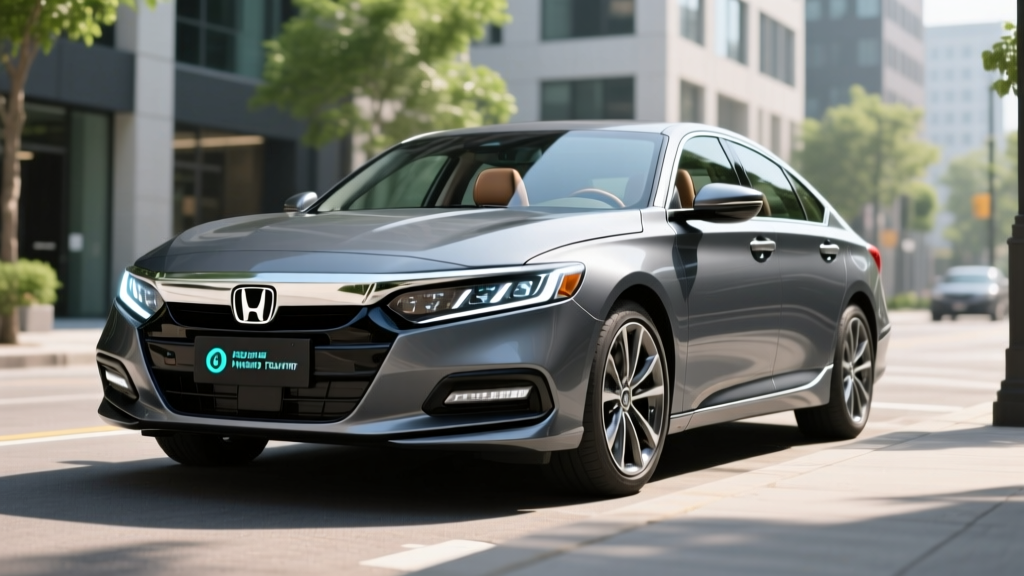
The 2024 Honda Accord Hybrid Touring sits at the top of Honda's midsize sedan lineup, pairing a two-motor hybrid system with the most feature-loaded trim available. For buyers who want near-EV efficiency in city driving without ever plugging in, it represents one of the most compelling conventional hybrid sedans on the market. But with the Touring trim pushing past $40,000, the question becomes whether the fuel savings and premium equipment justify the cost over a base hybrid or a full battery-electric vehicle.
This guide covers the Accord Hybrid Touring's real-world fuel economy, powertrain engineering, ownership economics, and how it compares to plug-in hybrids and full EVs for different driving patterns.
Fuel Economy: EPA Ratings and Real-World MPG
The 2024 Accord Hybrid Touring carries EPA ratings of 46 MPG city / 41 MPG highway / 44 MPG combined, according to fueleconomy.gov. These numbers apply specifically to the Touring and Sport-L trims, which use 19-inch alloy wheels. The lower Accord Hybrid trims (Sport, EX-L) with 18-inch wheels achieve slightly higher figures: 51 city / 44 highway / 48 combined.
| Trim | City MPG | Highway MPG | Combined MPG | Wheel Size |
|---|---|---|---|---|
| Sport / EX-L | 51 | 44 | 48 | 18-inch |
| Sport-L / Touring | 46 | 41 | 44 | 19-inch |
Powertrain: How the Two-Motor Hybrid System Works
The Accord Hybrid uses Honda's fourth-generation two-motor hybrid system, which operates differently from traditional planetary-gear hybrids like Toyota's setup. Here's how it works:
- Engine: 2.0-liter Atkinson-cycle inline-4, producing 146 hp and 134 lb-ft of torque
- Propulsion Motor: 181 hp, 247 lb-ft of torque — this motor drives the front wheels directly in most conditions
- Generator Motor: Acts as a generator to convert engine output into electricity for the propulsion motor or to charge the battery
- Combined System Output: 204 hp, 247 lb-ft of torque
- Transmission: No conventional transmission — Honda uses an e-CVT with a single fixed gear ratio for highway cruising, where a lock-up clutch connects the engine directly to the wheels
The system operates primarily in EV Drive (battery powers the propulsion motor) and Hybrid Drive (engine spins the generator, which powers the propulsion motor). Only at steady highway speeds does Engine Drive engage, mechanically linking the engine to the front axle. This architecture gives the Accord Hybrid a distinctly electric feel in daily driving — smooth, linear torque delivery with minimal engine noise at lower speeds.
| Specification | Value |
|---|---|
| Combined Horsepower | 204 hp |
| Combined Torque | 247 lb-ft |
| 0–60 MPH | ~6.5 seconds |
| Drivetrain | Front-wheel drive |
| Hybrid Battery | 1.06 kWh lithium-ion (nominal) |
| Fuel Tank | 12.8 gallons |
| Total Range (EPA est.) | ~563 miles |
| Cargo Volume | 16.7 cu ft |
| Curb Weight | ~3,477 lbs |
HEV vs PHEV vs EV: Which Powertrain Fits You?
The Accord Hybrid Touring is a conventional hybrid (HEV), meaning it charges its small battery entirely through regenerative braking and engine-driven generation. You never plug it in. This is fundamentally different from a plug-in hybrid (PHEV) or a battery-electric vehicle (BEV).
HEV vs PHEV vs BEV — Quick Comparison
| Factor | HEV (Accord Hybrid) | PHEV (e.g., Toyota Prius Prime) | BEV (e.g., Tesla Model 3) |
|---|---|---|---|
| Plug-in Required? | No | Yes (for EV range) | Yes (always) |
| Electric-Only Range | ~1 mile at low speed | 25–44 miles | 250–360 miles |
| Gasoline Use | Always blended | After EV range depletes | None |
| Home Charging Needed? | No | Recommended | Essential |
| Federal Tax Credit (§30D) | Not eligible | Up to $7,500 (varies) | Up to $7,500 (varies) |
| Best For | No home charging, long highway commutes | Short commute + home charger + road trips | Home charging access + mostly under 250 mi/day |
Choose the Accord Hybrid if you lack access to home or workplace charging, frequently take long road trips where charging infrastructure is sparse, or simply want maximum simplicity — fill up with gas and drive. The Accord Hybrid rewards city-heavy driving patterns with its best-in-class urban efficiency.
Consider a PHEV instead if you have a garage or driveway where you can install a Level 2 charger and your daily commute is under 40 miles. A PHEV lets you drive on electricity most days while keeping the gas engine for weekend trips.
Consider a full BEV if you have reliable home charging, your daily driving stays under 200 miles, and you want to eliminate gasoline costs entirely. Total cost of ownership often favors EVs over 5+ years, especially with tax credits.
Pricing, Trims, and Tax Credit Eligibility
The 2024 Honda Accord Hybrid Touring carries an MSRP of $39,990 (including destination charge). This positions it as the most expensive Accord trim, but it includes Honda's fullest feature set:
- 12.3-inch touchscreen with wireless Apple CarPlay and Android Auto
- 12-speaker Bose premium audio system
- Heated and ventilated front seats, heated rear seats
- Leather-trimmed interior
- Wireless phone charging
- Head-up display
- Low-speed braking control and front/rear parking sensors
- Honda Sensing suite (adaptive cruise, lane-keeping, collision mitigation)
- Google built-in (Google Assistant, Google Maps, Google Play)
For context, the Accord Hybrid Sport starts around $33,990, making the Touring a $6,000 premium for luxury and technology upgrades. The fuel economy difference between the trims (48 vs 44 combined MPG) means the Sport actually costs less to fuel, though the gap is roughly $100–$130 per year at 15,000 miles driven annually.
Battery Longevity, Warranty, and Replacement Costs
Hybrid battery longevity is consistently the top concern for hybrid buyers. The Accord Hybrid uses a compact lithium-ion battery pack mounted under the rear seats, and Honda backs it with substantial warranty coverage.
Hybrid Battery Warranty
- Federal emissions states: 8 years / 80,000 miles
- CARB states (CA, CO, CT, ME, MA, NJ, NY, OR, RI, VT, WA): 10 years / 150,000 miles
- Coverage: Defects and capacity loss below functional threshold
In practice, Honda's hybrid batteries have proven durable. The Accord Hybrid's battery is relatively small (~1.06 kWh) and the system's power control unit carefully manages charge and discharge cycles, rarely allowing the battery to reach full 100% or drop to 0%. This shallow cycling strategy significantly extends cell life. Based on long-term data from Honda and Toyota hybrid fleets, most hybrid batteries last 150,000–200,000+ miles before significant degradation, and many outlast the vehicle itself.
If replacement is needed outside warranty, a new OEM hybrid battery for the Accord Hybrid typically costs between $2,000 and $3,500 including labor. Third-party reconditioned packs are available for $1,000–$1,800. This is far less than a full EV battery replacement ($8,000–$20,000+) because the hybrid pack is much smaller.
The broader powertrain — engine, electric motors, and power control unit — is covered by Honda's 5-year/60,000-mile powertrain warranty. The hybrid system components beyond the battery (inverter, motors) typically carry the same 8-year/80,000-mile (or 10/150,000 in CARB states) coverage as the battery.
Ownership Costs: Fuel Savings vs. Upfront Price
To evaluate whether the Accord Hybrid Touring makes financial sense, compare its operating costs against the gas-only Accord (discontinued for 2024, but the 2023 1.5T achieved 33 MPG combined) and a comparable midsize EV.
| Vehicle | Efficiency | Annual Cost | 5-Year Cost |
|---|---|---|---|
| Accord Hybrid Touring | 44 MPG combined | ~$1,193 | ~$5,966 |
| 2023 Accord 1.5T (gas) | 33 MPG combined | ~$1,591 | ~$7,955 |
| Hyundai Ioniq 6 SE (EV) | 140 MPGe / 24 kWh/100mi | ~$540 (home charging) | ~$2,700 |
Fuel costs based on $3.50/gallon regular unleaded and $0.15/kWh home electricity. Actual costs vary by region. Source: fueleconomy.gov annual fuel cost estimates.
The Accord Hybrid saves approximately $398 per year ($1,990 over 5 years) compared to the previous-generation gas Accord. Against an EV charged primarily at home, the hybrid costs roughly $653 more per year in fuel. However, the Accord Hybrid's lack of charging dependency and lower purchase price (vs. many EVs) offset some of that gap for drivers without convenient charging access.
Insurance costs for the Accord Hybrid Touring typically run $1,600–$2,200 annually depending on location, driver profile, and coverage levels — roughly comparable to other well-equipped midsize sedans. Honda's strong safety ratings (IIHS Top Safety Pick+ for the 2024 model year) help keep premiums reasonable.
Who Should Buy the Accord Hybrid Touring?
✓ Ideal For
- City-heavy commuters (the hybrid system shines in stop-and-go)
- Drivers without home or workplace charging access
- High-mileage drivers who want low fuel costs without range planning
- Buyers who want premium features without luxury-brand pricing
- Those who regularly take long road trips (563-mile total range)
✗ Look Elsewhere If
- You have home charging and a short commute (a PHEV or BEV saves more)
- You want all-wheel drive (the Accord Hybrid is FWD only — consider the Toyota Camry Hybrid AWD)
- Towing is a priority (not rated for towing)
- You want the lowest possible Accord Hybrid price (the Sport trim at $33,990 gets better MPG)
- Federal tax credit eligibility is a deal-breaker
Frequently Asked Questions
How many MPG does the 2024 Honda Accord Hybrid Touring get?
The Touring trim earns EPA ratings of 46 city / 41 highway / 44 combined MPG. Real-world city driving often matches or slightly exceeds the EPA figure, while sustained highway driving at 75+ MPH typically yields 37–40 MPG. Cold weather reduces efficiency by roughly 5–10%.
Does the Accord Hybrid need to be plugged in?
No. The Accord Hybrid is a conventional hybrid (HEV), not a plug-in hybrid. Its small battery charges through regenerative braking and the gasoline engine. You fuel it like any other car at a gas station.
Does the 2024 Accord Hybrid qualify for any federal tax credit?
No. Under IRS §30D rules, only plug-in hybrids and battery-electric vehicles with at least 7 kWh of battery capacity are eligible. The Accord Hybrid's ~1 kWh battery disqualifies it. Some state or local incentives for high-efficiency vehicles may apply — check your state energy office.
How long will the hybrid battery last, and what does replacement cost?
Honda covers the hybrid battery for 8 years/80,000 miles (10 years/150,000 miles in CARB states). In practice, most Honda hybrid batteries last 150,000–200,000+ miles. Out-of-warranty replacement costs $2,000–$3,500 for an OEM pack, or $1,000–$1,800 for a reconditioned unit.
How does the Accord Hybrid compare to the Toyota Camry Hybrid?
The Camry Hybrid offers available all-wheel drive (the Accord is FWD only) and slightly higher combined MPG in its most efficient trim (up to 52 MPG combined for the LE). The Accord Hybrid Touring counters with a more upscale interior, a larger touchscreen, Google built-in, and a more refined ride. Both are excellent — AWD needs favor Toyota, while tech and comfort favor Honda.
Is the Accord Hybrid Touring worth the premium over the Sport trim?
The $6,000 premium buys Bose audio, ventilated seats, head-up display, leather, heated rear seats, parking sensors, and Google built-in. If those features matter to you, the Touring delivers strong value relative to luxury-brand competitors. If fuel economy is the top priority, the Sport trim actually achieves 48 combined MPG vs the Touring's 44, thanks to lighter 18-inch wheels.