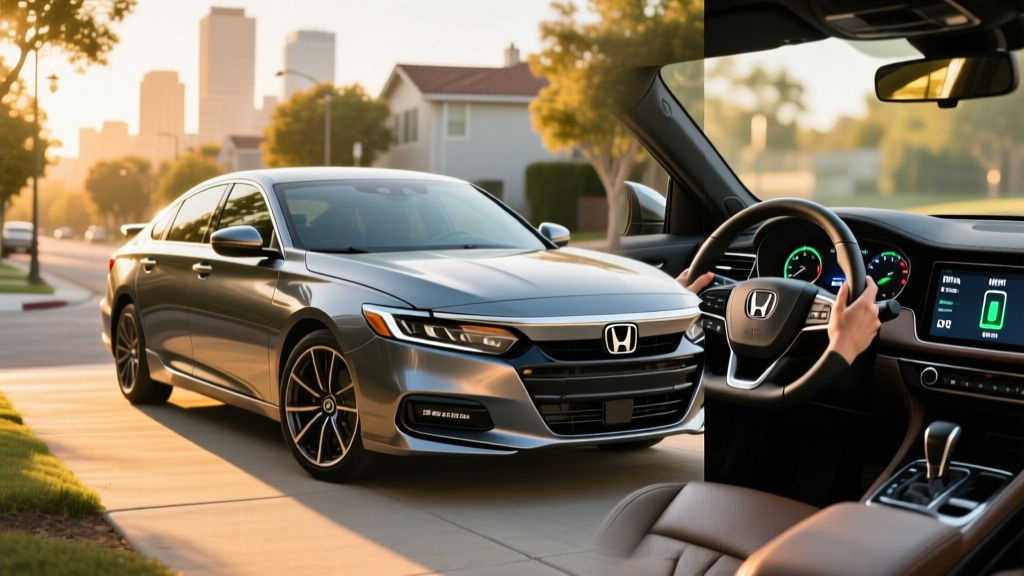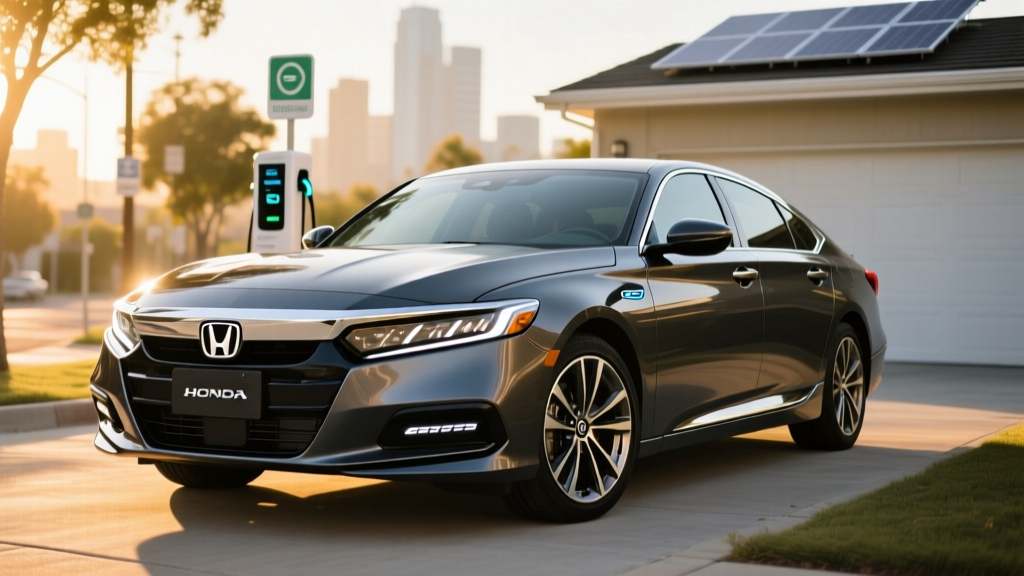
The Honda Accord Hybrid Touring sits at the top of Honda's midsize sedan lineup, pairing a proven two-motor hybrid system with the trim's most comprehensive tech and comfort package. For buyers weighing a conventional hybrid against plug-in hybrids and full EVs, the Accord Hybrid represents a no-plug-required path to 40+ MPG with zero range anxiety. Here's everything you need to know about specs, real-world efficiency, ownership costs, and whether it's the right electrified choice for your garage.
2026 Accord Hybrid Touring: Quick Verdict
The Touring trim commands a premium over the Sport-L and EX-L hybrid trims but delivers Google built-in navigation, a 12-speaker Bose audio system, heated rear seats, wireless phone charging, and Honda's full Honda Sensing ADAS suite. The powertrain is identical across all Accord Hybrid trims: a 2.0-liter Atkinson-cycle four-cylinder paired with a two-motor hybrid system producing a combined 204 horsepower and 247 lb-ft of torque. That's the key insight — you're paying for luxury and tech, not additional power.
| Specification | 2026 Accord Hybrid Touring |
|---|---|
| Powertrain | 2.0L Atkinson I-4 + 2-motor hybrid (HEV) |
| Combined Horsepower | 204 hp |
| Combined Torque | 247 lb-ft |
| Transmission | e-CVT (no fixed gears) |
| Drivetrain | Front-wheel drive |
| EPA MPG (City / Hwy / Combined) | 46 / 41 / 44 |
| Fuel Tank Capacity | 12.8 gallons |
| Total Driving Range | ~563 miles (EPA combined) |
| 0–60 mph | ~7.0 seconds |
| Cargo Volume | 16.7 cu ft |
| MSRP (Touring trim) | $40,350 (est.) |
| Hybrid Battery Warranty | 8 years / 100,000 miles (10 yr/150k in CARB states) |
Fuel Economy: EPA Ratings vs. Real-World MPG
The EPA rates the Accord Hybrid Touring at 46 MPG city, 41 MPG highway, and 44 MPG combined per fueleconomy.gov. The Touring's slightly lower highway figure compared to lower trims (which achieve up to 48 city / 47 highway) is attributable to its larger 19-inch alloy wheels and heavier curb weight from additional equipment.
| Driving Scenario | EPA Rating | Real-World Expectation |
|---|---|---|
| City (stop-and-go) | 46 MPG | 47–52 MPG (hybrids excel here) |
| Highway (70 mph cruise) | 41 MPG | 38–42 MPG |
| Combined (mixed driving) | 44 MPG | 42–46 MPG |
| Cold weather (below 30°F) | N/A | 36–40 MPG (engine runs more for cabin heat) |
The Accord Hybrid's two-motor system thrives in city driving, where regenerative braking recaptures energy at every stop and the electric motor handles low-speed propulsion without engaging the gasoline engine. Owners consistently report exceeding the EPA city estimate in warm-weather urban commuting. Highway driving is where conventional hybrids lose their edge — at sustained speeds above 65 mph, the gasoline engine does most of the work, and aerodynamic drag dominates. If your commute is 80% highway, expect combined figures closer to 40 MPG.
How the Hybrid Powertrain Works (HEV vs. PHEV Clarified)
The Accord Hybrid is a conventional hybrid electric vehicle (HEV) — it does not have a plug and cannot be charged from an external source. The system captures energy through regenerative braking and the gasoline engine to maintain a small lithium-ion battery pack (approximately 1.1 kWh usable). This is fundamentally different from a plug-in hybrid (PHEV) like the Toyota RAV4 Prime or the discontinued Honda Clarity Plug-In, which carries a much larger battery (typically 15–20 kWh) and offers 25–45 miles of electric-only driving before the gas engine kicks in.
| Feature | Accord Hybrid (HEV) | Typical PHEV (e.g., RAV4 Prime) |
|---|---|---|
| Plug-in charging | No — self-charging via regen + engine | Yes — Level 1 or Level 2 |
| Battery size | ~1.1 kWh | ~18.1 kWh |
| Electric-only range | None (EV mode limited to ~1 mile at low speed) | 25–42 miles |
| Federal tax credit (§30D) | Not eligible | Up to $7,500 (subject to sourcing/income rules) |
| Best for | Drivers without home/work charging access | Drivers with home charging and short commutes |
Honda's e-CVT in the Accord Hybrid doesn't use a traditional belt-and-pulley continuously variable transmission. Instead, it uses two electric motors — one primarily for propulsion, one primarily as a generator — connected through a lock-up clutch that engages at highway speeds for direct engine-to-wheel drive. This eliminates the "rubber band" feeling associated with older CVTs and delivers smooth, linear acceleration from a stop.
Pricing, Trims, and Tax Credit Eligibility
The 2026 Accord Hybrid is available in Sport, Sport-L, EX-L, and Touring trims. The Touring starts at an estimated $40,350 (including destination), placing it roughly $5,000 above the Sport-L Hybrid and $2,500 above the EX-L Hybrid. For context, the base Accord Hybrid Sport starts around $34,000.
Federal Tax Credit Status: The Accord Hybrid is a conventional HEV and does not qualify for the IRS §30D Clean Vehicle Credit, which is reserved for plug-in electric vehicles (BEVs and PHEVs) with battery packs of at least 7 kWh. According to IRS.gov §30D guidelines, the minimum battery capacity and plug-in requirement exclude all conventional hybrids.
- IRS §30D credit: Not eligible (HEV, no plug, battery below 7 kWh)
- State incentives: Some states offer small rebates ($250–$500) for hybrids — check your state energy office
- Employer/commuter benefits: Some employers offer preferred parking or fuel stipends for hybrid drivers
- Fuel savings offset: At 44 MPG combined vs. a 28 MPG gas sedan, you save approximately $700–$900/year at 15,000 miles driven (assuming $3.50/gal)
While the lack of a federal tax credit stings compared to PHEVs and BEVs, the Accord Hybrid's lower purchase price (no large battery premium) and absence of home charging infrastructure costs often result in a lower total cost of ownership over five years versus a PHEV you can't plug in at home.
Driving Impressions: Performance and Refinement
The 204-horsepower combined output delivers adequate acceleration — expect 0–60 mph in approximately 7.0 seconds, which is competitive with the turbocharged 1.5T gas Accord (192 hp) but trails the discontinued 2.0T variant. The electric motor's 247 lb-ft of torque is available from low RPM, giving the Accord Hybrid a responsive, eager feel around town that belies its efficiency focus.
The Touring trim adds adaptive dampers (not available on lower hybrid trims), which noticeably improves ride quality over rough pavement and body control during cornering. Cabin noise levels are among the lowest in the midsize sedan segment, aided by acoustic laminated front glass and active noise cancellation. The hybrid system transitions between EV drive, hybrid drive, and engine drive modes seamlessly — most drivers won't notice which mode is active without watching the power-flow display.
One honest limitation: the Accord Hybrid is front-wheel drive only. If you need all-wheel drive in a hybrid sedan, you'll need to look at the Toyota Camry Hybrid (AWD available) or step up to a luxury option like the Lexus ES 300h.
Battery Longevity, Warranty, and Replacement Cost
Hybrid battery longevity is consistently the top concern for first-time hybrid buyers, and it's the area where the data is most reassuring.
Honda Hybrid Battery Warranty:
- Standard: 8 years / 100,000 miles (capacity retention warranty)
- CARB states (CA, CT, ME, MD, MA, NJ, NY, OR, RI, VT, WA, and others adopting California emissions standards): 10 years / 150,000 miles
- Warranty covers battery capacity falling below approximately 70% of original capacity
Real-world lifespan data: Honda's lithium-ion hybrid battery packs in the Accord and Civic Hybrid have demonstrated strong longevity. Fleet data and owner reports suggest most packs retain 85–90% capacity at 150,000 miles under normal use. Complete failures before 100,000 miles are rare. Unlike the much larger batteries in EVs, the Accord Hybrid's small ~1.1 kWh pack is never deeply cycled — the system keeps the state of charge in a narrow middle band (roughly 40–60%), which dramatically reduces degradation.
Replacement cost (out of warranty): A new OEM hybrid battery pack for the Accord Hybrid typically costs $2,000–$3,500 installed. Third-party reconditioned packs are available for $1,200–$2,000. Compare this to EV battery replacements, which run $8,000–$20,000+.
Touring Trim: What You Get for the Premium
The Touring justifies its $40,350 price tag with features that meaningfully improve daily ownership:
- Google built-in: Google Maps navigation, Google Assistant voice control, and Google Play Store — eliminates reliance on phone mirroring for navigation
- 12-speaker Bose premium audio: Noticeably better than the standard 8-speaker system, particularly for podcast clarity and bass response
- Heated rear seats: Uncommon in this segment and a genuine comfort upgrade for passengers
- Wireless phone charging pad: 15W Qi-compatible
- Low-speed braking control and front/rear parking sensors: Augments the standard Honda Sensing suite
- 19-inch alloy wheels: Styling upgrade, though they cost ~1 MPG vs. 17-inch wheels on lower trims
- Adaptive dampers: The most impactful mechanical upgrade — smooths out harsh pavement and reduces body roll
Pros
- 44+ MPG combined with no plug required
- Strong city MPG (46+) with real-world gains in stop-and-go
- 563-mile total range — fewer fill-ups than any gas sedan
- Excellent reliability track record; low battery replacement cost
- Spacious 16.7 cu ft trunk (no hybrid battery intrusion)
- Honda Sensing ADAS is standard, not an expensive add-on
- Adaptive dampers on Touring genuinely improve ride quality
Cons
- No federal tax credit (HEV, not PHEV)
- Front-wheel drive only — no AWD option
- 19-inch wheels on Touring reduce MPG by ~1–2 MPG vs. lower trims
- No DC fast charging (not applicable — HEV)
- Cabin tech is good but trails Hyundai/Kia's latest interfaces
- $40K+ for a non-luxury sedan requires justifying the Touring premium
Accord Hybrid vs. PHEV vs. Full EV: Which Should You Choose?
Choose the Accord Hybrid (HEV) if:
- You don't have access to home or workplace Level 2 charging
- You want 40+ MPG without changing any habits — just fill up with gas
- You regularly take long road trips and don't want to plan around DC fast chargers
- You want the lowest upfront cost among electrified sedans
- You live in an apartment or street-park and can't install a charger
Choose a PHEV (e.g., Toyota Prius Prime, Hyundai Sonata PHEV) if:
- You have home Level 2 charging and a commute under 35 miles round-trip
- You want electric-only daily driving but gas flexibility for road trips
- You can qualify for the §30D federal tax credit (up to $7,500, subject to battery sourcing and income caps per IRS guidelines)
Choose a full EV (e.g., Tesla Model 3, Hyundai Ioniq 6, BMW i4) if:
- You have reliable home Level 2 charging
- You want zero tailpipe emissions and the lowest per-mile fuel cost (~$0.04–$0.06/mi on residential electricity vs. ~$0.09/mi for the Accord Hybrid at $3.50/gal)
- You qualify for the full $7,500 federal credit and any state EV rebates
- Your road trips are under 300 miles or you're comfortable with DC fast-charging stops
Five-Year Ownership Cost Estimate
To put the Accord Hybrid Touring's value in context, here's a five-year / 75,000-mile cost estimate compared to a typical gas-only midsize sedan rated at 28 MPG combined:
| Cost Category | Accord Hybrid Touring (44 MPG) | Gas Sedan (28 MPG) |
|---|---|---|
| Purchase price (MSRP) | $40,350 | $34,500 |
| Fuel cost (75,000 mi @ $3.50/gal) | $5,960 | $9,375 |
| Fuel savings vs. gas | $3,415 saved over 5 years | |
| Maintenance (est. 5 yr) | $2,800 | $3,500 |
| Insurance (est. 5 yr) | $8,500 | $7,800 |
| Federal tax credit | $0 | $0 |
| Estimated 5-yr total | ~$57,610 | ~$55,175 |
The Accord Hybrid Touring's fuel savings partially offset its higher purchase price, but the premium over a gas sedan isn't fully recovered in five years at current fuel prices. The value proposition strengthens significantly if gas prices rise above $4.00/gallon, or if you keep the car for 8–10 years (where the fuel savings compound to $6,000–$8,000). Insurance costs tend to be modestly higher for the Touring trim due to its higher replacement cost and advanced sensor suite.
Frequently Asked Questions
How many MPG does the Accord Hybrid Touring actually get?
The EPA rates it at 46 city / 41 highway / 44 combined. In real-world city driving with warm weather, many owners report 48–52 MPG thanks to regenerative braking. Highway-only driving at 75+ mph may drop to 37–39 MPG. Cold weather (below 30°F) typically reduces combined MPG by 10–15% because the gasoline engine runs more frequently to provide cabin heat.
Does the Accord Hybrid need to be plugged in?
No. The Accord Hybrid is a conventional HEV — it charges its own small battery through regenerative braking and the gasoline engine. There is no plug, no charging cable, and no need for home charging infrastructure. You simply drive it like a gas car and fill up at the pump.
Is the Accord Hybrid reliable, and what does a battery replacement cost?
Honda's hybrid system has an excellent reliability record spanning two decades (the first Insight debuted in 2000). The hybrid battery is warranted for 8 years/100,000 miles (10 years/150,000 miles in CARB states). Real-world data shows most packs retain 85%+ capacity at 150,000 miles. Out-of-warranty replacement costs $2,000–$3,500 for a new OEM pack — far less than an EV battery replacement.
Does the Accord Hybrid qualify for any tax credit?
No federal tax credit applies. The IRS §30D Clean Vehicle Credit requires a plug-in vehicle with at least 7 kWh of battery capacity. The Accord Hybrid's ~1.1 kWh pack disqualifies it. Some states offer small hybrid rebates ($250–$500), but these vary by jurisdiction — check your state's energy office or environmental agency for current programs.
How far can the Accord Hybrid go on a full tank?
With a 12.8-gallon fuel tank and 44 MPG combined EPA rating, the Accord Hybrid delivers approximately 563 miles of total range. In city-heavy driving at 48+ MPG, some drivers have exceeded 600 miles between fill-ups. This is roughly double the range of a typical 28 MPG gas sedan with a similar tank size.
How does the Accord Hybrid compare to the Toyota Camry Hybrid?
The 2026 Camry Hybrid (now exclusively hybrid) offers 44–52 MPG depending on trim, available AWD, and a lower starting price (~$30,000). The Accord Hybrid Touring counters with more rear-seat legroom, a larger trunk (16.7 vs. 15.1 cu ft), and a more refined ride on the Touring's adaptive dampers. If AWD is essential, the Camry wins. If interior space and ride quality matter more, the Accord Touring is the stronger pick.
Is the Touring trim worth the premium over the Sport-L Hybrid?
That depends on how much you value adaptive dampers, Bose audio, heated rear seats, and Google built-in navigation. The Sport-L Hybrid offers the same powertrain and nearly identical MPG for roughly $5,000 less. If you primarily drive alone on commutes, the Sport-L is the value pick. If you frequently carry passengers and prioritize ride comfort, the Touring's adaptive dampers and rear-seat amenities justify the cost.