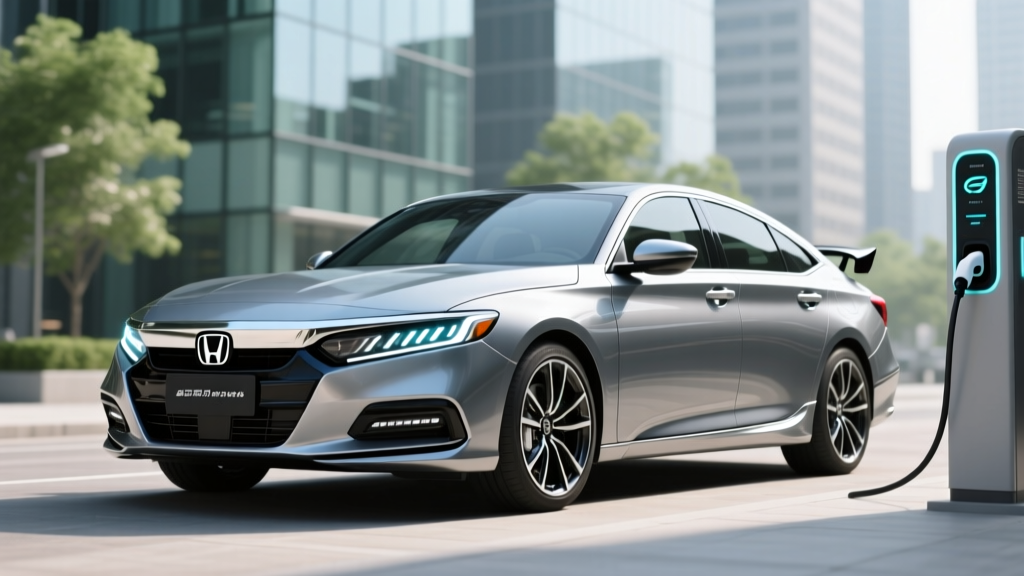
The 2026 Honda Accord Hybrid Sport Touring sits at the top of Honda's hybrid sedan lineup, blending a 48 MPG EPA combined rating with the brand's most complete technology and safety package. For buyers weighing a conventional hybrid against a plug-in hybrid or full battery-electric vehicle, the Accord Hybrid Sport Touring makes a compelling case: no charging infrastructure required, no range anxiety, and a proven two-motor powertrain that prioritizes electric-drive feel without ever needing a plug.
This guide breaks down every number that matters — fuel economy, powertrain output, battery warranty, real-world efficiency, pricing, and how the Accord Hybrid Sport Touring stacks up against PHEVs and BEVs for different driving lifestyles.
2026 Honda Accord Hybrid Sport Touring: Key Specifications
| Specification | Value |
|---|---|
| EPA Fuel Economy (City / Highway / Combined) | 51 / 44 / 48 MPG |
| Powertrain | 2.0L Atkinson-cycle 4-cyl + two-motor hybrid system |
| Combined System Horsepower | 204 hp |
| Combined System Torque | 247 lb-ft (electric motor) |
| Transmission | e-CVT (direct drive with lock-up clutch) |
| Hybrid Battery Type | Lithium-ion (approx. 1.1 kWh, non-plug-in) |
| Drivetrain | Front-wheel drive |
| 0–60 mph (est.) | ~7.0 seconds |
| Fuel Tank Capacity | 12.8 gallons |
| Total Driving Range (est.) | ~614 miles |
| Base MSRP (Sport Touring Hybrid) | $40,395 (incl. destination) |
| Federal EV Tax Credit (§30D) | Not eligible (conventional HEV) |
| Hybrid Battery Warranty | 10 years / 150,000 miles (CARB states) |
Fuel Economy: EPA Ratings vs. Real-World MPG
The EPA rates the 2026 Accord Hybrid Sport Touring at 51 MPG city, 44 MPG highway, and 48 MPG combined, according to fueleconomy.gov. These figures apply across all Accord Hybrid trims, including the Sport Touring, since all share the same fourth-generation two-motor hybrid system.
| Driving Scenario | EPA Estimate | Real-World Expectation |
|---|---|---|
| City / Stop-and-Go | 51 MPG | 50–55 MPG (hybrids excel here) |
| Highway (70 mph cruise) | 44 MPG | 40–45 MPG (aerodynamic drag reduces advantage) |
| Combined | 48 MPG | 45–50 MPG |
| Cold Weather (below 32°F) | — | 38–43 MPG (engine runs more for cabin heat) |
The Accord Hybrid's two-motor system operates primarily in EV Drive mode at low speeds, using the gasoline engine as a generator. At highway cruising speeds, the engine can clutch directly into the drivetrain for more efficient operation. This architecture means the Accord Hybrid typically exceeds its EPA city rating in moderate-temperature urban driving — a trait common to Honda and Toyota hybrid systems where regenerative braking recaptures energy that a gas-only car wastes as heat.
On sustained highway trips above 75 mph, expect the fuel economy to settle closer to 40–42 MPG. The hybrid system's advantage narrows at high speeds because the engine operates continuously and aerodynamic drag dominates. This is still 10–15 MPG better than the non-hybrid Accord 1.5T at equivalent speeds.
Two-Motor Hybrid Powertrain: How It Works
Honda's fourth-generation two-motor hybrid system pairs a 2.0-liter Atkinson-cycle four-cylinder engine with two electric motors and a compact lithium-ion battery pack. Here's the operating logic:
- EV Drive: At low speeds and light loads, the propulsion motor drives the wheels using battery energy alone. The engine remains off.
- Hybrid Drive: Under moderate acceleration, the engine spins a generator motor to produce electricity, which feeds the propulsion motor. Excess energy charges the battery.
- Engine Drive: At steady highway speeds, a lock-up clutch connects the engine directly to the wheels for maximum mechanical efficiency.
The result is 204 combined system horsepower and a driving feel that's smoother and more responsive than a traditional CVT-equipped gas car. The electric motor delivers its 247 lb-ft of torque instantly from a stop, giving the Accord Hybrid Sport Touring confident acceleration in merging and passing situations. The 0–60 mph time of approximately 7.0 seconds places it in the same territory as many turbocharged four-cylinder midsize sedans.
HEV vs. PHEV vs. BEV: Which Powertrain Fits You?
The Accord Hybrid is a conventional hybrid electric vehicle (HEV) — it cannot be plugged in. Its small lithium-ion battery recharges through regenerative braking and the gasoline engine. Honda does not currently offer a plug-in hybrid (PHEV) version of the Accord in the U.S. market.
| Factor | HEV (Accord Hybrid) | PHEV (e.g., Toyota Prius Prime) | BEV (e.g., Tesla Model 3) |
|---|---|---|---|
| Plug-in Required? | No | Yes (for EV range benefit) | Yes (always) |
| Electric-Only Range | ~1–2 miles at low speed | 25–44 miles (typical) | 250–360 miles |
| Combined Efficiency | 48 MPG | 48–52 MPG + 100+ MPGe | 120–132 MPGe |
| Home Charging Needed? | No | Recommended (120V or 240V) | Required (240V ideal) |
| Federal Tax Credit (§30D) | Not eligible | Up to $7,500 (if eligible) | Up to $7,500 (if eligible) |
| Best For | No charging access; long trips | Short commutes + long trips | Home charging; daily commuting |
| Upfront Cost | Lowest | Mid-range | Highest (before incentives) |
Choose the Accord Hybrid (HEV) if: You lack home or workplace charging, frequently drive long distances, want zero behavior change from a gas car, and prioritize proven reliability with no plug-in logistics.
Choose a PHEV if: You have access to a standard 120V or 240V outlet, your daily commute is under 30–40 miles round-trip, and you want electric driving for daily errands with gas backup for road trips.
Choose a BEV if: You have reliable Level 2 home charging, your daily driving is under 200 miles, you want the lowest per-mile fuel cost, and you're ready to plan around DC fast-charging on road trips.
Pricing, Trims, and Tax Credit Eligibility
The 2026 Honda Accord Hybrid is available in four trims. The Sport Touring Hybrid is the top-tier model:
| Trim | MSRP (incl. destination) |
|---|---|
| Sport Hybrid | ~$33,995 |
| Sport-L Hybrid | ~$36,395 |
| EX-L Hybrid | ~$37,395 |
| Sport Touring Hybrid | ~$40,395 |
The Sport Touring Hybrid justifies its premium with standard features including a 12.3-inch infotainment touchscreen with wireless Apple CarPlay and Android Auto, Google built-in, a 12-speaker Bose premium audio system, heated and ventilated front seats, heated rear seats, a heated steering wheel, wireless phone charging, a head-up display, low-speed braking control, and Honda Sensing (ADAS suite with adaptive cruise control, lane-keeping assist, and collision mitigation).
Federal Tax Credit Status
The Accord Hybrid does not qualify for the federal §30D Clean Vehicle Credit. Under current IRS rules, the §30D credit applies only to plug-in electric vehicles (PHEVs and BEVs) that meet battery capacity, critical mineral sourcing, MSRP caps, and buyer income thresholds. Conventional hybrids like the Accord Hybrid are excluded by statute.
Some states offer their own incentives for efficient vehicles, but these vary widely by jurisdiction. Check your state's energy or environmental agency for current programs. No federal incentive reduces the Accord Hybrid's purchase price at the point of sale.
Battery Warranty, Reliability, and Replacement Cost
Honda Hybrid Battery Warranty:
- CARB states (CA, NY, MA, and 14 others): 10 years / 150,000 miles
- Non-CARB states: 8 years / 100,000 miles
- Coverage threshold: Battery capacity must remain above ~70% of original; Honda covers repair or replacement if degradation exceeds this level under normal use.
Honda's hybrid battery packs have demonstrated strong longevity in real-world ownership. The Accord Hybrid's lithium-ion pack is small (approximately 1.1 kWh) and operates within a narrow state-of-charge window — typically between 20% and 80% — which minimizes degradation stress. The vehicle's battery management system (BMS) actively manages temperature and charge/discharge cycles.
Based on historical data from Honda's hybrid lineup (Insight, CR-V Hybrid, previous Accord Hybrid generations), most hybrid battery packs last well beyond the warranty period. Failures before 150,000 miles are uncommon under normal driving conditions.
Replacement Cost
If the hybrid battery does require replacement outside of warranty coverage, expect to pay between $2,500 and $4,500 for a new OEM pack including labor. Refurbished or reconditioned packs are available from third-party suppliers for $1,500–$2,500. This is significantly less than a full EV traction battery replacement ($8,000–$20,000+), reflecting the Accord Hybrid's much smaller pack size.
According to reliability data tracked by IIHS and owner surveys, the Accord Hybrid's powertrain components rank among the most dependable in the midsize sedan segment. The e-CVT design eliminates traditional transmission wear items like clutches, torque converters, and gear sets.
Sport Touring Trim: What You Get for the Premium
The Sport Touring Hybrid adds meaningful equipment over the Sport-L Hybrid ($4,000 below). Key differentiators include:
- Adaptive damper system (sport-tuned suspension with adjustable damping)
- 19-inch alloy wheels with matte-black finish
- Heated rear outboard seats
- Ventilated front seats
- Wireless phone charger
- Head-up display (HUD)
- Low-speed braking control with pedestrian detection
- Rear cross-traffic braking
- 12-speaker Bose audio system
- Wi-Fi hotspot capability
- Google built-in (Google Assistant, Google Maps, Play Store)
The adaptive dampers give the Sport Touring a noticeably firmer ride in Sport mode while maintaining compliance in Normal mode. It's a genuine handling upgrade, though the 19-inch wheels do transmit more road imperfection than the 17-inch wheels on lower trims — a tradeoff worth noting for buyers in areas with rough pavement.
Pros
- 48 MPG combined; routinely exceeds 50 MPG in city driving
- Smooth, responsive two-motor drive feel — no CVT drone
- No charging infrastructure required
- Excellent Honda Sensing safety suite (standard on all trims)
- 10-year/150k-mile hybrid battery warranty (CARB states)
- ~614-mile total range — fewer fuel stops on road trips
- Strong resale value in the hybrid sedan segment
Cons
- No federal tax credit (HEV, not PHEV/BEV)
- Highway MPG drops to ~40–42 at 75+ mph
- No all-wheel-drive option
- Sport Touring price pushes $40K — approaching luxury sedan territory
- 19-inch wheels on Sport Touring produce a firmer ride
- Only ~1–2 miles of EV-only driving at low speed
Ownership Costs: Fuel Savings vs. Gas-Only Accord
To contextualize the Accord Hybrid's value, compare annual fuel costs against the non-hybrid Accord 1.5T (rated at 29 city / 37 highway / 32 combined MPG):
| Metric | Accord Hybrid (48 MPG) | Accord 1.5T (32 MPG) |
|---|---|---|
| Annual fuel (15,000 mi/yr at $3.40/gal) | $1,063 | $1,594 |
| 5-year fuel cost | $5,313 | $7,969 |
| 5-year savings vs. gas model | $2,656 | |
| Cost per mile (fuel only) | $0.071 | $0.106 |
The Sport Touring Hybrid carries a ~$6,400 premium over the base Accord 1.5T LX. At current fuel prices, the hybrid powertrain pays back its premium in roughly 12 years for an average driver. However, the Sport Touring trim includes substantial equipment (Bose audio, adaptive dampers, HUD, ventilated seats) that the base LX lacks — making a direct price comparison imperfect. The hybrid's advantage is most pronounced for high-mileage drivers (20,000+ miles/year) and those who do predominantly city driving where the 51 MPG city rating delivers maximum savings.
Frequently Asked Questions
How many MPG does the 2026 Honda Accord Hybrid Sport Touring get?
The EPA rates it at 51 MPG city, 44 MPG highway, and 48 MPG combined. In real-world city driving with moderate temperatures, many owners report 50–55 MPG. Highway driving at 70–75 mph typically yields 40–45 MPG. Cold weather (below freezing) reduces efficiency to approximately 38–43 MPG due to increased engine runtime for cabin heating.
Can the Accord Hybrid drive on electric power only?
Only at very low speeds (typically under 25 mph) and for roughly 1–2 miles before the engine engages. The Accord Hybrid's battery is approximately 1.1 kWh — far too small for meaningful electric-only range. This is by design: the hybrid system uses the battery as a buffer for regenerative energy capture and smooth acceleration assist, not as a primary energy source. If you want substantial electric-only driving, you'll need a PHEV or BEV.
Does the Honda Accord Hybrid need to be plugged in?
No. The Accord Hybrid is a conventional HEV. Its battery charges entirely through regenerative braking and the gasoline engine. You fuel it exactly like a conventional gas car — there is no plug, no charging cable, and no change to your refueling habits.
Is the Accord Hybrid battery reliable and what does replacement cost?
Honda's hybrid batteries have a strong reliability record. The pack is warranted for 10 years/150,000 miles in CARB states and 8 years/100,000 miles elsewhere. Most packs last well beyond the warranty period. If replacement is needed out of warranty, expect $2,500–$4,500 for a new OEM pack, or $1,500–$2,500 for a refurbished unit. This is substantially less than EV battery replacement costs.
Does the Accord Hybrid qualify for any federal tax credit?
No. The federal §30D Clean Vehicle Credit applies only to plug-in vehicles (PHEVs and BEVs) that meet battery sourcing, MSRP, and buyer income requirements. The Accord Hybrid, as a conventional HEV, is not eligible. Check your state's energy agency for any local hybrid incentives, but do not expect a federal credit.
How does the Accord Hybrid compare to the Toyota Camry Hybrid?
The 2026 Toyota Camry Hybrid (LE trim) is rated at 51 MPG combined with standard AWD availability, priced approximately $2,000–$3,000 below the Accord Hybrid Sport Touring at equivalent trims. The Accord offers more rear-seat legroom, a more refined two-motor drive feel, and Honda Sensing as standard. The Camry Hybrid's available AWD and slightly lower pricing make it the practical pick; the Accord Hybrid wins on driving dynamics and interior space. Both are segment benchmarks.
What is the total driving range on a full tank?
With a 12.8-gallon fuel tank and 48 MPG combined, the Accord Hybrid Sport Touring delivers approximately 614 miles of total range. In city-heavy driving at 50+ MPG, range can extend to 640+ miles. This exceeds most BEVs' real-world range and eliminates any range anxiety on long trips.