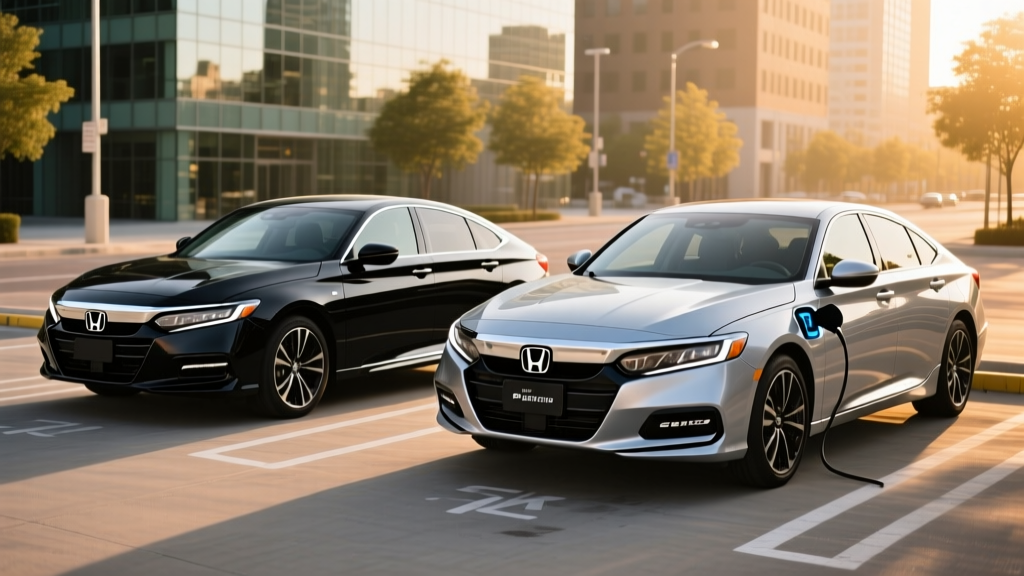
Honda's midsize sedan lineup can be confusing for electrified-car shoppers. The Accord Hybrid has been a staple for years, but searches for an Accord Hybrid Plug In reveal a common question: does Honda still sell a plug-in version, and how does it compare to the conventional hybrid? This guide breaks down the 2026 Honda Accord Hybrid (HEV), the status of the Accord Plug-In Hybrid (PHEV), and exactly what you'll spend on fuel, electricity, and ownership over five years.
The Accord Hybrid vs. Accord Plug-In: What's the Difference?
Before we get into MPG and pricing, it's critical to distinguish between the two powertrain types Honda has offered under the Accord nameplate:
Conventional Hybrid (HEV) — 2026 Accord Hybrid
- No plug required. The battery recharges through regenerative braking and the gasoline engine.
- Small battery: ~1.06 kWh lithium-ion pack.
- Electric-only driving: Very limited — typically under 1 mile at low speeds.
- How you fuel it: Gas station only, exactly like a conventional car.
- Tax credit: Not eligible for the federal §30D EV credit.
Plug-In Hybrid (PHEV) — Accord Plug-In (Discontinued After 2015)
- Plugs into a wall outlet or charger to fill a larger battery.
- Larger battery: 6.7 kWh usable (2014–2015 model).
- Electric-only range: EPA-rated 13 miles (original model).
- How you fuel it: Plug in for electric miles; gas engine kicks in after battery depletes.
- Tax credit: Was eligible when new; no longer in production.
The bottom line: As of the 2026 model year, Honda does not offer a plug-in Accord in the United States. The Accord Plug-In Hybrid was discontinued after the 2015 model year and replaced by the Clarity Plug-In Hybrid (also discontinued after 2021). If you're shopping for a 2026 Accord with electrification, your option is the Accord Hybrid (HEV).
2026 Honda Accord Hybrid: EPA MPG & Real-World Fuel Economy
The 2026 Accord Hybrid uses Honda's two-motor hybrid system, pairing a 2.0-liter Atkinson-cycle four-cylinder engine with dual electric motors for a combined system output of 204 horsepower and 247 lb-ft of torque. Here's what the EPA says — and what you can actually expect:
| Trim | City MPG | Highway MPG | Combined MPG |
|---|---|---|---|
| Sport Hybrid / Sport-L Hybrid | 46 | 41 | 44 |
| EX-L Hybrid / Touring Hybrid | 51 | 44 | 48 |
Source: fueleconomy.gov
Real-World MPG vs. EPA Sticker
Honda's hybrid system excels in stop-and-go city driving, where the electric motors handle most low-speed propulsion. In our experience and owner-reported data:
- City driving: Many owners report exceeding the EPA city estimate, seeing 50–55 MPG on the EX-L/Touring trims in warm weather with moderate traffic.
- Highway driving (70–80 mph): Expect 38–42 MPG. The gasoline engine runs more frequently at sustained high speeds, and aerodynamic drag reduces efficiency.
- Cold weather (below 32°F): Plan for a 10–15% drop. The engine runs more often to provide cabin heat, and battery efficiency decreases. Combined MPG may fall to 38–42 on the higher trims.
- Mountainous terrain: Regenerative braking on descents partially offsets uphill fuel consumption, but expect 35–40 MPG on steep grades.
The Accord Hybrid's real-world combined fuel economy typically lands between 42 and 50 MPG depending on your driving mix — making it one of the most efficient midsize sedans available without a plug.
Powertrain & Driving Experience
| Specification | 2026 Accord Hybrid |
|---|---|
| Engine | 2.0L Atkinson-cycle 4-cylinder |
| Electric Motors | Dual-motor hybrid system |
| Combined Horsepower | 204 hp |
| Combined Torque | 247 lb-ft |
| Transmission | eCVT (direct-drive) |
| 0–60 mph | ~7.0 seconds |
| Drivetrain | Front-wheel drive |
| Battery Capacity | ~1.06 kWh (lithium-ion) |
| Fuel Tank | 12.8 gallons |
| Total Range (est.) | ~550–610 miles |
Honda's hybrid powertrain operates primarily in EV mode at low speeds, switches to hybrid mode for acceleration and cruising, and can engage the engine directly to the wheels at highway speeds via a lock-up clutch. The result is seamless power delivery without the "rubber-band" feel that older CVTs exhibited. The 247 lb-ft of torque from the electric motors provides responsive off-the-line acceleration that feels punchier than the horsepower number suggests.
Pricing, Trims & Tax Credit Eligibility
The 2026 Accord Hybrid is available across four trims. Here's the MSRP breakdown:
| Trim | MSRP (incl. destination) |
|---|---|
| Sport Hybrid | ~$34,990 |
| Sport-L Hybrid | ~$36,490 |
| EX-L Hybrid | ~$37,990 |
| Touring Hybrid | ~$41,490 |
Does the Accord Hybrid Qualify for a Federal Tax Credit?
No. The federal §30D Clean Vehicle Credit applies only to plug-in electric vehicles (BEVs and PHEVs) with a minimum battery capacity of 7 kWh and the ability to be recharged from an external source. The Accord Hybrid's ~1.06 kWh battery and self-charging design make it ineligible.
There is also no federal tax credit for conventional hybrids. Some states and local utilities offer modest rebates for hybrid purchases — check your state energy office and local utility for current programs. These vary widely by jurisdiction and change frequently.
Battery & Powertrain Warranty
Honda covers the Accord Hybrid's battery and hybrid-system components for 8 years or 100,000 miles (whichever comes first) under the hybrid battery warranty. In states that follow California Air Resources Board (CARB) standards — including CA, NY, MA, WA, OR, and others — the hybrid battery warranty extends to 10 years or 150,000 miles.
The powertrain warranty covers 5 years or 60,000 miles, and the basic new-vehicle warranty covers 3 years or 36,000 miles.
Reliability & Battery Replacement Cost
Honda's hybrid system has proven durable over multiple generations. The Accord Hybrid uses a lithium-ion battery pack that, unlike early nickel-metal hydride (NiMH) packs, degrades slowly and is designed to last the life of the vehicle under normal use.
What Owners Report
- Honda hybrid batteries in the Accord, Civic, and CR-V lines commonly exceed 150,000–200,000 miles without significant capacity loss.
- Because the HEV battery is small (~1.06 kWh) and never deeply cycled (the system maintains a state-of-charge buffer), degradation is minimal compared to full EVs.
- Hybrid system reliability scores from Consumer Reports and J.D. Power consistently rate the Accord Hybrid at or above average for the midsize sedan segment.
Battery Replacement Cost
If the hybrid battery does fail outside warranty, replacement costs typically range from $2,000 to $4,000 including parts and labor at a Honda dealer. Third-party hybrid battery shops may offer refurbished units for $1,500–$2,500. Given the 8–10 year warranty coverage and the battery's track record, out-of-pocket replacement is uncommon for original owners.
Accord Hybrid vs. PHEV vs. Full EV: Which Should You Choose?
If you searched for "Accord Hybrid Plug In" because you want some electric driving without full EV commitment, here's a decision framework:
Choose the Accord Hybrid (HEV) if:
- You don't have reliable access to home or workplace charging.
- You want a simple ownership experience — gas and go, no plugs.
- Your commute involves a mix of city and highway driving.
- You want 500+ miles of total range without planning charging stops.
- Budget is a priority — the Accord Hybrid starts ~$5,000–$10,000 less than comparable BEVs.
Choose a Plug-In Hybrid (e.g., Toyota Prius Prime, Hyundai Tucson PHEV) if:
- You can charge at home (Level 1 or Level 2) and want 25–45 miles of electric-only commuting.
- Your daily round-trip commute is under 40 miles, so you rarely burn gas.
- You want to qualify for the federal §30D tax credit (up to $7,500, subject to MSRP caps, income limits, and battery-sourcing requirements per IRS rules).
- You still want a gas engine for longer road trips without charging-planning anxiety.
Choose a Full EV (e.g., Tesla Model 3, Hyundai Ioniq 6) if:
- You have reliable home Level 2 charging and your daily driving is under 250 miles.
- You want the lowest per-mile "fuel" cost (electricity at ~$0.04–$0.06/mile vs. gas at ~$0.10–$0.14/mile for a 48 MPG hybrid).
- You want minimal maintenance (no oil changes, fewer brake replacements due to regen).
- You're ready to plan longer road trips around DC fast-charging infrastructure.
What Happened to the Accord Plug-In Hybrid?
Honda sold the Accord Plug-In Hybrid only for the 2014 and 2015 model years. It featured a 6.7 kWh battery, an EPA-rated 13 miles of electric-only range, and a combined 196 horsepower. When new, it qualified for a portion of the federal tax credit.
Honda replaced it with the Clarity Plug-In Hybrid (2018–2021), which offered a much more usable 47 miles of electric range and a 17 kWh battery. The Clarity was discontinued after 2021 as Honda shifted its electrification strategy toward dedicated EV platforms (the e:Ny1 and Prologue) and expanded its conventional hybrid lineup.
As of 2026, Honda has not announced a next-generation Accord PHEV for the U.S. market. If a plug-in Accord returns, it would likely need at least 30+ miles of electric range and DC fast-charging capability to compete with rivals like the Toyota Prius Prime (44 miles EV range) and Hyundai Sonata PHEV (expected ~35 miles).
Total Ownership Cost: Accord Hybrid vs. Gas Accord
One of the strongest arguments for the Accord Hybrid is its cost-per-mile advantage over the gasoline-only Accord (1.5L turbo). Here's a simplified 5-year comparison assuming 15,000 miles/year and $3.50/gallon regular fuel:
| Factor | Accord Hybrid (48 MPG combined) | Accord 1.5T (33 MPG combined) |
|---|---|---|
| Annual fuel cost | ~$1,094 | ~$1,591 |
| 5-year fuel cost | ~$5,469 | ~$7,955 |
| 5-year fuel savings | ~$2,486 saved with Hybrid | |
| Maintenance (5-yr est.) | Comparable | Comparable |
| MSRP premium (Hybrid vs. 1.5T) | ~$1,500–$2,000 more for Hybrid | |
The Accord Hybrid typically pays for its price premium within 3–4 years of average driving through fuel savings alone — and that's before considering the hybrid's stronger resale value.
Frequently Asked Questions
How many MPG does the 2026 Honda Accord Hybrid get?
The EPA rates the Accord Hybrid at 48 MPG combined (51 city / 44 highway) for EX-L and Touring trims, and 44 MPG combined (46 city / 41 highway) for Sport trims. Real-world results often exceed the EPA city figure in stop-and-go driving but may fall slightly short on sustained highway trips at 75+ mph.
Does the Honda Accord come in a plug-in hybrid version?
Not for the 2026 model year. Honda discontinued the Accord Plug-In Hybrid after 2015 and has not reintroduced a PHEV variant of the Accord in the U.S. market. The current Accord Hybrid is a conventional (non-plug-in) HEV.
Is the Honda Accord Hybrid reliable?
Yes. Honda's two-motor hybrid system has a strong reliability track record across multiple model lines. The hybrid battery is covered for 8 years/100,000 miles (10 years/150,000 miles in CARB states), and most batteries last well beyond 150,000 miles without issue.
What does it cost to replace the Accord Hybrid battery?
Dealer replacement runs approximately $2,000–$4,000 including labor. Refurbished batteries from hybrid specialists cost $1,500–$2,500. However, battery failure is rare within the warranty period, and most original owners never face this expense.
Does the Accord Hybrid qualify for any tax credit?
No. The federal §30D Clean Vehicle Credit requires a plug-in vehicle with at least 7 kWh of battery capacity. The Accord Hybrid's ~1.06 kWh self-charging battery does not qualify. Some state or utility rebates may apply — check local programs for current availability.
Should I buy a used Accord Plug-In Hybrid instead?
The 2014–2015 Accord Plug-In offers only 13 miles of electric range, which is modest by today's standards. If you can find one with a healthy battery (request a battery health report), it can serve as a short-commute PHEV. However, the Clarity Plug-In (2018–2021, 47 miles EV range) is a far more capable used PHEV from Honda.
Pros — 2026 Accord Hybrid
- Class-leading 48 MPG combined (EX-L/Touring)
- Smooth, responsive 204 hp hybrid powertrain
- Spacious cabin with 16.7 cu ft trunk (no battery intrusion)
- Excellent Honda Sensing safety suite standard
- Strong reliability record; 8–10 year hybrid battery warranty
- Pays for its premium over gas Accord in ~3–4 years
Cons — 2026 Accord Hybrid
- No plug-in option available — can't access PHEV tax credit
- Highway MPG drops at sustained 75+ mph speeds
- FWD only — no AWD option (unlike Toyota Camry Hybrid)
- Cold-weather fuel economy drops 10–15%
- Infotainment interface lags behind competitors in responsiveness