Quick Verdict: The Accord Hybrid at a Glance
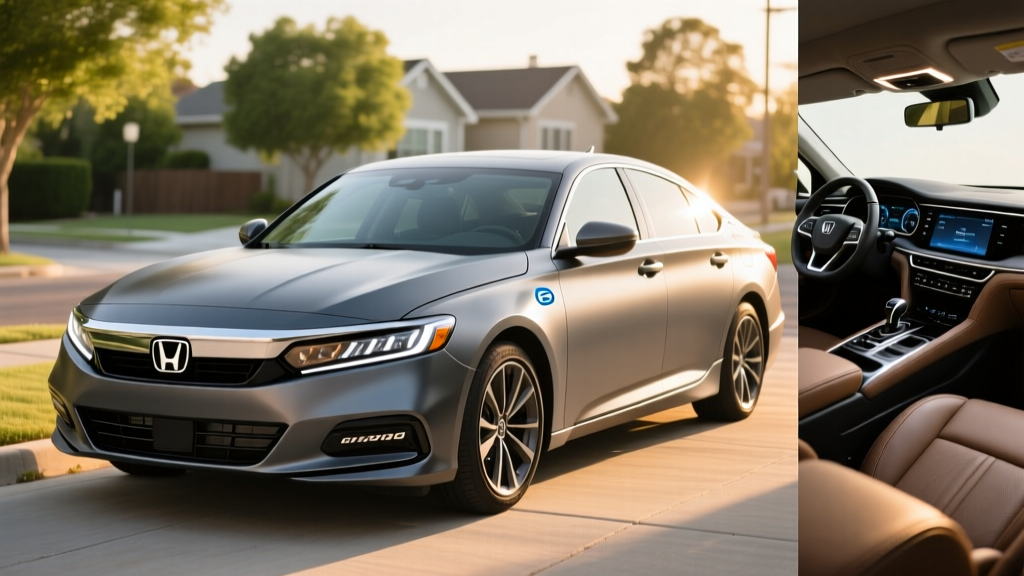
The Honda Accord Hybrid remains one of the most compelling midsize sedans for buyers who want exceptional fuel economy without plugging in. For 2026, Honda continues the hybrid powertrain across multiple trims, with the Accord Hybrid MSRP starting at $33,650 (including destination) for the Sport Hybrid trim and climbing to $39,300 for the top-tier Sport Touring Hybrid. Every Accord Hybrid pairs a 2.0-liter four-cylinder engine with a two-motor system for a combined 204 horsepower and an EPA-estimated 48 MPG combined.
If you're cross-shopping electrified sedans, the Accord Hybrid occupies a specific niche: it's a conventional hybrid electric vehicle (HEV), not a plug-in hybrid (PHEV). That means no charging cable, no electric-only range to manage, and no federal tax credit eligibility — but also no range anxiety and no home charger installation. Let's break down every number that matters.
Understanding the Accord Hybrid: HEV, Not PHEV
Conventional Hybrid (HEV) vs. Plug-In Hybrid (PHEV)
| Feature | Honda Accord Hybrid (HEV) | Typical PHEV (e.g., Toyota Prius Prime) |
|---|---|---|
| Plug-in charging required? | No — charges via regenerative braking and engine | Yes — Level 1 or Level 2 for full electric range |
| Electric-only range | ~1 mile at low speed (motor assist only) | 30-45 miles on battery alone |
| Battery capacity | ~1.0 kWh (small buffer) | 10-18 kWh usable |
| Federal tax credit (§30D) | Not eligible | Up to $7,500 if sourcing/income rules met |
| Total range | ~560 miles (12.8-gal tank) | ~400-500 miles combined EV + gas |
| Best for | Drivers without home charging access | Drivers with home charging + short commutes |
The Accord Hybrid uses Honda's two-motor hybrid system, which operates primarily in electric-drive mode at low and moderate speeds. The gasoline engine acts mostly as a generator, spinning to produce electricity that feeds the drive motor. At highway cruising speeds, a lock-up clutch connects the engine directly to the wheels for efficiency. This is fundamentally different from a PHEV, which carries a much larger battery you charge from the grid and can drive 30+ miles on electricity alone before the engine engages.
The Accord Hybrid does not have a charging port. You cannot plug it in. The small lithium-ion battery recharges through regenerative braking and the gasoline engine. If you want plug-in capability in a Honda sedan, you'd need to look outside the Accord lineup — Honda currently does not offer an Accord PHEV in the US market.
2026 Accord Hybrid MSRP by Trim
| Trim | MSRP (incl. destination) | Key Additions |
|---|---|---|
| Sport Hybrid | $33,650 | 19" wheels, sport pedals, black accents, heated front seats, wireless CarPlay/Android Auto |
| EX-L Hybrid | $35,700 | Leather seats, power passenger seat, wireless charging pad, low-speed braking control |
| Sport-L Hybrid | $36,050 | Sport exterior styling + leather interior, heated steering wheel |
| Sport Touring Hybrid | $39,300 | Bose 12-speaker audio, heated rear seats, front ventilated seats, Honda Sensing suite enhancements, navigation |
All trims share the same hybrid powertrain. The price spread from base Sport Hybrid to Sport Touring Hybrid is $5,650, with most of that gap driven by interior materials, audio, and advanced comfort features rather than performance or efficiency differences.
Tax Credit Eligibility
The Accord Hybrid does not qualify for the federal §30D clean vehicle tax credit. Under current IRS rules, the §30D credit applies only to battery electric vehicles (BEVs) and plug-in hybrids (PHEVs) that meet battery capacity thresholds (at least 7 kWh for PHEVs), critical-mineral sourcing requirements, MSRP caps, and buyer income limits. Because the Accord Hybrid is a conventional HEV with a battery far below that threshold, it is ineligible.
Some states and local utilities offer rebates or incentives for conventional hybrids, but these vary widely by jurisdiction. Check your state energy office or utility provider for current programs — never assume a specific amount without verifying against official sources.
Fuel Economy: EPA Ratings and Real-World MPG
| Metric | EPA Estimate | Real-World Expectation |
|---|---|---|
| City MPG | 51 MPG | 48-55 MPG (hybrids excel in stop-and-go) |
| Highway MPG | 44 MPG | 40-46 MPG (engine direct-drive at cruise) |
| Combined MPG | 48 MPG | 44-50 MPG depending on driving mix |
| Fuel tank capacity | 12.8 gallons | — |
| Total range | ~614 miles | ~550-640 miles real-world |
Source: fueleconomy.gov — EPA estimates for 2025/2026 Accord Hybrid. Actual results will vary.
Why Hybrids Often Beat EPA in the City
The Accord Hybrid's 51 MPG city rating is higher than its 44 MPG highway figure — the opposite of what you'd see in a conventional gas car. This happens because city driving generates frequent braking events, which feed energy back into the battery via regenerative braking. At low speeds, the Accord Hybrid runs almost entirely on its electric drive motor, with the gasoline engine spinning only when the battery buffer depletes. Stop-and-go traffic, paradoxically, is where this powertrain shines brightest.
On the highway, the engine connects directly to the front wheels through the lock-up clutch. While efficient, you lose the regenerative advantage, and aerodynamic drag at 70-80 MPH reduces economy. Expect 40-44 MPG on a sustained 75-MPH interstate cruise, with slightly better numbers at 65 MPH.
Cold Weather Impact
Hybrid fuel economy drops in winter, but less dramatically than EV range. Expect a 5-10% reduction in MPG during sub-freezing months as the engine runs more frequently to maintain cabin heat and battery temperature. Unlike a full EV, you're not risking being stranded — the gasoline tank provides consistent range regardless of temperature.
Powertrain and Performance Specs
| Specification | Value |
|---|---|
| Engine | 2.0L Atkinson-cycle inline-4 |
| Engine output | 146 hp / 134 lb-ft torque |
| Drive motor output | 181 hp / 247 lb-ft torque |
| Combined system output | 204 hp |
| 0-60 mph (est.) | ~7.0 seconds |
| Drivetrain | Front-wheel drive (FWD) |
| Transmission | Direct-drive (no conventional gearbox) |
| Battery type | Lithium-ion, ~1.0 kWh |
| Curb weight | ~3,477 lbs (Sport Touring Hybrid) |
Honda's two-motor hybrid system eliminates the traditional transmission entirely. There are no gears to shift — the electric drive motor provides smooth, linear torque from a stop, and the engine couples in seamlessly at highway speeds. The result is refinement that feels closer to an EV than a conventional gas car, especially in city driving. The 204 combined horsepower is adequate for confident highway merging and passing, though it won't match the acceleration of turbocharged competitors or any battery-electric sedan.
Battery Warranty, Reliability, and Replacement Cost
Honda Hybrid Battery Warranty
- Coverage: 8 years / 100,000 miles (10 years / 150,000 miles in CARB states including CA, NY, MA, and others)
- What's covered: Hybrid battery pack and hybrid system components (inverter, drive motor)
- Threshold: Honda warrants the battery against defects and excessive capacity loss
- Replacement cost (out of warranty): $2,000–$4,000 for the hybrid battery pack, based on current parts pricing and independent shop labor
Hybrid battery longevity is consistently strong across Honda's lineup. The Accord Hybrid's lithium-ion pack is small (~1.0 kWh) and operates within a narrow state-of-charge window — it never fully charges or fully depletes — which dramatically reduces degradation stress compared to a full EV battery. Real-world data from earlier-generation Accord Hybrids (2014-2022) shows most original batteries lasting well beyond 150,000 miles without significant issues.
If replacement is eventually needed, the cost is a fraction of what a full EV battery swap would run. The smaller battery pack and simpler integration mean lower parts cost and less labor. Independent hybrid specialists often offer refurbished packs for $1,500-$2,500, while a new OEM pack through a Honda dealer typically falls in the $3,000-$4,000 range installed.
Overall Reliability
Honda's hybrid powertrain has a strong reliability track record. The two-motor system has fewer wear components than a conventional automatic transmission (no torque converter, no planetary gearset, no clutch packs). Brake pad life is also extended — regenerative braking handles most deceleration, so friction brakes see far less use. Owners commonly report 60,000-80,000 miles on original brake pads.
Who Should Buy the Accord Hybrid vs. a PHEV or EV?
Choose the Accord Hybrid (HEV) if:
- You don't have reliable access to home or workplace Level 2 charging
- You want 550+ miles of total range without planning charging stops
- Your budget is $33,000-$40,000 and you want low running costs
- You drive a mix of city and highway and want simplicity — just fill up with gas
- You don't want to manage a plug-in routine or install a home charger ($500-$2,000+ install cost)
Choose a PHEV (e.g., Toyota Prius Prime, Hyundai Tucson PHEV) if:
- You have Level 2 charging at home and a commute under 40 miles round-trip
- You want to drive most daily miles on electricity but keep a gas engine for road trips
- You can qualify for the federal §30D tax credit (up to $7,500, subject to income, MSRP caps, and battery sourcing rules)
Choose a full EV (e.g., Tesla Model 3, Hyundai Ioniq 6) if:
- You have home charging and want the lowest per-mile energy cost (~$0.04-$0.06/mi vs. ~$0.10-$0.14/mi for the Accord Hybrid)
- You want 300+ miles of EPA range, instant torque, and zero tailpipe emissions
- You qualify for the full $7,500 federal credit plus any state EV rebates
- You're comfortable planning DC fast-charging stops on road trips
Total Cost of Ownership: Accord Hybrid vs. Gas Accord
At 48 MPG combined and $3.40/gallon regular unleaded (2026 national average), the Accord Hybrid costs roughly $0.07 per mile in fuel. A conventional gas-only midsize sedan averaging 30 MPG combined would cost about $0.11 per mile. Over 15,000 miles per year, that's a fuel savings of approximately $600 annually, or $3,000 over five years.
The hybrid powertrain typically adds $1,500-$2,000 to the purchase price versus a comparable gas-only trim. With fuel savings of $600/year, the payback period is roughly 2.5-3.5 years — well within typical ownership duration. Add in extended brake pad life and the strong resale value of hybrid sedans, and the total cost of ownership tilts clearly in the hybrid's favor for most buyers.
Pros and Cons
Pros
- 48 MPG combined EPA — among the best in the midsize sedan class
- No plug-in charging required — works with existing gas station infrastructure
- Refined, smooth power delivery that feels EV-like in city driving
- Strong 8yr/100k-mile hybrid battery warranty (10yr/150k in CARB states)
- 614-mile total range eliminates road-trip range anxiety
- Lower brake wear thanks to regenerative braking
- Honda Sensing ADAS suite standard on all trims
Cons
- No federal tax credit eligibility (HEV, not PHEV or BEV)
- FWD only — no AWD option for snow-belt buyers
- 204 hp is adequate, not quick — 0-60 in ~7 seconds trails turbocharged rivals
- Highway MPG drops to 44 — less advantage on long interstate commutes
- No spare tire — tire repair kit only on most trims
- Base Sport Hybrid trim starts at $33,650 — a premium over some non-hybrid competitors
Frequently Asked Questions
How many MPG does the Honda Accord Hybrid get?
The 2026 Accord Hybrid is EPA-rated at 51 MPG city, 44 MPG highway, and 48 MPG combined. In real-world driving, many owners report matching or slightly exceeding the city figure in stop-and-go traffic, while highway-heavy driving typically yields 40-44 MPG.
Does the Accord Hybrid need to be plugged in?
No. The Accord Hybrid is a conventional hybrid (HEV). Its small lithium-ion battery recharges automatically through regenerative braking and the gasoline engine. There is no charging port and no plug-in capability.
Does the Honda Accord Hybrid qualify for a tax credit?
No. The federal §30D clean vehicle credit applies only to plug-in hybrids (PHEVs) and battery electric vehicles (BEVs) that meet battery capacity, sourcing, MSRP, and income requirements. The Accord Hybrid is a conventional HEV and is not eligible. Check your state and utility for any local hybrid incentives, which vary by jurisdiction.
How long will the Accord Hybrid battery last?
Honda warrants the hybrid battery for 8 years/100,000 miles (10 years/150,000 miles in CARB states). Based on long-term data from previous Accord Hybrid generations, most batteries last well beyond 150,000 miles. Out-of-warranty replacement runs $2,000-$4,000 depending on OEM vs. refurbished parts and labor source.
Is the Accord Hybrid better than a full EV?
It depends on your situation. The Accord Hybrid is better if you lack home charging, drive long highway routes, or want the lowest upfront cost with no charging infrastructure investment. A full EV is better if you have home Level 2 charging, want the lowest per-mile energy cost (~$0.04-$0.06/mi vs. ~$0.07-$0.10/mi for the hybrid), and qualify for the $7,500 federal tax credit that can bring EV pricing close to the Accord Hybrid's MSRP.
What is the 2026 Accord Hybrid MSRP?
The 2026 Honda Accord Hybrid starts at $33,650 for the Sport Hybrid trim (including destination). The EX-L Hybrid is $35,700, the Sport-L Hybrid is $36,050, and the fully loaded Sport Touring Hybrid is $39,300.
Does the Accord Hybrid have all-wheel drive?
No. All Accord Hybrid trims are front-wheel drive only. If AWD is a priority, consider the Toyota Camry Hybrid (AWD available) or a hybrid SUV like the Honda CR-V Hybrid.