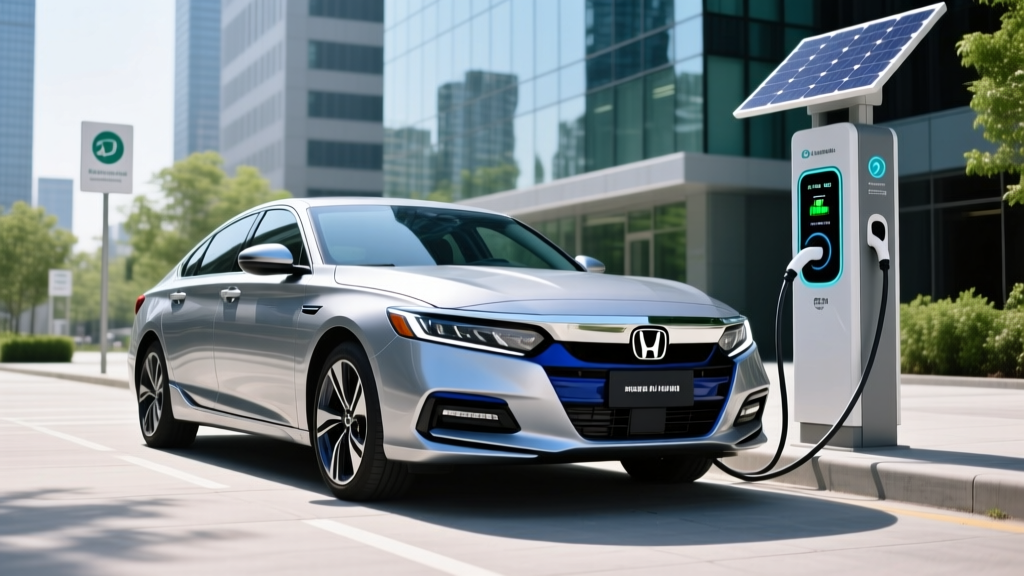
The Honda Accord Hybrid remains one of the most compelling midsize sedans for buyers who want electric-like efficiency without plugging in. For the 2026 model year, Honda continues with its proven two-motor hybrid system, delivering class-leading city fuel economy and a refined driving experience. If you've been searching for an Accord Hybrid and wondering whether it stacks up against plug-in hybrids or full EVs, this guide breaks down every number that matters.
Quick Verdict: Who the Accord Hybrid Is For
The 2026 Honda Accord Hybrid targets drivers who want maximum fuel savings with zero lifestyle changes. No charging cables, no range planning, no home electrical upgrades. You fill up at any gas station and let Honda's two-motor system handle the rest. It's ideal for commuters who rack up city miles, rideshare drivers watching fuel costs, and anyone who wants a spacious sedan that sips fuel without the complexity of a plug-in hybrid (PHEV) or the charging infrastructure demands of a battery electric vehicle (BEV).
Choose a PHEV instead if: You have a short commute (under 30 miles), can charge at home, and want electric-only daily driving with a gas backup.
Choose a full EV if: You have Level 2 home charging, rarely exceed 250 miles between stops, and want zero tailpipe emissions.
EPA Fuel Economy and Real-World MPG
The 2026 Accord Hybrid carries over the powertrain introduced with the eleventh generation, and the EPA numbers remain among the best in the midsize sedan segment. According to fueleconomy.gov, the Accord Hybrid posts:
| Trim | City MPG | Highway MPG | Combined MPG |
|---|---|---|---|
| Sport / Sport-L | 51 | 44 | 48 |
| EX-L | 51 | 44 | 48 |
Those numbers are for the Sport, Sport-L, and EX-L trims equipped with the standard hybrid powertrain. Honda does not offer a non-hybrid Accord for 2026 — every Accord sold in the U.S. now uses the hybrid system, making fuel economy a non-issue across the lineup.
Real-World MPG: What Owners Actually See
One advantage of Honda's two-motor hybrid system is that real-world city driving often exceeds the EPA city rating. In stop-and-go traffic, the electric motor handles most propulsion while the 2.0-liter engine acts as a generator. Owners regularly report 50–55 MPG in urban commuting during moderate temperatures.
Highway driving tells a different story. At sustained 75–80 mph speeds, the Accord Hybrid typically returns 40–43 MPG. The system's efficiency advantage shrinks at high speed because aerodynamic drag dominates and the engine drives the wheels directly through a single fixed gear ratio. In cold weather (below 30°F), expect a 5–8 MPG drop across the board as the engine runs more frequently to provide cabin heat and maintain battery temperature.
Powertrain Specs: How the Accord Hybrid Drives
The 2026 Accord Hybrid uses Honda's fourth-generation two-motor hybrid system. Here's what's under the hood:
| Specification | Value |
|---|---|
| Engine | 2.0L Atkinson-cycle inline-4 |
| Engine Output | 146 hp / 134 lb-ft torque |
| Drive Motor Output | 181 hp / 247 lb-ft torque |
| Combined System Output | 204 hp / 247 lb-ft torque |
| Transmission | e-CVT (single-speed direct drive + engine clutch) |
| Drivetrain | Front-wheel drive |
| 0–60 mph | ~7.2 seconds (est.) |
| Hybrid Battery | ~1.0 kWh lithium-ion (self-charging HEV) |
The Accord Hybrid operates in three modes seamlessly managed by the powertrain computer:
- EV Drive: Battery powers the drive motor alone — used at low speeds and light acceleration for short distances (typically under 1 mile).
- Hybrid Drive: The gas engine spins a generator that feeds electricity to the drive motor. This is the primary mode for city and suburban driving.
- Engine Drive: At highway cruising speeds, a lock-up clutch connects the engine directly to the front wheels for maximum efficiency.
The result is smooth, electric-motor-dominant acceleration around town with the engine kicking in seamlessly when you need more power or when highway speeds demand direct mechanical drive. The e-CVT avoids the rubber-band effect of traditional belt-driven CVTs because there's no belt — it's a gearset connecting two motor-generators.
HEV vs. PHEV vs. EV: Where the Accord Hybrid Fits
Shoppers cross-shopping the Accord Hybrid often wonder how it compares to plug-in alternatives. Here's the fundamental distinction:
| Factor | Accord Hybrid (HEV) | Typical PHEV (e.g., Toyota Prius Prime) | Full EV (e.g., Tesla Model 3) |
|---|---|---|---|
| Plug-in Required? | No — self-charging via regenerative braking and engine | Yes — needs Level 1 or Level 2 for electric range | Yes — Level 2 home or DC fast charging |
| Electric-Only Range | Under 1 mile (low speed only) | 35–45 miles | 250–360 miles |
| Fuel / Energy | Gasoline only | Gasoline + electricity | Electricity only |
| Combined MPG / MPGe | 48 MPG | 48 MPG (hybrid mode) / 127 MPGe (electric) | 132 MPGe |
| Home Charging Needed? | No | Recommended (120V works, 240V ideal) | Essential (240V Level 2) |
| §30D Federal Tax Credit | Not eligible | Up to $7,500 (if requirements met) | Up to $7,500 (if requirements met) |
| Starting MSRP | ~$34,695 | ~$33,445 (Prius Prime) | ~$39,990 (Model 3 RWD) |
The Accord Hybrid's advantage is simplicity. You never think about charging, battery state, or trip planning. Its trade-off is that you can't access the §30D federal tax credit, which is reserved for plug-in vehicles with at least 7 kWh of battery capacity under current IRS rules. The Accord Hybrid's battery is approximately 1 kWh — far below the PHEV/EV threshold.
Pricing, Trims, and Tax Credit Eligibility
For 2026, the Honda Accord Hybrid is available in three trims:
| Trim | MSRP (incl. destination) | Key Features |
|---|---|---|
| Sport | $34,695 | 19-inch wheels, wireless CarPlay/Android Auto, heated front seats, Honda Sensing suite |
| Sport-L | $36,345 | Leather-trimmed seats, power passenger seat, wireless phone charger |
| EX-L | $38,695 | Leather, power moonroof, heated rear seats, premium audio |
- ❌ Does NOT qualify — battery capacity below 7 kWh minimum
- ❌ Not a plug-in vehicle — cannot charge from external source
- Some states may offer minor hybrid incentives (check your state energy office)
- Employer or utility rebates for fuel-efficient vehicles may apply locally
While the Accord Hybrid misses the federal credit, its lower base price compared to most PHEVs and EVs narrows the gap. A fully loaded EX-L at roughly $38,700 still undercuts many competing electrified sedans even after their tax credit adjustments.
Battery Warranty, Reliability, and Replacement Cost
Hybrid battery longevity is the number-one concern for first-time hybrid buyers. Honda addresses this with one of the industry's strongest warranty packages:
- Duration: 8 years / 100,000 miles (10 years / 150,000 miles in CARB states including CA, CO, CT, ME, MA, NJ, NY, OR, RI, VT, WA)
- Coverage: Hybrid battery pack, electric motor, power control unit, and related hybrid system components
- Capacity threshold: Honda warrants against defects and abnormal degradation — no specific percentage retention guarantee as with EVs
Real-World Reliability Data
Honda's hybrid system has been in production since the early 2000s, and the current two-motor architecture (introduced in 2014 for the Accord) has proven exceptionally durable. Third-party reliability surveys from Consumer Reports and J.D. Power consistently rate the Accord Hybrid at or above average. The hybrid battery in Honda's system experiences relatively shallow charge-discharge cycles because the powertrain computer keeps the battery in a narrow state-of-charge window — typically between 40% and 70%. This strategy dramatically reduces stress on the lithium-ion cells.
Based on repair industry data and owner reports, Accord Hybrid battery replacement (if needed out of warranty) runs approximately $2,000–$4,000 including parts and labor. However, most hybrid batteries last well beyond the warranty period. Many owners report 150,000–200,000+ miles with no significant battery degradation. The smaller battery size (compared to a full EV) also means lower replacement cost if failure does occur.
For comparison, the NHTSA has not issued any hybrid-battery-specific recalls for the current-generation Accord Hybrid, and Honda's hybrid components share commonality across the CR-V Hybrid and Civic Hybrid, ensuring parts availability for years to come.
Daily Ownership: What Living with the Accord Hybrid Is Like
Beyond the spec sheet, the Accord Hybrid distinguishes itself with practical ownership advantages:
- No charging infrastructure needed: If you live in an apartment, park on the street, or simply don't want to manage charging, the HEV eliminates that friction entirely.
- Regenerative braking: The Accord Hybrid uses regen to slow the car and recharge the battery, reducing brake wear. Many owners report 60,000–80,000 miles on original brake pads.
- Low maintenance: No oil changes related to the hybrid system. The 2.0L engine still requires standard oil changes (typically every 7,500–10,000 miles), but the engine runs less frequently than in a conventional gas car.
- Cargo space: The hybrid battery is packaged under the rear seats, preserving a full 16.7 cubic feet of trunk space — identical to non-hybrid midsize competitors.
- Honda Sensing: Standard across all trims, this Level 2 driver-assistance suite includes adaptive cruise control, lane-keeping assist, and collision mitigation braking.
Pros and Cons at a Glance
- Best-in-class city MPG (51 city EPA)
- No charging required — fill up anywhere
- Spacious cabin with full trunk (16.7 cu ft)
- Strong 8-year/100k-mile hybrid warranty (10yr in CARB states)
- Refined ride quality and quiet cabin
- Competitive pricing from ~$34,695
- No federal tax credit eligibility
- Highway MPG trails city (44 hwy) — less efficient on road trips
- No all-wheel-drive option (FWD only)
- Electric-only driving limited to under 1 mile at low speed
- CVT-like engine drone under hard acceleration
Frequently Asked Questions
How many MPG does the 2026 Honda Accord Hybrid get?
The EPA rates the Accord Hybrid at 51 MPG city, 44 MPG highway, and 48 MPG combined. In real-world city driving, many owners see 50–55 MPG. Highway driving at 75+ mph typically returns 40–43 MPG. Cold weather reduces these figures by roughly 5–8 MPG.
Does the Accord Hybrid need to be plugged in?
No. The Accord Hybrid is a conventional self-charging hybrid (HEV), not a plug-in hybrid (PHEV). It recharges its small lithium-ion battery through regenerative braking and the gasoline engine. You never need to plug it in — just fill up at any gas station.
Can the Accord Hybrid drive on electric power alone?
Yes, but only at very low speeds (typically under 25 mph) and for short distances (under 1 mile). The electric motor provides the majority of propulsion in city driving, but the gas engine is always available to generate electricity or directly drive the wheels. This is fundamentally different from a PHEV, which offers 30–45 miles of true electric-only range.
Is the Accord Hybrid reliable? What about battery replacement cost?
Honda's hybrid system has an excellent reliability track record spanning two decades. The hybrid battery is warranted for 8 years/100,000 miles (10 years/150,000 miles in CARB states). Out-of-warranty replacement costs approximately $2,000–$4,000, but most batteries last 150,000+ miles without significant issues thanks to Honda's conservative charge management strategy.
Does the 2026 Accord Hybrid qualify for any tax credit?
No. The federal §30D clean vehicle credit requires a minimum battery capacity of 7 kWh and plug-in charging capability. The Accord Hybrid's battery is approximately 1 kWh and it cannot be plugged in. It does not qualify for the federal tax credit. Check your state's energy office for any local hybrid incentives, which are uncommon but occasionally available.
How does the Accord Hybrid compare to the Toyota Camry Hybrid?
The 2026 Camry Hybrid (redesigned for 2025) offers a comparable 51/49/50 MPG rating with standard all-wheel drive — something the Accord Hybrid lacks. The Camry Hybrid starts slightly lower but the Accord Hybrid offers a more premium interior and slightly larger trunk. Both are excellent choices; the Accord wins on cabin refinement and cargo space, while the Camry wins on AWD availability and marginally better highway MPG.
Should I buy the Accord Hybrid or a full EV?
If you have reliable Level 2 home charging, drive under 250 miles daily, and want the lowest per-mile energy cost, a full EV like the Tesla Model 3 or Hyundai Ioniq 6 will save more on fuel and maintenance over time — plus they qualify for up to $7,500 in federal tax credits. If you lack home charging, regularly take long road trips, or simply want zero complexity, the Accord Hybrid is the pragmatic choice. Calculate your local electricity rates versus gas prices and factor in the $7,500 credit before deciding.