Honda Accord Hybrid MPG: What the EPA Says vs. What You'll Actually Get
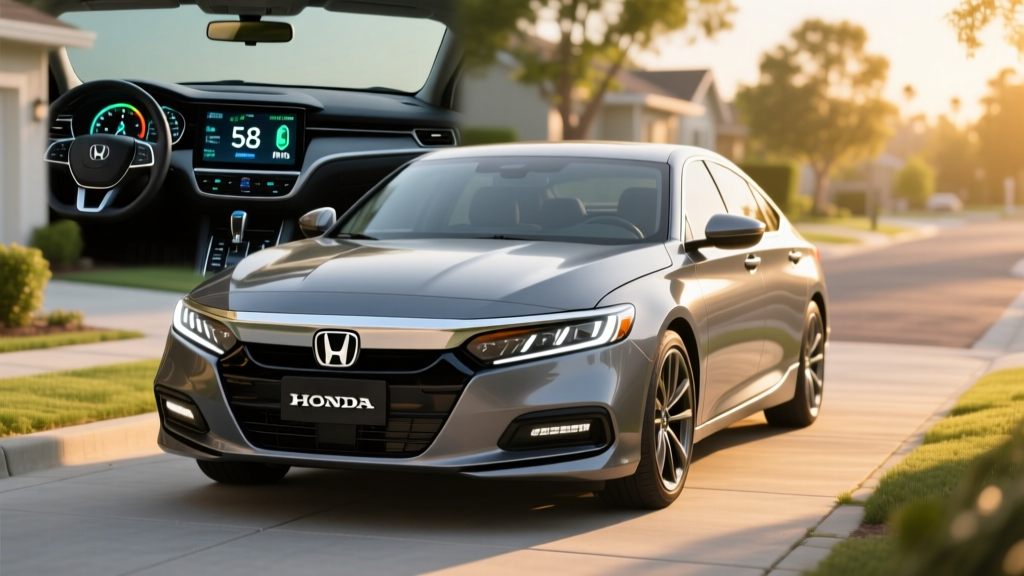
The 2026 Honda Accord Hybrid returns the same two-motor e-CVT powertrain that has made it one of the best-selling midsize hybrid sedans in the U.S. For buyers researching Accord Hybrid MPG, the headline figure is 48 MPG combined — but real-world results often diverge from the sticker depending on your driving mix, climate, and whether you choose the Sport/Limited trims (which carry a slight efficiency penalty from larger wheels).
| Trim | City MPG | Highway MPG | Combined MPG | Annual Fuel Cost* |
|---|---|---|---|---|
| EX-L Hybrid | 51 | 44 | 48 | ~$1,150 |
| Sport-L Hybrid | 51 | 44 | 48 | ~$1,150 |
| Touring Hybrid | 50 | 43 | 47 | ~$1,175 |
*Based on 15,000 miles/year, $3.50/gal regular unleaded, 55% city / 45% highway. Source: fueleconomy.gov
The Accord Hybrid achieves these numbers through Honda's two-motor hybrid system, which operates primarily as a series hybrid at low and moderate speeds — the gas engine acts as a generator while the 184-hp drive motor handles propulsion. At highway cruising speeds, a lockup clutch connects the 2.0-liter Atkinson-cycle four-cylinder directly to the wheels for efficiency.
Real-World Accord Hybrid MPG: City vs. Highway vs. Cold Weather
Like most hybrids, the Accord HEV (hybrid electric vehicle) punches above its EPA rating in stop-and-go city driving. The regenerative braking system recaptures energy during deceleration, and the engine shuts off entirely at stops. Owners who drive predominantly urban routes regularly report 52–55 MPG in warm weather. Conversely, sustained highway driving at 75+ MPH can pull combined figures down to 41–43 MPG, since the electric motor contributes less at high constant speeds and aerodynamic drag dominates.
Cold weather introduces a 10–15% penalty. In freezing temperatures, the engine runs more frequently to generate cabin heat (the Accord Hybrid lacks a heat pump, unlike some competitors) and the battery's internal resistance increases. Expect 40–43 MPG combined in sub-30°F conditions, still well above the non-hybrid Accord's 29 MPG combined.
Powertrain Specs: Horsepower, Engine, and How the Hybrid System Works
| Specification | Detail |
|---|---|
| Engine | 2.0L Atkinson-cycle DOHC 4-cylinder |
| Engine Horsepower | 146 hp @ 6,100 rpm |
| Drive Motor Output | 184 hp / 247 lb-ft torque |
| Combined System Output | 204 hp |
| Transmission | e-CVT (single-speed direct drive + engine clutch) |
| Drivetrain | Front-wheel drive |
| 0–60 MPH | ~7.0 seconds |
| Hybrid Battery | ~1.0 kWh lithium-ion (self-charging, no plug) |
| Towing Capacity | Not rated for towing |
The Accord Hybrid uses Honda's fourth-generation two-motor hybrid system. The key insight: this is a conventional hybrid (HEV), not a plug-in. You never plug it in. The battery charges through regenerative braking and the gasoline engine. The small ~1.0 kWh battery pack is sufficient to power the car on electric-only mode for very short distances at low speeds (roughly 1–2 miles under 25 MPH), but its primary role is to buffer energy for the drive motor and smooth the engine's load.
HEV vs. PHEV vs. EV: Which Powertrain Fits Your Life?
Not every buyer needs a plug-in. Here's how the Accord Hybrid stacks up against PHEV and full EV alternatives:
| Factor | Accord Hybrid (HEV) | Midsize PHEV (e.g., Toyota Prius Prime) | Battery EV (e.g., Tesla Model 3) |
|---|---|---|---|
| Plug Required? | No — gas only | Yes, for EV range benefit | Yes, always |
| Electric-Only Range | ~1 mile (low speed) | 35–44 miles | 270–360 miles |
| Combined MPG / MPGe | 48 MPG | 52 MPG + 127 MPGe | 132 MPGe |
| Home Charging Needed | No | Recommended (Level 2) | Essential (Level 2) |
| Base MSRP (2026) | ~$34,990 | ~$34,595 | ~$40,240 |
| Federal Tax Credit | Not eligible | Up to $3,750 (varies) | Up to $7,500 (varies) |
| Best For | No home charging, long trips | Short commutes + home charging | Home charging, low running cost |
Choose the Accord Hybrid if: You lack access to home or workplace charging, regularly take road trips exceeding 300 miles, or want maximum simplicity — just fill up with gas and go. The Accord HEV removes all charging logistics while still cutting fuel costs by roughly 40% compared to a non-hybrid midsize sedan.
Consider a PHEV instead if: Your daily commute is under 40 miles and you can install a Level 2 charger at home. A PHEV lets you drive most weekdays on electricity alone while retaining a gas engine for longer trips.
Consider a full EV if: You have reliable home charging, drive under 300 miles between charging opportunities, and want the lowest per-mile fuel cost (typically $0.04–$0.06/mile on residential electricity vs. $0.10–$0.12/mile in the Accord Hybrid).
Pricing, Trims, and Tax Credit Eligibility
The 2026 Accord Hybrid is available in three trims. Pricing includes destination:
| Trim | MSRP | Key Features |
|---|---|---|
| EX-L Hybrid | $34,990 | Leather, heated front seats, wireless CarPlay/Android Auto, 12.3" touchscreen |
| Sport-L Hybrid | $36,490 | Sport-tuned suspension, black exterior accents, 19" alloy wheels |
| Touring Hybrid | $40,390 | Adaptive dampers, Bose 12-speaker audio, HUD, ventilated front seats, heated rear seats |
Tax credit note: The Accord Hybrid is a conventional HEV — it does not qualify for the federal §30D Clean Vehicle Credit, which applies only to plug-in hybrids (PHEVs) and battery electric vehicles (BEVs) meeting battery sourcing, MSRP, and buyer income requirements per IRS guidelines. Some states offer their own hybrid incentives, but these vary widely by jurisdiction. Check your state's energy office or DMV for current programs.
Hybrid Battery Warranty, Lifespan, and Replacement Cost
Battery longevity is the number-one concern for hybrid buyers. Honda backs the Accord Hybrid's lithium-ion battery pack with a robust warranty:
• 8 years / 100,000 miles (49 states + D.C.)
• 10 years / 150,000 miles (California and states adopting CARB emissions standards: CO, CT, ME, MD, MA, NJ, NY, OR, RI, VT, WA)
• Coverage: defects and capacity loss below approximately 60% of original capacity
• The 12V auxiliary battery carries a separate 3-year/36,000-mile warranty
In practice, Honda's hybrid batteries have proven exceptionally durable. Real-world data from fleet operators and long-term owners suggests most Accord Hybrid battery packs retain 85–90% of their original capacity at 150,000 miles. The small ~1.0 kWh pack undergoes shallow charge/discharge cycles (typically operating between 40–60% state of charge), which dramatically reduces degradation compared to a full EV battery that cycles from 10–90% daily.
Replacement cost if out of warranty: A new OEM hybrid battery pack for the Accord Hybrid currently runs approximately $2,500–$3,500 installed at a Honda dealer. Third-party refurbished packs are available for $1,500–$2,200. Given the warranty coverage and the battery's demonstrated longevity, most owners will never face this expense.
The broader powertrain — including the engine, drive motor, generator, and e-CVT — is covered under Honda's 5-year/60,000-mile powertrain warranty. Honda's hybrid components have consistently earned top reliability scores; the Accord Hybrid carries strong predicted-reliability ratings from major automotive evaluators.
Driving Impressions and Ownership Practicalities
The Accord Hybrid drives like a normal sedan — which is exactly its appeal. The electric motor's instant torque gives it responsive off-the-line acceleration, and the transition between electric and gas power is nearly imperceptible in normal driving. The e-CVT avoids the rubber-band feeling of older continuously variable transmissions because the engine's direct-drive clutch engages at highway speeds, creating a fixed gear ratio.
Cabin noise is well-managed, though the engine does drone under hard acceleration (a characteristic of Atkinson-cycle engines held at constant RPM by the e-CVT). The Touring trim's adaptive dampers add a noticeable improvement in ride quality over rough pavement.
Practical ownership advantages:
- No charging infrastructure needed — works with any gas station, anywhere
- Lower maintenance than gas-only — regenerative braking extends brake pad life to 80,000–100,000+ miles; no timing belt (chain-driven); oil changes every 7,500–10,000 miles
- Insurance: Typically 5–10% higher than a non-hybrid Accord due to higher MSRP and specialized repair training, but generally lower than full EV insurance
- Depreciation: The Accord Hybrid retains value well — expect approximately 55–60% residual value at 5 years / 60,000 miles, aided by strong hybrid demand in the used market
Pros and Cons at a Glance
- 48 MPG combined with no plug-in required
- 600+ mile real-world range per tank
- Spacious cabin with 16.7 cu ft trunk (hybrid battery under rear seats, no cargo penalty)
- Standard Honda Sensing ADAS suite (Level 2 driver assist)
- Strong hybrid battery warranty (up to 10yr/150k mi in CARB states)
- Low maintenance costs and proven long-term reliability
- No federal tax credit (HEV, not PHEV)
- Highway MPG drops to low 40s at 75+ MPH
- No all-wheel-drive option (FWD only)
- Engine drone under hard acceleration
- Touring trim pushes past $40K with limited luxury features vs. premium brands
- Cold-weather MPG penalty of 10–15%
Frequently Asked Questions
How many MPG does the 2026 Honda Accord Hybrid get?
The EPA rates the Accord Hybrid EX-L and Sport-L at 51 city / 44 highway / 48 combined MPG. The Touring trim rates slightly lower at 50/43/47 MPG due to larger 19-inch wheels and additional weight. In real-world city driving, many owners report exceeding the EPA city figure, reaching 52–55 MPG.
Does the Accord Hybrid need to be plugged in?
No. The Accord Hybrid is a conventional self-charging hybrid (HEV). It charges its small lithium-ion battery through regenerative braking and the gasoline engine. You simply fill it with regular unleaded gasoline like any other car.
How far can the Accord Hybrid drive on electric only?
Only about 1–2 miles at speeds under 25 MPH. The Accord Hybrid's electric motor assists the engine continuously, but the ~1.0 kWh battery is too small for meaningful electric-only range. If you want 30+ miles of electric-only driving, you'd need a plug-in hybrid (PHEV) or a full battery EV.
Is the Accord Hybrid battery reliable and what does replacement cost?
Yes. Honda's hybrid batteries are among the most reliable in the industry, with most retaining 85–90% capacity at 150,000 miles. The battery is warrantied for 8 years/100,000 miles (10 years/150,000 miles in CARB states). Out-of-warranty replacement runs approximately $2,500–$3,500 at a dealer, or $1,500–$2,200 with a refurbished pack.
Does the Accord Hybrid qualify for any tax credit?
The Accord Hybrid does not qualify for the federal §30D Clean Vehicle Credit because it is a conventional hybrid (HEV), not a plug-in vehicle. The federal credit applies only to PHEVs and BEVs meeting specific battery sourcing, MSRP caps ($55,000 for sedans), and buyer income limits. Some states may offer separate hybrid incentives — check your local energy office for details.
How does the Accord Hybrid compare to the Toyota Camry Hybrid?
The Camry Hybrid (53 combined MPG with FWD) slightly outperforms the Accord Hybrid on fuel economy and offers an AWD option. The Accord Hybrid counters with a more spacious rear seat (40.8" vs. 38.0" rear legroom), a larger trunk, and a more refined driving feel. Both carry strong reliability records and similar hybrid battery warranties.
Is the Accord Hybrid good for long road trips?
Excellent. With 600+ miles of range per tank, comfortable seating, and Honda Sensing adaptive cruise control, the Accord Hybrid is one of the best midsize sedans for road trips. You'll stop less often for fuel than in virtually any non-hybrid vehicle, and you avoid the charging-planning logistics of a full EV on routes with sparse DC fast-charging infrastructure.
Sources: fueleconomy.gov, Honda Accord Hybrid specifications, IRS §30D Clean Vehicle Credit.