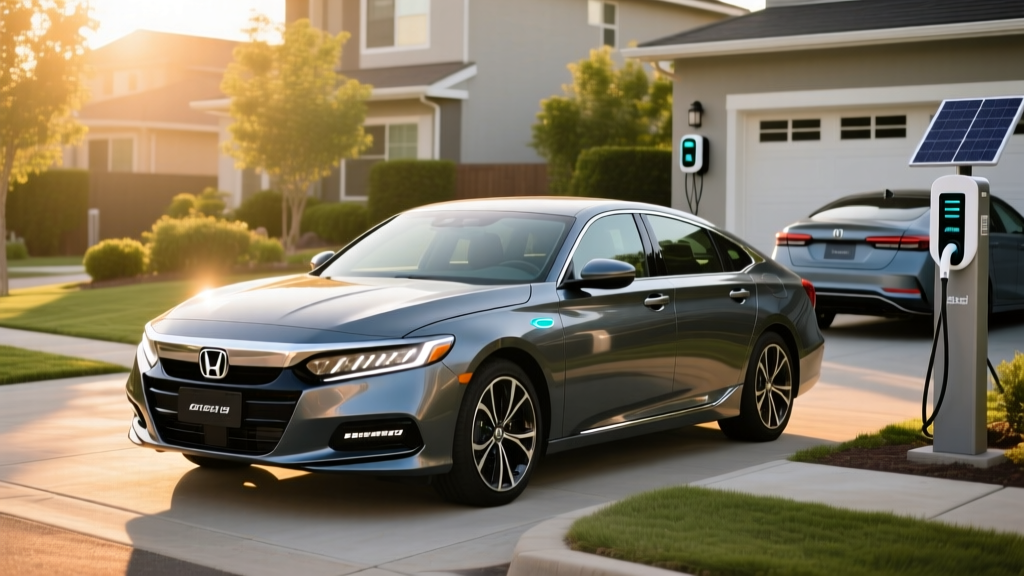
The Honda Accord Hybrid has long been the midsize sedan benchmark for buyers who want electric-like city efficiency without ever plugging in. For 2026, Honda continues its two-motor hybrid system across the Accord lineup, promising EPA ratings near 48 MPG combined. But sticker numbers only tell half the story — real-world driving conditions, trim-level weight differences, and seasonal temperature swings all shift the actual fuel economy you'll see at the pump.
This guide breaks down the 2026 Honda Accord Hybrid's EPA and real-world MPG, explains the powertrain behind the numbers, covers the hybrid battery warranty and replacement cost, and helps you decide whether this HEV, a plug-in hybrid, or a full battery-electric vehicle is the right call for your daily driving.
2026 Honda Accord Hybrid MPG: EPA Numbers and Real-World Results
The 2026 Accord Hybrid uses Honda's fourth-generation two-motor hybrid system paired with a 2.0-liter Atkinson-cycle inline-4 engine. The EPA rates the Accord Hybrid at 51 MPG city / 44 MPG highway / 48 MPG combined for the Sport and EX-L trims. The heavier Sport-L and Touring trims drop slightly to 46 MPG combined.
| Trim | City MPG | Highway MPG | Combined MPG | Fuel Tank (gal) | Est. Total Range (mi) |
|---|---|---|---|---|---|
| Sport | 51 | 44 | 48 | 12.8 | ~614 |
| EX-L | 51 | 44 | 48 | 12.8 | ~614 |
| Sport-L | 48 | 43 | 46 | 12.8 | ~589 |
| Touring | 48 | 43 | 46 | 12.8 | ~589 |
Source: fueleconomy.gov — EPA estimates. Actual mileage will vary.
Honda's hybrid system excels in stop-and-go city driving, where the electric motors handle most low-speed propulsion. In real-world testing, Accord Hybrid owners frequently report 50–54 MPG in city and suburban driving, exceeding the EPA city estimate. Highway cruising at 75+ MPH typically yields 40–43 MPG, slightly below the EPA highway number. In cold weather (below 32°F), expect a 5–10% reduction across the board as the engine runs more frequently for cabin heat and battery warmup. Drivers in mild climates with mostly city commutes regularly see lifetime averages of 47–50 MPG.
How the Accord Hybrid Powertrain Delivers 48 MPG
The Accord Hybrid does not use a conventional planetary-gear CVT like Toyota's Hybrid Synergy Drive. Instead, Honda employs a series-parallel two-motor system that operates in three distinct modes:
- EV Drive: The lithium-ion battery powers the propulsion motor directly — used for low-speed starts, gentle acceleration, and short low-speed cruising. The engine is off.
- Hybrid Drive: The gasoline engine spins a generator motor to produce electricity, which feeds the propulsion motor. The engine is not mechanically connected to the wheels. This is the dominant mode in city and suburban driving.
- Engine Drive: At steady highway speeds, a lock-up clutch mechanically connects the engine to the front wheels via a single-speed gear ratio, bypassing the electric motors for maximum efficiency at cruise.
| Specification | Value |
|---|---|
| Engine | 2.0L Atkinson-cycle DOHC inline-4 |
| Engine Horsepower | 146 hp @ 6,100 rpm |
| Engine Torque | 134 lb-ft @ 4,500 rpm |
| Propulsion Motor Output | 181 hp / 247 lb-ft torque |
| Total System Horsepower | 204 hp |
| Total System Torque | 247 lb-ft (motor-driven) |
| Hybrid Battery | ~1.1 kWh lithium-ion (NMC) |
| Drivetrain | Front-wheel drive (FWD) |
| Transmission | Direct-drive (no traditional gearbox) |
| 0–60 MPH (est.) | ~7.5 seconds |
The key to the Accord Hybrid's city MPG advantage is that the propulsion motor — not the gas engine — does most of the work below 50 MPH. The motor delivers 247 lb-ft of torque instantly from zero RPM, giving responsive off-the-line acceleration while the engine stays off or runs at its most efficient RPM as a generator. Regenerative braking recaptures energy at every stop, recharging the small battery pack. The result: you burn far less fuel in urban driving than a conventional gas Accord, which idles and accelerates purely on engine power.
HEV vs. PHEV vs. Full EV: Which Powertrain Fits Your Life?
The Accord Hybrid is a conventional hybrid (HEV) — it cannot be plugged in and has no meaningful electric-only range beyond a mile or two at very low speeds. Honda does not currently offer a plug-in hybrid (PHEV) variant of the Accord in the U.S. market. Here's how the three electrified powertrains compare for a midsize sedan buyer:
| Factor | HEV (Accord Hybrid) | PHEV (e.g., Toyota Camry PHEV) | BEV (e.g., Tesla Model 3 / Hyundai Ioniq 6) |
|---|---|---|---|
| Plug-in Required? | No — gas only | Yes (optional, but unlocks EV range) | Yes — mandatory |
| Electric-Only Range | ~1 mi (low speed only) | 35–50 mi (typical) | 270–360 mi (EPA) |
| City MPG / MPGe | 51 MPG | ~45 MPG (gas) / 100+ MPGe (electric) | 130+ MPGe |
| Total Range | ~614 mi | ~550+ mi (combined EV + gas) | 270–360 mi |
| Home Charging Needed? | No | Recommended (Level 2) | Yes (Level 2 strongly recommended) |
| Fuel Cost per Mile | ~$0.08 (at $3.50/gal) | ~$0.04 (electric) / $0.09 (gas) | ~$0.04 (at $0.14/kWh) |
| Federal Tax Credit (§30D) | Not eligible | Up to $7,500 (if eligible) | Up to $7,500 (if eligible) |
| Starting MSRP Range | $33,000–$40,000 | $35,000–$45,000 | $38,000–$55,000 |
Choose the Accord Hybrid (HEV) if: You don't have access to home or workplace charging, your commute involves heavy stop-and-go traffic, you want maximum range without range anxiety, and you prefer a lower purchase price with no plug-in logistics.
Choose a PHEV if: You have Level 2 home charging, your daily commute is under 40 miles (so you can run mostly on electricity), but you still want gas-engine flexibility for longer road trips without charging stops.
Choose a full BEV if: You have reliable home charging, your daily driving is under 250 miles, you want the lowest per-mile fuel cost and minimal maintenance, and you're ready to plan around DC fast charging on road trips.
2026 Honda Accord Hybrid Pricing and Tax Credit Eligibility
The 2026 Accord Hybrid is available in four trims, all using the same powertrain:
| Trim | MSRP (incl. destination) | Key Features |
|---|---|---|
| Sport | ~$33,600 | 19" wheels, sport styling, 10.2" touchscreen, wireless CarPlay/Android Auto |
| EX-L | ~$35,600 | Leather seats, heated front seats, power moonroof, wireless charging |
| Sport-L | ~$36,100 | Sport styling + leather interior, heated front seats |
| Touring | ~$39,600 | Navigation, Bose 12-speaker audio, ventilated front seats, heated rear seats, low-speed braking control |
Federal tax credit (§30D): The Accord Hybrid is a conventional HEV, not a plug-in vehicle. It does not qualify for the federal §30D Clean Vehicle Credit, which requires a minimum battery capacity of 7 kWh and plug-in capability. This credit applies only to PHEVs and BEVs that meet battery-sourcing, critical-mineral, MSRP cap, and buyer income requirements per IRS guidelines.
Some states offer rebates or HOV-lane access for conventional hybrids, but these vary widely by jurisdiction and change frequently. Check your state's energy office or DMV for current programs.
Hybrid Battery Warranty, Lifespan, and Replacement Cost
Hybrid battery longevity is consistently the top concern among first-time hybrid buyers. Here's what Honda provides and what the data shows:
Honda covers the Accord Hybrid's lithium-ion battery pack with a 8-year / 100,000-mile warranty (extended to 10 years / 150,000 miles in California Air Resources Board (CARB) states, which include CA, CO, CT, ME, MA, NJ, NY, OR, RI, VT, and WA). This warranty covers defects and capacity loss below a functional threshold — typically defined as the battery's inability to hold sufficient charge for normal hybrid operation.
Real-world lifespan: Honda's hybrid battery packs are designed to last the life of the vehicle. Unlike full EV batteries, the Accord Hybrid's ~1.1 kWh pack operates in a narrow state-of-charge window (roughly 20–80% SoC), managed by the hybrid control system to minimize degradation. This shallow-cycling strategy dramatically reduces wear. Data from earlier-generation Honda hybrids (Insight, older Accords) shows battery packs routinely exceeding 150,000–200,000 miles before any capacity-related service is needed.
Replacement cost: If the hybrid battery does fail outside warranty, a replacement pack from Honda currently costs approximately $2,000–$3,500 (parts), with labor adding $500–$1,000 depending on the dealership. Third-party refurbished packs are available for $1,000–$2,000. This is far less than a full EV battery replacement ($8,000–$20,000), because the hybrid pack is much smaller.
| Item | Details |
|---|---|
| Battery Chemistry | Lithium-ion (NMC) |
| Battery Capacity | ~1.1 kWh |
| Warranty (Federal) | 8 years / 100,000 miles |
| Warranty (CARB States) | 10 years / 150,000 miles |
| OEM Replacement Cost | $2,500–$4,500 (parts + labor) |
| Expected Lifespan | 150,000–200,000+ miles |
Reliability, Safety, and Long-Term Ownership Costs
The Accord Hybrid benefits from Honda's extensive hybrid production history and the Accord platform's strong reliability record. The two-motor hybrid system has fewer moving parts than a conventional automatic transmission — there's no torque converter, no multi-speed gearbox, and no starter motor. The engine itself runs under lighter load because the electric motors handle acceleration demand.
Maintenance advantages over gas-only Accords:
- Regenerative braking significantly reduces brake pad wear — many hybrid owners report original brake pads at 80,000+ miles
- No transmission fluid changes (the e-CVT system uses a simpler fluid schedule)
- Engine oil change intervals remain at the standard ~7,500–10,000 miles
- No starter motor to replace (the hybrid system starts the engine via the generator motor)
The 2026 Accord earned top marks from the IIHS, including a Top Safety Pick+ designation with Good ratings across all crashworthiness tests. Honda Sensing — the brand's ADAS suite — is standard on all trims and includes adaptive cruise control, lane-keeping assist, collision mitigation braking, and traffic sign recognition. This is a SAE Level 1–2 driver-assistance system, meaning the driver must remain fully engaged at all times.
Insurance note: Hybrid Accord insurance premiums are generally comparable to gas-only Accord trims. Unlike some full EVs, hybrids don't carry the insurance surcharge associated with high-voltage traction batteries and expensive collision repairs. Expect annual premiums of $1,400–$2,000 depending on your profile and location.
Pros and Cons of the 2026 Honda Accord Hybrid
- Best-in-class city MPG (51 EPA, often exceeded in real-world driving)
- No plug-in required — zero lifestyle change from a gas car
- 614+ miles of total range; no range anxiety on road trips
- Strong low-speed torque (247 lb-ft) from electric motor
- Spacious midsize cabin with 16.7 cu-ft trunk
- Standard Honda Sensing ADAS on all trims
- Proven hybrid system with 8–10 year battery warranty
- Low long-term maintenance costs (brake and transmission savings)
- No federal tax credit eligibility (HEV, not PHEV/BEV)
- Highway MPG (43–44) is good but not exceptional — advantage narrows at 75+ MPH
- Not available with AWD (FWD only)
- No PHEV variant offered — no electric-only commute capability
- Hybrid trims start ~$2,500 higher than equivalent gas-only Accord trims
- Engine drone under hard acceleration (fixed-ratio engine-drive at high load)
- Cargo space slightly reduced vs. non-hybrid due to battery placement under rear seats
Frequently Asked Questions
How many MPG does the Honda Accord Hybrid get?
The 2026 Honda Accord Hybrid achieves an EPA-estimated 51 MPG city, 44 MPG highway, and 48 MPG combined on Sport and EX-L trims. Sport-L and Touring trims are rated at 48 city / 43 highway / 46 combined. Real-world city driving often exceeds the EPA estimate, with many owners reporting 50–54 MPG in urban conditions.
Does the Honda Accord Hybrid need to be plugged in?
No. The Accord Hybrid is a conventional hybrid (HEV). It charges its small battery entirely through regenerative braking and the gasoline engine. There is no plug, no charging cable, and no electric-only range to manage. You fuel it exactly like a gas car.
How far can the Accord Hybrid go on electric power alone?
Effectively about one mile at very low speeds (under 25 MPH) on a fully charged hybrid battery. This is not a plug-in hybrid — the EV mode exists to enable silent, zero-emotion starts and low-speed maneuvering, not for commuting. For meaningful electric-only range (35–50 miles), you'd need a PHEV like the Toyota Prius Prime.
Is the Honda Accord Hybrid reliable?
Yes. Honda's two-motor hybrid system has been in production since 2014 (with earlier IMA hybrids dating to 1999). The Accord Hybrid has no conventional transmission, no starter motor, and reduced brake wear — all factors that lower long-term failure risk. The hybrid battery is warrantied for 8 years/100,000 miles (10/150,000 in CARB states), and real-world data shows these packs routinely lasting 150,000–200,000+ miles.
What does it cost to replace the hybrid battery?
An OEM replacement lithium-ion battery pack from Honda costs approximately $2,000–$3,500 for the part, plus $500–$1,000 in labor, totaling roughly $2,500–$4,500. Third-party refurbished packs can reduce this to $1,500–$2,500 installed. Given the pack's expected lifespan of 150,000–200,000+ miles, most owners will never face this expense.
Does the Honda Accord Hybrid qualify for a tax credit?
No. The federal §30D Clean Vehicle Credit requires a vehicle to have a battery capacity of at least 7 kWh and plug-in charging capability. The Accord Hybrid's ~1.1 kWh battery and HEV-only design make it ineligible. Only plug-in hybrids (PHEVs) and battery-electric vehicles (BEVs) can qualify, subject to MSRP caps, buyer income limits, and battery-sourcing requirements outlined by the IRS.
How does the Accord Hybrid compare to the Toyota Camry Hybrid?
The Camry Hybrid is the Accord Hybrid's closest rival. The 2026 Camry Hybrid offers a slightly higher EPA combined rating (up to 52 MPG) and is available with AWD — a notable advantage in snow-belt states. The Accord Hybrid counters with a more spacious rear seat, larger trunk, and a more responsive driving feel thanks to its 247 lb-ft electric motor torque. Both are excellent choices; the decision often comes down to AWD need (Camry) vs. interior space and driving dynamics (Accord).