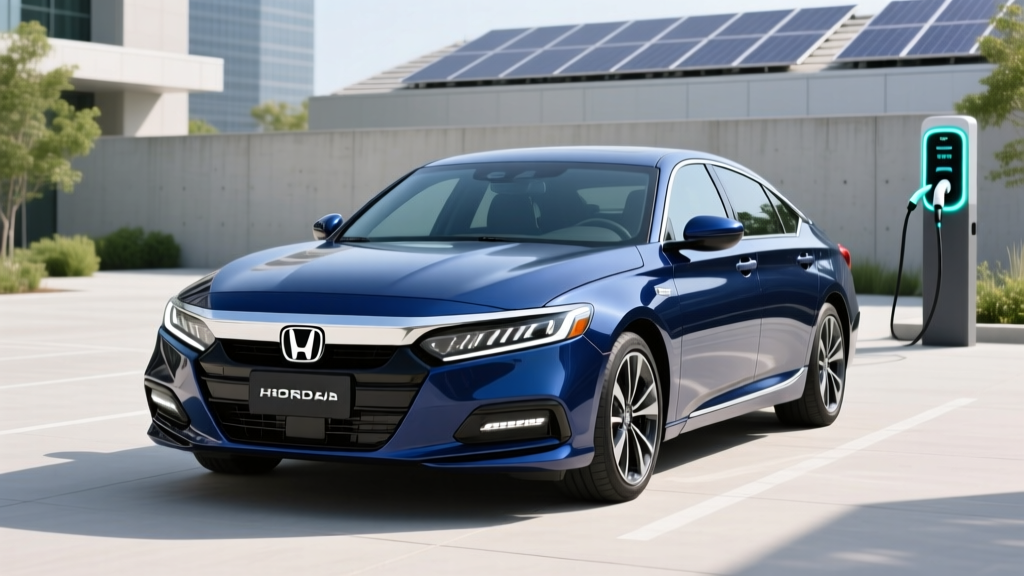
If you've been searching for Honda Accord Hybrid cars for sale, you're looking at one of the most established midsize hybrid sedans on the market. For 2026, the Accord Hybrid continues with Honda's two-motor e-CVT powertrain, delivering strong city fuel economy, a spacious cabin, and a starting price that undercuts many rivals. But before you sign the paperwork, you need the exact numbers — MPG breakdowns, real-world efficiency expectations, battery warranty details, and how this hybrid stacks up against plug-in hybrids and full EVs.
This guide covers everything a research-driven buyer needs to evaluate the 2026 Honda Accord Hybrid, whether you're cross-shopping the Toyota Camry Hybrid, Hyundai Sonata Hybrid, or considering stepping up to a PHEV or BEV.
HEV vs PHEV: Where the Accord Hybrid Fits
A common point of confusion for shoppers new to electrified vehicles is the difference between a conventional hybrid (HEV) and a plug-in hybrid (PHEV). The Honda Accord Hybrid is a conventional hybrid (HEV) — it does not plug in. It uses a small lithium-ion battery that recharges through regenerative braking and the gasoline engine. You simply fuel it like any other car.
HEV vs PHEV vs EV — Quick Comparison
| Feature | HEV (Accord Hybrid) | PHEV (e.g., Prius Prime) | BEV (e.g., Tesla Model 3) |
|---|---|---|---|
| Plugs in? | No | Yes (Level 1/2) | Yes (Level 1/2/DC) |
| Electric-only range | ~1 mi (low-speed) | 25-44 mi typical | 250-360 mi typical |
| Gas engine? | Yes (primary) | Yes (backup) | No |
| Federal tax credit (§30D) | Not eligible | Up to $7,500* | Up to $7,500* |
| Home charging needed? | No | Recommended | Essential |
| Fuel cost per mile | ~$0.07 | ~$0.04-0.07 | ~$0.03-0.05 |
*§30D credit eligibility depends on MSRP caps, buyer income limits, and battery component/critical-mineral sourcing. See IRS.gov for current rules.
The Accord Hybrid occupies a clear lane: maximum simplicity with meaningful fuel savings. No charging infrastructure required, no range anxiety, and no change to your fueling habits.
Fuel Economy: EPA Ratings and Real-World MPG
The 2026 Honda Accord Hybrid carries forward Honda's fourth-generation two-motor hybrid system. Here's the EPA fuel economy breakdown by trim, sourced from fueleconomy.gov:
| Trim | City MPG | Highway MPG | Combined MPG |
|---|---|---|---|
| Sport Hybrid | 51 | 44 | 48 |
| EX-L Hybrid | 51 | 44 | 48 |
| Sport-L Hybrid | 51 | 44 | 48 |
| Touring Hybrid | 46 | 41 | 44 |
Real-World MPG vs EPA Sticker
Honda's hybrid system excels in city driving, where the electric motor handles low-speed propulsion and the engine acts primarily as a generator. In real-world testing, owners frequently report exceeding the EPA city rating — 52-55 MPG is achievable in stop-and-go traffic with moderate acceleration.
However, highway fuel economy tends to run slightly below the 44 MPG EPA figure, especially at sustained speeds above 70 mph or in cold weather. Expect 40-43 MPG on the highway in real-world conditions, dropping to 37-39 MPG in winter when the engine runs more frequently for cabin heat. The Touring trim's heavier weight and larger wheels account for its lower 44 MPG combined rating.
Powertrain Specs: How the Accord Hybrid Drives
The Accord Hybrid pairs a 2.0-liter Atkinson-cycle four-cylinder engine with two electric motors in Honda's e-CVT configuration. Unlike a traditional CVT with a belt and pulleys, this system uses the motors to create a continuously variable ratio electronically — resulting in smooth, linear acceleration without the rubber-band feeling of older CVTs.
| Specification | 2026 Accord Hybrid |
|---|---|
| Combined System Horsepower | 204 hp |
| Combined Torque | 247 lb-ft (motor torque) |
| Engine | 2.0L DOHC Atkinson-cycle I-4 |
| Drive Motor Output | 181 hp / 247 lb-ft |
| Transmission | e-CVT (two-motor system) |
| Drivetrain | Front-wheel drive |
| 0-60 mph | ~7.0 seconds |
| Hybrid Battery | ~1.3 kWh lithium-ion |
| Fuel Tank | 12.8 gallons |
The 247 lb-ft of electric motor torque is available from a standstill, which gives the Accord Hybrid surprisingly confident off-the-line acceleration. The engine engages directly via a lock-up clutch only at higher cruising speeds, where it's more efficient than running the motor-generator loop. In practice, the transition between EV mode, hybrid mode, and engine-direct drive is nearly imperceptible from the driver's seat.
One limitation: there is no AWD option on the Accord Hybrid. If you need all-wheel drive in a midsize hybrid sedan, the Toyota Camry Hybrid (available with AWD) is the direct alternative.
Pricing, Trims, and Tax Credit Eligibility
For 2026, the Honda Accord Hybrid is available in four trims. Here's the MSRP breakdown (destination charge included):
| Trim | MSRP (incl. destination) | §30D Federal Credit |
|---|---|---|
| Sport Hybrid | $34,095 | Not eligible |
| EX-L Hybrid | $36,495 | Not eligible |
| Sport-L Hybrid | $37,095 | Not eligible |
| Touring Hybrid | $40,395 | Not eligible |
Why No Federal Tax Credit?
The IRS §30D New Clean Vehicle Credit applies only to plug-in electric vehicles (PHEVs and BEVs) with a battery capacity of at least 7 kWh. The Accord Hybrid's ~1.3 kWh battery does not meet this threshold. As a conventional HEV, it is not eligible for the federal §30D credit, the used-EV credit (§25E), or the commercial clean vehicle credit (§45W).
Some states and local utilities offer small rebates for conventional hybrids, but these vary widely by jurisdiction. Check your state energy office or utility provider for current programs.
Battery Warranty, Reliability, and Replacement Cost
Hybrid battery longevity is consistently the top concern among first-time hybrid buyers. Here's what Honda covers and what real-world data shows:
Honda Accord Hybrid Battery Warranty
- Hybrid battery (IPU): 10 years / 150,000 miles (in CARB states); 8 years / 100,000 miles (non-CARB states)
- Hybrid system components: 8 years / 100,000 miles nationwide
- Powertrain warranty: 5 years / 60,000 miles
- Limited vehicle warranty: 3 years / 36,000 miles
Honda's fourth-generation hybrid system has proven highly reliable. The lithium-ion Intelligent Power Unit (IPU) is far smaller and less stressed than an EV traction battery — it cycles through a narrow state-of-charge window and never experiences the deep discharge cycles that accelerate degradation in larger batteries. In practice, Accord Hybrid IPU failures before 150,000 miles are uncommon.
If the hybrid battery does require replacement outside of warranty, expect a cost of approximately $2,500 to $4,000 for a new OEM unit, including labor. Refurbished or aftermarket units can bring this down to $1,500–$2,500. This is dramatically less than EV battery replacement, which can exceed $10,000–$20,000.
For reliability data, the Accord consistently earns strong marks from IIHS (Top Safety Pick+ when equipped with the right headlights) and above-average predicted reliability scores from major automotive survey sources.
Accord Hybrid vs. the Competition
The midsize hybrid sedan segment has several strong contenders. Here's how the Accord Hybrid compares to its most direct rivals on the metrics that matter:
| Metric | Honda Accord Hybrid | Toyota Camry Hybrid | Hyundai Sonata Hybrid |
|---|---|---|---|
| Combined MPG | 48 | 52 (LE) | 47 |
| Combined HP | 204 | 225 | 192 |
| 0-60 mph | ~7.0s | ~6.8s | ~7.8s |
| Starting MSRP | $34,095 | $30,495 | $32,250 |
| AWD Available? | No | Yes | No |
| Cargo Volume | 16.7 cu ft | 15.1 cu ft | 16.0 cu ft |
| Solar Roof Option? | No | No | Yes |
The Camry Hybrid wins on pure fuel economy and offers AWD, while the Accord Hybrid leads in trunk space and interior room. The Sonata Hybrid's available solar roof panel is a unique feature that provides a small trickle charge to the 12V battery.
Pros
- Best-in-class cargo space (16.7 cu ft)
- Spacious rear seat — genuine adult comfort
- Strong city MPG (51 EPA, often exceeded)
- Refined, quiet ride quality
- 10-year/150k-mile battery warranty (CARB states)
- Excellent IIHS safety ratings
Cons
- No AWD option available
- Higher starting price than Camry Hybrid
- Touring trim drops to 44 MPG combined
- No federal tax credit eligibility
- Infotainment lags behind rivals in responsiveness
- Engine drone under hard acceleration
Who Should Buy the Accord Hybrid vs a PHEV or EV?
The right electrified vehicle depends on your driving patterns, home setup, and budget. Here's a practical decision framework:
Choose the Accord Hybrid (HEV) If:
- You don't have access to home or workplace charging
- You want fuel savings without changing your fueling routine
- Your budget is under $40,000 and you need a full-size sedan
- You drive a mix of city and highway miles with no short-commute pattern
- You plan to keep the car 8-10+ years and value proven reliability
Choose a PHEV (e.g., Prius Prime) If:
- You have Level 1 or Level 2 charging at home
- Your daily commute is under 40 miles round-trip (electric-only covers it)
- You want to qualify for the §30D federal tax credit (up to $7,500)
- You take regular road trips where gas-engine range is essential
Choose a Full EV (e.g., Tesla Model 3, Hyundai Ioniq 6) If:
- You have reliable home Level 2 charging
- Your daily driving is under 250 miles
- You want the lowest per-mile fuel cost and minimal maintenance
- You want to maximize federal and state incentive eligibility
- You're ready to plan around DC fast charging on road trips
5-Year Cost of Ownership Estimate
Here's how the Accord Hybrid stacks up on estimated 5-year ownership costs compared to its gas-only counterpart and a comparable EV. Assumes 15,000 miles/year, $3.50/gallon gas, and $0.14/kWh electricity:
| Cost Category | Accord Hybrid (48 MPG) | Accord Gas (32 MPG) | Model 3 RWD (EV) |
|---|---|---|---|
| Purchase Price (base) | $34,095 | $29,295 | $38,990 |
| Federal Tax Credit | $0 | $0 | -$7,500* |
| Fuel/Energy (5 yr) | $5,469 | $8,203 | $3,500 |
| Maintenance (5 yr) | $2,200 | $3,000 | $1,400 |
| Net 5-Year Cost | $41,764 | $40,498 | $36,390 |
*Model 3 credit assumes full §30D eligibility. Actual credit depends on income, sourcing, and MSRP caps. Does not include insurance, depreciation, or state incentives. Source: author calculations based on EPA data.
The Accord Hybrid saves roughly $2,700 in fuel over five years compared to the gas Accord, largely offsetting its higher purchase price. The EV wins on total cost if you qualify for the full tax credit and have home charging, but requires a higher upfront investment and lifestyle adjustment.
Frequently Asked Questions
How many MPG does the Honda Accord Hybrid get?
The 2026 Accord Hybrid (Sport, EX-L, and Sport-L trims) is EPA-rated at 51 city / 44 highway / 48 combined MPG. The Touring trim rates at 46/41/44 due to additional weight and larger wheels. In real-world driving, city MPG often exceeds the EPA estimate, while highway MPG may run 2-4 MPG below the sticker, particularly at sustained speeds above 70 mph.
Does the Honda Accord Hybrid need to be plugged in?
No. The Accord Hybrid is a conventional hybrid (HEV). Its small lithium-ion battery recharges automatically through regenerative braking and the gasoline engine. You never plug it in — you simply fill it with gas like a standard vehicle.
Is the Honda Accord Hybrid reliable, and what does battery replacement cost?
Honda's hybrid system is among the most proven in the industry, with the current-generation powertrain showing strong reliability data. The hybrid battery (IPU) is covered for 10 years/150,000 miles in CARB states and 8 years/100,000 miles elsewhere. Out-of-warranty replacement costs approximately $2,500–$4,000 for a new OEM battery — significantly less than an EV battery replacement.
Does the Accord Hybrid qualify for any tax credit?
The Accord Hybrid does not qualify for the federal §30D New Clean Vehicle Credit, which requires a plug-in vehicle with at least 7 kWh of battery capacity. Some states and utilities offer small hybrid rebates, but these vary by location. If the federal tax credit is a priority, consider a PHEV like the Toyota Prius Prime or a BEV like the Tesla Model 3.
How does the Accord Hybrid compare to a full EV for daily commuting?
For a 30-mile daily commute, the Accord Hybrid will use about 0.6 gallons of gas per day (~$2.10 at $3.50/gal). A comparable EV would use roughly 9 kWh (~$1.26 at $0.14/kWh). The EV saves about $0.84/day in fuel, or roughly $210 per year at 250 workdays — but requires home charging access and a higher purchase price (partially offset by the $7,500 federal credit). If you can't charge at home, the Accord Hybrid delivers excellent efficiency with zero infrastructure requirements.
Can I get AWD on the Honda Accord Hybrid?
No. The 2026 Accord Hybrid is front-wheel drive only across all trims. If AWD is essential, the Toyota Camry Hybrid offers available electronic AWD, though it uses a smaller rear motor and reduces fuel economy slightly.