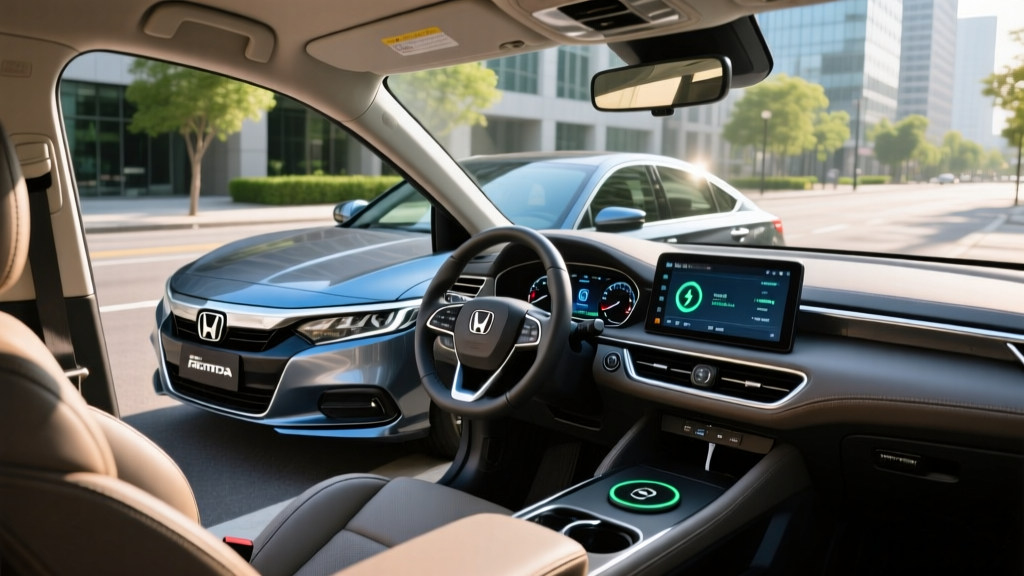
If you are searching for a midsize sedan that slashes fuel costs without requiring a charger in your garage, the Honda Accord Hybrid remains one of the strongest candidates on the market. A Honda Accord Hybrid lease can be an especially smart move for drivers who want predictable monthly payments, full warranty coverage for the duration of the lease, and the latest powertrain refinements — all without committing to a long-term purchase. This guide breaks down everything you need to know about the 2026 Accord Hybrid before you sign on the dotted line.
2026 Honda Accord Hybrid: Quick Spec Overview
Before we get into the lease economics, here is a snapshot of the 2026 Accord Hybrid's core specifications. Note that Honda offers the Accord Hybrid across multiple trims (Sport, Sport-L, EX-L, and Touring), all sharing the same two-motor hybrid powertrain.
| Spec | Value |
|---|---|
| Powertrain Type | Conventional Hybrid (HEV) — no plug required |
| Engine | 2.0L Atkinson-cycle 4-cylinder + two electric motors |
| Combined Horsepower | 204 hp (combined system output) |
| Combined Torque | 247 lb-ft (electric motor peak) |
| EPA MPG (City / Hwy / Combined) | 51 / 44 / 48 MPG (Sport trims); 48 / 47 / 48 MPG (EX-L, Touring with 19" wheels) |
| Fuel Tank Capacity | 12.8 gallons |
| Total Driving Range | ~614 miles (Sport); ~589 miles (EX-L/Touring) |
| 0–60 mph | ~7.0 seconds (est.) |
| Drivetrain | Front-wheel drive (e-CVT) |
| Starting MSRP | ~$34,495 (Sport) to ~$40,495 (Touring) |
| Hybrid Battery Warranty | 8 years / 100,000 miles (10 yr / 150,000 mi in CARB states) |
How Many MPG Does the Accord Hybrid Actually Get?
The EPA rates the 2026 Accord Hybrid at 51 city / 44 highway / 48 combined MPG on Sport trims equipped with 18-inch wheels and low-rolling-resistance tires. Step up to the EX-L or Touring with larger 19-inch alloy wheels, and the rating drops slightly to 48 city / 47 highway / 48 combined. According to fueleconomy.gov, these figures place the Accord Hybrid among the most efficient midsize sedans available.
HEV vs. PHEV vs. Full EV: Which Powertrain Fits You?
Shoppers cross-shopping a Honda Accord Hybrid lease often wonder whether a plug-in hybrid (PHEV) or a battery electric vehicle (BEV) might be a better fit. Here is a clear breakdown — and why Honda's approach matters.
The Accord Hybrid is a conventional HEV (hybrid electric vehicle). It does not have a plug, a large battery pack, or an electric-only driving mode of any meaningful distance. Instead, it uses a small lithium-ion battery (roughly 1.1 kWh) paired with two electric motors and a 2.0L gasoline engine. The system seamlessly blends electric and gas power, recharging the battery through regenerative braking and the engine. You never plug it in. You simply fill up at any gas station.
| Factor | HEV (Accord Hybrid) | PHEV (e.g., Toyota Prius Prime) | BEV (e.g., Tesla Model 3) |
|---|---|---|---|
| Plug-in Charging Required? | No | Yes (for full benefit) | Yes (always) |
| Electric-Only Range | ~1 mile (low speed) | 30–44 miles typical | 250–360+ miles |
| Total Range | ~590–614 miles | ~500–600+ miles | 250–360+ miles |
| Home Charging Needed? | No | Recommended (Level 2) | Essential |
| Federal Tax Credit (§30D) | Not eligible | Up to $7,500 (varies) | Up to $7,500 (varies) |
| Best For | High-mileage commuters without home charging | Short commutes + road trips | Home-charging access + daily electric driving |
Choose the Accord Hybrid (HEV) if: You do not have access to home or workplace charging, you drive significant highway miles, you want maximum simplicity with no plug-in routine, and you want lower monthly costs than a BEV or PHEV lease typically requires.
Consider a PHEV if: Your daily commute is under 40 miles round-trip, you can install a Level 2 charger at home, and you want electric-only driving for most days with gas backup for road trips.
Consider a full BEV if: You have reliable home charging, your daily driving is under 300 miles, and you want to eliminate gasoline costs entirely while potentially qualifying for the full IRS §30D federal tax credit.
Lease Pricing: What to Expect in 2026
Lease deals vary by region, dealer, and current Honda Financial Services promotions, but here is a realistic framework for a 2026 Accord Hybrid lease based on typical market conditions:
| Trim | MSRP | Typical Monthly Payment (36 mo / 12K mi/yr) | Due at Signing (Est.) |
|---|---|---|---|
| Sport | $34,495 | $379–$429 | $2,500–$3,500 |
| Sport-L | $36,195 | $399–$449 | $2,500–$3,500 |
| EX-L | $37,795 | $419–$469 | $3,000–$4,000 |
| Touring | $40,495 | $459–$519 | $3,000–$4,000 |
Key lease variables to watch:
- Money factor (interest rate): Honda Financial Services periodically offers subsidized money factors on Accord Hybrid leases, particularly at model-year launch and end-of-quarter. A promotional rate can save $30–$60/month versus a standard rate.
- Residual value: The Accord Hybrid holds value well. A 36-month lease typically carries a 55–60% residual, which keeps monthly payments moderate.
- Mileage allowance: Standard leases include 10,000 or 12,000 miles per year. If you commute heavily, bumping to 15,000 miles/year typically adds $20–$40/month — still worthwhile given the Accord Hybrid's strong fuel economy at high mileage.
- Loyalty and conquest incentives: Honda frequently offers $500–$1,000 loyalty cash for current Honda owners or conquest bonuses for owners of competing brands. Check Honda's current offers page before visiting the dealer.
Does the Accord Hybrid Qualify for a Tax Credit?
No. The Honda Accord Hybrid is a conventional hybrid (HEV), not a plug-in hybrid or battery electric vehicle. Under current IRS §30D rules, only new plug-in electric vehicles (PHEVs and BEVs) with sufficient battery capacity qualify for the federal clean vehicle credit of up to $7,500. The Accord Hybrid does not meet the plug-in requirement and is not eligible.
Some states offer their own hybrid purchase incentives or HOV lane access for hybrids, but these programs vary widely and change frequently. Check your state's energy office or DMV website for current programs. A few states (notably California, Colorado, and Oregon) have offered rebates or tax credits for efficient hybrids in the past, but eligibility is often income-capped and model-specific.
Lease-specific note: When you lease, any available manufacturer incentives are typically applied as a capitalized cost reduction, which lowers your monthly payment. Federal tax credits, when applicable, are claimed by the leasing company (the legal owner), though some manufacturers pass the savings through as a lease discount. Since the Accord Hybrid doesn't qualify for §30D, this is not a factor here.
Powertrain Deep Dive: How Honda's Two-Motor System Works
The 2026 Accord Hybrid uses Honda's fourth-generation two-motor hybrid system, which is fundamentally different from the traditional planetary-gear hybrid designs used by some competitors. Here is how it operates:
- At low speeds and in city driving: The 2.0L engine acts primarily as a generator, producing electricity that powers the propulsion motor. This gives the Accord Hybrid an EV-like feel off the line, with instant electric torque (247 lb-ft from the drive motor).
- At highway cruising: A lock-up clutch engages, directly connecting the engine to the drive wheels for efficient high-speed operation without the energy losses of electric conversion.
- Under hard acceleration: Both the engine (via generator) and the battery feed the propulsion motor simultaneously, delivering the full 204 hp system output.
- During deceleration: Regenerative braking recaptures kinetic energy, with steering-wheel paddles allowing you to adjust regen intensity across four levels.
The result is a powertrain that feels more responsive than its 204 hp suggests, particularly in urban driving where electric torque delivery is immediate. The e-CVT transmission is smooth and avoids the rubber-band effect that plagued earlier CVT designs.
Battery Warranty, Reliability, and Replacement Costs
Reliability track record: Honda's hybrid system has proven robust over multiple generations. The Accord Hybrid uses a relatively small battery (approximately 1.1 kWh), which undergoes shallower charge/discharge cycles than a PHEV or BEV pack, reducing degradation stress. Third-generation Accord Hybrid models (2018–2022) have shown excellent long-term reliability with few reported hybrid-system failures. IIHS has historically rated the Accord as a Top Safety Pick+, adding confidence for lease-term ownership.
Battery replacement cost: If the hybrid battery fails outside warranty coverage, replacement typically costs between $2,500 and $4,500 including parts and labor at a Honda dealership. However, this scenario is rare within the first 10 years of ownership. Individual battery modules can sometimes be replaced for less. For lessees on a standard 36-month lease, battery replacement is virtually a non-concern — the vehicle will remain fully under warranty throughout the lease term.
Pros and Cons of Leasing the Accord Hybrid
Pros
- Exceptional real-world fuel economy (44–48 MPG mixed)
- No plug-in charging required — works with existing gas infrastructure
- Strong electric torque for responsive city driving
- Full hybrid battery warranty coverage for the entire lease term
- Spacious interior with 16.7 cu-ft trunk (no battery intrusion)
- Honda Sensing ADAS suite standard on all trims
- Lower monthly payments than comparable PHEV or BEV leases
Cons
- Not eligible for the $7,500 federal EV tax credit
- Highway MPG drops to ~40–43 at sustained 75+ mph speeds
- No electric-only driving mode for zero-emission commutes
- Only front-wheel drive available (no AWD option)
- Higher base price than the non-hybrid Accord (1.5T turbo)
- Road noise on coarse pavement is noticeable (improved but still present)
Frequently Asked Questions
Is a Honda Accord Hybrid lease better than buying?
Leasing makes sense if you prefer lower monthly payments, always want to be under warranty, and like driving a new car every 3–4 years. With a 36-month lease, the Accord Hybrid's entire hybrid system and battery remain fully covered by Honda's warranty. Buying (or financing) is better if you drive very high annual mileage (over 15,000 miles/year), want to build equity, or plan to keep the car 7+ years to maximize the fuel savings payback.
How far can the Accord Hybrid go on electric only?
Essentially zero meaningful distance. The Accord Hybrid is a conventional HEV, not a plug-in hybrid. The small ~1.1 kWh battery enables brief electric-only movement at very low speeds (parking lots, stop-and-go creep) for roughly a mile or less, but the gasoline engine is always part of the driving equation. If you want 30–40 miles of electric-only range, you need a PHEV like the Toyota Prius Prime or Hyundai Tucson PHEV.
Does the Accord Hybrid need to be plugged in?
No. The Accord Hybrid charges its battery entirely through regenerative braking and the onboard gasoline engine. There is no plug, no charging port, and no need for any home charging equipment. You refuel at any standard gas station.
What is the total cost of ownership vs. a gas Accord?
Over a 36-month lease at 12,000 miles/year, the Accord Hybrid saves approximately $1,200–$1,800 in fuel costs compared to the gasoline Accord 1.5T (rated at 29/37/32 MPG). The hybrid carries a roughly $1,500–$2,000 MSRP premium over equivalent gas trims, so the fuel savings largely offset the higher purchase price within the lease term. Insurance costs are comparable between hybrid and gas trims.
Is the Accord Hybrid good for long road trips?
Yes — this is where the HEV format excels. With a total range of approximately 590–614 miles per tank and no charging stops needed, the Accord Hybrid is an excellent road-trip car. Highway fuel economy of 40–44 MPG (real-world) means fewer fuel stops and lower trip costs than most competitors. The cabin is spacious, the ride is comfortable, and Honda Sensing adaptive cruise control reduces fatigue on long drives.
How reliable is the Honda Accord Hybrid system?
Honda's two-motor hybrid system has demonstrated strong reliability since its introduction. The system has fewer wear components than a conventional automatic transmission (no torque converter, no multi-speed gear shifts), and the battery undergoes gentle shallow-cycle usage. Consumer Reports and J.D. Power have generally rated recent Accord Hybrid models favorably for predicted reliability. Combined with the 8-year/100,000-mile battery warranty, reliability risk during a typical lease term is very low.