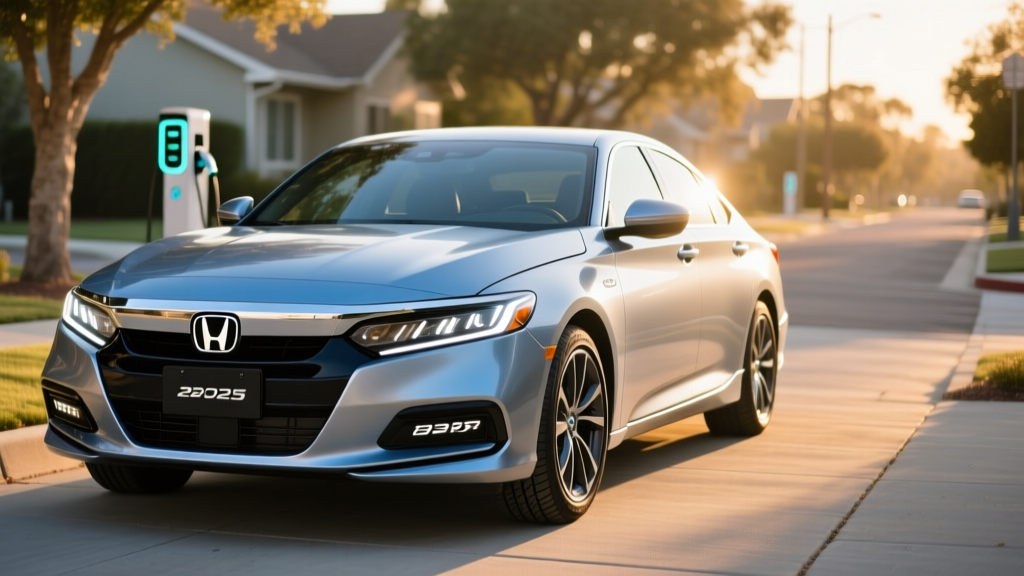
The midsize sedan segment has thinned out, but the Honda Accord Hybrid remains a benchmark for buyers who want electrified efficiency without the charging logistics of a full battery-electric vehicle. If you've been searching for Honda Accord Hybrid hp figures, efficiency data, or long-term ownership costs, this guide covers the current-generation powertrain in detail — with exact numbers, real-world expectations, and a clear framework for whether this hybrid fits your driveway.
Unlike a plug-in hybrid (PHEV) or a battery-electric vehicle (BEV), the Accord Hybrid is a conventional hybrid electric vehicle (HEV). It generates its own electricity through regenerative braking and its gasoline engine — you never plug it in. That distinction matters for your daily routine, your fuel budget, and your tax-credit eligibility.
2025 Honda Accord Hybrid Horsepower and Powertrain Breakdown
The current-generation Accord Hybrid uses Honda's fourth-generation two-motor hybrid system. Here is exactly what's under the hood:
| Component | Specification |
|---|---|
| Combined System Output | 204 hp (152 kW) |
| Combined Torque | 247 lb-ft (335 Nm) |
| Gasoline Engine | 2.0L DOHC 4-cylinder Atkinson-cycle |
| Engine Horsepower | 146 hp @ 6,100 rpm |
| Engine Torque | 134 lb-ft @ 4,500 rpm |
| Drive Motor | AC synchronous permanent-magnet |
| Drive Motor Output | 181 hp (135 kW) / 247 lb-ft |
| Transmission | e-CVT (no traditional gears) |
| Drivetrain | Front-wheel drive |
| 0–60 mph (tested) | ~6.5 seconds |
| Hybrid Battery | Lithium-ion, ~1.06 kWh (small buffer) |
The 204 combined horsepower figure answers the core Honda Accord Hybrid hp question, but the real story is the 247 lb-ft of torque. Electric motors deliver peak torque from zero RPM, which means the Accord Hybrid feels noticeably more responsive off the line than its peak horsepower number suggests. In everyday driving — merging onto highways, climbing grades, passing slower traffic — the hybrid powertrain feels more eager than many turbocharged four-cylinder sedans with higher peak-hp ratings.
The e-CVT is not a belt-and-pulley continuously variable transmission like you'd find in some competitors. Honda's system uses a clutch-based arrangement where the gasoline engine can directly drive the wheels at highway speeds, bypassing the generator-motor loop entirely. This direct-drive mode improves highway efficiency and reduces the "drone" associated with traditional CVTs under hard acceleration.
Fuel Economy: EPA Ratings and Real-World MPG
Fuel efficiency is the Accord Hybrid's headline act. Here are the official EPA figures from fueleconomy.gov:
| Trim | City MPG | Highway MPG | Combined MPG |
|---|---|---|---|
| Sport / Sport-L | 46 | 41 | 44 |
| EX-L / Sport Touring | 51 | 44 | 48 |
The trim-dependent difference is real and worth understanding. The Sport trims come with larger 19-inch alloy wheels, stickier tires, and slightly different gearing — all of which add rolling resistance and reduce efficiency by roughly 4 MPG combined compared to the EX-L and Sport Touring with 17-inch wheels.
In mixed suburban and city driving, the Accord Hybrid frequently exceeds its EPA combined rating. Hybrids benefit disproportionately from stop-and-go traffic, where regenerative braking recaptures energy and the electric motor handles low-speed propulsion. Many owners report 50–54 MPG in city-heavy commutes on the EX-L and Sport Touring trims.
Highway-only driving at 75+ mph is where the Accord Hybrid falls slightly below its EPA highway number. Expect 38–42 MPG on sustained interstate trips. In cold weather (below 30°F), plan for a 5–10% efficiency drop across all conditions as the engine runs more frequently for cabin heat and battery conditioning.
For context, a comparable gasoline-only midsize sedan averaging 30 MPG combined would cost roughly $1,950 per year in fuel (15,000 miles at $3.90/gallon). The Accord Hybrid at 48 MPG combined drops that to approximately $1,220 — a savings of about $730 annually, or $3,650 over five years.
HEV vs. PHEV vs. EV: Which Powertrain Fits Your Life?
The Accord Hybrid is a conventional HEV. Honda does not currently offer a plug-in hybrid (PHEV) Accord in the U.S. market, and a fully electric Accord is not part of the lineup. Here is how these three powertrain types compare for a midsize sedan buyer:
| Factor | HEV (Accord Hybrid) | PHEV (e.g., Toyota Prius Prime) | BEV (e.g., Tesla Model 3) |
|---|---|---|---|
| Plug In Required? | No | Yes (for EV range) | Yes (always) |
| Electric-Only Range | 0 miles (EV assist only) | 30–44 miles typical | 250–360+ miles |
| Combined Efficiency | 44–48 MPG | 48–52 MPG + MPGe | 120–140 MPGe |
| Home Charging Needed? | No | Recommended (120V OK) | Yes (240V ideal) |
| Federal Tax Credit (§30D) | Not eligible | Up to $7,500* | Up to $7,500* |
| Maintenance Complexity | Low (oil changes, no plug) | Moderate (engine + battery) | Lowest (no engine) |
| Best For | No charging access, long trips | Short commutes + home outlet | Home L2 charging, low mi cost |
*Federal §30D tax credit eligibility depends on MSRP caps, buyer income limits, battery-component sourcing, and critical-mineral requirements. See IRS.gov for current rules and consult a tax professional.
The Accord Hybrid is the right call if you lack reliable access to a charging outlet — whether you live in an apartment, park on the street, or simply don't want to manage charging logistics. It's also the strongest choice for drivers who take frequent long road trips where BEV charging stops would add time and planning.
Hybrid Battery Warranty, Lifespan, and Replacement Cost
- Hybrid Battery: 8 years / 100,000 miles (10 years / 150,000 miles in CARB states including CA, NY, MA, and others)
- Powertrain Warranty: 5 years / 60,000 miles
- Limited Vehicle Warranty: 3 years / 36,000 miles
The lithium-ion hybrid battery pack in the Accord Hybrid is small — approximately 1.06 kWh — because it doesn't need to store energy for electric-only driving. Its job is to buffer energy between the engine, generator, and drive motor. This smaller capacity means less thermal stress per cell compared to a BEV's large pack, and historically, Honda's hybrid batteries have proven durable well beyond the warranty period.
Based on service data from earlier-generation Accord Hybrids and similar Honda systems, most hybrid battery packs last 150,000–200,000+ miles before significant degradation. If a replacement is needed out of warranty, expect a cost in the range of $2,000–$4,000 for a new OEM pack (including labor), though refurbished units may be available for less. This is dramatically cheaper than a BEV battery replacement, which can exceed $10,000–$15,000.
For comparison, the hybrid system's inverter and electric motors are covered under the powertrain warranty and have historically shown very low failure rates. The most common "hybrid system" service item is actually the 12-volt auxiliary battery, which is a standard maintenance part that costs $150–$250 to replace.
Pricing, Trim Levels, and Tax Credit Eligibility
| Trim | MSRP (incl. destination) | Key Features |
|---|---|---|
| Sport | ~$34,490 | 19" wheels, sport suspension tuning, heated front seats |
| EX-L | ~$36,490 | Leather, 17" wheels, wireless CarPlay/Android Auto, 51/44 MPG |
| Sport-L | ~$37,090 | Sport styling with leather, 19" wheels |
| Sport Touring | ~$39,890 | Full option: Bose audio, navigation, heated rear seats, low-speed braking |
Tax credit status: The Honda Accord Hybrid is a conventional HEV, not a plug-in vehicle. It does not qualify for the federal §30D New Clean Vehicle Credit, which requires plug-in capability and a minimum battery capacity of 7 kWh. It also does not qualify for most state EV rebates that target PHEVs and BEVs.
However, some states and local utilities offer smaller incentives for any electrified vehicle, including conventional hybrids. Check your state's energy office or utility provider for any applicable rebates. The lack of a federal credit does narrow the price gap versus a PHEV competitor that may qualify for up to $7,500, but the Accord Hybrid's lower base price and zero charging infrastructure cost often offset this advantage over a typical ownership cycle.
Daily Driving, Reliability, and Ownership Costs
The Accord Hybrid's reliability record is strong. Honda's two-motor hybrid system has been in production since 2014 (Accord) and has accumulated millions of fleet miles across the Honda and Acura lineups. The system has fewer wear components than a conventional automatic transmission — there is no torque converter, no traditional gear set, and no clutch packs that cycle under load.
Routine maintenance for the Accord Hybrid is nearly identical to a gasoline Accord: oil changes (typically every 7,500–10,000 miles with synthetic), tire rotations, brake fluid, and cabin air filters. One advantage: regenerative braking significantly reduces brake pad wear. Many hybrid owners report original brake pads lasting 80,000–100,000+ miles.
- Fuel: ~$6,100 (at 48 MPG combined, $3.90/gal average)
- Maintenance: ~$2,500 (routine service, no major hybrid-specific items)
- Insurance: ~$7,500–$9,000 (varies by driver profile and state)
- Depreciation: ~$12,000–$14,000 (Accord Hybrid retains value well)
- Estimated 5-Year Total: ~$28,000–$32,000 (before tax credits on competitors)
Insurance premiums for the Accord Hybrid are typically within 5–10% of the gasoline Accord, and lower than most BEVs, which carry higher repair-cost assumptions from insurers.
Who Should Buy the Accord Hybrid — and Who Shouldn't
Choose the Honda Accord Hybrid if:
- You want 44–48 MPG without changing your fueling habits or installing a charger
- You take regular road trips and don't want to plan around DC fast-charging stops
- You want a midsize sedan with strong resale value and proven hybrid reliability
- Your commute is city-heavy, where the hybrid system delivers its best MPG
- You want 204 hp with 247 lb-ft of torque for confident highway merging
Look elsewhere if:
- You have home charging and want the lowest per-mile energy cost (consider a BEV)
- You want electric-only commuting with zero tailpipe emissions on short trips (consider a PHEV like the Prius Prime)
- You want AWD — the Accord Hybrid is FWD only (the Toyota Camry Hybrid offers AWD)
- You need to maximize federal tax-credit savings on your next vehicle purchase
Frequently Asked Questions
How many horsepower does the Honda Accord Hybrid have?
The 2025 Honda Accord Hybrid produces 204 combined system horsepower and 247 lb-ft of combined torque. The gasoline 2.0L engine contributes 146 hp, while the electric drive motor produces 181 hp. The combined system output is not a simple sum because the engine and motor peak at different RPMs.
How many MPG does the Accord Hybrid actually get?
The EPA rates the EX-L and Sport Touring trims at 51 city / 44 highway / 48 combined MPG. The Sport and Sport-L trims with 19-inch wheels are rated at 46 city / 41 highway / 44 combined. In real-world city driving, many owners exceed the EPA combined rating, while sustained highway driving above 75 mph typically returns 38–42 MPG.
Does the Honda Accord Hybrid need to be plugged in?
No. The Accord Hybrid is a conventional hybrid (HEV). It charges its own small lithium-ion battery through regenerative braking and the gasoline engine. There is no plug, no charging cable, and no electric-only range. You fuel it exclusively at gas stations.
Is the Accord Hybrid battery expensive to replace?
A new OEM hybrid battery replacement costs approximately $2,000–$4,000 including labor. However, Honda's hybrid batteries are covered for 8 years / 100,000 miles (10 years / 150,000 miles in CARB states), and most last well beyond warranty. The small ~1.06 kWh pack is far less expensive to replace than a BEV traction battery.
Does the Honda Accord Hybrid qualify for any tax credits?
No. The federal §30D New Clean Vehicle Credit requires plug-in capability and a minimum 7 kWh battery. As a conventional hybrid, the Accord Hybrid does not qualify. Some state or utility-level incentives may apply — check your local programs.
How does the Accord Hybrid compare to the Toyota Camry Hybrid?
The Camry Hybrid (now AWD-available and redesigned) offers comparable MPG (up to 52 combined on LE AWD trims) and a slightly lower starting price. The Accord Hybrid counters with more rear-seat legroom, a larger trunk, and a more refined interior at higher trims. Both are strong choices — the Accord leans toward premium midsize comfort, while the Camry offers AWD versatility and a slightly lower entry point. See fueleconomy.gov for side-by-side EPA data.