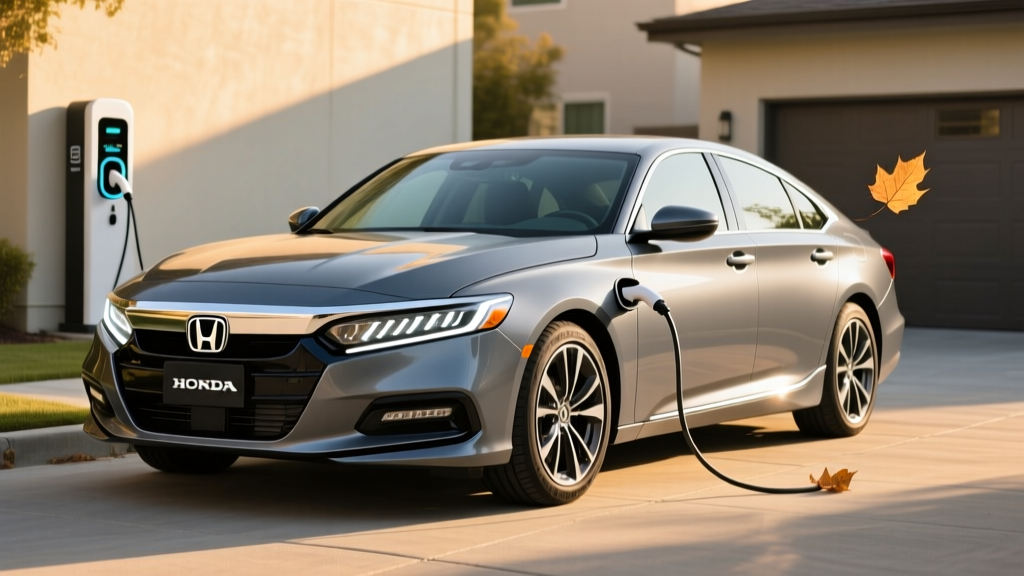
The Honda Accord Hybrid remains one of the most fuel-efficient midsize sedans you can buy without plugging in. For the 2026 model year, Honda's two-motor hybrid system continues to deliver exceptional city mileage, a refined driving experience, and the kind of long-term reliability that has made the Accord a segment benchmark for decades. If you're researching Honda Accord Hybrid fuel efficiency to decide whether it beats a conventional gas sedan, a plug-in hybrid, or a full battery-electric vehicle, this guide gives you every number you need.
How Many MPG Does the Honda Accord Hybrid Get?
The EPA rates the 2026 Honda Accord Hybrid at 51 MPG city / 44 MPG highway / 48 MPG combined for the Sport, Sport-L, and EX-L trims equipped with 18-inch wheels. The higher-spec Accord Hybrid Touring, which rides on 19-inch alloy wheels, drops slightly to 46 MPG city / 41 MPG highway / 44 MPG combined due to increased rolling resistance and curb weight.
| Trim | City MPG | Highway MPG | Combined MPG |
|---|---|---|---|
| Sport / Sport-L / EX-L (18" wheels) | 51 | 44 | 48 |
| Touring (19" wheels) | 46 | 41 | 44 |
Source: EPA Fuel Economy Guide
Real-World MPG: Where the Accord Hybrid Shines (and Where It Doesn't)
EPA numbers are a starting point, not a guarantee. The Accord Hybrid's two-motor system operates differently than a conventional automatic transmission — at low speeds and in stop-and-go traffic, the gasoline engine acts as a generator while the electric motor drives the wheels directly. This architecture is why the Accord Hybrid's city rating (51 MPG) actually exceeds its highway rating (44 MPG), the opposite of most gas cars.
- City / suburban commuting: 48–54 MPG (many owners report exceeding the EPA city estimate in warm weather)
- Steady 70 MPH highway cruising: 40–44 MPG (hybrid advantage shrinks at sustained high speed)
- Cold weather (below 35°F): Expect a 5–10 MPG drop as the engine runs more often for cabin heat and battery conditioning
- Mountain / hilly terrain: 38–42 MPG on sustained climbs, partially recovered through regenerative braking on descents
The Accord Hybrid uses a 1.3 kWh lithium-ion battery pack — far too small for electric-only driving at meaningful speeds, but ideal for capturing braking energy and assisting acceleration. Because the battery is small, there is no plug and no range anxiety. You refuel at any gas station, and the 12.8-gallon fuel tank yields a theoretical combined range of up to 614 miles on a single fill-up.
Powertrain Specs: How the Two-Motor Hybrid System Works
Honda's fourth-generation two-motor hybrid system pairs a 2.0-liter Atkinson-cycle four-cylinder engine with two electric motors. Here is the breakdown:
| Gasoline Engine | 2.0L DOHC Atkinson-cycle 4-cylinder |
| Engine Output | 146 HP @ 6,100 RPM / 134 lb-ft torque @ 4,500 RPM |
| Electric Drive Motor | 181 HP / 247 lb-ft torque |
| Combined System Output | 204 HP / 247 lb-ft torque |
| Hybrid Battery | 1.3 kWh lithium-ion (not plug-in) |
| Transmission | Electronic continuously variable (e-CVT) |
| Drivetrain | Front-wheel drive |
| 0–60 MPH | ~6.5 seconds (estimated) |
| Curb Weight | 3,477–3,538 lbs (varies by trim) |
Unlike Toyota's planetary-gear hybrid system, Honda's setup can operate in three distinct modes: EV Drive (battery powers the motor at low speeds), Hybrid Drive (engine generates electricity for the motor), and Engine Drive (engine connects directly to the wheels via a lock-up clutch at steady highway speeds). This direct engine connection at highway cruise is what helps the Accord Hybrid close the efficiency gap with its city numbers.
HEV vs. PHEV vs. EV: Which Powertrain Fits Your Life?
The Accord is offered only as a conventional hybrid (HEV) — Honda does not currently sell a plug-in hybrid version. If you're cross-shopping, here's how the three electrified powertrains stack up for a midsize sedan buyer:
| Factor | Conventional Hybrid (HEV) | Plug-In Hybrid (PHEV) | Battery Electric (BEV) |
|---|---|---|---|
| Plug-in charging required? | No | Yes (Level 1 or 2) | Yes (Level 2 + DC fast) |
| Electric-only range | < 1 mile at very low speed | 25–45 miles typical | 250–350+ miles |
| City fuel economy | 48–54 MPG | 35–42 MPG (gas) + 100+ MPGe (electric) | N/A — no gas |
| Home charging install | None | $300–$1,200 (Level 2 optional) | $800–$2,500 (Level 2 required) |
| Federal tax credit | Not eligible | Up to $7,500 (if eligible) | Up to $7,500 (if eligible) |
| Upfront price premium | ~$1,500–$2,500 over gas | ~$4,000–$7,000 over gas | ~$5,000–$15,000 over gas |
| Best for | No home charging, long highway trips | Short commutes + occasional road trips | Home charging access, daily driving < 250 mi |
- You rent or live in an apartment without charging access
- Your commute involves mixed city/highway driving under 60 miles round-trip
- You take frequent road trips over 300 miles and don't want to plan charging stops
- You want a proven, low-complexity powertrain with minimal maintenance
- You can install a Level 2 charger at home and your daily commute is under 40 miles
- You want to drive mostly on electricity but still need gas flexibility for long trips
- You qualify for the federal tax credit, offsetting the higher purchase price
- You have reliable home charging and drive under 250 miles daily
- You want the lowest per-mile fuel cost and near-zero routine powertrain maintenance
- You qualify for the §30D federal tax credit and your state offers additional EV incentives
Pricing, Trims, and Tax Credit Eligibility
The 2026 Honda Accord Hybrid is available in four trims. Pricing starts in the low $30,000 range:
| Trim | MSRP (approx.) | Key Features |
|---|---|---|
| Sport | $33,655 | 18" wheels, heated front seats, wireless CarPlay/Android Auto |
| Sport-L | $35,350 | Leather-trimmed seats, power passenger seat, wireless charging pad |
| EX-L | $36,655 | Leather interior, heated rear seats, low-speed braking control |
| Touring | $39,655 | 19" wheels, Bose audio, ventilated front seats, heated steering wheel, Google built-in |
Federal tax credit: The Honda Accord Hybrid is a conventional hybrid (HEV), not a plug-in. It does not qualify for the IRS §30D Clean Vehicle Credit, which applies only to plug-in electric vehicles (PHEVs and BEVs) with sufficient battery capacity and qualifying battery sourcing. There is no federal tax credit for conventional hybrids as of the 2026 tax year. For the latest rules, consult the IRS Clean Vehicle Tax Credits page.
State incentives: A handful of states offer rebates or HOV lane access for hybrids, but these programs vary widely and change frequently. Check your state energy office or DMV for current offerings.
Reliability and Hybrid Battery Warranty
Hybrid battery longevity is consistently the top concern among first-time hybrid buyers. Here's what you need to know about the Accord Hybrid:
- Hybrid battery coverage: 8 years / 100,000 miles (10 years / 150,000 miles in CARB states including CA, NY, MA, and others)
- Powertrain warranty: 5 years / 60,000 miles
- Limited vehicle warranty: 3 years / 36,000 miles
- Capacity threshold: Honda covers the hybrid battery if it fails or drops below functional capacity — unlike EV batteries, there is no published percentage-retention threshold because the 1.3 kWh pack is not providing meaningful range
Real-world battery lifespan: Honda's hybrid systems have proven exceptionally durable. The 1.3 kWh battery in the Accord Hybrid undergoes shallow charge/discharge cycles (typically operating between 40% and 80% state of charge), which drastically reduces degradation compared to full EV batteries that cycle from 10% to 90% or higher. Based on data from earlier-generation Accord and Insight Hybrids, the battery pack routinely lasts 150,000–200,000+ miles before any significant capacity loss.
Replacement cost if out of warranty: A new OEM hybrid battery pack for the Accord Hybrid typically costs between $2,000 and $3,500 including labor. Third-party refurbished packs are available for $1,200–$2,000. Given the shallow cycling and Honda's track record, most owners will never need a replacement.
Overall reliability: The Accord has historically earned top marks from both IIHS (Top Safety Pick+) and NHTSA (5-star overall). Honda's hybrid powertrain adds complexity over a gas-only Accord but removes the conventional automatic transmission — the e-CVT has no gears, belts, or clutch packs to wear out, which can actually reduce long-term maintenance costs.
Who Should Buy the Honda Accord Hybrid?
- Class-leading city fuel economy (51 MPG EPA)
- No plug-in charging required — zero infrastructure investment
- 614+ mile total range per tank
- Smooth, responsive electric-motor torque off the line (247 lb-ft)
- Proven Honda reliability with 8–10 year hybrid battery warranty
- Spacious cabin with 16.7 cu-ft trunk (no major battery intrusion)
- No federal tax credit (HEV, not PHEV/BEV)
- Highway MPG (44) trails city by a noticeable margin
- Not available with all-wheel drive
- Engine drone under hard acceleration (e-CVT characteristic)
- Higher starting price than the gas-only Accord (~$1,500 premium)
The Accord Hybrid is ideal for drivers who want maximum fuel savings without altering their refueling habits. If you drive 15,000 miles per year in mixed conditions at 48 MPG combined, you'll use approximately 312 gallons annually — compared to about 500 gallons in a comparable 30-MPG gas sedan. At $3.40/gallon, that's roughly $640 per year in fuel savings, which pays back the hybrid premium in about 2.5 years.
If you have home charging access and a short commute, a PHEV could save more on a per-mile basis during electric-only driving. But the Accord Hybrid wins on simplicity: no charging cord, no range planning, no tax-credit paperwork, and no question about whether you'll find a working public charger on a road trip.
Frequently Asked Questions
How many MPG does the Honda Accord Hybrid get in real-world driving?
Most owners report 46–54 MPG in mixed city/suburban driving, closely matching or slightly exceeding the EPA combined rating of 48 MPG. Sustained highway driving at 75+ MPH typically yields 40–43 MPG. Cold weather reduces fuel economy by 5–10 MPG due to increased engine operation for cabin heat.
Does the Honda Accord Hybrid need to be plugged in?
No. The Accord Hybrid is a conventional hybrid (HEV), not a plug-in. Its 1.3 kWh battery recharges through regenerative braking and the gasoline engine. You refuel exclusively at gas stations.
How far can the Honda Accord Hybrid drive on electric only?
Less than one mile, and only at very low speeds (under 25 MPH in ideal conditions). The battery is too small for meaningful electric-only driving. If electric-only commuting is your goal, consider a PHEV like the Toyota Prius Prime (up to 44 miles electric-only) or a full EV.
Does the Honda Accord Hybrid qualify for a federal tax credit?
No. The IRS §30D Clean Vehicle Credit applies only to plug-in vehicles (PHEVs and BEVs) with qualifying battery capacity and sourcing. The Accord Hybrid is a conventional HEV and is not eligible for any federal purchase incentive as of 2026. Check IRS.gov for current rules.
How long will the hybrid battery last, and what does replacement cost?
Honda's hybrid battery is warrantied for 8 years / 100,000 miles (10 years / 150,000 miles in CARB states). Real-world data from prior-generation Honda hybrids suggests the battery typically lasts 150,000–200,000+ miles. If replacement is needed out of warranty, expect to pay $2,000–$3,500 for a new OEM pack with labor.
Is the Accord Hybrid slower than the gas Accord?
No — the hybrid actually produces more low-end torque (247 lb-ft from the electric motor vs. the gas 1.5T's 192 lb-ft). The hybrid hits 0–60 MPH in approximately 6.5 seconds, comparable to or slightly quicker than the turbocharged gas model. The difference is most noticeable in city acceleration, where electric motor response is instant.
Should I buy the Accord Hybrid or a full electric vehicle?
If you lack home charging, frequently drive over 300 miles in a day, or live in an area with sparse public charging infrastructure, the Accord Hybrid is the pragmatic choice. If you have reliable home Level 2 charging, drive under 250 miles daily, and want the lowest per-mile fuel cost, a full EV like the Tesla Model 3 or Hyundai Ioniq 6 will save more over five years — especially if you qualify for the $7,500 federal tax credit.