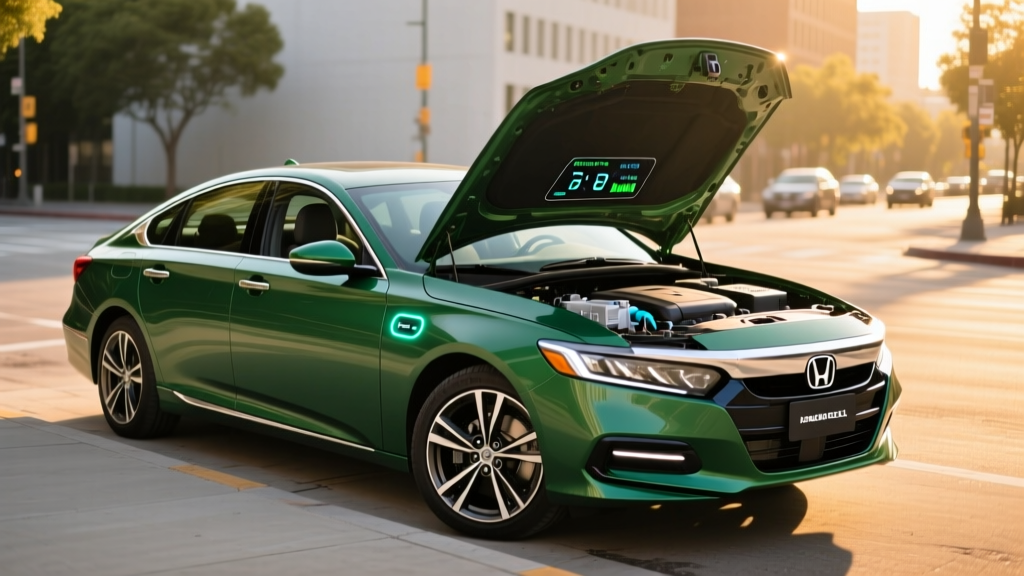
The midsize hybrid sedan segment has no shortage of contenders, but the Honda Accord Hybrid EX-L continues to anchor itself as a top pick for buyers who want near-50 MPG efficiency without sacrificing interior refinement or daily-driver practicality. For 2026, Honda carries forward the two-motor hybrid system introduced with the current generation, pairing it with the upscale EX-L trim's leather cabin, premium audio, and advanced safety suite.
This guide breaks down everything a prospective buyer needs: exact EPA fuel economy figures, real-world MPG expectations, powertrain specs, battery warranty coverage, pricing, and how the Accord Hybrid stacks up against plug-in hybrids and full battery-electric vehicles. If you're cross-shopping electrified sedans, these are the numbers that matter.
HEV vs. PHEV vs. EV: Where the Accord Hybrid Fits
Conventional Hybrid (HEV): The Accord Hybrid is a self-charging hybrid. It has no plug. A small lithium-ion battery (roughly 1.1 kWh usable) is recharged through regenerative braking and the gasoline engine. You simply fill up at a gas station and drive. The electric motor assists the engine and can propel the car at low speeds, but there is no meaningful electric-only range.
Plug-in Hybrid (PHEV): A PHEV like the Toyota Prius Prime or Hyundai Sonata PHEV carries a larger battery (13–18 kWh typically) that you plug in to charge. It delivers 25–44 miles of electric-only driving before the gas engine takes over. PHEVs qualify for the federal §30D tax credit if they meet battery-sourcing, MSRP, and income requirements.
Battery Electric (BEV): A full EV like the Tesla Model 3 or Hyundai Ioniq 6 has no gas engine. Range comes entirely from a large battery pack (60–100+ kWh). BEVs require home or public charging access and offer the lowest per-mile fueling cost — but demand lifestyle adaptation for road trips and cold-weather range loss.
The Accord Hybrid EX-L is the right choice if you want dramatically better fuel economy than a gas car, cannot charge at home, or simply don't want to think about plugging in. It bridges the gap between conventional ownership and electrified efficiency.
EPA Fuel Economy and Real-World MPG
The 2026 Honda Accord Hybrid (all trims, including the EX-L) carries the following EPA-estimated fuel economy:
| Metric | EPA Estimate | Real-World Expectation |
|---|---|---|
| City MPG | 51 MPG | 48–53 MPG (hybrids often exceed EPA in stop-and-go) |
| Highway MPG | 44 MPG | 40–45 MPG (sustained 70+ mph reduces regen benefit) |
| Combined MPG | 48 MPG | 44–50 MPG depending on driving mix |
Why real-world MPG varies: Hybrids shine in city driving where regenerative braking recaptures energy at every stoplight. On long highway cruises above 70 mph, the gasoline engine does most of the work, and efficiency drops closer to 40–42 MPG. In mixed suburban commuting with moderate speeds, many owners report matching or slightly exceeding the 48 MPG combined sticker. Cold weather (below 30°F) can reduce fuel economy by 5–10% as the engine runs more frequently to provide cabin heat.
For comparison, the non-hybrid 2026 Accord 1.5T achieves 29 city / 37 highway / 32 combined — a 50% improvement with the hybrid powertrain in city driving.
Powertrain Specs: Engine, Motors, and Horsepower
| Specification | Detail |
|---|---|
| Engine | 2.0L DOHC Atkinson-cycle inline-4 |
| Electric Motors | Two-motor hybrid system (drive + generator) |
| Combined System Horsepower | 204 hp |
| Combined System Torque | 247 lb-ft (electric motor) |
| Transmission | e-CVT (electrically variable, no traditional gears) |
| Drivetrain | Front-wheel drive |
| 0–60 mph | ~7.2 seconds (estimated) |
| Battery Type | Lithium-ion, ~1.1 kWh usable |
| Fuel Tank | 12.8 gallons |
| Total Driving Range | ~614 miles (EPA combined) |
Honda's two-motor hybrid system operates differently than a Toyota-style planetary gearset. At low speeds, the gasoline engine acts primarily as a generator, powering the electric drive motor. At highway speeds, a lockup clutch connects the engine directly to the wheels for efficiency. The result is smooth, linear acceleration from the 247 lb-ft electric motor torque — available from near zero RPM — making the Accord Hybrid feel quicker in daily driving than the 204 hp figure suggests.
2026 Accord Hybrid EX-L Pricing and Trim Features
The 2026 Honda Accord Hybrid is offered in Sport, Sport-L, EX-L, and Sport Touring trims. The EX-L sits as the premium comfort-oriented trim:
- MSRP: Approximately $35,995 (including destination charge)
- Key EX-L features: Leather-trimmed seats, heated front seats, 10-speaker audio system, wireless Apple CarPlay/Android Auto, 10.2-inch digital instrument cluster, 12.3-inch infotainment touchscreen, Honda Sensing safety suite, power moonroof, heated side mirrors
- Notable omission: No ventilated seats or heated rear seats (those are reserved for the Sport Touring hybrid)
Federal and State Tax Credit Eligibility
Does the Accord Hybrid qualify for the federal §30D tax credit? No. The IRS §30D Clean Vehicle Credit applies only to plug-in electric vehicles (PHEVs and BEVs) with a minimum battery capacity of 7 kWh. The Accord Hybrid's ~1.1 kWh battery disqualifies it entirely. Conventional hybrids (HEVs) are not eligible for the $7,500 federal purchase credit or the up-to-$4,000 used-EV credit.
Some states offer modest rebates or HOV lane access for hybrids, but these vary by jurisdiction. Check your state's energy office or DMV for current programs.
Battery Warranty, Reliability, and Replacement Cost
Honda Hybrid Battery Warranty: Honda covers the Accord Hybrid's lithium-ion battery pack for 10 years or 150,000 miles (whichever comes first) in all 50 states. This covers defects and excessive capacity loss. In states that follow California Air Resources Board (CARB) emissions warranties, hybrid system components may receive additional coverage.
Hybrid System Warranty: The broader hybrid system — including the electric drive motor, generator, power control unit, and e-CVT — is also covered under the 10-year/150,000-mile powertrain warranty.
Real-World Reliability
Honda's two-motor hybrid system, now in its fourth generation, has proven highly reliable in fleet and consumer data. Unlike early hybrid systems from the 2000s, modern lithium-ion packs are designed to last the vehicle's lifetime under normal use. Degradation in the small 1.1 kWh battery is minimal because the system keeps the battery in a narrow state-of-charge window (roughly 40–60%), avoiding the deep cycles that accelerate wear.
Battery replacement cost: If the hybrid battery does fail outside of warranty — rare but possible at high mileage — replacement costs typically range from $2,000 to $4,000 for parts and labor at a Honda dealer. Third-party refurbishment shops may offer lower-cost options. This is significantly less than a full EV battery replacement ($8,000–$20,000+), reflecting the Accord Hybrid's much smaller pack.
Accord Hybrid vs. PHEV vs. EV: Decision Framework
Choosing between a conventional hybrid, plug-in hybrid, and full EV depends on your charging access, daily mileage, and willingness to adapt. Here's a practical framework:
Choose the Accord Hybrid (HEV) if:
- You cannot charge at home (apartment, street parking, no garage outlet)
- You want maximum simplicity — no plugs, no charging apps, no range planning
- You drive 15,000+ miles per year and want consistent 45–50 MPG everywhere
- You take frequent road trips and don't want to rely on public charging infrastructure
Choose a PHEV (e.g., Prius Prime, Sonata PHEV) if:
- You can charge at home (Level 1 or Level 2) and have a commute under 40 miles
- You want to drive mostly on electricity daily but need gas flexibility for road trips
- You want to qualify for the federal tax credit (up to $7,500, subject to MSRP caps, income limits, and battery-sourcing rules)
Choose a full EV (e.g., Model 3, Ioniq 6) if:
- You have reliable home Level 2 charging and your daily driving is under 250 miles
- You want the lowest per-mile fueling cost (electricity at $0.14/kWh ≈ $4.50 per "gallon equivalent")
- You want minimal maintenance (no oil changes, no transmission fluid, fewer brake replacements due to regen)
- You're comfortable with public DC fast charging on road trips and cold-weather range reduction (15–30%)
Ownership Costs: 5-Year Fuel Savings vs. Gas Accord
| Cost Factor | Accord Hybrid EX-L | Accord 1.5T EX-L (Gas) |
|---|---|---|
| MSRP (approx.) | $35,995 | $34,495 |
| EPA Combined MPG | 48 MPG | 32 MPG |
| Annual fuel cost (15,000 mi, $3.50/gal) | $1,094 | $1,641 |
| 5-year fuel cost | $5,469 | $8,203 |
| 5-year fuel savings (Hybrid) | $2,734 saved | |
| Maintenance (5-year est.) | ~$2,800 | ~$3,200 |
| Federal tax credit | $0 | $0 |
The hybrid's $1,500 price premium over the gas model pays for itself in fuel savings within roughly 2.7 years at current gas prices. Over a typical 5-year ownership period, the hybrid saves approximately $2,700 in fuel alone, with additional savings from slightly lower maintenance (the hybrid system places less wear on the brake pads due to regenerative braking, and the engine runs less in city driving, reducing oil degradation).
Pros and Cons: Accord Hybrid EX-L
Pros
- 51 MPG city is class-leading for a midsize sedan
- Smooth, torquey acceleration from the electric drive motor
- No charging infrastructure needed — true fill-up-and-go convenience
- EX-L trim offers premium leather, 10-speaker audio, and full Honda Sensing suite
- 10-year/150,000-mile hybrid battery warranty provides long-term peace of mind
- Spacious cabin with 16.7 cu-ft trunk (no hybrid battery intrusion)
- Excellent IIHS safety ratings
Cons
- No federal tax credit eligibility (HEV, not PHEV)
- Highway MPG (44) trails city MPG (51) — less efficient on long road trips
- No all-wheel-drive option (Toyota Camry Hybrid offers AWD)
- EX-L lacks ventilated seats and premium features of the Sport Touring
- Cold-weather fuel economy drops 5–10% as engine runs for cabin heat
- Infotainment system, while improved, still lags some competitors in responsiveness
Frequently Asked Questions
How many MPG does the Honda Accord Hybrid EX-L get?
The EPA rates the 2026 Accord Hybrid at 51 city / 44 highway / 48 combined MPG. In real-world mixed driving, expect 44–50 MPG. City-heavy commutes often yield results at or slightly above the EPA sticker thanks to regenerative braking. Sustained highway driving above 70 mph may drop efficiency to 40–42 MPG.
Does the Accord Hybrid need to be plugged in?
No. The Accord Hybrid is a conventional hybrid (HEV), not a plug-in hybrid (PHEV). The battery recharges through regenerative braking and the gasoline engine. You never plug it in — you simply refuel at any gas station.
Is the Honda Accord Hybrid reliable?
Honda's fourth-generation two-motor hybrid system has a strong reliability track record. The lithium-ion battery is covered by a 10-year/150,000-mile warranty. Real-world data from high-mileage Accord and CR-V Hybrid owners shows minimal battery degradation, largely because Honda's system keeps the battery in a narrow, protective state-of-charge window.
What does it cost to replace the Accord Hybrid battery?
Out-of-warranty hybrid battery replacement typically costs $2,000–$4,000 at a Honda dealer. However, failures are uncommon within the first 150,000 miles. This is far less than EV battery replacements, which can exceed $10,000–$20,000, because the Accord Hybrid's pack is only ~1.1 kWh.
Does the Accord Hybrid qualify for any tax credit?
No. The federal §30D Clean Vehicle Credit requires a minimum 7 kWh battery and plug-in capability. The Accord Hybrid has neither. Only PHEVs (like the Prius Prime) and BEVs (like the Tesla Model 3) qualify, and even those must meet MSRP caps, buyer income limits, and battery critical-mineral sourcing requirements under current IRS rules.
How does the Accord Hybrid compare to the Toyota Camry Hybrid?
The 2026 Camry Hybrid (now exclusively hybrid) achieves 51 city / 49 highway / 50 combined MPG in FWD form and offers available AWD — a key advantage in snowy climates. The Accord Hybrid counters with a more refined ride, larger trunk (16.7 vs. 15.1 cu-ft), and a more premium EX-L interior. Both are excellent choices; AWD needs favor the Camry, while interior quality and highway composure favor the Accord.
How far can the Accord Hybrid drive on a full tank?
With a 12.8-gallon fuel tank and a 48 MPG combined rating, the Accord Hybrid delivers approximately 614 miles of total range. In real-world mixed driving, expect 550–620 miles between fill-ups. This exceeds most EVs and PHEVs in total range and eliminates any range-anxiety concern for road trips.