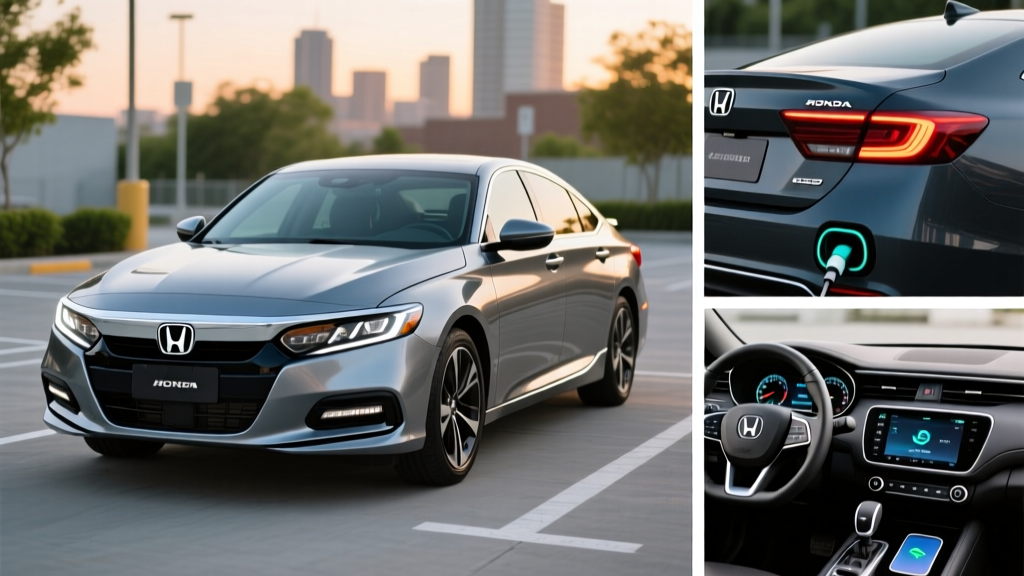
The 2021 Honda Accord Hybrid occupies a specific niche that still resonates in 2026: a midsize sedan that sips fuel without asking you to plug in, change your driving habits, or sacrifice trunk space. Honda's two-motor hybrid system pairs a 2.0-liter Atkinson-cycle four-cylinder with electric motors for a combined 212 horsepower and an EPA-estimated 48 MPG combined. For used-car shoppers and current owners evaluating long-term costs, this guide breaks down every number that matters — from real-world fuel economy to battery replacement economics.
HEV vs PHEV: Where the Accord Hybrid Fits
Before examining the specs, it is essential to distinguish what the Accord Hybrid is — and what it is not. The 2021 Accord Hybrid is a conventional hybrid electric vehicle (HEV). It does not have a plug, it cannot charge from a wall outlet, and it has no meaningful electric-only driving range. Instead, it uses regenerative braking and its gasoline engine to charge a small 1.3 kWh lithium-ion battery pack, which buffers energy for the electric drive motors.
HEV vs PHEV vs BEV — Quick Reference
| Feature | HEV (Accord Hybrid) | PHEV (e.g., RAV4 Prime) | BEV (e.g., Tesla Model 3) |
|---|---|---|---|
| Plugs in? | No | Yes | Yes |
| Electric-only range | ~1 mi (low speed) | 25–42 mi typical | 250–350+ mi |
| Battery size | 1.3 kWh | 13–18 kWh | 60–82 kWh |
| Tailpipe emissions | Yes (reduced) | Yes (when engine runs) | None |
| Federal tax credit (§30D) | Not eligible | Eligible (if criteria met) | Eligible (if criteria met) |
If you were hoping the Accord Hybrid could handle your 15-mile commute on electricity alone, you need a PHEV or a full BEV. The Accord Hybrid's value proposition is simpler: dramatically reduce fuel consumption with zero lifestyle changes.
Powertrain Specs: 212 HP From Two Motors and a Four-Cylinder
Honda's hybrid system in the 2021 Accord is closer to a series hybrid than most competitors. The gasoline engine primarily acts as a generator, producing electricity that feeds the drive motor. Only at sustained highway speeds does a clutch engage to connect the engine directly to the front wheels.
| Specification | 2021 Honda Accord Hybrid |
|---|---|
| Engine | 2.0L Atkinson-cycle I-4 |
| Engine output | 143 hp / 129 lb-ft torque |
| Drive motor output | 181 hp / 232 lb-ft torque |
| Combined system output | 212 hp |
| Transmission | e-CVT (no traditional gears) |
| Drivetrain | Front-wheel drive |
| 0–60 mph | ~6.7 seconds (Car and Driver tested) |
| Battery capacity | 1.3 kWh lithium-ion |
| Curb weight | ~3,300–3,400 lbs (varies by trim) |
The electric-dominant architecture means the Accord Hybrid feels more like an EV around town than its Toyota Camry Hybrid rival, which uses a more traditional parallel-hybrid power-split device. The instant torque from the 181-hp drive motor gives it punchy off-the-line acceleration, and the transition to engine power at highway speed is nearly imperceptible.
Fuel Economy: EPA Ratings and Real-World MPG
The EPA rates the 2021 Accord Hybrid differently depending on trim, because the Sport and Touring trims wear larger 19-inch wheels that increase rolling resistance.
| Trim Group | City | Highway | Combined |
|---|---|---|---|
| Hybrid / Hybrid EX / Hybrid EX-L (17" wheels) | 48 MPG | 47 MPG | 48 MPG |
| Hybrid Sport / Hybrid Touring (19" wheels) | 44 MPG | 41 MPG | 43 MPG |
Source: fueleconomy.gov
Over 15,000 miles per year at the combined 48 MPG rating and $3.40/gallon gas, you would spend roughly $1,063 annually on fuel — compared to about $1,889 for the non-hybrid 1.5T Accord rated at 30 MPG combined. That is approximately $826 in annual fuel savings for the hybrid.
Trims, Pricing, and Tax Credit Eligibility in 2026
The 2021 Accord Hybrid was offered in five trims. Here is the original MSRP alongside typical 2026 used-market pricing for models in good condition with 40,000–60,000 miles:
| Trim | 2021 MSRP | 2026 Used Range |
|---|---|---|
| Hybrid | $27,325 | $18,500–$21,000 |
| Hybrid EX | $29,735 | $20,000–$23,000 |
| Hybrid EX-L | $32,315 | $22,000–$25,500 |
| Hybrid Sport | $33,115 | $22,500–$26,000 |
| Hybrid Touring | $37,095 | $25,000–$29,000 |
Federal Tax Credit: Not Eligible
The 2021 Honda Accord Hybrid does not qualify for the federal §30D clean vehicle tax credit. Under current IRS rules, the credit applies only to plug-in electric vehicles (PHEVs and BEVs) with a battery capacity of at least 7 kWh. The Accord Hybrid's 1.3 kWh battery falls far below that threshold. This is true whether you buy new (no longer possible) or used.
The used clean vehicle credit (up to $4,000 or 30% of sale price, whichever is less) also requires the vehicle to be a qualifying plug-in EV or fuel-cell vehicle. Conventional hybrids like the Accord Hybrid are excluded.
Some states offer their own incentives for hybrids, though these have become rare as programs shift toward plug-in vehicles. Check your state's energy or DMV website for current programs.
Battery Warranty, Lifespan, and Replacement Cost
Hybrid Battery Warranty & Longevity
- Warranty: 8 years / 100,000 miles (10 years / 150,000 miles in CARB states — CA, CT, ME, MA, MD, NJ, NY, OR, RI, VT, WA, and others adopting California emissions standards)
- Chemistry: Lithium-ion (Honda IMA/IPU system)
- Expected lifespan: Most Accord Hybrid batteries last 150,000–200,000+ miles with normal use
- Replacement cost (2026): $2,000–$4,000 for a refurbished or new OEM battery pack, plus $500–$1,000 labor
Honda's hybrid battery track record is strong. The IPU (Intelligent Power Unit) in the 2021 Accord Hybrid is a mature design that has benefited from over two decades of Honda hybrid development. Unlike larger PHEV and BEV batteries, the 1.3 kWh pack operates within a narrow state-of-charge window — Honda's battery management system never allows full 100% charge or deep discharge, which significantly reduces degradation stress.
For a 2021 model in 2026, the battery is roughly five years old. If you are buying used, request a hybrid system diagnostic from a Honda dealer that can show battery module health. Pay attention to whether the vehicle was primarily driven in extreme heat (Arizona, Texas) or sat unused for long periods, both of which can accelerate degradation.
If the battery does need replacement out of warranty, independent hybrid shops have become a viable alternative to dealerships, often offering refurbished packs for $2,000–$2,500 installed. This is a fraction of BEV battery replacement costs, which can exceed $10,000–$15,000.
Reliability, Safety, and Ownership Costs
The 2021 Accord Hybrid earned strong reliability and safety credentials. The IIHS named it a Top Safety Pick+ when equipped with specific headlights, and it received a 5-star overall rating from NHTSA.
On the maintenance side, the hybrid system actually reduces some service costs compared to the gasoline-only Accord:
- Brake wear: Regenerative braking handles most deceleration, so brake pads routinely last 80,000–100,000+ miles
- No traditional transmission: The e-CVT has no gears, bands, or torque converter to service — no transmission fluid flushes
- Engine wear: The Atkinson-cycle engine runs fewer hours than a conventional engine because the electric motor handles low-speed driving
- Oil changes: Still required every 7,500–10,000 miles (Honda's Maintenance Minder system tracks this)
Insurance costs for the Accord Hybrid tend to run 5–10% higher than the gas-only model due to the higher purchase price and hybrid-specific repair considerations, but remain well below typical BEV insurance premiums.
Pros, Cons, and Who Should Buy
Pros
- 48 MPG combined — among the best in the midsize sedan class
- EV-like city driving feel with instant electric torque
- Same trunk space as gas Accord (16.7 cu ft — battery under rear seats)
- Strong IIHS Top Safety Pick+ rating
- Low long-term maintenance (brake and transmission savings)
- No plug, no range anxiety, no charging infrastructure needed
Cons
- No federal tax credit eligibility
- Highway MPG drops to 41–47 (lower than city)
- Sport/Touring 19" wheels reduce fuel economy by 5 MPG
- Not a PHEV — no electric-only commuting capability
- Only available as a 2021 used purchase (discontinued in this generation's form after 2022 refresh)
- Cabin noise under hard acceleration (engine drones as generator)
Should You Choose the Accord Hybrid, a PHEV, or a Full EV?
Choose the 2021 Accord Hybrid if: You lack home charging access, drive 10,000–20,000 miles per year with a mix of city and highway, want maximum fuel savings with zero behavioral change, and are buying on a used-car budget of $18,000–$29,000.
Choose a PHEV (e.g., Toyota RAV4 Prime, Hyundai Tucson PHEV) if: You have home Level 2 charging, your daily commute is under 30 miles round-trip, and you want to drive mostly on electricity while keeping a gas engine for road trips. Budget $30,000–$45,000 used.
Choose a full BEV (e.g., Tesla Model 3, Hyundai Ioniq 6) if: You have reliable home charging, want zero tailpipe emissions, qualify for the §30D tax credit (income and sourcing rules apply), and are ready to plan around DC fast charging for road trips. Budget $25,000–$45,000+ used.
Frequently Asked Questions
How many MPG does the 2021 Honda Accord Hybrid get?
The EPA rates the base Hybrid, EX, and EX-L trims at 48 city / 47 highway / 48 combined MPG. The Sport and Touring trims with 19-inch wheels are rated at 44/41/43 MPG. In real-world city driving, many owners report exceeding 50 MPG.
Can the 2021 Accord Hybrid drive on electric power only?
Only at very low speeds (under ~25 mph) for brief distances — roughly one mile or less. This is a conventional hybrid, not a plug-in. The gasoline engine generates electricity for the drive motor during normal driving. If you need electric-only commuting, look at a PHEV or BEV.
Does the 2021 Accord Hybrid qualify for any tax credit?
No. The federal §30D clean vehicle credit applies only to plug-in vehicles (PHEVs and BEVs) with at least 7 kWh of battery capacity. The Accord Hybrid's 1.3 kWh pack does not qualify for any federal credit, new or used. Some states may offer minor hybrid incentives — check your state energy office.
How long will the hybrid battery last, and what does replacement cost?
Honda warrants the hybrid battery for 8 years/100,000 miles (10 years/150,000 miles in CARB states). In practice, most Accord Hybrid batteries last 150,000–200,000+ miles. A replacement battery costs approximately $2,000–$4,000 depending on whether you use a refurbished pack from an independent shop or a new OEM unit from a Honda dealer.
Is the 2021 Accord Hybrid reliable?
Yes. Honda's two-motor hybrid system has a strong reliability record, and the 2021 Accord as a platform has few widespread complaints. The hybrid system actually reduces wear on brakes and eliminates the traditional transmission entirely. The IIHS named it a Top Safety Pick+, and NHTSA gave it 5 stars overall.
Does the Accord Hybrid need to be plugged in?
No. The 2021 Accord Hybrid is a self-charging conventional hybrid. The battery recharges through regenerative braking and the gasoline engine. There is no plug, no charging port, and no need for any home or public charging infrastructure.
How does the Accord Hybrid compare to the Toyota Camry Hybrid?
The 2021 Camry Hybrid LE is EPA-rated at 52/53/52 MPG — slightly higher than the Accord Hybrid's 48 combined. However, the Accord Hybrid offers more rear-seat legroom (40.8 vs 38.0 inches), a larger trunk (16.7 vs 15.1 cu ft), and a more EV-like driving feel due to Honda's series-dominant hybrid architecture. The Camry Hybrid uses a more traditional parallel system with a planetary gearset. Both are excellent; the Accord wins on space and driving dynamics, the Camry on peak fuel economy.