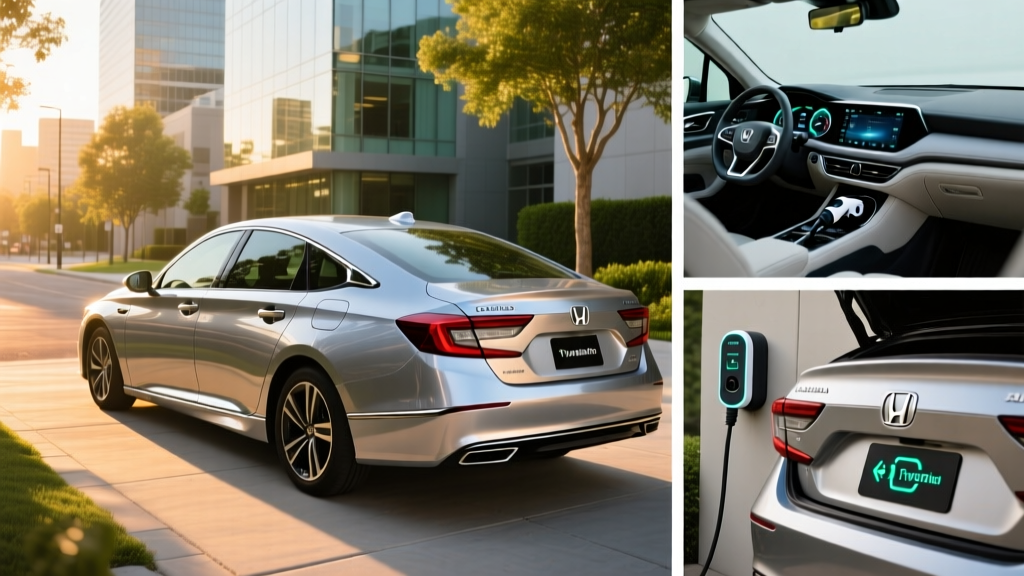
The midsize sedan segment hasn't gone fully electric, and the 2026 Honda Accord Hybrid proves there's still a compelling case for electrification without a plug. Honda's two-motor hybrid system pairs a 2.0-liter Atkinson-cycle engine with electric motors to deliver 48 MPG combined — a figure that routinely beats its EPA sticker in stop-and-go driving. For buyers not ready to commit to a full battery-electric vehicle but unwilling to settle for a conventional gas powertrain, the Accord Hybrid occupies a precise middle ground.
This guide covers everything a research-heavy buyer needs: exact EPA figures, real-world fuel economy observations, powertrain architecture, trim pricing, battery longevity data, and how the Accord Hybrid stacks up against plug-in hybrids and full EVs in total cost of ownership.
HEV vs PHEV: Where the Accord Hybrid Fits
Before examining specs, it's essential to clarify what the 2026 Accord Hybrid is — and what it isn't. Honda sells the Accord as a conventional hybrid electric vehicle (HEV), not a plug-in hybrid (PHEV). That distinction carries real ownership implications.
| Feature | HEV (Accord Hybrid) | PHEV (e.g., Toyota Prius Prime) | Full EV (BEV) |
|---|---|---|---|
| Plug-in charging required | No | Yes (Level 1 or 2) | Yes (Level 2 or DC) |
| Electric-only range | ~1 mile at low speed | 25–44 miles typical | 200–400+ miles |
| Battery size | ~1.1 kWh | 13–18 kWh typical | 60–100+ kWh |
| Federal tax credit (§30D) | Not eligible | Up to $7,500 (if eligible) | Up to $7,500 (if eligible) |
| Home charging install needed | No | Recommended | Required |
| Tailpipe emissions | Low | Zero (EV mode) / Low | Zero |
The Accord Hybrid recovers energy through regenerative braking and uses its small lithium-ion battery to assist the gasoline engine and enable brief electric-only motoring at low speeds. You never plug it in — it refuels exclusively at a gas station. If you're looking for 30+ miles of electric-only commuting, you'll need to look at a PHEV like the Toyota Prius Prime or a full EV.
Fuel Economy: EPA Ratings and Real-World MPG
The 2026 Honda Accord Hybrid carries forward Honda's proven fourth-generation two-motor hybrid system, refined for efficiency across the trim lineup. Here are the official EPA figures as listed on fueleconomy.gov:
| Trim | City MPG | Highway MPG | Combined MPG |
|---|---|---|---|
| Sport Hybrid | 51 | 44 | 48 |
| Sport-L Hybrid | 51 | 44 | 48 |
| EX-L Hybrid | 51 | 44 | 48 |
| Sport Touring Hybrid | 51 | 44 | 48 |
Real-World MPG: What to Actually Expect
The Accord Hybrid's 51 MPG city rating isn't marketing optimism — it's a genuine reflection of how the two-motor system works. In city driving, the electric motor does most of the propulsion work while the engine acts primarily as a generator, running at its most efficient RPM. Owners who do heavy stop-and-go commuting regularly report 50–54 MPG in warm weather, exceeding the EPA city figure.
Highway driving tells a different story. At sustained 70–80 mph speeds, the engine takes over direct propulsion, and aerodynamic drag dominates. Expect 40–44 MPG on the highway in real-world conditions. In cold weather (below 35°F), engine warm-up cycles and cabin heating reduce efficiency; plan for a combined 42–45 MPG in winter months for northern-climate drivers.
With a 12.8-gallon fuel tank, the Accord Hybrid delivers a real-world total range of approximately 530–615 miles depending on driving mix — enough for most drivers to visit a gas station once every two weeks.
Powertrain and Performance Specs
Honda's hybrid system uses a series-parallel architecture that seamlessly switches between electric drive, engine-generator mode, and direct engine drive depending on speed and load.
| Specification | 2026 Honda Accord Hybrid |
|---|---|
| Engine | 2.0L 4-cylinder Atkinson-cycle |
| Combined system horsepower | 204 hp |
| Combined system torque | 247 lb-ft |
| Electric motor output | 181 hp / 247 lb-ft (drive motor) |
| Transmission | e-CVT (no traditional gears) |
| Drivetrain | Front-wheel drive |
| 0–60 mph | ~7.2 seconds |
| Battery type | Lithium-ion (~1.1 kWh) |
| Cargo volume | 16.7 cu ft |
| Curb weight | ~3,477 lbs (Sport Touring) |
The 247 lb-ft of torque from the electric drive motor gives the Accord Hybrid strong initial acceleration — it feels quicker off the line than its 7.2-second 0–60 time suggests. The e-CVT avoids the rubber-band effect of older CVTs because the engine RPM isn't directly tied to wheel speed in most driving conditions. Honda also includes paddle-shift-selectable regen levels, letting you increase regenerative braking intensity without committing to full one-pedal driving.
Pricing, Trims, and Tax Credit Eligibility
The 2026 Accord Hybrid is available across four trims, with the hybrid powertrain standard on Sport and above (the base LX and SE trims use a 1.5L turbocharged gas-only engine).
| Trim | MSRP (est.) | Powertrain |
|---|---|---|
| Sport Hybrid | $32,895 | 2.0L Hybrid |
| Sport-L Hybrid | $34,895 | 2.0L Hybrid |
| EX-L Hybrid | $36,395 | 2.0L Hybrid |
| Sport Touring Hybrid | $39,395 | 2.0L Hybrid |
Note: MSRP figures are estimated based on Honda's current pricing trajectory and may vary at launch. Destination charges (~$1,095) are additional.
Federal Tax Credit: Does the Accord Hybrid Qualify?
Short answer: No. The 2026 Honda Accord Hybrid is a conventional HEV and does not qualify for the IRS §30D Clean Vehicle Credit. That credit — up to $7,500 — applies only to plug-in electric vehicles (BEVs and PHEVs) that meet battery sourcing, MSRP caps, and buyer income requirements.
Conventional hybrids like the Accord Hybrid are excluded from §30D. Some states offer separate incentives for hybrids, but these are uncommon and vary by jurisdiction. Check your state's energy office or DMV for any local programs.
Battery Warranty, Reliability, and Replacement Cost
Hybrid battery longevity remains a top concern for buyers transitioning from conventional gas cars. Honda addresses this with robust warranty coverage:
| Coverage | Term |
|---|---|
| Hybrid battery warranty | 8 years / 100,000 miles (10 yr / 150,000 mi in CARB states) |
| Powertrain warranty | 5 years / 60,000 miles |
| New vehicle limited warranty | 3 years / 36,000 miles |
In California Air Resources Board (CARB) states — which include CA, CT, CO, ME, MD, MA, NJ, NY, OR, RI, VT, and WA — the hybrid battery warranty extends to 10 years / 150,000 miles under emissions component coverage.
Real-World Battery Longevity
Honda's hybrid system has been in production since the early 2000s, and real-world failure data is encouraging. The ~1.1 kWh battery in the Accord Hybrid is small, lightly stressed, and never fully charged or fully depleted — the system maintains a state-of-charge buffer that dramatically extends cell life. Based on historical Honda hybrid data and industry tracking, most Accord Hybrid batteries last well beyond 150,000 miles without significant degradation.
If replacement is needed out of warranty, expect a cost of $2,000–$4,000 for a new hybrid battery pack (parts and labor) at a Honda dealer. Independent hybrid specialists often offer refurbished packs for $1,200–$2,500. This is substantially less than a full EV battery replacement, which can exceed $10,000–$18,000.
Overall Reliability
Honda's hybrid powertrain has earned strong reliability marks. The e-CVT eliminates traditional transmission wear components (no clutch packs, torque converters, or gear sets to fail). The IIHS typically rates the Accord highly for crash safety. The primary maintenance items remain standard: oil changes (every 7,500–10,000 miles), brake fluid, cabin air filter, and tire rotation. Brake pad life is often extended well beyond 80,000 miles thanks to regenerative braking reducing friction brake use.
Accord Hybrid vs PHEV vs Full EV: Which Is Right for You?
The decision between a conventional hybrid, plug-in hybrid, and full EV hinges on your driving pattern, charging access, and budget.
Choose the Accord Hybrid (HEV) if:
- You lack access to home or workplace charging (apartment, street parking)
- Your commute is 20–60 miles round-trip with mixed city/highway driving
- You want 500+ miles of range without planning charging stops
- You prefer the lowest upfront cost among electrified options
- You want zero change to your refueling habits
Choose a PHEV (e.g., Toyota Prius Prime, Hyundai Tucson PHEV) if:
- You can install a Level 2 charger at home
- Your daily commute is under 40 miles (covering most trips on electric only)
- You want electric commuting with gas-engine backup for road trips
- You may qualify for the §30D federal tax credit
Choose a full EV (e.g., Tesla Model 3, Hyundai Ioniq 6) if:
- You have reliable home Level 2 charging
- Your daily driving is under 250 miles
- You want zero tailpipe emissions and the lowest per-mile energy cost
- You're willing to plan around DC fast charging on road trips
For a buyer with no home charging access who drives 15,000 miles per year, the Accord Hybrid at 48 MPG combined burns roughly 312 gallons annually — about $1,092 at $3.50/gallon. A comparable gas-only Accord (30 MPG combined) would use 500 gallons, costing $1,750. That's a $658 annual fuel savings without ever plugging in.
Pros and Cons at a Glance
Pros
- 48 MPG combined — routinely exceeds EPA city rating in real-world driving
- No charging infrastructure needed — zero lifestyle change
- 247 lb-ft of electric torque delivers responsive acceleration
- Strong reliability track record with 8–10 year battery warranty
- 16.7 cu ft trunk — no battery intrusion compromising cargo space
- Lower hybrid battery replacement cost than full EV batteries
- Honda Sensing ADAS suite standard on all trims
Cons
- Not eligible for the $7,500 federal §30D tax credit
- No electric-only commuting capability (unlike PHEVs)
- Highway MPG drops to ~40–44, narrowing advantage over efficient gas sedans
- FWD only — no all-wheel-drive option (unlike Toyota Camry Hybrid AWD)
- Hybrid trims start at ~$32,895, a premium over the gas-only base model
- Cold-weather efficiency loss of 5–10% in winter months
Frequently Asked Questions
How many MPG does the 2026 Honda Accord Hybrid get?
The EPA rates the Accord Hybrid at 51 MPG city, 44 MPG highway, and 48 MPG combined across all hybrid trims. In real-world city driving, many owners report 50–54 MPG. Highway driving at 70–80 mph typically yields 40–44 MPG. Cold weather reduces combined efficiency to approximately 42–45 MPG.
Does the Honda Accord Hybrid need to be plugged in?
No. The Accord Hybrid is a conventional hybrid (HEV), not a plug-in hybrid (PHEV). It charges its small battery through regenerative braking and the gasoline engine. You refuel it exclusively at a gas station.
How far can the Accord Hybrid go on electric only?
Less than one mile at very low speeds. The Accord Hybrid's ~1.1 kWh battery is designed for assist and energy recapture, not sustained electric-only driving. If you need 25–40 miles of electric-only range, consider a PHEV instead.
Is the 2026 Accord Hybrid reliable?
Honda's hybrid powertrain has a strong reliability record spanning two decades of production. The e-CVT has fewer moving parts than a conventional automatic transmission. The hybrid battery is warranted for 8 years / 100,000 miles (10 years / 150,000 miles in CARB states), and real-world data suggests most packs last well beyond 150,000 miles without failure.
What does a replacement hybrid battery cost?
Out-of-warranty replacement for the Accord Hybrid battery typically costs $2,000–$4,000 at a Honda dealer (parts and labor). Refurbished packs from independent hybrid specialists range from $1,200–$2,500. This is significantly less than full EV battery replacements.
Does the 2026 Accord Hybrid qualify for a federal tax credit?
No. The IRS §30D Clean Vehicle Credit applies only to plug-in electric vehicles (BEVs and PHEVs). Conventional hybrids like the Accord Hybrid do not qualify. Check your state energy office for any local hybrid incentives, though these are uncommon.
Should I buy the Accord Hybrid or a full EV?
If you have reliable home Level 2 charging, drive under 250 miles daily, and want the lowest per-mile energy cost, a full EV like the Tesla Model 3 or Hyundai Ioniq 6 may save more over five years. If you lack home charging, take frequent long road trips, or prefer zero change to your refueling routine, the Accord Hybrid is the more practical choice.
Does the Accord Hybrid have all-wheel drive?
No. The 2026 Accord Hybrid is front-wheel drive only. If AWD is a priority in a hybrid sedan, the Toyota Camry Hybrid offers an available electronic AWD system.