Quick Verdict: The Accord Hybrid Sport Balances Efficiency and Engagement
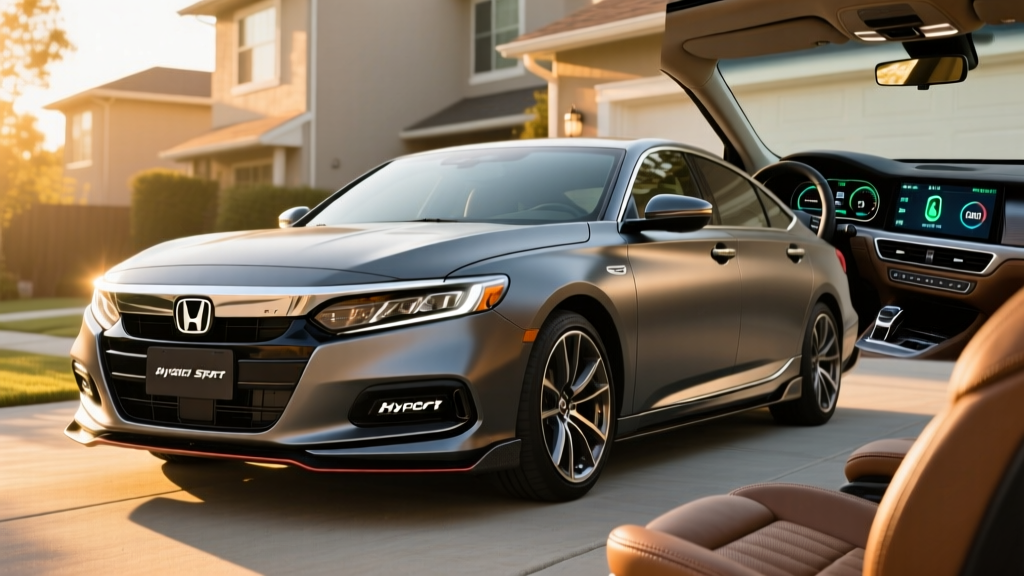
The 2025 Honda Accord Hybrid Sport occupies a specific niche in the midsize sedan market: it delivers near-50 MPG combined fuel economy without sacrificing the driving dynamics that made the Accord a perennial favorite. Unlike the more comfort-oriented Hybrid EX-L, the Sport trim adds paddle shifters, a sport-tuned suspension calibration, and 19-inch alloy wheels — all while maintaining the same efficient two-motor hybrid powertrain.
For buyers weighing a conventional hybrid against a plug-in hybrid or full battery-electric vehicle, the Accord Hybrid Sport makes a compelling case. It requires zero lifestyle changes — no home charger installation, no route planning for charging stops, no cold-weather range loss anxiety. You simply fuel up at any gas station and drive. The trade-off? You'll still spend roughly $1,500–$2,000 annually on gasoline depending on mileage, whereas a full EV could cut that to $400–$600 in electricity.
| Specification | 2025 Honda Accord Hybrid Sport |
|---|---|
| Powertrain | 2.0L Atkinson-cycle 4-cyl + two electric motors |
| Combined Horsepower | 204 hp |
| Combined Torque | 247 lb-ft (electric motor) |
| Transmission | eCVT (direct-drive with lock-up clutch) |
| EPA MPG (City / Hwy / Combined) | 50 / 45 / 48 |
| Fuel Tank Capacity | 12.8 gallons |
| Total Range | ~614 miles |
| 0–60 mph | ~7.5 seconds |
| Drivetrain | Front-wheel drive |
| Hybrid Battery Warranty | 8 years / 100,000 miles (10 yr/150k mi in CARB states) |
| Base MSRP (incl. destination) | ~$34,995 |
HEV vs. PHEV vs. EV: Where the Accord Hybrid Fits
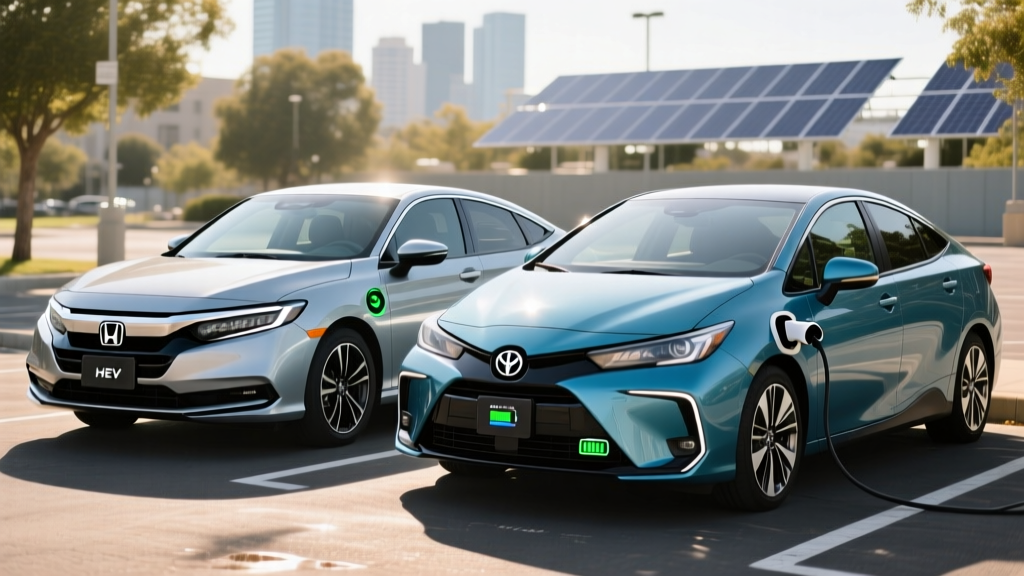
Before evaluating the Accord Hybrid Sport's specifics, it's worth clarifying the three electrified powertrain categories, because buyer confusion here leads to mismatched expectations.
| Feature | Conventional Hybrid (HEV) | Plug-in Hybrid (PHEV) | Battery Electric (BEV) |
|---|---|---|---|
| Plug in to charge? | No — self-charging via regen + engine | Yes — has a charge port | Yes — charge port required |
| Electric-only range | Less than 1 mile (assist only) | 20–50 miles typical | 200–400+ miles |
| Battery size | 1.0–1.5 kWh | 10–25 kWh | 60–120 kWh |
| Fuel required? | Yes — gasoline | Yes — gasoline + electricity | No — electricity only |
| Federal tax credit | No (§30D requires plug-in) | Up to $7,500 (income/sourcing rules apply) | Up to $7,500 (income/sourcing rules apply) |
| Home charging needed? | No | Recommended for full benefit | Essential |
The 2025 Honda Accord Hybrid Sport is a conventional hybrid (HEV). It has no plug, no electric-only driving mode beyond brief low-speed assist, and it cannot be charged from a wall outlet. Its small ~1.3 kWh lithium-ion battery recharges exclusively through regenerative braking and the gasoline engine. Honda does not currently offer a plug-in hybrid variant of the Accord in the US market — if you need PHEV capability in a Honda sedan, the Clarity Plug-In Hybrid was discontinued after 2021.
This matters for tax credit eligibility: because the Accord Hybrid is an HEV, it does not qualify for the federal §30D Clean Vehicle Credit, which requires a plug-in vehicle with a battery capacity of at least 7 kWh. Some states offer modest hybrid rebates, but the $7,500 federal credit is off the table.
Real-World MPG: Does the Accord Hybrid Sport Hit 48 MPG?
The EPA rates the 2025 Accord Hybrid Sport at 50 city / 45 highway / 48 combined MPG according to fueleconomy.gov. But EPA stickers tell only part of the story.
| Driving Scenario | Expected MPG | Notes |
|---|---|---|
| City / stop-and-go | 48–54 MPG | Hybrids excel here; regen recaptures braking energy |
| Suburban mixed | 45–50 MPG | Closest to EPA combined rating |
| Highway (70–75 mph) | 38–43 MPG | Aero drag dominates; electric assist less impactful |
| Cold weather (below 30°F) | 36–42 MPG combined | Engine runs more to heat cabin; battery less efficient |
| Aggressive driving | 34–40 MPG combined | Hard acceleration bypasses efficiency optimizations |
The Accord Hybrid's two-motor system operates primarily as a series hybrid at low and moderate speeds — the gasoline engine generates electricity that powers the drive motor, with the engine mechanically connecting to the wheels only at steady highway cruising via a lock-up clutch. This architecture means city driving, where the engine can run at its most efficient RPM regardless of vehicle speed, often yields higher MPG than highway driving. Many owners report exceeding 50 MPG on suburban commutes with moderate traffic.
However, sustained highway driving at 75+ mph, especially in winter, will drop fuel economy into the high 30s. If your commute is 90% highway, expect a real-world combined average closer to 42–44 MPG rather than the EPA's 48.
Powertrain Deep Dive: 204 HP from a Hybrid?
Honda's fourth-generation two-motor hybrid system pairs a 2.0-liter Atkinson-cycle inline-four (producing 146 hp and 134 lb-ft on its own) with a propulsion motor rated at 181 hp and 247 lb-ft of torque. The combined system output is 204 hp, with the electric motor providing the majority of the thrust you feel during acceleration.
The result is a 0–60 mph time of approximately 7.5 seconds — not sports-sedan quick, but responsive enough for confident highway merging and passing. The electric motor's instant torque delivery makes the Accord Hybrid feel punchier around town than the horsepower figure suggests. Sport mode sharpens throttle response and adds simulated gear shifts through the paddle shifters, which modulate regenerative braking intensity rather than changing actual gears in the eCVT.
The Sport trim's suspension tuning is slightly firmer than the EX-L, and the 19-inch wheels (wrapped in 235/40R19 tires) provide sharper turn-in at the cost of some ride compliance on rough pavement. Road noise is well-managed but more noticeable than on the 17-inch-equipped trims.
Battery Longevity, Warranty, and Replacement Cost
Honda Hybrid Battery Warranty
- Coverage: 8 years / 100,000 miles (standard); 10 years / 150,000 miles in CARB states (CA, CT, ME, MA, NJ, NY, OR, RI, VT, WA, and others adopting California emissions standards)
- What's covered: Hybrid battery pack, power control unit, and related hybrid-system components against defects and excessive capacity loss
- Capacity threshold: Honda does not publish a specific degradation percentage trigger, but industry standard is replacement if capacity drops below 60–70% of original
The Accord Hybrid's ~1.3 kWh lithium-ion battery pack is small compared to a PHEV or BEV, and it operates within a narrow state-of-charge window (roughly 40–80% SoC) managed by the hybrid control system. This shallow-cycling strategy dramatically reduces degradation stress. Honda's hybrid batteries from the third-generation system (2018–2022 Accord Hybrid) have shown excellent longevity, with few reported failures within the warranty period.
If replacement is needed out of warranty, expect to pay $2,000–$3,500 for a new OEM hybrid battery pack installed at a Honda dealer. Third-party refurbished packs are available for $1,200–$2,000. Given that Honda's hybrid system has proven reliable over hundreds of thousands of fleet miles, this is a low-probability expense for most owners.
For context, a full EV battery replacement runs $8,000–$20,000 depending on capacity — the Accord Hybrid's small battery is far cheaper to replace, and far less likely to need it.
Pricing, Tax Credits, and Total Cost of Ownership
The 2025 Honda Accord Hybrid Sport carries an MSRP of approximately $34,995 including destination charges. This positions it roughly $2,500 above the Hybrid EX-L and about $5,000 above the base gasoline Accord LX.
Because the Accord Hybrid is a conventional HEV with no plug, it does not qualify for the federal §30D Clean Vehicle Credit. Per IRS guidelines, the §30D credit requires a vehicle with a plug and a battery capacity of at least 7 kWh. The Accord Hybrid's ~1.3 kWh pack and lack of a charge port make it ineligible.
Does the 2025 Accord Hybrid Sport Qualify for Incentives?
- ❌ Federal §30D Clean Vehicle Credit ($7,500) — Not eligible (HEV, no plug)
- ❌ Federal Used Clean Vehicle Credit (§25E, up to $4,000) — Not eligible for new purchase; may apply if buying a qualifying used plug-in vehicle instead
- ⚠️ State hybrid rebates — Varies by state; some states (e.g., Colorado, Maryland) have offered modest HEV rebates, but most state incentives now target PHEVs and BEVs
- ✅ Employer commuter benefits / HSA-adjacent programs — Some employers offer hybrid purchase stipends; check your HR department
Despite the lack of tax credits, the Accord Hybrid Sport's total cost of ownership remains competitive. At 48 MPG combined and $3.50/gallon gasoline, a driver covering 15,000 miles annually spends roughly $1,094 per year on fuel. A comparable gasoline-only midsize sedan averaging 30 MPG combined would cost about $1,750 annually — a savings of ~$656/year, or ~$3,280 over five years, for the hybrid.
Insurance costs for the Accord Hybrid Sport are typically in line with or slightly below the gasoline Accord, as hybrid sedans tend to attract lower-risk driver demographics. Honda's strong resale values also help offset the higher initial purchase price.
Who Should Choose the Accord Hybrid Sport?
Choose the Accord Hybrid Sport If:
- You drive 12,000–20,000 miles per year, especially with significant city or suburban driving
- You cannot install a home Level 2 charger (apartment, street parking, condo restrictions)
- You want to reduce fuel costs without changing your refueling habits
- You value Honda's reliability reputation and strong resale value
- You prefer a sport-tuned ride over the softer EX-L tuning
Consider a PHEV or Full EV Instead If:
- You can charge at home and want to drive on electricity for daily commutes (look at the Toyota RAV4 Prime, Hyundai Tucson PHEV, or a full EV like the Tesla Model 3 or Hyundai Ioniq 6)
- You want to qualify for the $7,500 federal tax credit
- Your daily driving is under 40 miles round-trip and you want zero tailpipe emissions on most trips
- You're willing to plan charging stops on road trips for a full EV's lower per-mile energy cost
Pros
- 48 MPG combined EPA — among the most efficient midsize sedans available
- No plug-in required — zero lifestyle adjustment from a gas car
- Strong 204 hp output with instant electric torque
- Excellent Honda Sensing safety suite (standard)
- Sport trim adds visual and handling upgrades without extreme price premium
- Proven hybrid reliability with strong battery warranty
Cons
- No federal tax credit eligibility
- Highway MPG drops noticeably at 75+ mph
- No all-wheel-drive option (FWD only)
- 19-inch wheels trade some ride comfort for style
- No plug-in variant available — cannot drive on electric alone
- Rear-seat headroom slightly reduced by battery pack placement
Frequently Asked Questions
How many MPG does the 2025 Honda Accord Hybrid Sport get?
The EPA rates it at 50 city / 45 highway / 48 combined MPG. Real-world results vary: expect 48–54 MPG in city driving, 38–43 MPG on sustained highway trips at 70–75 mph, and 36–42 MPG combined in cold weather below 30°F.
Can I plug in the Accord Hybrid Sport to charge?
No. The Accord Hybrid Sport is a conventional hybrid (HEV), not a plug-in hybrid (PHEV). It has no charge port. The small hybrid battery recharges through regenerative braking and the gasoline engine. You fuel it at any gas station like a conventional car.
Does the 2025 Accord Hybrid Sport qualify for any tax credit?
It does not qualify for the federal §30D Clean Vehicle Credit, which requires a plug-in vehicle with at least 7 kWh of battery capacity. Some states may offer modest hybrid rebates, but these vary by jurisdiction and are far smaller than the federal credit. Check your state's energy office for current programs.
Is the Accord Hybrid reliable, and what does battery replacement cost?
Honda's hybrid system has demonstrated strong reliability across multiple generations. The hybrid battery is warranted for 8 years/100,000 miles (10 years/150,000 miles in CARB states). Out-of-warranty replacement costs approximately $2,000–$3,500 at a dealer. Based on long-term fleet data, most hybrid batteries last well beyond the warranty period without significant degradation.
How does the Accord Hybrid Sport compare to the Accord Hybrid EX-L?
Both share the same 204 hp hybrid powertrain and 48 MPG combined rating. The Sport adds 19-inch wheels, paddle shifters, sport-tuned suspension, black exterior accents, and a leather-wrapped steering wheel. The EX-L offers leather-trimmed seats, a power-adjustable passenger seat, and a softer ride on 17-inch wheels. The Sport is ~$500 less expensive than the EX-L.
Should I buy the Accord Hybrid Sport or a full EV like the Tesla Model 3?
If you can charge at home and drive under 300 miles daily, a full EV offers lower per-mile energy costs (~4 cents/mile vs. ~7 cents/mile for the hybrid), zero tailpipe emissions, and federal tax credit eligibility. However, if you lack home charging access, frequently drive 400+ miles in a day, or live in an area with unreliable public charging infrastructure, the Accord Hybrid Sport eliminates range and charging anxiety entirely while still cutting fuel costs significantly versus a gas-only sedan.
What is the Accord Hybrid Sport's total driving range?
With a 12.8-gallon fuel tank and 48 MPG combined, the Accord Hybrid Sport can travel approximately 614 miles on a full tank. In city-heavy driving at 50+ MPG, range can exceed 640 miles. Highway-dominant driving reduces this to roughly 500–550 miles per tank.
Sources: EPA fuel economy data via fueleconomy.gov; IRS Clean Vehicle Credit rules via irs.gov; Honda specifications via automobiles.honda.com.