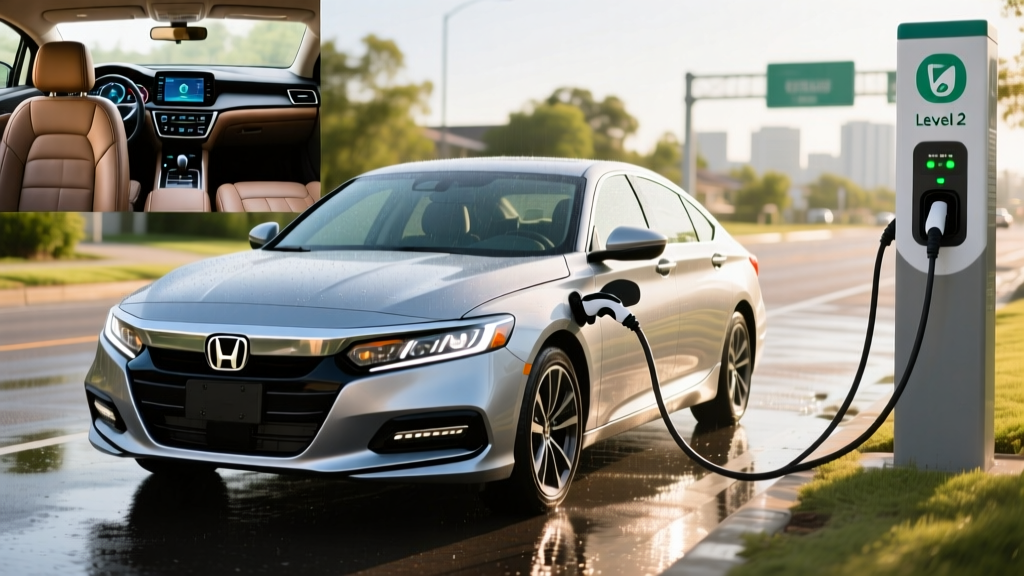
The 2018 Honda Accord Hybrid Touring was the flagship trim of Honda's 10th-generation Accord Hybrid lineup, pairing a 2.0-liter Atkinson-cycle engine with a two-motor hybrid system to deliver 212 combined horsepower and an EPA-estimated 47 MPG combined. In 2026, it remains one of the most compelling used midsize sedans for buyers who want hybrid efficiency without plugging in — and without sacrificing premium features.
This guide breaks down the real-world fuel economy, powertrain specs, battery longevity, ownership costs, and whether the 2018 Accord Hybrid Touring holds up against modern hybrids, PHEVs, and full EVs eight years after its debut.
EPA Fuel Economy vs. Real-World MPG
The 2018 Accord Hybrid Touring carries the same EPA ratings as other Accord Hybrid trims, since all share the identical powertrain and battery. Honda's official figures are competitive even against 2026 competitors:
| Metric | EPA Estimate | Real-World Expectation |
|---|---|---|
| City MPG | 47 MPG | 44–50 MPG (hybrids often beat EPA in stop-and-go) |
| Highway MPG | 46 MPG | 42–45 MPG (sustained 75+ mph reduces regen benefit) |
| Combined MPG | 47 MPG | 43–47 MPG depending on driving mix |
| Total Range | ~610 miles (12.8-gal tank) | 550–620 miles |
Because the Accord Hybrid uses Honda's two-motor system (which can drive the wheels electrically at low-to-mid speeds), city driving tends to yield results at or above the EPA sticker. Highway efficiency drops slightly because the engine must engage directly at sustained speeds, and the relatively small 1.3 kWh battery offers minimal electric-only assistance above 50 mph.
Cold-weather impact is modest compared to full EVs: expect a 5–10% MPG reduction in sub-30°F conditions, primarily from engine warm-up cycles and cabin heating load. That still leaves you at roughly 42–44 MPG combined in winter — far better than the gas-only Accord's ~33 MPG combined.
Powertrain: 212 HP Two-Motor Hybrid System
The 2018 Accord Hybrid uses Honda's third-generation two-motor hybrid system, which operates differently from a traditional parallel hybrid like the Toyota Camry Hybrid. Here's the breakdown:
| Specification | Detail |
|---|---|
| Engine | 2.0L 4-cylinder Atkinson-cycle (146 hp, 129 lb-ft) |
| Drive Motor | AC synchronous permanent-magnet (181 hp, 232 lb-ft) |
| Generator Motor | AC synchronous (acts as starter/generator) |
| Combined System Output | 212 hp |
| Transmission | e-CVT (no traditional gears — motor-driven) |
| Hybrid Battery | 1.3 kWh lithium-ion (gross) |
| 0–60 mph | ~7.1 seconds |
| Drivetrain | Front-wheel drive |
In most driving conditions below ~50 mph, the gasoline engine acts solely as a generator — it powers the drive motor electrically rather than turning the wheels directly. At highway speeds, a lock-up clutch engages, connecting the engine directly to the front axle for improved efficiency. This series-parallel architecture gives the Accord Hybrid a smoother, more EV-like feel around town compared to competitors with conventional planetary-gear e-CVTs.
HEV vs. PHEV vs. EV: Which Fits You?
The 2018 Accord Hybrid is a conventional hybrid (HEV) — it does not plug in, has no electric-only range to speak of, and generates all its electricity from the gasoline engine and regenerative braking. Honda did not offer a plug-in hybrid (PHEV) version of the 10th-generation Accord.
| Factor | HEV (Accord Hybrid) | PHEV (e.g., Toyota Prius Prime) | Full EV (e.g., Tesla Model 3) |
|---|---|---|---|
| Plug-in required? | No | Yes (Level 1/2) | Yes (Level 2/DCFC) |
| Electric-only range | ~1 mile at low speed | 25–44 miles (typical) | 250–360 miles |
| Fuel/energy cost per mile | ~$0.08 (gas) | ~$0.04 (electric) / ~$0.08 (gas) | ~$0.04 (electric) |
| Home charging needed? | No | Recommended | Essential |
| Tax credit (new, 2018) | None | Up to $4,502 (Prius Prime) | Up to $7,500 |
| Used EV credit (§25E, 2026) | Not eligible | Eligible: up to $4,000 | Eligible: up to $4,000 |
If you lack access to home or workplace charging, the Accord Hybrid is the clear winner — you simply fuel up at any gas station and let the hybrid system optimize efficiency. If you have reliable Level 2 charging at home and a commute under 30 miles, a PHEV or full EV will deliver lower per-mile operating costs.
Battery Longevity, Warranty & Replacement Cost
Original Warranty: Honda covered the 2018 Accord Hybrid's lithium-ion battery for 8 years / 100,000 miles (10 years / 150,000 miles in CARB states including California, New York, Massachusetts, and others). That means in 2026, the original 8-year/100k warranty has expired for most vehicles — but the 10-year/150k CARB warranty may still apply for cars registered in those states.
The 1.3 kWh lithium-ion pack in the Accord Hybrid is modest in size, which actually works in its favor for longevity. Because the hybrid system manages charge and discharge within a narrow state-of-charge window (roughly 40–80%), the battery experiences far less stress than a full EV battery that cycles through deep discharges daily.
Real-world degradation data: Based on owner reports and fleet data, the 10th-gen Accord Hybrid battery typically retains 85–95% of its original capacity after 100,000 miles. Because the battery is small and the hybrid system is tolerant of minor capacity loss, most owners notice little to no fuel-economy degradation even at 150,000+ miles.
Replacement cost in 2026: If the hybrid battery does fail out of warranty, expect:
- OEM replacement battery pack: $2,000–$3,500 (parts)
- Labor: $500–$1,000
- Total installed: $2,500–$4,500 at a Honda dealer
- Aftermarket/refurbished options: $1,200–$2,000 installed at independent hybrid specialists
This is significantly cheaper than a full EV battery replacement ($5,000–$15,000+) because the pack is small. The hybrid system's other components — the drive motor, generator motor, and power control unit — have proven highly reliable, with few reported failures.
Touring Trim: What You Get at the Top
The Touring was the most expensive Accord Hybrid trim in 2018, and it came loaded with features that remain competitive in 2026:
- Honda Sensing suite: Adaptive cruise control, lane-keeping assist, forward collision warning with automatic emergency braking, road departure mitigation
- Navigation: 8-inch touchscreen with embedded GPS, Apple CarPlay, Android Auto
- Audio: 10-speaker premium audio system
- Comfort: Heated and ventilated front seats, heated rear seats, leather upholstery, heated steering wheel
- Convenience: Wireless phone charging, front and rear parking sensors, rain-sensing wipers, LED headlights with auto high-beam
- Wheels: 19-inch alloy wheels (unique to Touring)
The Honda Sensing suite is a Level 2 driver-assistance system per SAE classification — it provides steering and acceleration/braking support but requires the driver to remain fully engaged at all times. It is not self-driving.
2026 Used Pricing & Tax Credit Eligibility
As of early 2026, the 2018 Honda Accord Hybrid Touring trades in the used market at approximately:
- 60,000–80,000 miles: $18,000–$22,000
- 80,000–120,000 miles: $15,000–$18,500
- 120,000+ miles: $12,000–$15,000
Original MSRP (2018): $34,990 (including destination)
Tax credit eligibility: The 2018 Accord Hybrid does not qualify for the federal §30D new clean vehicle credit (that applied only to plug-in vehicles, and the Accord Hybrid is a conventional HEV). However, under the §25E used clean vehicle credit, conventional hybrids are also excluded — this credit applies only to used EVs and PHEVs with at least 7 kWh of battery capacity. The Accord Hybrid's 1.3 kWh pack falls well below that threshold.
Bottom line: no federal tax credits apply to this vehicle. Some states may offer used hybrid incentives — check your state energy office or DMV for current programs.
Reliability & Common Issues
The 10th-generation Accord Hybrid has earned strong reliability marks. Key data points:
- NHTSA Safety Rating: 5-Star Overall — see NHTSA.gov
- IIHS Rating: Top Safety Pick+ (with specific headlights)
- Common complaints: Infotainment system lag, occasional 12V battery drain (unrelated to the hybrid battery), and minor wind noise from the 19-inch Touring wheels
- Recalls: Check the VIN at NHTSA.gov/recalls — some 2018 Accords had recalls for fuel pump assemblies and software issues
The hybrid-specific components (battery, motors, power control unit, e-CVT) have proven notably trouble-free across Honda's fleet. Unlike some early hybrid systems from other manufacturers, Honda's two-motor design avoids the mechanical complexity of planetary gearsets, reducing failure points.
Who Should Buy the 2018 Accord Hybrid Touring in 2026?
Pros
- 47 MPG combined with no plug-in requirement
- Premium Touring features rival 2026 midsize sedans
- Proven reliability with low hybrid-battery failure rates
- Affordable battery replacement ($2,500–$4,500) if needed
- Spacious cabin, 16.7 cu-ft trunk (battery doesn't eat cargo space)
- Smooth, EV-like low-speed driving feel
Cons
- No federal tax credit eligibility (HEV, not PHEV/EV)
- 8-year/100k battery warranty likely expired on most examples
- Infotainment feels dated vs. 2026 systems
- 19-inch Touring wheels produce more road noise than lower trims
- No DC fast charging or plug-in capability
- Higher used prices than gas-only Accord (hybrid premium persists)
Decision Framework
Choose the 2018 Accord Hybrid Touring if: You want maximum MPG without plugging in, you lack home charging access, you prioritize a loaded feature set, and you plan to keep the car 3–5+ years with 15,000+ miles/year (where the fuel savings compound).
Look at a used PHEV or EV instead if: You have reliable Level 2 home charging, your commute is under 30 miles (PHEV covers it on electric), or you want to qualify for the up-to-$4,000 §25E used clean vehicle credit (requires a qualifying PHEV or EV with 7+ kWh battery).
Consider a newer Accord Hybrid (2023–2026) if: You want updated infotainment, a fresh battery warranty, and Honda's latest Sensing suite with improved lane-centering and low-speed braking.
FAQ: 2018 Honda Accord Hybrid Touring
How many MPG does the 2018 Honda Accord Hybrid Touring get?
The EPA rates it at 47 city / 46 highway / 47 combined MPG. Real-world results typically range from 43–50 MPG depending on driving conditions, with city-heavy commutes often exceeding the EPA estimate thanks to the two-motor hybrid system's regenerative braking.
Does the 2018 Accord Hybrid need to be plugged in?
No. This is a conventional hybrid (HEV), not a plug-in hybrid (PHEV). It charges its 1.3 kWh battery entirely through the gasoline engine and regenerative braking. You never plug it in — just fill up at any gas station.
How far can the 2018 Accord Hybrid go on electric only?
Effectively about 1 mile at very low speeds (under 25 mph) in EV mode. The battery is too small for meaningful electric-only driving. If you want 25–40 miles of electric-only range, you need a PHEV like the Toyota Prius Prime or Hyundai Tucson PHEV.
Is the 2018 Accord Hybrid reliable, and what does battery replacement cost?
Yes — the 10th-generation Accord Hybrid has strong reliability data with few hybrid-system failures reported. The original 8-year/100,000-mile battery warranty has likely expired, but replacement costs are manageable: $2,500–$4,500 for an OEM pack installed, or $1,200–$2,000 for an aftermarket option. Most batteries retain 85–95% capacity even at 100,000+ miles.
Does the 2018 Accord Hybrid qualify for any tax credit in 2026?
No federal tax credits apply. It does not qualify for the §30D new vehicle credit (conventional hybrids were never eligible) or the §25E used clean vehicle credit (requires 7+ kWh battery; the Accord Hybrid has 1.3 kWh). Some states may offer their own used hybrid incentives — consult your state's energy office or a tax professional for current programs.
How does the 2018 Accord Hybrid compare to the gas-only 2018 Accord?
The gas-only 2018 Accord (1.5T) rates at 30 city / 38 highway / 33 combined MPG. The Hybrid's 47 MPG combined saves roughly $500–$700 per year in fuel costs at 15,000 miles/year and current gas prices. The hybrid also delivers smoother low-speed acceleration and a quieter cabin at idle (engine off). The trade-off is a higher purchase price and slightly less trunk space (though the difference is minimal in the 10th gen).
What's the difference between the Accord Hybrid Touring and lower trims?
The Touring adds ventilated front seats, heated rear seats, wireless phone charging, front/rear parking sensors, navigation, a 10-speaker audio system, LED headlights, rain-sensing wipers, and 19-inch wheels. Lower trims (EX, EX-L) share the same powertrain and MPG but forgo these premium features and use 17-inch wheels, which some owners find quieter on rough pavement.