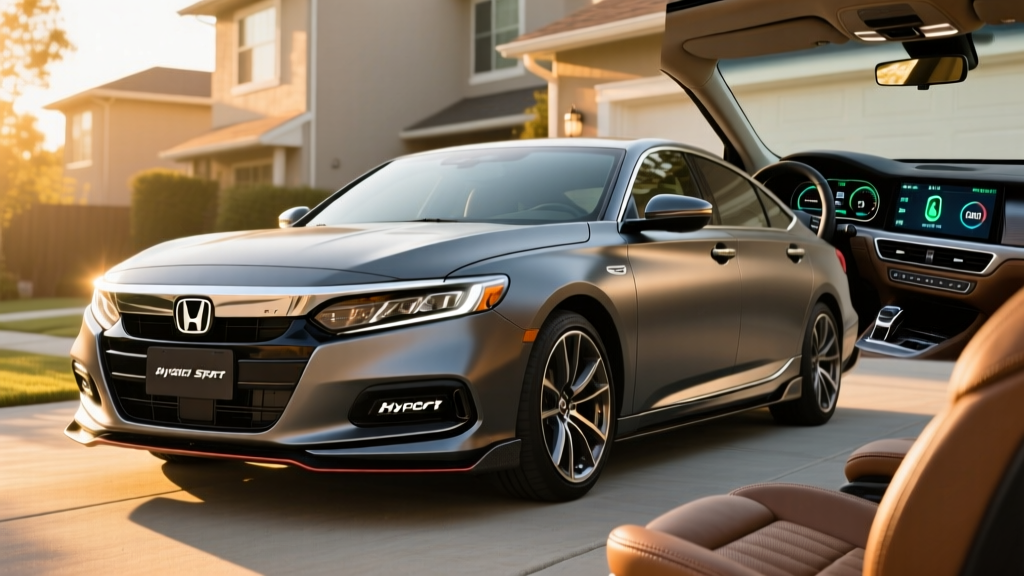
The 2018 Honda Accord Hybrid arrived as part of the 10th-generation Accord redesign, pairing a 2.0-liter Atkinson-cycle engine with a two-motor hybrid system to deliver midsize-sedan comfort with compact-car fuel economy. In 2026, it remains one of the most compelling used hybrids on the market — especially for buyers who want EV-like city efficiency without ever plugging in. This guide covers every spec that matters: real-world MPG, battery longevity, replacement costs, and how it stacks up against plug-in hybrids and full EVs today.
2018 Honda Accord Hybrid: Core Specifications
| Specification | Value |
|---|---|
| Powertrain Type | Conventional Hybrid (HEV) — no plug |
| Engine | 2.0L Atkinson-cycle 4-cylinder |
| Engine Output | 143 hp / 129 lb-ft torque |
| Electric Motor Output | 181 hp / 232 lb-ft torque |
| Combined System Horsepower | 212 hp |
| Transmission | Electronic CVT (e-CVT, no traditional gears) |
| Hybrid Battery | 1.3 kWh lithium-ion (usable ~0.9 kWh) |
| Drivetrain | Front-wheel drive |
| 0–60 mph | ~7.1 seconds |
| Curb Weight | ~3,300 lbs |
| EPA Fuel Economy | 48 city / 47 highway / 48 combined MPG |
| Fuel Tank | 12.8 gallons |
| Total Driving Range | ~614 miles (EPA est.) |
| Battery Warranty (original) | 8 years / 100,000 miles (10 yr / 150,000 mi in CARB states) |
Fuel Economy: EPA Numbers vs. Real-World MPG
The EPA rates the 2018 Accord Hybrid at 48 MPG city, 47 MPG highway, and 48 MPG combined across all trims (Hybrid, Hybrid EX, EX-L, and Touring). These figures come from fueleconomy.gov and apply to all 2018 Accord Hybrid variants — Honda does not differentiate trims for efficiency.
| Driving Scenario | EPA Rating | Real-World Expectation |
|---|---|---|
| City | 48 MPG | 46–52 MPG (hybrids often exceed EPA in stop-and-go) |
| Highway (70 mph) | 47 MPG | 40–44 MPG (aerodynamic drag, less regen benefit) |
| Combined | 48 MPG | 43–48 MPG depending on driving mix |
| Cold Weather (below 32°F) | — | 38–43 MPG (engine runs more for cabin heat) |
Like most conventional hybrids, the Accord Hybrid thrives in city driving. The two-motor system uses regenerative braking to recapture energy at every stop, and the gas engine shuts off frequently at low speeds. On the highway, the engine operates more continuously and aerodynamic drag rises, so expect 40–44 MPG at sustained 70–75 mph cruising. In cold weather, the engine runs longer to warm the cabin and catalytic converter, reducing efficiency by roughly 10–15%.
HEV vs. PHEV vs. EV: Which Powertrain Fits You?
A common question from shoppers cross-referencing the Accord Hybrid is whether they should consider a plug-in hybrid (PHEV) or a full battery electric vehicle (BEV) instead. Here is how the three powertrain types compare for a typical midsize-sedan buyer in 2026:
| Factor | HEV (Accord Hybrid) | PHEV (e.g., Toyota Prius Prime) | BEV (e.g., Tesla Model 3) |
|---|---|---|---|
| Plug-in Required? | No | Yes (for EV mode) | Yes |
| Electric-Only Range | ~1 mile at low speed | 35–44 miles (typical 2026 PHEV) | 250–360+ miles |
| Total Range | ~614 miles | ~500–600 miles combined | 250–360+ miles |
| Home Charging Needed? | No | Recommended (Level 1 or 2) | Essential (Level 2 strongly recommended) |
| Fuel Cost (per mile) | ~$0.08–0.10 | ~$0.03–0.05 (EV mode) / ~$0.09 (gas) | ~$0.03–0.05 |
| Upfront Price (2026 used/new) | ~$18,000–24,000 (used) | ~$33,000+ (new) | ~$38,000+ (new) |
| Federal Tax Credit | None | Up to $7,500 (§30D, if eligible) | Up to $7,500 (§30D, if eligible) |
| Maintenance Complexity | Low (gas + hybrid system) | Moderate (two full systems) | Lowest (no engine, no oil changes) |
Choose the 2018 Accord Hybrid (HEV) if: You lack access to home or workplace charging, want the lowest possible purchase price, drive a mix of city and highway miles, and prefer zero lifestyle change from a conventional gas car.
Choose a PHEV if: You can install a Level 2 charger at home, your daily commute is under 40 miles round-trip (covering most days on electricity), but you still want gas-engine range for road trips.
Choose a BEV if: You have reliable home charging, want the lowest per-mile fuel cost, are ready to plan road-trip charging stops, and prioritize minimal maintenance.
Hybrid Powertrain: How the Two-Motor System Works
Honda's hybrid system in the 2018 Accord is fundamentally different from Toyota's planetary-gear Hybrid Synergy Drive. The Accord uses an Integrated Motor Assist system with two electric motors — one primarily drives the wheels, and the other acts as a generator. In most driving conditions, the gas engine generates electricity that powers the drive motor, making the Accord Hybrid operate more like a series hybrid (similar to a locomotive or the Chevrolet Volt's range-extended mode).
At highway speeds (typically above 45–50 mph under light load), a lockup clutch mechanically connects the engine directly to the front wheels for more efficient cruising. This means the Accord Hybrid has no traditional multi-speed transmission — the e-CVT manages the interplay between engine, generator, and drive motor seamlessly.
The result is 212 combined system horsepower with strong low-end torque (232 lb-ft from the drive motor available from 0 RPM), giving the Accord Hybrid a surprisingly responsive feel off the line. The 0–60 mph time of roughly 7.1 seconds puts it in the same ballpark as many turbocharged gas midsize sedans.
Battery Longevity, Warranty, and Replacement Cost
The 2018 Accord Hybrid uses a 1.3 kWh lithium-ion battery pack mounted beneath the rear seats. Because it is a conventional HEV, the battery is relatively small and operates within a narrow state-of-charge window (roughly 40–80% SoC), which is the sweet spot for lithium-ion longevity. The battery management system never allows full charge or full discharge, significantly reducing stress and degradation.
How Long Do Accord Hybrid Batteries Actually Last?
Real-world data from owner forums and repair databases suggests the 10th-generation Accord Hybrid battery is highly durable. Most units show minimal capacity loss at 100,000 miles. Failures before 150,000 miles are uncommon. The small battery size and conservative charge management mean this pack typically outlasts the larger batteries in PHEVs and BEVs in terms of calendar years, even though it cycles far more frequently.
Battery Replacement Cost
If the hybrid battery does fail outside of warranty, here is what to expect:
- OEM replacement (Honda dealer): $2,000–$3,500 including parts and labor
- Refurbished/remanufactured pack: $1,200–$2,000
- Individual cell module replacement: $500–$1,000 (specialist hybrid shops can replace only the degraded modules)
Compared to a full EV battery replacement ($5,000–$20,000+), the Accord Hybrid's small pack is relatively affordable to service. The inverter and power control unit carry separate warranty coverage and are also generally reliable, though inverter replacement (if needed) can run $1,500–$2,500.
2026 Used Market Pricing and Tax Credit Eligibility
As a used vehicle in 2026, the 2018 Honda Accord Hybrid is priced entirely on the secondary market. Typical transaction prices:
- Hybrid (base): $17,000–$20,000 (80,000–110,000 miles)
- Hybrid EX: $19,000–$22,000
- Hybrid EX-L: $20,000–$24,000
- Hybrid Touring: $22,000–$26,000 (lower mileage, loaded)
Does the 2018 Accord Hybrid Qualify for Any Tax Credit?
No federal tax credit applies. The IRS §30D New Clean Vehicle Credit is available only for new qualifying vehicles, and the Used Clean Vehicle Credit (§25E) applies only to used BEVs and fuel-cell vehicles — not conventional hybrids or PHEVs purchased used. The 2018 Accord Hybrid originally did not qualify for a federal credit when new either, as Honda's hybrid system does not meet the minimum battery capacity threshold that was in place at the time.
Some states and municipalities offer incentives for hybrid purchases, but these vary widely by jurisdiction and are typically aimed at new vehicles. Check your state's energy office or Alternative Fuels Data Center for current local programs.
Reliability, Safety, and Ownership Costs
The 10th-generation Accord platform earned strong reliability marks. The hybrid variant adds complexity (two motors, inverter, hybrid battery) but removes the traditional transmission — a common failure point in gas cars. There is no torque converter, no planetary gearset, and no transmission fluid to change on the scheduled maintenance interval.
Safety Ratings
The 2018 Accord (including Hybrid trims) earned a 5-star overall rating from NHTSA and was named an IIHS Top Safety Pick+ when equipped with LED headlights (standard on EX-L and Touring, optional on lower trims). Honda Sensing — the brand's suite of driver-assistance features including adaptive cruise control, lane-keeping assist, forward collision warning, and automatic emergency braking — is standard on every 2018 Accord Hybrid trim.
Keep in mind: Honda Sensing is an SAE Level 2 driver-assistance system. It requires the driver to remain fully engaged, hands on the wheel, eyes on the road at all times. It is not autonomous driving.
Annual Ownership Costs (Estimated)
- Fuel (12,000 miles/yr at $3.30/gal, 46 MPG avg): ~$860/year
- Insurance: ~$1,400–$1,800/year (varies by state, driver profile)
- Maintenance: ~$400–$600/year (oil changes every 7,500 mi, tire rotation, cabin filter)
- Total annual operating cost: ~$2,700–$3,300
For comparison, a gas-only 2018 Accord 1.5T at 30 MPG combined would cost roughly $1,320/year in fuel alone — nearly $500 more annually.
Pros and Cons: 2018 Honda Accord Hybrid in 2026
Pros
- 48 MPG EPA combined — among the best in the midsize sedan class
- No plug-in required; zero lifestyle change from a gas car
- Strong 212 hp with responsive electric torque off the line
- Spacious cabin with 16.7 cu ft trunk (battery does not eat cargo space)
- Honda Sensing ADAS standard on every trim
- IIHS Top Safety Pick+ / NHTSA 5-star safety
- Proven reliability with conservative battery management
- Affordable battery replacement ($2,000–$3,500) if ever needed
Cons
- Highway MPG drops to low 40s at sustained 70+ mph
- Cold-weather fuel economy drops 10–15%
- No electric-only driving beyond very low-speed creeping
- Original battery warranty has expired for most non-CARB states (2026)
- No federal or state tax credit available for used hybrid purchase
- Road noise is noticeable at highway speeds (common Accord critique)
- Infotainment system is dated by 2026 standards (no wireless CarPlay on most trims)
Frequently Asked Questions
How many MPG does the 2018 Honda Accord Hybrid get?
The EPA rates it at 48 MPG city, 47 MPG highway, and 48 MPG combined. In real-world mixed driving, most owners average 43–48 MPG. City-heavy driving can push it above 50 MPG, while sustained highway cruising at 75 mph typically yields 40–44 MPG.
Does the 2018 Accord Hybrid need to be plugged in?
No. This is a conventional hybrid (HEV), not a plug-in hybrid (PHEV). The battery recharges through regenerative braking and the gas engine. You fuel it exactly like a regular car — with gasoline at any station.
How far can the 2018 Accord Hybrid go on electric only?
Effectively zero miles in any practical sense. The hybrid system can propel the car on electric power alone at very low speeds (under 25 mph, light acceleration) for roughly a mile or less, but the 1.3 kWh battery is not designed for sustained EV driving. This is by design — the small battery enables excellent fuel economy without the cost, weight, or charging requirements of a PHEV.
Is the 2018 Accord Hybrid reliable?
Yes. The 10th-generation Accord Hybrid has a strong reliability record. Honda's two-motor hybrid system has fewer moving parts than a conventional automatic transmission, and the battery management system is conservative, keeping the lithium-ion pack in a long-life state-of-charge window. Major hybrid components (inverter, motors) rarely fail before 150,000 miles.
What is the battery replacement cost?
An OEM replacement hybrid battery pack costs $2,000–$3,500 at a Honda dealer. Refurbished packs run $1,200–$2,000, and individual module replacement at a specialist shop can cost $500–$1,000. Given the battery's track record, most 2018 Accord Hybrids will never need a replacement.
Does the 2018 Accord Hybrid qualify for a tax credit?
No. There is no federal tax credit for purchasing a used hybrid vehicle. The IRS Used Clean Vehicle Credit (§25E) applies only to used battery-electric and fuel-cell vehicles. The 2018 Accord Hybrid did not qualify for a federal credit when new either. Check your state's energy office for any local hybrid incentives, though these are increasingly rare.
Should I buy the 2018 Accord Hybrid or a full EV?
If you cannot charge at home or work, the Accord Hybrid is the clear choice — it delivers EV-like city efficiency with zero infrastructure requirements. If you have reliable Level 2 home charging and want the lowest per-mile cost and minimal maintenance, a used BEV like a Tesla Model 3 or Chevrolet Bolt may save more over time, but at a higher upfront purchase price and with range planning required for road trips.
What is the total driving range?
With a 12.8-gallon fuel tank and 48 MPG combined, the EPA-estimated total range is approximately 614 miles. Real-world range varies from roughly 520 miles (highway-heavy, cold weather) to 650+ miles (city-heavy, warm weather).