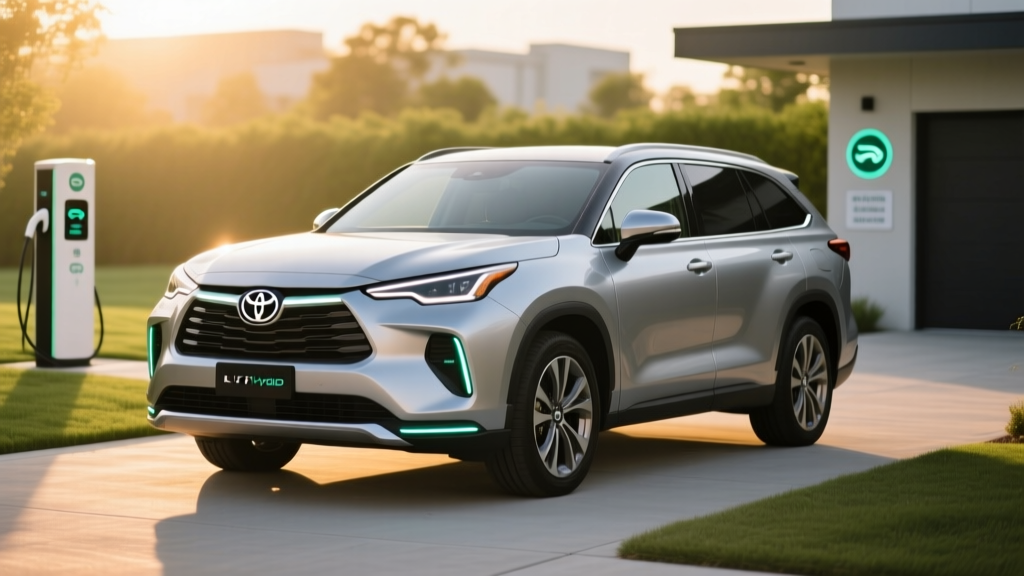
The Toyota Highlander Hybrid has spent over a decade proving that a three-row family SUV doesn't need to guzzle fuel. The LE trim sits at the base of the lineup, offering the best value proposition in the range — the same proven hybrid powertrain without the premium-trim price bump. For 2026, the Highlander LE Hybrid continues with the 2.5-liter four-cylinder hybrid system that Toyota has refined across millions of vehicles, delivering EPA-rated efficiency that embarrasses many compact sedans.
If you're researching the Highlander LE Hybrid, you're likely weighing it against a fully electric SUV, a plug-in hybrid alternative, or a conventional gas three-row. This guide breaks down the exact numbers — MPG, horsepower, pricing, battery longevity, and tax credit status — so you can make a spec-driven decision.
Highlander LE Hybrid Fuel Economy: EPA and Real-World MPG
The 2026 Toyota Highlander LE Hybrid carries EPA ratings that place it among the most efficient three-row SUVs on the market. Here's the official breakdown from fueleconomy.gov:
| Metric | AWD-i (Standard) |
|---|---|
| City MPG | 35 |
| Highway MPG | 35 |
| Combined MPG | 35 |
| Annual Fuel Cost (est.) | ~$1,850 |
| Fuel Tank Capacity | 17.1 gallons |
| Total Range (est.) | ~598 miles |
Real-World MPG: What Owners Actually See
Toyota's hybrid system excels in stop-and-go city driving, where the electric motors handle low-speed propulsion and regenerative braking recaptures energy. Many Highlander Hybrid owners report 36–38 MPG in mixed city/suburban driving, slightly exceeding the EPA city estimate. Highway-only trips at 75+ mph tend to drop efficiency to 30–32 MPG, as the gasoline engine carries more of the load and aerodynamic drag increases.
In cold weather (below 30°F), expect a temporary efficiency penalty of 3–5 MPG during short trips. The engine runs more frequently to provide cabin heat and maintain operating temperature. On longer drives once the system is warm, the penalty shrinks to 1–2 MPG. This is a characteristic of all hybrids — not unique to Toyota — and far less severe than the range loss experienced by battery-electric vehicles in winter.
Hybrid Powertrain: 243 HP With Proven Architecture
The Highlander LE Hybrid uses Toyota's fourth-generation hybrid synergy drive, pairing a 2.5-liter Dynamic Force inline-four engine with two front electric motors and a rear electric motor for electronic on-demand AWD (AWD-i). There's no mechanical driveshaft to the rear wheels — the rear motor engages independently when the system detects slip or under hard acceleration.
| Specification | Detail |
|---|---|
| Engine | 2.5L inline-4 (A25A-FXS), Atkinson cycle |
| Engine Output | 186 hp / 175 lb-ft torque |
| Front Electric Motors | 2 permanent-magnet motor-generators |
| Rear Electric Motor | 54 hp (AWD-i) |
| Net Combined System HP | 243 hp |
| Transmission | eCVT (planetary gearset, no belt) |
| Drivetrain | AWD-i (electronic on-demand) |
| 0–60 mph (est.) | ~7.8 seconds |
| Towing Capacity | 3,500 lbs |
The eCVT is not a traditional belt-driven CVT — it uses a planetary gearset that seamlessly blends engine and motor power. There are no fixed "gears" to shift, and none of the rubber-band drone associated with older CVTs. Under hard acceleration, the engine RPM rises and holds, but the system is notably quieter than previous generations thanks to improved sound insulation and the engine's inherent smoothness.
HEV vs PHEV vs EV: Which Three-Row Fits You?
Toyota does not offer a plug-in hybrid (PHEV) version of the Highlander in the US market. The Highlander Hybrid is a conventional hybrid (HEV) — it generates all its own electricity through the gasoline engine and regenerative braking. You never plug it in.
HEV vs PHEV vs BEV — Quick Comparison
| Factor | HEV (Highlander Hybrid) | PHEV (e.g., Kia Sorento PHEV) | BEV (e.g., Kia EV9) |
|---|---|---|---|
| Plug in to charge? | No | Yes (optional) | Yes (required) |
| Electric-only range | 0 miles (EV assist only) | 30–32 miles | 240–300+ miles |
| Fueling | Gas station only | Gas + Level 1/2 charging | Electric charging only |
| Home charging install | Not needed | Recommended ($500–$2,000) | Essential ($800–$3,000+) |
| Tailpipe emissions | Low (hybrid efficiency) | Zero on EV mode, low combined | Zero (upstream grid-dependent) |
| Federal tax credit | Not eligible | Up to $7,500 (if qualified) | Up to $7,500 (if qualified) |
| Best for | No home charging access; simple ownership | Short commutes + road trips | Home charging + mostly under 250 mi/day |
The Highlander LE Hybrid is the right choice if you want maximum simplicity — no charging infrastructure to install, no electric range to manage, no plug-in routine to remember. You fuel up at any gas station and drive. If you have home charging access and a commute under 30 miles, a PHEV like the Sorento PHEV offers zero-emission weekday driving with gas-engine flexibility for weekend trips. A full EV like the EV9 eliminates fuel stops entirely but requires reliable charging access.
Pricing, Trims, and Tax Credit Eligibility
The 2026 Toyota Highlander LE Hybrid starts at approximately $41,215 MSRP (including destination charge). The LE is the entry point to the Hybrid lineup; stepping up to XLE, Limited, or Platinum trims adds $3,000–$10,000 but does not change the powertrain or fuel economy.
| Trim | MSRP (AWD-i) |
|---|---|
| LE Hybrid | $41,215 |
| XLE Hybrid | $44,715 |
| Limited Hybrid | $49,215 |
| Platinum Hybrid | $53,065 |
Federal Tax Credit Status
The Highlander Hybrid does not qualify for the federal §30D Clean Vehicle Credit. Under current IRS rules, the §30D credit applies only to plug-in electric vehicles (PHEVs and BEVs) with sufficient battery capacity. Conventional hybrids like the Highlander HEV are excluded regardless of efficiency.
Some states offer their own hybrid or high-efficiency vehicle rebates, but these vary by jurisdiction and change frequently. Check your state's energy or environmental agency website for current programs. The fuel cost savings alone — roughly $700–$900 per year compared to the gas-only Highlander — provide a meaningful payback without any incentive.
Hybrid Battery Warranty, Lifespan, and Replacement Cost
Hybrid battery longevity remains the single most common concern among first-time hybrid buyers. Toyota addresses this with robust warranty coverage:
2026 Highlander Hybrid — Battery & Powertrain Warranty
- Hybrid Battery Warranty: 10 years / 150,000 miles (whichever comes first)
- Hybrid System Components: 8 years / 100,000 miles
- Powertrain Warranty: 5 years / 60,000 miles
- Basic Warranty: 3 years / 36,000 miles
The 10-year/150,000-mile hybrid battery warranty applies to 2020 and newer model-year Toyota hybrids across all 50 states. Source: Toyota Owner's Warranty Guide.
Real-World Battery Degradation
Toyota's nickel-metal hydride (NiMH) hybrid battery in the Highlander is designed for shallow charge/discharge cycles — the system never fully depletes or fully charges the battery during normal operation. This buffer management strategy dramatically extends cell life. Data from high-mileage Prius and Camry Hybrid fleets (which use similar battery architecture) shows most hybrid batteries retain 85–90% capacity at 150,000 miles. Failures before 200,000 miles are uncommon.
If replacement becomes necessary outside warranty, a refurbished Highlander Hybrid battery typically costs $2,000–$3,500 installed at an independent hybrid specialist. A new OEM battery from a Toyota dealer runs $3,500–$5,000+. Given the 10-year warranty and the battery's proven track record, most owners will never face this expense.
Who Should Buy the Highlander LE Hybrid?
Decision Framework
Choose the Highlander LE Hybrid if:
- You need three rows but want fuel costs near a compact sedan
- You lack home charging access (apartment, street parking, no garage)
- You want zero behavior change — no plugging in, no route planning for chargers
- You prioritize Toyota's long-term reliability record and resale value
- You tow occasionally (3,500-lb capacity covers small boats and utility trailers)
Look elsewhere if:
- You want electric-only driving for your commute (consider a PHEV)
- You want to eliminate gasoline entirely (consider a BEV like the Kia EV9 or Tesla Model X)
- You need maximum cargo space (the Highlander's third row and cargo area are tighter than the Grand Highlander or Telluride)
- You want a federal tax credit to offset purchase price (only PHEVs and BEVs qualify)
Pros and Cons at a Glance
Pros
- 35 MPG combined EPA — exceptional for a 3-row AWD SUV
- No plug-in charging required; works with existing gas-station infrastructure
- 10-year / 150,000-mile hybrid battery warranty
- Strong resale value and Toyota reliability reputation
- AWD-i provides confident traction in rain and light snow
- 3,500-lb towing capacity
Cons
- No PHEV option — can't drive on electric-only power
- No federal tax credit eligibility
- Third-row space is tight for adults; consider Grand Highlander for regular 3-row use
- Cargo volume behind third row is limited (16.1 cu ft)
- Acceleration is adequate but not quick (~7.8 sec 0–60)
- Infotainment on LE trim uses an 8-inch screen (smaller than higher trims)
Frequently Asked Questions
How many MPG does the Highlander LE Hybrid get?
The EPA rates the 2026 Highlander LE Hybrid AWD-i at 35 MPG city, 35 highway, and 35 combined. Real-world mixed driving often yields 34–38 MPG, with city-heavy routes sometimes exceeding the EPA estimate thanks to regenerative braking.
Does the Highlander Hybrid need to be plugged in?
No. The Highlander Hybrid is a conventional hybrid (HEV). It charges its own battery through the gasoline engine and regenerative braking. You never plug it in — you simply fill up at a gas station as you would with any other vehicle.
Is the Highlander Hybrid battery reliable, and what does replacement cost?
Toyota's hybrid batteries have an excellent long-term reliability record, backed by a 10-year / 150,000-mile warranty. Most batteries last well beyond 200,000 miles under normal use. If replacement is needed out of warranty, expect $2,000–$3,500 for a refurbished unit or $3,500–$5,000+ for a new OEM battery.
Does the Highlander Hybrid qualify for any tax credit?
The conventional Highlander Hybrid does not qualify for the federal §30D Clean Vehicle Credit, which is limited to plug-in vehicles (PHEVs and BEVs). Some states may offer efficiency-related rebates, but these vary. Check your state energy office for current programs.
How does the Highlander Hybrid compare to a gas-only Highlander?
The gas-only 2026 Highlander (turbocharged 2.4L) rates around 24 MPG combined. The Hybrid's 35 MPG combined saves roughly $700–$900 per year in fuel at 15,000 miles driven annually (based on $3.50/gallon). Over a typical 7-year ownership period, that's $4,900–$6,300 in fuel savings, which more than offsets the Hybrid's modest price premium.
Highlander Hybrid vs Grand Highlander Hybrid — which is better?
The Grand Highlander Hybrid offers a more usable third row (adults can sit comfortably) and significantly more cargo space (up to 97.5 cu ft with seats folded vs the Highlander's 84.3 cu ft). It's rated at 34 MPG combined — nearly identical. If you regularly carry passengers in the third row, the Grand Highlander is the better fit. If you only use the third row occasionally for children, the standard Highlander LE Hybrid offers better value and easier parking.