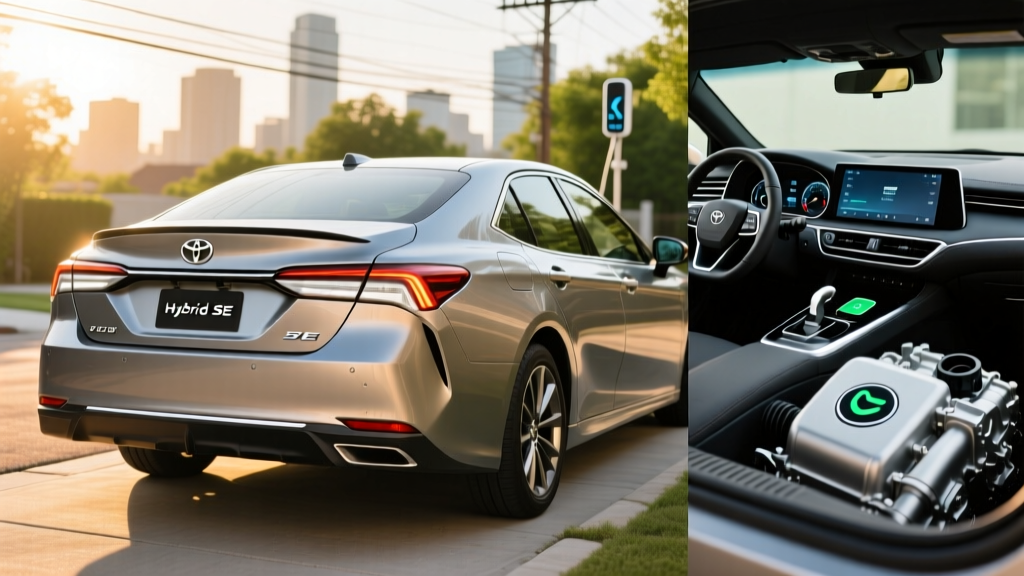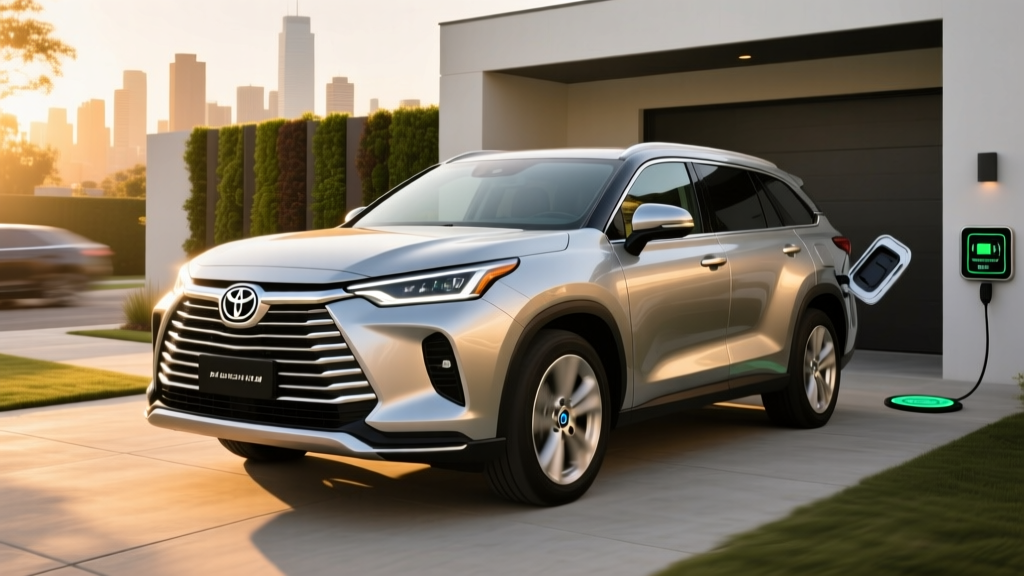
Quick Verdict: The Highlander Hybrid Platinum at a Glance
The Toyota Highlander Hybrid Platinum sits at the top of Toyota's three-row hybrid SUV lineup, pairing a 2.5-liter four-cylinder engine with dual electric motors for a combined 243 horsepower and an EPA-estimated 35 MPG combined. For 2026, the Platinum trim adds premium features like a panoramic sunroof, heated and ventilated second-row seats, and a 12.3-inch infotainment display — all without requiring a plug or any change to your fueling routine.
This is a conventional hybrid (HEV), not a plug-in. You never plug it in. The hybrid system recovers energy during braking and deceleration, storing it in a compact nickel-metal hydride (NiMH) battery that assists the gasoline engine. The result is a midsize three-row SUV that sips fuel like a compact sedan while seating up to seven passengers.
The Highlander Hybrid is a conventional hybrid (HEV). It generates its own electricity through regenerative braking and the gasoline engine. You fuel it like any other car — no plug, no charging cable, no electric-only range. A plug-in hybrid (PHEV), by contrast, has a larger battery you charge from a wall outlet or public charger, giving 20–40 miles of electric-only driving before the gas engine kicks in. Toyota does not currently offer a Highlander PHEV in the US market. If you need electric-only commuting capability in a Toyota SUV, the RAV4 Prime PHEV (42 miles electric-only) is the closest alternative, though it seats only five.
Fuel Economy: EPA Ratings and Real-World MPG
Fuel economy is the Highlander Hybrid's headline advantage over its gas-only counterpart. Here's the full EPA breakdown for the 2026 Platinum trim with standard electronic AWD:
| Metric | EPA Estimate |
|---|---|
| City MPG | 35 MPG |
| Highway MPG | 35 MPG |
| Combined MPG | 35 MPG |
| Fuel Tank Capacity | 17.1 gallons |
| Total Estimated Range | ~598 miles |
Source: fueleconomy.gov
Real-World MPG: What to Actually Expect
Toyota's hybrid system excels in city driving, where frequent stops maximize regenerative braking. In real-world mixed driving, owners commonly report 33–37 MPG combined. On long highway trips at 75+ mph, expect the figure to dip to 30–32 MPG — the electric motors contribute less at sustained high speeds, and the 4,500-pound curb weight works against efficiency. In cold weather (below 30°F), the engine runs more frequently to maintain cabin heat and battery temperature, reducing observed economy by roughly 2–4 MPG.
Compared to the gas-only Highlander (24 MPG combined with the turbocharged 2.4-liter four-cylinder), the hybrid saves approximately 180–200 gallons of fuel per year at 15,000 miles annually — roughly $600–$750 per year at $3.50/gallon.
Powertrain and Performance Specifications
| Specification | Detail |
|---|---|
| Engine | 2.5L DOHC 4-cylinder Atkinson-cycle |
| Engine Output | 186 hp / 186 lb-ft torque |
| Front Electric Motor | 134 hp / 199 lb-ft |
| Rear Electric Motor (AWD) | 54 hp / 89 lb-ft |
| Combined Net Horsepower | 243 hp |
| Drivetrain | Electronic On-Demand AWD (eAWD) |
| Transmission | eCVT (electronically controlled continuously variable) |
| 0–60 mph (est.) | ~7.8 seconds |
| Towing Capacity | 3,500 lbs |
| Hybrid Battery Type | Nickel-Metal Hydride (NiMH) |
| Hybrid Battery Location | Under rear seats |
The Highlander Hybrid uses Toyota's fourth-generation hybrid system. The eAWD setup employs a dedicated rear motor that engages automatically during acceleration, slippery conditions, or when the system detects front-wheel slip. Unlike mechanical AWD systems, there's no driveshaft connecting the axles — the rear motor activates in milliseconds, providing up to 80% of torque to the rear wheels when needed.
The 243 combined horsepower is adequate for merging and passing, but the Highlander Hybrid is tuned for efficiency, not sportiness. The eCVT delivers seamless acceleration without shift shock, though it can drone under hard throttle. For a three-row family hauler, the powertrain is well-matched to its purpose.
2026 Highlander Hybrid Platinum Pricing and Trim Details
| Trim | MSRP (est.) |
|---|---|
| LE | ~$42,000 |
| XLE | ~$45,500 |
| Limited | ~$49,500 |
| Platinum | ~$54,000 |
The Platinum trim commands a premium over the Limited, adding a panoramic glass roof, 360-degree camera system, heated and ventilated second-row captain's chairs, head-up display, and a premium JBL audio system. Destination charges add approximately $1,395.
Federal and State Tax Credit Eligibility
The Highlander Hybrid is a conventional hybrid (HEV), not a plug-in electric vehicle. It does not qualify for the federal §30D Clean Vehicle Credit (up to $7,500), which is reserved for BEVs and PHEVs with plug-in capability and specific battery-sourcing requirements per IRS guidelines.
Some states and local utilities offer rebates for conventional hybrids, but these are uncommon and vary by jurisdiction. Check your state energy office or utility provider for any available incentives. Hybrid buyers should factor fuel savings — not tax credits — into their purchase calculus.
Hybrid Battery Longevity, Warranty, and Replacement Cost
Battery lifespan is consistently the top concern among first-time hybrid buyers. Here's what the data shows:
- Coverage: 10 years / 150,000 miles (whichever comes first)
- What's covered: Hybrid battery pack, hybrid control module, and related hybrid system components
- Capacity threshold: Toyota warrants the battery against defects and abnormal capacity loss — there is no specific percentage degradation threshold published, but failures within the warranty period are replaced at no cost
Real-World Battery Lifespan
Toyota's NiMH hybrid batteries have an exceptional longevity track record. Data from fleet operators and long-term owners indicates that Toyota hybrid batteries routinely last 150,000–200,000+ miles before requiring replacement. The Prius, which uses a similar chemistry and system architecture, has documented cases of original batteries exceeding 300,000 miles.
NiMH chemistry is inherently more tolerant of the shallow charge-discharge cycles used in conventional hybrids than lithium-ion alternatives. The Highlander Hybrid's system keeps the battery in a narrow state-of-charge window (roughly 40–60%), which dramatically reduces degradation stress.
Replacement Cost If Out of Warranty
If the hybrid battery fails after the 10-year/150,000-mile warranty expires, replacement costs typically range from $2,500 to $4,500 for a new OEM battery pack, including labor. Refurbished or reconditioned NiMH modules are available from third-party suppliers for $1,500–$2,500 installed. Given the battery's proven longevity and the vehicle's expected service life, most owners will never face this expense.
Highlander Hybrid vs Full EV vs Gas: Which Fits You?
Choosing between a conventional hybrid, a plug-in hybrid, a full battery electric vehicle, and a gas-only SUV depends on your driving patterns, charging access, and budget. Here's a practical decision framework:
| Factor | Highlander Hybrid (HEV) | Full EV (e.g., Kia EV9) | Gas-Only Highlander |
|---|---|---|---|
| Annual Fuel/Energy Cost (15k mi) | ~$1,750 | ~$750 (home charging) | ~$2,500 |
| Home Charging Required? | No | Yes (Level 2 recommended) | No |
| Road-Trip Convenience | Excellent — gas stations everywhere | Requires DC fast-charging planning | Excellent |
| Three-Row Seating | Yes (7 passengers) | Limited options (EV9, etc.) | Yes |
| Federal Tax Credit | None | Up to $7,500 (if eligible) | None |
| Maintenance Cost | Low (no plug system) | Lowest (no engine) | Standard |
| Best For | No home charging, frequent road trips, need 3 rows | Home charging, mostly <300 mi trips | Lowest upfront cost |
- Choose the Highlander Hybrid if: You don't have access to home charging, regularly take road trips over 300 miles, need three-row seating, and want maximum fuel savings without changing your fueling habits.
- Choose a full EV (like the Kia EV9 or Tesla Model X) if: You can install a Level 2 home charger, most daily trips are under 300 miles, you want the lowest per-mile energy cost, and you're eligible for the $7,500 federal credit.
- Choose the gas-only Highlander if: Upfront purchase price is your primary concern, you drive fewer than 10,000 miles per year (making the hybrid fuel savings less impactful), or you prefer the turbocharged engine's power delivery.
Platinum Trim Features and Daily Ownership
The Platinum trim justifies its ~$54,000 MSRP with a feature set that rivals luxury competitors at lower price points. Key additions over the Limited trim include:
- Panoramic glass roof with power sunshade
- Heated and ventilated second-row captain's chairs (reduces seating to 7 from 8)
- 360-degree bird's-eye view camera with perimeter scan
- Head-up display (10-inch color projection)
- 12.3-inch touchscreen with wireless Apple CarPlay and Android Auto
- JBL 11-speaker premium audio system
- Toyota Safety Sense 3.0 (pre-collision, lane tracing, adaptive cruise, road sign assist)
- Digital rearview mirror with HomeLink
Cargo space behind the third row is 16.1 cubic feet — adequate for a week's groceries but tight for a full family road trip with all seats occupied. Fold the third row and you get 48.4 cu ft; fold both rear rows for 84.3 cu ft. The hybrid battery's under-seat placement preserves all cargo and passenger space compared to the gas model.
Toyota Safety Sense 3.0 is a Level 2 driver-assist suite per SAE classification. It provides adaptive cruise control with lane centering, but the driver must remain fully engaged with hands on the wheel and eyes on the road at all times. This is not autonomous driving.
Pros and Cons
- 35 MPG combined — best in the three-row SUV class
- No plug-in required; fuel like any gas car
- Proven hybrid reliability with 10yr/150k mi battery warranty
- Standard eAWD for all-weather confidence
- Platinum trim offers luxury features at mainstream pricing
- 3,500-lb towing capacity (adequate for small trailers/boats)
- No federal tax credit (HEV, not PHEV/BEV)
- 243 hp feels adequate, not quick — eCVT drone under hard acceleration
- Third row is tight for adults on long trips
- Platinum trim pushes MSRP above $54,000
- No PHEV variant available — no electric-only commute mode
- 16.1 cu ft cargo behind third row is below some rivals
Frequently Asked Questions
How many MPG does the 2026 Highlander Hybrid Platinum get?
The EPA rates it at 35 MPG city, 35 MPG highway, and 35 MPG combined. In real-world mixed driving, expect 33–37 MPG. Highway-only driving at 75+ mph typically yields 30–32 MPG, while city-heavy routes with frequent stops can push above 37 MPG thanks to regenerative braking.
Does the Highlander Hybrid need to be plugged in?
No. The Highlander Hybrid is a conventional hybrid (HEV). It charges its own battery through regenerative braking and the gasoline engine. You never plug it in — just fill up at any gas station as you would with a conventional vehicle.
Is there a Highlander plug-in hybrid (PHEV)?
Toyota does not offer a Highlander PHEV in the United States. If you want a Toyota PHEV with electric-only driving, the RAV4 Prime offers 42 miles of electric range but seats only five. For a three-row PHEV, you'd need to look at competitors like the Jeep Grand Cherokee 4xe (25 miles electric) or the Mazda CX-90 PHEV (26 miles electric).
How long will the Highlander Hybrid battery last?
Toyota's NiMH hybrid batteries have a strong track record of lasting 150,000–200,000+ miles. The battery is warranted for 10 years or 150,000 miles. Many Toyota hybrid owners never need a battery replacement during the vehicle's ownership life.
What does it cost to replace the hybrid battery?
Out-of-warranty replacement runs $2,500–$4,500 for a new OEM battery, or $1,500–$2,500 for a refurbished unit. Given the battery's proven longevity, this is a low-probability expense for most owners.
Does the Highlander Hybrid qualify for a federal tax credit?
No. The federal §30D Clean Vehicle Credit applies only to plug-in electric vehicles (BEVs and PHEVs) that meet battery-sourcing, MSRP, and buyer income requirements. Conventional hybrids like the Highlander Hybrid do not qualify. Check IRS.gov for current credit rules.
Is the Highlander Hybrid good for towing?
It's rated for 3,500 pounds — sufficient for a small utility trailer, a pair of jet skis, or a light pop-up camper. It's not suited for large travel trailers or heavy boat loads. Note that towing will reduce fuel economy significantly, often into the mid-to-high 20s MPG.
How does the Highlander Hybrid compare to the Kia Sorento Hybrid?
The Sorento Hybrid offers similar fuel economy (34 MPG combined) and three-row seating at a slightly lower starting price. The Highlander Hybrid edges ahead on cargo space, proven long-term reliability data, and resale value. The Sorento offers a PHEV variant (32 miles electric-only) if plug-in capability matters to you.
Always verify current pricing, specifications, and incentive eligibility with your local Toyota dealer and official sources including fueleconomy.gov and IRS.gov. Specifications and pricing are estimates based on available model-year information and may vary.