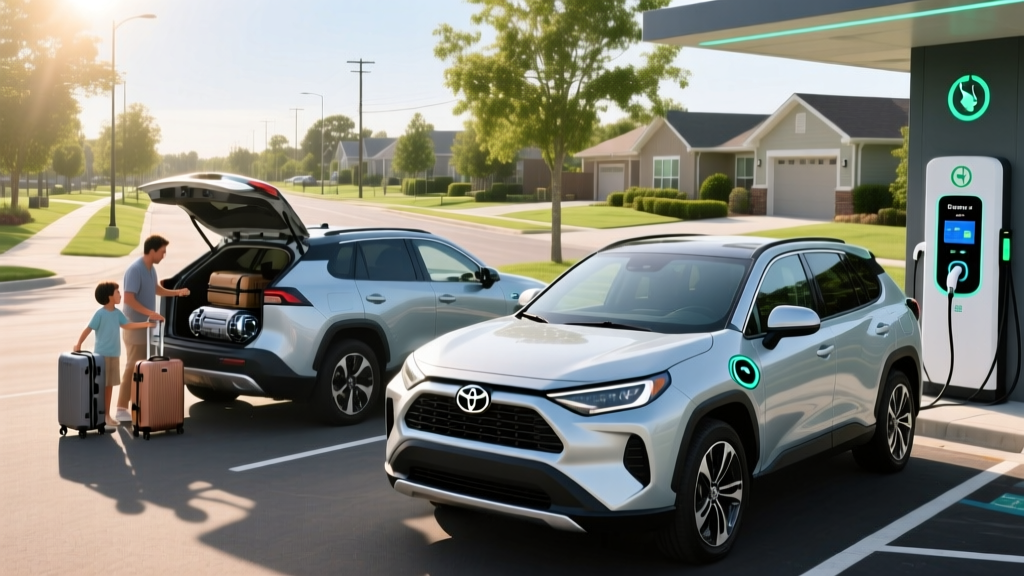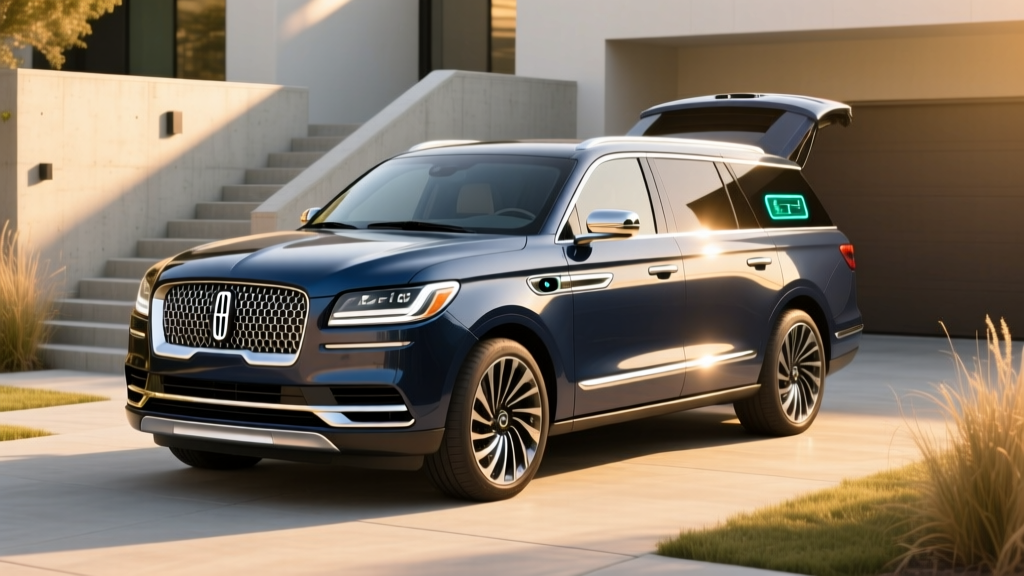
Quick Verdict: The Highlander Hybrid in 2026
The Toyota Highlander Hybrid remains one of the few three-row midsize SUVs that pairs genuine family practicality with hybrid efficiency — no plug required. For 2026, Toyota continues to refine the cabin materials, tech interface, and powertrain tuning that have made this HEV (conventional hybrid electric vehicle) a segment staple. If your search for "highlander hybrid interior" is driven by a desire to know whether the cabin justifies the ~$42,000 starting price and whether the hybrid system delivers on its MPG promise, this guide breaks down every number that matters.
| Spec | Value |
|---|---|
| Powertrain | 2.5L inline-4 + 2 electric motors (AWD: 3 motors) |
| Combined Horsepower | 243 hp (net system) |
| EPA Fuel Economy (FWD) | 36 city / 35 hwy / 36 combined MPG |
| EPA Fuel Economy (AWD) | 35 city / 34 hwy / 35 combined MPG |
| Drivetrain | FWD or electronic AWD (eAWD) |
| Seating | 7 or 8 passengers (bench vs. captain's chairs) |
| Cargo (behind 3rd row) | ~16.1 cu ft |
| Cargo (max, seats folded) | ~84.3 cu ft |
| Towing Capacity | 3,500 lbs |
| Hybrid Battery | ~1.9 kWh NiMH (self-charging, no plug) |
| Battery Warranty | 10 years / 150,000 miles |
| Starting MSRP (LE trim) | ~$42,020 |
| Federal Tax Credit | Not eligible (§30D requires plug-in capability) |
Highlander Hybrid Interior: What You Actually Get
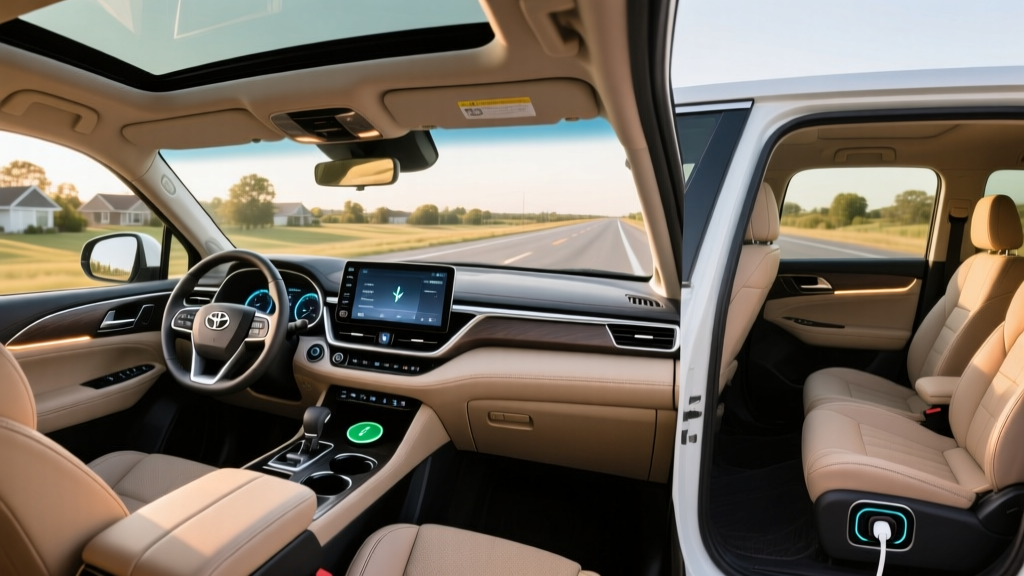
The 2026 Highlander Hybrid interior carries forward Toyota's incremental approach: soft-touch materials on the dash and upper door panels, available leather-trimmed seats on XLE and above, and a standard 8-inch or available 12.3-inch touchscreen running Toyota's latest multimedia system. Second-row captain's chairs (standard on Limited and Platinum) reduce seating from eight to seven but improve individual comfort and third-row access.
Key interior features by trim:
- LE ($42,020): Fabric seats, 8-inch touchscreen, tri-zone climate control, 7 USB-C ports across three rows, wireless Apple CarPlay/Android Auto.
- XLE ($46,070): SofTex synthetic leather, heated front seats, power liftgate, 12.3-inch screen option, ambient lighting.
- Limited ($50,120): Genuine leather, ventilated front seats, panoramic moonroof, 11-speaker JBL audio, head-up display.
- Platinum ($54,070): Panoramic view monitor, digital rearview mirror, heated second-row seats, premium navigation.
The third row remains best suited for children or short-trip adults — a common limitation in this segment. Cargo behind the third row is 16.1 cu ft, enough for a couple of carry-ons or a week's groceries, but the Volkswagen Atlas and Kia Telluride offer more. Fold the third row and you get a usable 48.4 cu ft; fold both rear rows for a flat 84.3 cu ft floor.
HEV vs PHEV vs EV: Which Powertrain Fits Your Family?
Before evaluating the Highlander Hybrid's fuel economy, it's essential to understand where it sits in the electrification spectrum. The Highlander Hybrid is a conventional hybrid (HEV) — it charges its small battery through regenerative braking and the gasoline engine. You never plug it in. Toyota does not currently offer a Highlander Plug-in Hybrid (PHEV) in the U.S. market.
| Factor | HEV (Highlander Hybrid) | PHEV (e.g., RAV4 Prime) | BEV (e.g., Tesla Model X) |
|---|---|---|---|
| Plug-in required? | No | Yes (for electric range) | Yes (always) |
| Electric-only range | 0 miles (motor assists only) | 20–42 miles typical | 250–350+ miles |
| Home charging needed? | No | Recommended (Level 2) | Essential |
| Federal tax credit (§30D) | Not eligible | Up to $7,500 (if eligible) | Up to $7,500 (if eligible) |
| Best for | No home charging access; road trips | Short commutes + road trip flexibility | Home charging + mostly electric driving |
| Upfront cost premium | ~$2,000–3,000 over gas | ~$5,000–8,000 over gas | $10,000–20,000+ over gas |
Choose the Highlander Hybrid (HEV) if: You lack home charging access, drive a mix of city and highway miles, want a three-row SUV without range anxiety, and don't want to change your refueling habits.
Consider a PHEV instead if: You have Level 2 home charging, your daily commute is under 35 miles, and you want some electric-only driving without sacrificing road-trip range. (Look at the RAV4 Prime or the Kia Sorento PHEV, though neither offers three rows of adult-friendly space.)
Consider a full EV if: You have reliable home charging, mostly drive within 200 miles of home, and want the lowest per-mile fuel cost and zero tailpipe emissions.
Fuel Economy: EPA Numbers vs Real-World MPG
The 2026 Highlander Hybrid's EPA ratings are straightforward and, in practice, achievable:
| Drivetrain | City MPG | Highway MPG | Combined MPG |
|---|---|---|---|
| FWD | 36 | 35 | 36 |
| AWD (eAWD) | 35 | 34 | 35 |
Source: fueleconomy.gov
Real-world expectations: Toyota's hybrid system excels in city and suburban driving, where regenerative braking recaptures energy at every stop. Many owners report exceeding the EPA city figure in stop-and-go traffic — 37–40 MPG is common in warm-weather urban driving. Highway cruising at 75+ mph is where the 2.5L four-cylinder works hardest, and real-world highway numbers can dip to 30–32 MPG, especially with a full load of passengers and cargo, or in cold weather below 30°F.
Annual fuel cost estimate: At 15,000 miles/year and $3.40/gallon (national average), the AWD Highlander Hybrid (35 combined MPG) costs roughly $1,457/year in gasoline. A comparable gas-only midsize SUV at 24 combined MPG would cost $2,125/year — a savings of ~$668 annually with the hybrid.
Powertrain Deep Dive: 243 hp, eAWD, and the Hybrid Synergy System
The Highlander Hybrid uses Toyota's fourth-generation Hybrid Synergy Drive. A 2.5-liter Atkinson-cycle four-cylinder engine produces 186 hp and 175 lb-ft of torque on its own. Two front-mounted motor-generators (one primarily for propulsion, one for starting and regeneration) add electric torque seamlessly. In AWD models, a rear-mounted electric motor provides up to 54 hp to the rear axle when slip is detected — there's no mechanical driveshaft.
Net system output is 243 horsepower. This is adequate for family driving — 0–60 mph takes approximately 7.8 seconds — but the Highlander Hybrid is not a performance SUV. The CVT (continuously variable transmission) keeps the engine in its efficiency sweet spot, which means noticeable drone under hard acceleration. In normal driving, the transitions between electric and gas power are nearly imperceptible.
The hybrid battery pack is a nickel-metal hydride (NiMH) unit with approximately 1.9 kWh of capacity. This is a self-charging system: it captures kinetic energy during braking and deceleration and uses the gas engine to top up when needed. There is no plug, no charging port, and no electric-only driving mode beyond very low-speed creep (under ~15 mph for short distances).
Battery Longevity, Warranty, and Replacement Cost
Toyota Hybrid Battery Warranty: 10 years or 150,000 miles (whichever comes first), covering defects and capacity loss below a defined threshold. This applies to all 50 states.
Hybrid System Warranty: 8 years / 100,000 miles on hybrid-specific components (inverter, control module, motor-generators).
Toyota's NiMH hybrid batteries have a strong longevity track record. Data from fleet operators and long-term owners suggests these packs commonly last 150,000–200,000+ miles before significant degradation. Unlike the larger lithium-ion packs in PHEVs and BEVs, the Highlander Hybrid's small NiMH pack is never deeply cycled — the system keeps it between roughly 40% and 80% state of charge, which dramatically extends cycle life.
Replacement cost if out of warranty: A new OEM hybrid battery for the Highlander Hybrid typically runs $3,000–$4,500 installed at a Toyota dealer. Refurbished or aftermarket packs can reduce this to $1,500–$2,500. Given the 10-year/150,000-mile warranty and the pack's demonstrated longevity, this is a lower-risk ownership concern than many buyers assume.
For comparison, a full BEV battery replacement (e.g., Tesla Model X) can exceed $15,000–$22,000, though those packs are far larger and warrantied similarly.
Pricing, Trims, and Tax Credit Eligibility
The 2026 Highlander Hybrid lineup spans four trims, with AWD available across all:
- LE: ~$42,020 (FWD) / ~$43,620 (AWD)
- XLE: ~$46,070 (FWD) / ~$47,670 (AWD)
- Limited: ~$50,120 (FWD) / ~$51,720 (AWD)
- Platinum: ~$54,070 (FWD) / ~$55,670 (AWD)
Federal §30D Tax Credit — Does the Highlander Hybrid Qualify?
- ❌ No. The IRS §30D Clean Vehicle Credit applies only to plug-in electric vehicles (PHEVs and BEVs) with a minimum battery capacity of 7 kWh and a charging port.
- ❌ The Highlander Hybrid is a conventional HEV with a ~1.9 kWh pack and no plug — it does not meet the statutory definition.
- ✅ Some states offer separate incentives for conventional hybrids, but these are increasingly rare. Check your state's energy office or AFDC state incentive database.
- ✅ The hybrid's fuel savings (~$668/year vs. a gas equivalent) partially offset the lack of federal incentive over time.
For buyers who want a three-row Toyota with federal tax credit eligibility, the Grand Highlander Hybrid is also an HEV (no credit). Toyota does not currently sell a plug-in hybrid three-row SUV in the U.S. Buyers needing PHEV tax credits and three rows should examine the Kia Sorento PHEV (though third-row space is tight) or wait for future product announcements.
Reliability and Ownership Costs
Toyota's hybrid systems are among the most proven in the industry, with over 25 years of continuous refinement since the original Prius. The Highlander Hybrid consistently earns above-average reliability ratings. IIHS has awarded recent Highlanders top safety marks, and the hybrid powertrain introduces no additional failure points beyond the conventional model — in fact, the hybrid's regenerative braking reduces wear on the friction brake pads, often lasting 80,000+ miles.
5-Year Estimated Ownership Costs:
| Category | Highlander Hybrid AWD | Gas V6 Competitor (~22 MPG) |
|---|---|---|
| Purchase Price (mid-trim) | ~$47,670 | ~$44,000 |
| Fuel (5 yr, 15K mi/yr) | ~$7,285 | ~$11,364 |
| Maintenance (5 yr) | ~$2,800 | ~$3,200 |
| Estimated Depreciation | ~$18,000 | ~$19,500 |
| 5-Year Total | ~$75,755 | ~$78,064 |
The hybrid's higher purchase price is largely recovered through fuel savings and stronger resale value within 5 years. Toyota Hybrids hold value well due to market demand and proven durability.
Pros and Cons at a Glance
✅ Pros
- 35–36 MPG combined in a three-row SUV — exceptional for the segment
- No plug-in required; no behavior change from a gas vehicle
- 10-year / 150,000-mile hybrid battery warranty
- Strong resale value and proven reliability track record
- Standard Toyota Safety Sense 3.0 (adaptive cruise, lane tracing, auto emergency braking)
- Smooth, quiet powertrain in normal driving conditions
❌ Cons
- No federal tax credit eligibility (HEV, not PHEV/BEV)
- Third row is tight for adults on longer trips
- Cargo behind third row (16.1 cu ft) trails rivals like Atlas and Telluride
- CVT drone under hard acceleration
- No DC fast charging (not applicable — no plug)
- Platinum trim pushes past $55,000
Who Should Buy the Highlander Hybrid?
The 2026 Highlander Hybrid is the right call for families who:
- Need three rows but don't want a minivan or full-size SUV
- Drive 12,000–18,000 miles/year and want to minimize fuel costs without changing refueling habits
- Live in apartments or homes without Level 2 charging access (making a PHEV or BEV impractical)
- Value long-term reliability and low maintenance costs over cutting-edge EV tech
- Take regular road trips where charging infrastructure is sparse or unreliable
It's not the right choice if you want electric-only commuting, federal tax credits, or the instant torque and one-pedal driving experience of a full EV. In that case, consider whether a BEV three-row SUV (like the Kia EV9 or Rivian R1S) fits your budget and charging situation.
Frequently Asked Questions
How many MPG does the Highlander Hybrid get?
The EPA rates the 2026 Highlander Hybrid at 36 city / 35 highway / 36 combined (FWD) and 35/34/35 (AWD). Real-world city driving often exceeds the EPA estimate; highway driving at high speeds may fall 2–4 MPG short, particularly in cold weather or when fully loaded.
Does the Highlander Hybrid need to be plugged in?
No. The Highlander Hybrid is a conventional HEV. Its ~1.9 kWh battery charges entirely through regenerative braking and the gasoline engine. There is no charging port.
Is there a plug-in hybrid (PHEV) Highlander?
As of 2026, Toyota does not offer a Highlander PHEV in the U.S. market. The closest Toyota PHEV is the RAV4 Prime (42 miles electric-only, but only two rows). For a three-row PHEV, look at the Kia Sorento PHEV.
Is the hybrid battery reliable and what does replacement cost?
Toyota's NiMH hybrid batteries commonly last 150,000–200,000+ miles. The warranty covers 10 years/150,000 miles. Out-of-pocket replacement runs $3,000–$4,500 at a dealer, or $1,500–$2,500 for refurbished units.
Does the Highlander Hybrid qualify for any tax credit?
It does not qualify for the federal §30D Clean Vehicle Credit, which requires plug-in capability and a minimum 7 kWh battery. Some states may offer minor hybrid incentives — check the AFDC database for your state.
How does the Highlander Hybrid compare to the gas-only Highlander?
The hybrid delivers roughly 40–50% better fuel economy (35 MPG combined vs. ~24 MPG for the turbo-four gas model), with only a modest price premium (~$2,000–$3,000). The trade-off is slightly less peak power and a CVT instead of an 8-speed automatic. For most buyers, the hybrid's fuel savings pay back the premium within 3–4 years.