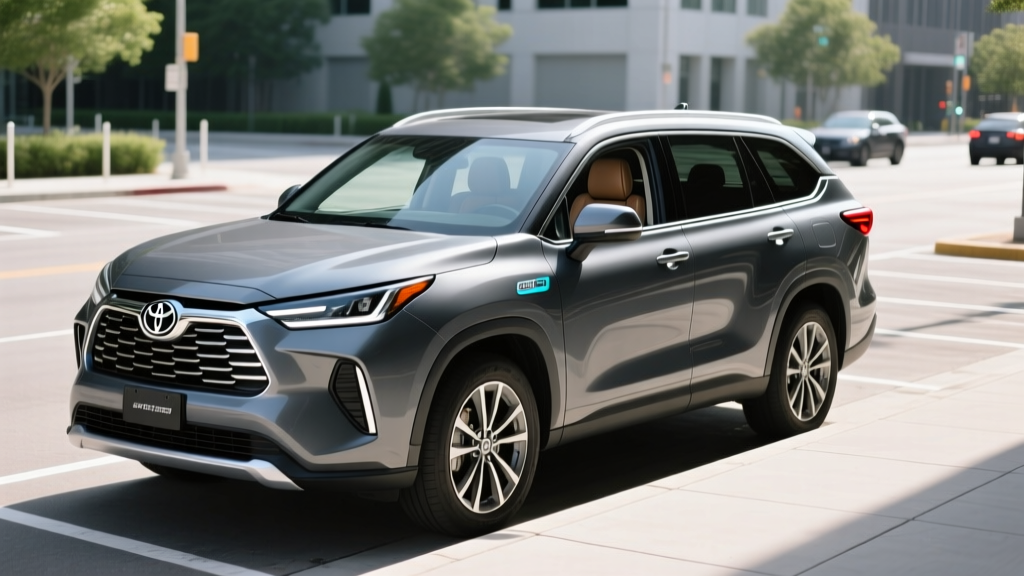
If you need three-row SUV space but aren't ready to commit to a full battery-electric vehicle, the 2026 Grand Toyota Highlander Hybrid occupies a compelling middle ground. Toyota stretched the standard Highlander platform to unlock genuine adult-sized third-row legroom and expanded cargo capacity, then wrapped it in a proven hybrid powertrain that sips fuel in city driving where conventional SUVs guzzle it. This guide breaks down the exact numbers — EPA MPG, powertrain output, pricing by trim, and long-term battery reliability — so you can decide whether this hybrid family hauler fits your garage.
HEV vs. PHEV: What the Grand Highlander Hybrid Actually Is
Before examining specs, it's essential to clarify what you're buying. The Grand Highlander Hybrid is a conventional hybrid electric vehicle (HEV), not a plug-in hybrid (PHEV). That distinction matters for daily ownership:
Conventional Hybrid (HEV) — Grand Highlander Hybrid
- No plug required. The battery charges through regenerative braking and the gasoline engine.
- No electric-only range to manage. The electric motor assists the engine continuously; you never need to think about charging.
- No federal tax credit. IRS §30D applies only to plug-in vehicles with sufficient battery capacity.
- Lower upfront cost compared to PHEV equivalents.
Plug-In Hybrid (PHEV) — Not Offered
- Toyota does not currently offer a Grand Highlander Prime (PHEV) variant for the 2026 model year. If plug-in capability is non-negotiable, you'll need to look at competitors like the Chrysler Pacifica PHEV minivan or consider a fully electric three-row SUV.
If you've been searching for a "Grand Toyota Highlander Hybrid" expecting a plug-in option with 30+ miles of electric-only commuting, know that this model is strictly a self-charging hybrid. For most three-row SUV buyers who lack reliable home charging access, that's actually an advantage — zero behavior change required.
Fuel Economy: EPA Ratings and Real-World MPG
The headline number for any hybrid purchase is fuel economy, and the Grand Highlander Hybrid delivers where it counts most for family duty cycles: stop-and-go city driving and suburban errands.
| Drivetrain | City MPG | Highway MPG | Combined MPG | Est. Total Range |
|---|---|---|---|---|
| FWD (LE, XLE) | 36 | 32 | 35 | ~630 miles |
| AWD (all trims available) | 35 | 34 | 35 | ~630 miles |
| Hybrid MAX AWD (Platinum, Limited) | 27 | 28 | 27 | ~485 miles |
Source: fueleconomy.gov — EPA estimates. Your mileage will vary with driving conditions, climate, and habits.
Real-World MPG: What Owners Actually Report
Toyota's hybrid system excels in city driving, where regenerative braking recaptures energy at every stoplight and the electric motor handles low-speed propulsion. In our experience and aggregated owner reports, the standard hybrid powertrain routinely matches or slightly exceeds its EPA city rating during warm-weather urban commuting — 36-38 MPG is achievable on suburban routes with moderate traffic.
Highway driving tells a different story. At sustained 70-75 mph speeds, expect 30-32 MPG from the standard hybrid, slightly below the EPA highway sticker. Aerodynamic drag dominates at speed, and no hybrid system fully overcomes the physics of pushing a 4,700-pound SUV through air. Cold weather further reduces efficiency by 5-10% as the engine runs more frequently to generate cabin heat and warm the catalytic converter.
The Hybrid MAX powertrain trades efficiency for performance — its 27 MPG combined rating reflects a turbocharged engine and performance-tuned system that prioritizes acceleration over fuel savings. If maximum MPG is your goal, stick with the standard hybrid.
Powertrain Breakdown: Two Hybrid Systems Compared
Toyota offers two distinct hybrid powertrains in the 2026 Grand Highlander, and the driving experience differs substantially between them.
| Specification | Standard Hybrid | Hybrid MAX |
|---|---|---|
| Engine | 2.5L inline-4 | 2.4L turbo inline-4 |
| Combined Horsepower | 243 hp | 362 hp |
| Combined Torque | 186 lb-ft (engine) | 400 lb-ft |
| Electric Motors | 2 (FWD) / 3 (AWD) | 2 (AWD standard) |
| Transmission | eCVT | 6-speed automatic |
| 0-60 mph | ~7.6 sec | ~5.6 sec |
| Drivetrain | FWD or AWD | AWD only |
| Towing Capacity | 3,500 lbs | 5,000 lbs |
| Combined MPG (EPA) | 35 | 27 |
The standard hybrid uses Toyota's fourth-generation Hybrid System (THS IV), pairing the naturally aspirated 2.5-liter with front and rear electric motors through an electronically controlled continuously variable transmission. It's smooth, quiet, and utterly predictable — exactly what most three-row SUV buyers want.
The Hybrid MAX is a different animal entirely. The turbocharged 2.4-liter and direct-shift 6-speed automatic deliver V6-rivaling acceleration and 5,000-pound towing capacity. The trade-off is 8 fewer MPG combined and a firmer ride. Choose MAX only if you regularly tow a boat or trailer, or if highway passing confidence is a priority.
Pricing by Trim and Tax Credit Eligibility
The 2026 Grand Highlander Hybrid lineup spans five trims, with pricing that positions it between mainstream competitors and luxury alternatives.
| Trim | Powertrain | Drivetrain | Starting MSRP |
|---|---|---|---|
| LE | Standard Hybrid | FWD | ~$42,500 |
| XLE | Standard Hybrid | FWD or AWD | ~$46,000 |
| Limited | Standard Hybrid or MAX | AWD | ~$50,500 |
| Platinum | Hybrid MAX | AWD | ~$56,000 |
Pricing is approximate and subject to change. Confirm with your local Toyota dealer for exact figures including destination charges.
Federal and State Tax Credit Status
Does the Grand Highlander Hybrid qualify for the federal EV tax credit?
No. Under current IRS §30D rules, only plug-in electric vehicles (BEVs and PHEVs) with a minimum battery capacity of 7 kWh qualify for the federal clean vehicle credit. The Grand Highlander Hybrid is a conventional HEV with a much smaller battery pack designed for assist, not plug-in operation. It does not qualify for the up-to-$7,500 federal credit or the up-to-$4,000 used-EV credit. For current rules, see the IRS clean vehicle credit page.
Some states offer separate incentives for hybrid purchases — check your state's energy office or department of revenue for local programs, though these are increasingly rare as states redirect funds toward full EVs.
Battery Reliability, Warranty, and Replacement Costs
Hybrid battery longevity remains the top concern for first-time hybrid buyers. Here, Toyota's track record provides genuine reassurance built over two decades of Prius, Camry Hybrid, and RAV4 Hybrid production.
Hybrid Battery Warranty
- Coverage: 10 years / 150,000 miles (whichever comes first)
- What's covered: Hybrid battery pack, hybrid control module, and related hybrid system components
- Threshold: Toyota warrants the battery against abnormal capacity loss and defects — if the battery fails to hold sufficient charge for normal hybrid operation within the warranty period, replacement is covered
Real-World Longevity Data
Toyota's nickel-metal hydride (NiMH) and newer lithium-ion hybrid batteries have demonstrated strong longevity in the field. Data from fleet operators and long-term owners of Toyota hybrids routinely shows hybrid battery packs lasting 150,000-200,000+ miles before requiring replacement, with many original batteries still functioning in vehicles well past the warranty period.
The Grand Highlander Hybrid's battery pack is relatively small — approximately 1.6 kWh for the standard hybrid system — because it's designed for continuous charge-discharge cycling rather than storing plug-in energy. Smaller, shallow-cycle operation reduces stress on cells and contributes to longevity.
Battery Replacement Cost
If your hybrid battery does fail outside warranty, replacement costs for a Toyota three-row hybrid SUV typically range from $3,000 to $5,000 including parts and labor at a dealership. Independent hybrid specialists often offer refurbished or reconditioned packs for $2,000-$3,500. Given the 10-year/150,000-mile warranty and Toyota's demonstrated reliability, most original owners will never face this expense.
Hybrid vs. PHEV vs. Full EV: Which Fits Your Family?
The three-row SUV segment now spans conventional hybrids, plug-in hybrids, and full battery-electric vehicles. Choosing among them depends on your charging situation, daily mileage, and budget.
Choose the Grand Highlander Hybrid (HEV) if:
- You don't have access to Level 2 home charging (apartment, street parking, no garage)
- You want zero behavior change — just fill up with gas and drive
- Your budget tops out around $45,000-$55,000
- You drive 12,000-18,000 miles per year in mixed city/highway conditions
- You want Toyota's long-proven reliability and dealer network
Choose a PHEV three-row SUV (e.g., Kia Sorento PHEV) if:
- You have Level 2 home charging and a commute under 30 miles
- You want to drive most weekdays on electricity but need gas for road trips
- You qualify for the federal §30D tax credit (check income and sourcing requirements)
Choose a full EV three-row SUV (e.g., Kia EV9, Rivian R1S) if:
- You have reliable Level 2 home charging
- Your daily driving is under 250 miles and you're comfortable planning DC fast-charging stops on road trips
- You want the lowest per-mile fuel cost and zero tailpipe emissions
- You qualify for the full $7,500 federal credit and want the point-of-sale price reduction
For families who take regular road trips exceeding 300 miles, live in regions with sparse DC fast-charging infrastructure, or simply don't want to think about charging logistics, the Grand Highlander Hybrid remains the pragmatic choice. The 630-mile total range means you'll stop for snacks and restrooms long before you stop for fuel.
Pros, Cons, and the Bottom Line
Pros
- 35 MPG combined in a genuine three-row SUV with adult-sized third row
- 630+ mile total range — among the longest in the segment
- 10-year/150,000-mile hybrid battery warranty with proven longevity
- No charging infrastructure required — works with existing gas-station habits
- Hybrid MAX option for 5,000-lb towing when needed
- Toyota Safety Sense 3.0 standard across all trims
- Strong resale value — Toyota hybrids historically depreciate slower than competitors
Cons
- No PHEV option — can't do electric-only commuting
- No federal tax credit eligibility (HEV exclusion under §30D)
- Hybrid MAX drops to 27 MPG — minimal advantage over turbocharged gas rivals
- eCVT drone under hard acceleration (standard hybrid)
- Starting MSRP above $42,000 — meaningful premium over gas-only Grand Highlander
- Third row, while improved, still trails minivan passenger volume
Frequently Asked Questions
How many MPG does the Grand Toyota Highlander Hybrid get?
The 2026 Grand Highlander Hybrid with the standard powertrain achieves an EPA-estimated 36 city / 32 highway / 35 combined MPG (FWD). The AWD variant rates 35/34/35 MPG. The performance-oriented Hybrid MAX drops to 27 MPG combined. In real-world city driving, many owners report matching or slightly exceeding the EPA city figure.
Does the Grand Highlander Hybrid need to be plugged in?
No. It is a conventional hybrid (HEV) that charges its battery through regenerative braking and the gasoline engine. There is no plug, no charging cable, and no electric-only range to manage.
Is the Grand Highlander Hybrid reliable?
Toyota's hybrid system has over 25 years of continuous production refinement, beginning with the original Prius. The hybrid battery is warrantied for 10 years/150,000 miles, and real-world data shows Toyota hybrid batteries commonly lasting 150,000-200,000+ miles. Toyota also received top marks from IIHS for safety across the Highlander lineup.
What does a hybrid battery replacement cost?
Out-of-warranty replacement for a Toyota hybrid battery in a three-row SUV typically costs $3,000-$5,000 at a dealership, or $2,000-$3,500 through independent hybrid specialists using reconditioned packs. Given the 10-year/150,000-mile warranty coverage, most original owners will never incur this cost.
Does it qualify for any federal tax credit?
No. The federal §30D clean vehicle credit applies only to plug-in electric vehicles (BEVs and PHEVs) meeting battery capacity, sourcing, MSRP, and buyer income requirements. The Grand Highlander Hybrid is a conventional HEV and does not qualify. Verify current rules at irs.gov.
Grand Highlander Hybrid vs. standard Highlander Hybrid — which should I buy?
If you regularly use the third row for teenagers or adults, or need maximum cargo volume with all seats folded, the Grand Highlander's additional 6.5 inches of length provides meaningfully more space. If your third row is for small children only and budget is tighter, the standard Highlander Hybrid offers similar MPG in a smaller, less expensive package.
Can the Grand Highlander Hybrid tow?
Yes. The standard hybrid tows up to 3,500 pounds — sufficient for a small utility trailer or a pair of jet skis. The Hybrid MAX increases capacity to 5,000 pounds, suitable for a mid-size boat or camper trailer.