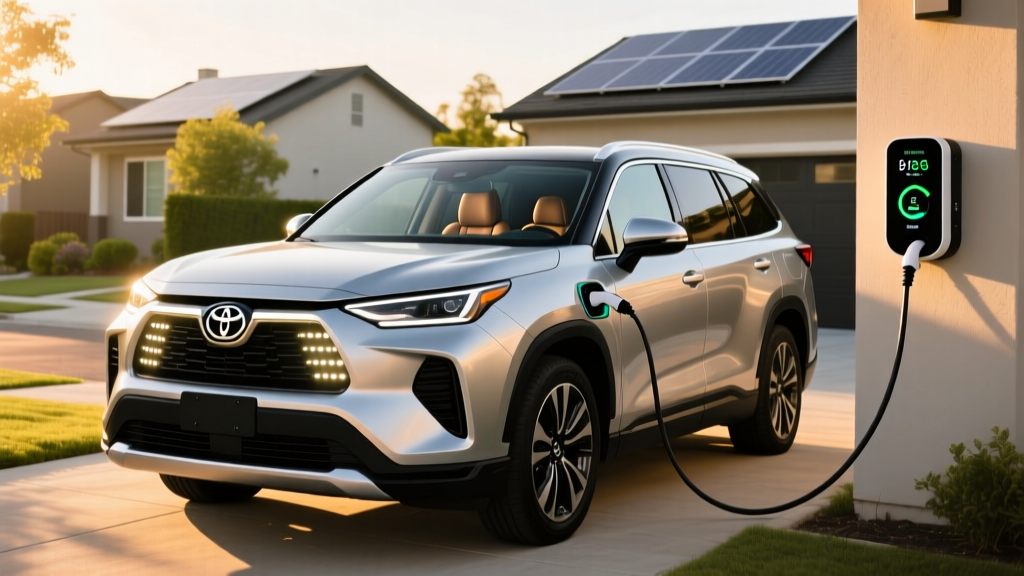
The 2026 Toyota Grand Highlander Platinum Hybrid occupies a narrow but compelling lane: a three-row family hauler that sips fuel without requiring a charging cable or range compromises. As Toyota's largest hybrid SUV, it competes against the Kia Sorento Hybrid, Hyundai Santa Fe Hybrid, and its own non-hybrid sibling — while the Hybrid MAX powertrain in the Platinum trim adds a performance edge that most three-row crossovers can't match.
This guide breaks down exactly what you get at the Platinum trim level, real-world fuel economy versus EPA estimates, powertrain specs, ownership economics, and whether this hybrid makes more sense for your household than a PHEV or full EV.
HEV vs PHEV: What the Grand Highlander Hybrid Actually Is
Before evaluating the Grand Highlander Platinum Hybrid, it's critical to understand what it is not: it is not a plug-in hybrid. The Grand Highlander Hybrid is a conventional hybrid electric vehicle (HEV). It charges its own small battery through regenerative braking and the gasoline engine. You never plug it in. There is no electric-only driving range to manage, no Level 2 charger to install, and no range anxiety when the battery depletes — because the 2.4-liter turbocharged engine is always the primary power source.
| Feature | Grand Highlander Hybrid (HEV) | Typical PHEV (e.g., Sorento PHEV) | Full EV (e.g., Rivian R1S) |
|---|---|---|---|
| Plug-in charging required? | No | Yes (Level 2 recommended) | Yes (Level 2 + DC fast) |
| Electric-only range | None (EV assist only) | 30–36 miles EPA | 300+ miles EPA |
| Battery size | ~1.4 kWh (NiMH, self-charging) | ~13–18 kWh (lithium-ion) | 90–150 kWh (lithium-ion) |
| Fueling | Gasoline only | Gasoline + electricity | Electricity only |
| Federal tax credit (§30D) | Not eligible | Up to $7,500 (if sourcing rules met) | Up to $7,500 (if sourcing rules met) |
| Best for | No home charging access; long trips | Short commutes + road trips | Home charging + mostly under 300 mi/day |
Toyota does not currently offer a Grand Highlander PHEV in the U.S. market. If plug-in capability is a priority, you'd need to look at competitors like the Kia Sorento PHEV (32 miles electric-only) or step up to a full EV.
Fuel Economy: EPA Ratings and Real-World MPG
The Grand Highlander Hybrid comes in two powertrain configurations depending on trim. The standard Hybrid powertrain (LE, XLE trims) uses a 2.5-liter four-cylinder paired with electric motors, while the Hybrid MAX powertrain (Limited, Platinum trims) uses a 2.4-liter turbocharged four-cylinder with a more powerful electric motor and a six-speed automatic transmission instead of the eCVT.
The Platinum trim exclusively uses the Hybrid MAX system, which trades a small amount of efficiency for significantly more power.
| Powertrain | Drivetrain | City MPG | Highway MPG | Combined MPG | Source |
|---|---|---|---|---|---|
| Hybrid MAX (Platinum) | AWD | 26 | 27 | 27 | EPA / fueleconomy.gov |
| Standard Hybrid (LE/XLE) | FWD | 37 | 34 | 36 | EPA / fueleconomy.gov |
| Standard Hybrid (LE/XLE) | AWD | 36 | 32 | 34 | EPA / fueleconomy.gov |
Real-World MPG: What to Actually Expect
The Hybrid MAX's 27 MPG combined EPA rating is honest for mixed driving, but real-world results depend heavily on your driving profile:
- City-dominant driving: Hybrids excel in stop-and-go traffic where regenerative braking recaptures energy. Expect 26–28 MPG in urban conditions — close to or slightly above the EPA city figure.
- Highway cruising (70–80 mph): The turbo four-cylinder works harder at sustained speed. Expect 25–27 MPG on flat interstate runs. This is where the Hybrid MAX's efficiency penalty versus the standard Hybrid (34 highway) is most noticeable.
- Cold weather (below 32°F): Hybrid fuel economy typically drops 10–15% in winter due to increased engine idling for cabin heat and reduced battery efficiency. Plan for 23–25 MPG combined in freezing conditions.
- Mountainous terrain: Regen on descents partially offsets climbing consumption, but expect 22–25 MPG on sustained grades.
The standard Hybrid powertrain (not available on Platinum) delivers substantially better fuel economy — 36 combined AWD — but produces only 245 hp versus the Hybrid MAX's 362 hp. If fuel savings are your absolute priority, the lower trims win decisively.
Powertrain and Performance Specs
| Specification | Grand Highlander Hybrid MAX (Platinum) |
|---|---|
| Engine | 2.4L turbocharged 4-cylinder + electric motor |
| Combined horsepower | 362 hp |
| Combined torque | 400 lb-ft |
| Transmission | 6-speed automatic (Direct Shift) |
| Drivetrain | AWD (electronic on-demand rear motor) |
| 0–60 mph | ~6.0 seconds (est.) |
| Towing capacity | 5,000 lbs (max rated) |
| Hybrid battery type | Nickel-metal hydride (NiMH), ~1.4 kWh |
| Fuel tank capacity | 17.1 gallons |
| Total driving range | ~460 miles (est. at combined MPG) |
The Hybrid MAX powertrain was introduced to give Toyota's larger vehicles a performance-oriented hybrid option. The 362 hp and 400 lb-ft of torque make the Grand Highlander Platinum one of the quickest three-row crossovers in its class, and the six-speed automatic delivers more natural shift feel than the eCVT in the standard Hybrid. The tradeoff is roughly 9 MPG combined versus the standard Hybrid — a meaningful difference over a year of commuting.
Pricing, Trims, and Tax Credit Eligibility
The 2026 Grand Highlander Platinum Hybrid MAX sits at the top of the lineup. Pricing reflects its premium positioning:
- Platinum Hybrid MAX AWD MSRP: ~$54,970 (base, before destination)
- Destination charge: ~$1,490
- Total starting price: ~$56,460
Fully loaded with accessories (roof rack, cargo mats, door edge guards, wireless charging pad), expect an out-the-door MSRP around $58,000–$59,500 before taxes and fees.
Federal Tax Credit: Not Eligible
§30D Federal Tax Credit Status: The Grand Highlander Hybrid does not qualify for the IRS §30D Clean Vehicle Credit. Under current IRS rules, only plug-in electric vehicles (PHEVs and BEVs) with sufficient battery capacity are eligible. Conventional hybrids like this one are excluded regardless of price or efficiency. See IRS.gov §30D guidelines for eligibility details.
This is a meaningful consideration. A competing PHEV like the Kia Sorento PHEV may qualify for up to $7,500 in federal credits (subject to MSRP caps, buyer income limits, and battery component/critical mineral sourcing requirements under current-year rules). That credit can narrow or even erase the Grand Highlander Hybrid's price advantage versus a plug-in alternative. Consult a tax professional to verify your specific eligibility for any PHEV or EV credit.
Battery Warranty, Reliability, and Replacement Costs
Hybrid battery longevity is the single most common concern among first-time hybrid buyers. Toyota's track record here is among the best in the industry, with decades of real-world data from the Prius, Camry Hybrid, and Highlander Hybrid lineages.
| Warranty Component | Coverage |
|---|---|
| Hybrid battery | 10 years / 150,000 miles (whichever comes first) |
| Hybrid system components | 8 years / 100,000 miles |
| Powertrain (engine, transmission) | 5 years / 60,000 miles |
| Basic bumper-to-bumper | 3 years / 36,000 miles |
Hybrid Battery Replacement Cost
If the hybrid battery fails outside warranty, replacement costs for a Toyota Hybrid MAX system typically range from $3,000 to $5,000 including parts and labor at a dealership. Independent hybrid specialists may offer refurbished battery packs for $2,000–$3,500. However, Toyota's NiMH hybrid batteries have demonstrated exceptional longevity — it's common for them to last 150,000–200,000+ miles with minimal degradation, since the battery is relatively small and never deeply cycled (the system keeps it in a narrow state-of-charge window to maximize lifespan).
The Hybrid MAX's battery is smaller and less stressed than a PHEV or EV battery, which is a reliability advantage. Toyota's hybrid systems consistently rank at or near the top in long-term reliability surveys from Consumer Reports and J.D. Power.
Platinum Trim: What You Get for the Money
The Platinum is the Grand Highlander's range-topping trim. Beyond the Hybrid MAX powertrain, it includes features not available on lower trims:
- Panoramic glass roof with power sunshade
- Heated and ventilated second-row captain's chairs (7-passenger config.)
- 12.3-inch digital instrument cluster
- 14-inch Toyota Audio Multimedia touchscreen
- JBL 11-speaker premium audio with subwoofer
- Head-up display (HUD)
- 360-degree panoramic view monitor
- Digital rearview mirror
- Heated steering wheel
- Toyota Safety Sense 3.0 (TSS 3.0) — pre-collision, lane tracing, adaptive cruise, road sign assist
- Wireless Apple CarPlay and Android Auto
- Qi wireless phone charging
The second-row captain's chairs reduce seating to seven (versus eight with the bench), but they dramatically improve third-row access and second-row comfort — a worthwhile tradeoff for most families.
Pros
- 362 hp makes it one of the quickest three-row crossovers available
- 5,000-lb towing capacity — best in hybrid SUV class
- Generous third-row space (adults fit comfortably)
- No charging infrastructure required
- Toyota's proven hybrid reliability and 10-year battery warranty
- Strong cargo volume: 97.5 cu ft behind front seats
Cons
- 27 MPG combined is modest — standard Hybrid gets 34–36 MPG
- No federal tax credit eligibility
- Platinum trim pushes $57K+ — premium pricing
- Hybrid MAX's 6-speed auto less smooth than eCVT at low speeds
- No PHEV variant available for electric-only commuting
- Insurance premiums higher than standard Hybrid due to powertrain cost
Who Should Buy This — and Who Shouldn't
Choose the Grand Highlander Platinum Hybrid MAX if:
- You need three rows, towing capability, and passing power but can't install a home charger
- You take frequent long road trips where EV charging infrastructure is sparse
- You want Toyota's hybrid reliability without managing plug-in routines
- Performance matters — you want 362 hp in a family SUV
Consider a PHEV or full EV instead if:
- Your daily commute is under 35 miles and you have Level 2 home charging — a PHEV eliminates most gasoline use
- You want federal tax credit eligibility (up to $7,500 for qualifying PHEVs/EVs)
- Fuel cost minimization is your top priority — the standard Hybrid or a full EV saves significantly more per mile
- You rarely tow or need the extra horsepower — the LE/XLE Hybrid at 36 MPG combined costs ~$10K less
Annual Fuel Cost Comparison
At 15,000 miles/year and $3.50/gallon regular unleaded:
- Grand Highlander Hybrid MAX (27 MPG): ~$1,944/year
- Grand Highlander Hybrid AWD (34 MPG): ~$1,544/year
- Grand Highlander gas-only AWD (24 MPG): ~$2,188/year
- Competitor PHEV (32 mi electric + 35 MPG gas): ~$800–$1,200/year (varies by electricity cost and commute)
The Hybrid MAX saves roughly $244/year versus the gas-only model, but costs about $400/year more than the standard Hybrid and $700–$1,100/year more than a PHEV used primarily on electric. Over five years, that's a $2,000–$5,500 fuel cost gap worth factoring into your purchase decision.
Frequently Asked Questions
How many MPG does the Grand Highlander Platinum Hybrid get?
The 2026 Grand Highlander Platinum Hybrid MAX with AWD is EPA-rated at 26 city / 27 highway / 27 combined MPG. Real-world results typically range from 23–28 MPG depending on driving conditions, with city driving yielding slightly better results than sustained highway travel.
Does the Grand Highlander Hybrid need to be plugged in?
No. The Grand Highlander Hybrid is a conventional hybrid (HEV), not a plug-in hybrid. It charges its own battery through regenerative braking and the gasoline engine. You fuel it exclusively with gasoline, just like a conventional car.
How far can the Grand Highlander Hybrid go on electric only?
The Grand Highlander Hybrid cannot drive on electric power alone for any meaningful distance. The electric motor assists the gasoline engine during acceleration and low-speed maneuvers, but the engine is always running or ready to engage. For electric-only driving, you'd need a PHEV or full EV.
Is the Grand Highlander Hybrid reliable, and what does battery replacement cost?
Toyota's hybrid systems have an industry-leading reliability record spanning 25+ years. The hybrid battery is covered by a 10-year/150,000-mile warranty. Out-of-warranty replacement typically costs $3,000–$5,000 at a dealer, but NiMH hybrid batteries commonly last 150,000–200,000+ miles without failure.
Does the Grand Highlander Hybrid qualify for any tax credit?
No. Under current IRS §30D rules, only plug-in electric vehicles (PHEVs and BEVs) qualify for the federal Clean Vehicle Credit. Conventional hybrids are not eligible. Some states may offer separate incentives for high-efficiency vehicles — check your state's energy office for current programs.
What's the difference between the Hybrid MAX and the standard Hybrid?
The Hybrid MAX (Platinum/Limited trims) uses a 2.4L turbo engine + electric motor for 362 hp and 27 MPG combined with a 6-speed automatic. The standard Hybrid (LE/XLE trims) uses a 2.5L naturally aspirated engine + motors for 245 hp and 34–36 MPG combined with an eCVT. The MAX prioritizes performance; the standard Hybrid prioritizes efficiency.
How does the Grand Highlander Hybrid compare to a full EV like the Rivian R1S?
The Rivian R1S offers 300+ miles of electric range, 0–60 in ~3.5 seconds, and lower per-mile fuel costs, but starts at ~$75,000+, requires home charging infrastructure, and involves longer refueling times on road trips. The Grand Highlander Hybrid MAX costs ~$20K less, needs no charging setup, refuels in 5 minutes, and still delivers strong performance — at the cost of higher fuel spend and no electric-only capability.
Sources: fueleconomy.gov (EPA), Toyota Motor Corporation, IRS §30D Clean Vehicle Credits. Pricing and specifications reflect 2026 model year data available at time of publication. Tax credit eligibility is subject to change; consult a tax professional.