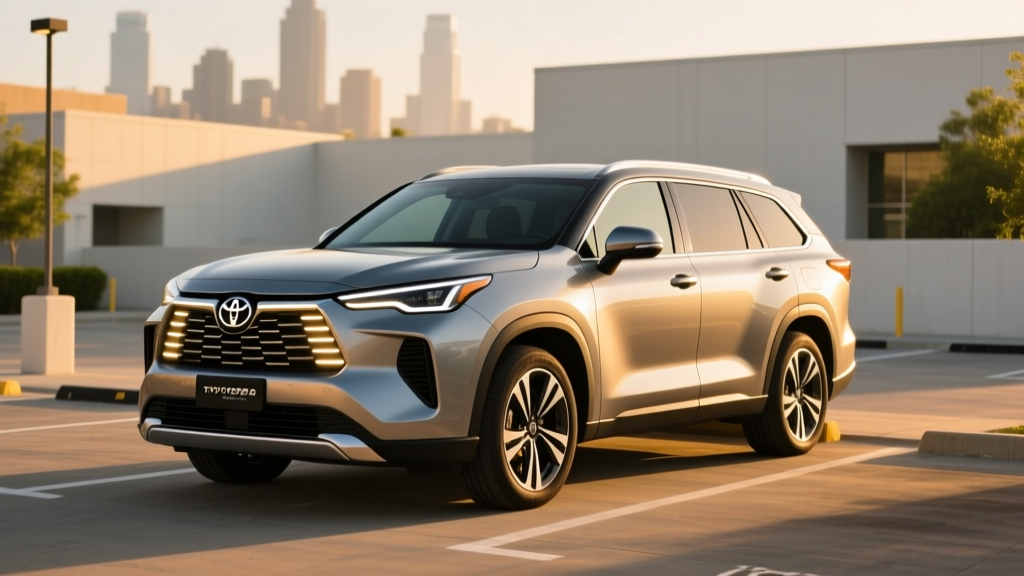
The Toyota Grand Highlander Hybrid occupies a narrow but increasingly crowded lane: a three-row family hauler that sips fuel without sacrificing cargo space or the option of all-wheel drive. The Limited trim sits in the middle of the hybrid lineup, adding premium touches over the XLE without stepping into the range-topping Platinum's price territory. For 2026, the Grand Highlander Hybrid continues with the proven 2.5-liter four-cylinder hybrid powertrain, and the Limited trim remains one of the most practical configurations for buyers who want three rows, standard AWD, and sub-40-MPG combined efficiency.
This guide breaks down exactly what the Grand Highlander Limited Hybrid delivers in fuel economy, powertrain performance, real-world ownership costs, and battery longevity — and how it stacks up against plug-in hybrid and full EV alternatives in the three-row segment.
Fuel Economy: EPA Ratings and Real-World MPG
The 2026 Grand Highlander Hybrid with standard electronic on-demand AWD carries an EPA-estimated 35 MPG combined (36 city / 34 highway). Front-wheel-drive models bump that slightly to 36 MPG combined (37 city / 35 highway), though AWD is by far the more popular configuration and comes standard on the Limited trim.
| Configuration | City MPG | Highway MPG | Combined MPG | Annual Fuel Cost* |
|---|---|---|---|---|
| FWD (LE/XLE) | 37 | 35 | 36 | ~$1,650 |
| AWD (Limited) | 36 | 34 | 35 | ~$1,700 |
| Hybrid MAX AWD (Platinum) | 27 | 28 | 27 | ~$2,200 |
*Based on 15,000 miles/year at $3.50/gallon regular unleaded. Source: EPA fueleconomy.gov.
In mixed suburban and highway driving, the Grand Highlander Hybrid AWD typically returns 33–37 MPG depending on conditions. City-heavy commutes often push the figure above the EPA estimate — Toyota's hybrid system recovers more energy through regenerative braking at lower speeds. Sustained highway driving at 75+ MPH, fully loaded with passengers and cargo, will pull efficiency down toward 30–32 MPG. Cold-weather operation (below freezing) can reduce MPG by 5–8% due to increased engine idling for cabin heat before the engine reaches operating temperature.
Powertrain: 2.5L Hybrid System Explained
The Grand Highlander Limited Hybrid uses Toyota's fourth-generation hybrid system, pairing a 2.5-liter inline-four Atkinson-cycle gasoline engine with two front-mounted motor-generators and a single rear electric motor for electronic AWD. Total system output is 245 horsepower.
| Engine | 2.5L I4 Atkinson-cycle |
| Gas Engine Output | 186 HP / 186 lb-ft torque |
| Front Electric Motors | Two motor-generators (MG1/MG2) |
| Rear Electric Motor | 54 HP (electronic AWD) |
| Combined System HP | 245 HP |
| Transmission | eCVT (planetary gearset) |
| Drivetrain | Electronic on-demand AWD (std on Limited) |
| 0–60 MPH | ~7.8 seconds |
| Towing Capacity | 3,500 lbs (hybrid) |
| Fuel Tank | 17.1 gallons |
| Total Driving Range | ~598 miles (EPA est.) |
This is a conventional hybrid (HEV), not a plug-in hybrid. The battery recharges exclusively through regenerative braking and the gasoline engine. There is no plug, no electric-only driving mode of meaningful distance, and no home charging setup required. This distinction matters because the Grand Highlander does not currently offer a PHEV variant — if you want plug-in electric range in a Toyota three-row, you'd need to look at the Sienna PHEV (minivan) or consider competitors like the Mazda CX-90 PHEV.
| Feature | Grand Highlander Hybrid (HEV) | Typical 3-Row PHEV (e.g., CX-90 PHEV) |
|---|---|---|
| Plug-in Charging | No — self-charging | Yes — Level 1/2 plug required |
| Electric-Only Range | ~1 mile at low speed | 25–30 miles |
| Battery Size | ~1.6 kWh (NiMH) | ~17.8 kWh (Li-ion) |
| Combined MPG (gas) | 35 MPG | 25 MPG (gas-only mode) |
| Federal Tax Credit | None | Up to $7,500 (§30D, if eligible) |
| Home Charging Needed | No | Yes (Level 2 recommended) |
Pricing, Trims, and Tax Credit Eligibility
The 2026 Grand Highlander Hybrid Limited starts at an MSRP of approximately $49,790 including destination charge. Key Limited-trim additions over the XLE Hybrid include SofTex-trimmed heated and ventilated front seats, a panoramic moonroof, a 12.3-inch digital driver display, and Toyota's Smart Key system with rear-door touch sensors.
| Trim | Drivetrain | MSRP (incl. destination) |
|---|---|---|
| LE Hybrid | FWD / AWD | $42,190 / $43,790 |
| XLE Hybrid | FWD / AWD | $45,220 / $46,820 |
| Limited Hybrid | AWD | $49,790 |
| Platinum Hybrid MAX | AWD | $55,405 |
The Grand Highlander Hybrid is a conventional HEV, not a plug-in electric vehicle. It does not qualify for the IRS §30D Clean Vehicle Credit (up to $7,500 for new PHEVs/BEVs). The §30D credit requires a minimum 7 kWh battery capacity and plug-in charging capability, neither of which applies here. Some states offer minor rebates for high-efficiency hybrids, but these vary by jurisdiction — check your state energy office or IRS clean vehicle credit page for current rules.
The lack of a federal tax credit is the Grand Highlander Hybrid's most significant financial disadvantage compared to PHEV competitors. A three-row PHEV like the Mazda CX-90 PHEV ($52,475 MSRP) may qualify for up to $7,500 under §30D if the buyer meets income caps ($150K single / $300K joint), the vehicle meets battery sourcing requirements, and the MSRP does not exceed $80,000 for SUVs. That credit can erase or reverse the sticker-price gap.
Battery Warranty, Reliability, and Replacement Cost
Toyota covers the Grand Highlander Hybrid's battery with a 10-year / 150,000-mile warranty (whichever comes first), consistent with Toyota's hybrid battery coverage across its lineup. This warranty guarantees the battery against defects and excessive capacity loss. The hybrid system components (inverter, transaxle, electric motors) carry the same 10-year/150,000-mile Hybrid System Warranty.
| Basic Warranty | 3 years / 36,000 miles |
| Powertrain Warranty | 5 years / 60,000 miles |
| Hybrid Battery Warranty | 10 years / 150,000 miles |
| Hybrid System Components | 10 years / 150,000 miles |
| Roadside Assistance | 2 years / 25,000 miles |
| Complimentary Maintenance | 2 years / 25,000 miles |
Toyota's hybrid battery track record is among the strongest in the industry. The nickel-metal hydride (NiMH) pack in the Grand Highlander Hybrid is smaller and less stressed than the lithium-ion packs in full EVs — it rarely cycles through deep charge/discharge, which contributes to longevity. Based on data from Toyota's Highlander Hybrid lineage (now in its fourth generation), hybrid battery replacement is uncommon before 150,000 miles. When replacement is needed out of warranty, expect a cost range of $2,000–$4,000 including parts and labor for a Toyota dealer replacement, or $1,500–$2,500 for a refurbished unit from independent hybrid specialists.
Toyota's reliability reputation in the hybrid segment is well-earned. The NHTSA vehicle page and IIHS ratings should be consulted for the latest safety data, as the Grand Highlander earned strong marks in crashworthiness testing in its debut year.
Who Should Buy the Grand Highlander Limited Hybrid?
The Grand Highlander Limited Hybrid is purpose-built for a specific buyer profile. Here's a practical decision framework:
- You need three usable rows (adults fit in the third row) and class-leading cargo volume behind the third row (~20.6 cu ft).
- You lack access to home or workplace Level 2 charging — a conventional HEV requires zero infrastructure changes.
- Your driving is a mix of city and highway, where the hybrid system's regenerative braking pays dividends in stop-and-go traffic.
- You want Toyota's long-term reliability record and 10-year hybrid battery warranty.
- Towing up to 3,500 lbs is occasional, not routine.
- You have Level 2 home charging and a short daily commute — a PHEV can cover 25–30 miles on electricity alone, eliminating most gas use.
- Federal tax credit eligibility would save you $7,500, making a PHEV's effective price lower than the Grand Highlander Hybrid Limited.
- You want electric-only driving for air quality, HOV lane access, or silent operation in residential areas.
- Performance is a priority — the 245 HP hybrid system is adequate but not brisk; the Hybrid MAX (362 HP) or a BEV like the Kia EV9 (379 HP AWD) delivers markedly stronger acceleration.
Real-World Ownership: What the Numbers Look Like at 5 Years
One of the Grand Highlander Hybrid's strongest arguments is its low running cost relative to gas-only three-row SUVs. Here's a five-year cost snapshot compared to a typical non-hybrid competitor in the segment (e.g., a turbocharged gas three-row SUV averaging 23 MPG combined):
| Cost Category | Grand Highlander Hybrid Ltd (35 MPG) | Gas 3-Row SUV (23 MPG) |
|---|---|---|
| Fuel (at $3.50/gal avg) | $7,500 | $11,413 |
| Maintenance (est.) | $2,800 | $3,500 |
| Insurance (est. avg) | $9,500 | $8,800 |
| Federal Tax Credit | $0 | $0 |
| Total Running Costs | ~$19,800 | ~$23,713 |
| Fuel Savings vs. Gas | ~$3,913 saved over 5 years | |
The fuel savings are meaningful but not transformative — roughly $780 per year. The real value proposition is the combination of efficiency, three-row practicality, and Toyota's reliability reputation. Insurance premiums for the Grand Highlander Hybrid tend to run slightly higher than gas-only competitors due to the higher replacement cost of hybrid components, which partially offsets fuel savings.
Grand Highlander Hybrid vs. the Three-Row Alternatives
Toyota Grand Highlander Hybrid — 35 MPG combined, no charging infrastructure needed, proven hybrid reliability, usable third row for adults. The Limited trim balances features and price effectively.
Mazda CX-90 PHEV — Up to $7,500 §30D credit (if eligible), 26 miles electric-only range, premium interior. Requires Level 2 home charging to realize full value.
Kia EV9 — Full BEV, 304 miles EPA range (LR AWD), 210 kW DC fast charging, three rows. Higher upfront cost but lowest running costs and zero tailpipe emissions. Requires reliable home charging access.
Frequently Asked Questions
How many MPG does the Grand Highlander Limited Hybrid get?
The 2026 Grand Highlander Hybrid Limited with standard AWD is EPA-rated at 36 city / 34 highway / 35 combined MPG. Real-world results typically range from 33–37 MPG depending on driving mix, with city-heavy routes often exceeding the EPA estimate and sustained highway driving at 75+ MPH dropping to 30–32 MPG when fully loaded.
Does the Grand Highlander Hybrid need to be plugged in?
No. The Grand Highlander Hybrid is a conventional hybrid (HEV), not a plug-in hybrid (PHEV). The battery charges through regenerative braking and the gasoline engine. You never plug it in — you simply fill it with gas like any other vehicle. There is no meaningful electric-only driving range.
Is there a Grand Highlander PHEV version?
As of the 2026 model year, Toyota does not offer a plug-in hybrid (PHEV) variant of the Grand Highlander. The hybrid lineup consists exclusively of conventional HEV models (the 245 HP system) and the Hybrid MAX performance variant (362 HP, also a conventional HEV). If Toyota introduces a Grand Highlander PHEV in the future, it would likely feature a larger lithium-ion battery (~15–20 kWh), 25–30 miles of electric-only range, and potential §30D tax credit eligibility.
Does the Grand Highlander Hybrid qualify for any tax credit?
The Grand Highlander Hybrid does not qualify for the federal §30D Clean Vehicle Credit because it is not a plug-in vehicle. The §30D credit requires a minimum 7 kWh battery and plug-in charging capability. Some states offer minor incentives for high-efficiency hybrids, but these vary widely — check your state's energy office for details. The hybrid's value proposition rests on fuel savings and reliability, not tax incentives.
How reliable is the Grand Highlander Hybrid battery and what does replacement cost?
Toyota covers the hybrid battery for 10 years / 150,000 miles. Toyota's NiMH hybrid batteries have an excellent longevity track record — failures before 150,000 miles are rare based on data from the broader Highlander Hybrid family. Out-of-warranty replacement costs range from $2,000–$4,000 at a Toyota dealer or $1,500–$2,500 for a refurbished unit from an independent hybrid specialist.
Hybrid vs. PHEV vs. EV — which three-row vehicle fits me?
Hybrid (HEV) — Choose this if you have no home charging access, want maximum simplicity, and drive a varied mix of city/highway. No plug, no range anxiety, just fill up with gas. Best for apartment dwellers or those who street-park.
Plug-in Hybrid (PHEV) — Choose this if you can install a Level 2 charger at home, have a short daily commute (under 30 miles), and want to drive mostly electric on weekdays while keeping gas flexibility for road trips. You'll need to plug in nightly to realize the benefits.
Full EV (BEV) — Choose this if you have reliable home charging, want the lowest running costs, and your road trips fall within DC fast-charging network coverage. Higher upfront cost, but lowest cost-per-mile and zero tailpipe emissions.
Can the Grand Highlander Hybrid tow?
Yes. The hybrid powertrain is rated for 3,500 lbs of towing capacity — sufficient for a small boat, light utility trailer, or a pair of personal watercraft. The Hybrid MAX variant increases this to 5,000 lbs if heavier towing is a regular need.