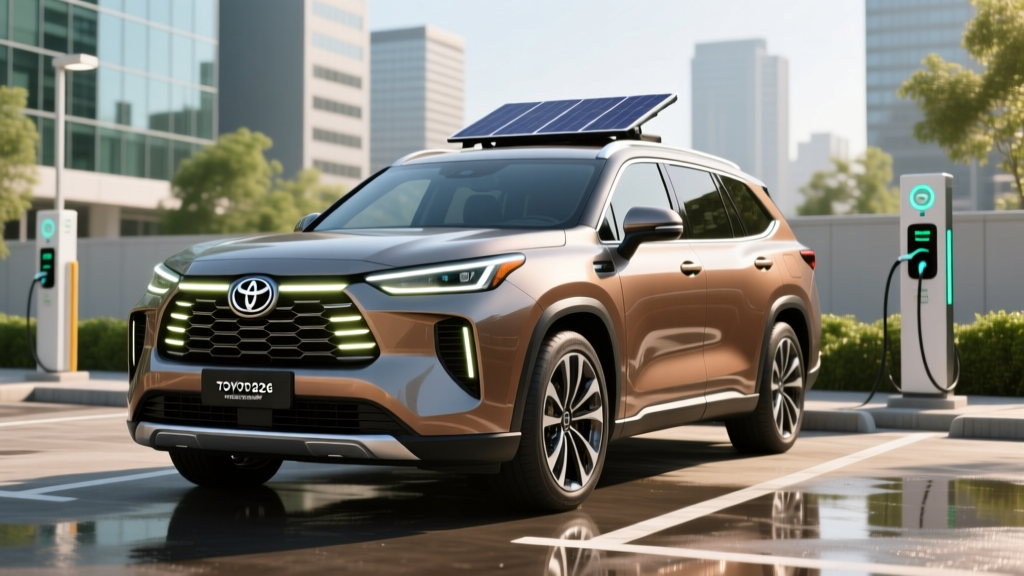
The Toyota Grand Highlander Hybrid occupies a narrow but valuable lane: three-row family hauler with genuine fuel efficiency and no plug required. For 2026, Toyota continues offering the Grand Highlander Hybrid in two distinct powertrain flavors — a standard hybrid setup tuned for efficiency and the Hybrid MAX variant tuned for performance. Neither is a plug-in hybrid, and neither requires any change to your daily routine beyond fewer stops at the gas station.
Below, we break down every number that matters — EPA fuel economy, real-world expectations, powertrain output, pricing by trim, warranty coverage, and whether any federal tax incentives apply — so you can decide if this is the right three-row for your driveway.
HEV vs PHEV: Where the Grand Highlander Hybrid Fits
Let's clear up the most common point of confusion right away. The Grand Highlander Hybrid is a conventional hybrid electric vehicle (HEV). It pairs a gasoline engine with one or more electric motors and a small battery pack that recharges through regenerative braking and engine power. You never plug it in. There is no electric-only driving range to manage, no charging cable to deal with, and no home charger to install.
| Attribute | Grand Highlander Hybrid (HEV) | Plug-In Hybrid (PHEV) Example | Full EV (BEV) |
|---|---|---|---|
| Plug-in charging required? | No | Yes (Level 2 recommended) | Yes (Level 2 + DC fast) |
| Electric-only range | None (motor assists engine) | Typically 25–45 mi | 200–400+ mi |
| Battery size | ~1.8 kWh (NiMH, self-charging) | 13–25 kWh (NMC/LFP) | 60–120+ kWh |
| Fuel needed? | Yes (regular unleaded) | Yes | No |
| Federal tax credit (§30D) | Not eligible | Up to $7,500 (if sourcing/income rules met) | Up to $7,500 (if sourcing/income rules met) |
| Best for | No home charging access; long trips | Short commute + home charging | Home charging + mostly under 300 mi/day |
If you're cross-shopping a plug-in hybrid like the Chrysler Pacifica PHEV or a full battery-electric SUV like the Kia EV9, the Grand Highlander Hybrid trades electric-only commuting capability for simplicity, lower sticker price, and zero range anxiety on cross-country drives.
2026 Grand Highlander Hybrid MPG: EPA Estimates and Real-World Data
Fuel economy is the headline reason buyers choose this powertrain over the turbocharged gas-only Grand Highlander. Here's how the EPA rates the 2026 Grand Highlander Hybrid, broken down by drivetrain configuration, per fueleconomy.gov:
| Powertrain | City MPG | Highway MPG | Combined MPG | Est. Total Range |
|---|---|---|---|---|
| Hybrid (FWD) | 37 | 34 | 36 | ~640 mi |
| Hybrid (AWD) | 35 | 33 | 34 | ~600 mi |
| Hybrid MAX (AWD) | 27 | 28 | 27 | ~480 mi |
Real-world expectations: Toyota's hybrid system is one of the most proven in the industry, and real-world city driving often exceeds EPA estimates because the electric motor handles low-speed propulsion where gasoline engines are least efficient. On city-heavy commutes with frequent stops, owners regularly report 37–40 MPG in the standard Hybrid AWD. Highway-only driving at 75+ mph will pull numbers down toward 30–32 MPG. The Hybrid MAX, with its turbocharged engine and performance tuning, behaves more like a conventional gas SUV — expect mid-20s in mixed driving.
Total range reality: With an 18.5-gallon fuel tank, the standard Hybrid FWD can cover roughly 640 miles between fill-ups under EPA combined conditions. On a real road trip with highway speeds, AC running, and a full load of passengers and cargo, plan for 540–580 miles before the low-fuel warning. That's still a full day of driving without a fuel stop.
Powertrain Specs: Two Hybrid Systems, Very Different Characters
Toyota offers two hybrid powertrains in the Grand Highlander, and they share little beyond the badge:
| Specification | Grand Highlander Hybrid | Grand Highlander Hybrid MAX |
|---|---|---|
| Engine | 2.5L 4-cylinder | 2.4L turbocharged 4-cylinder |
| Electric motors | 2 (front) + 1 (rear, AWD) | 1 (front) + 1 (rear) |
| Combined horsepower | 245 hp | 362 hp |
| Combined torque | 173 lb-ft (engine) | 400 lb-ft |
| Transmission | eCVT | 6-speed automatic |
| Drivetrain | FWD or AWD (electronic rear motor) | AWD standard |
| 0–60 mph (est.) | ~7.8 sec | ~6.3 sec |
| Towing capacity | 3,500 lb | 5,000 lb |
| Fuel type | Regular unleaded (87 octane) | Premium recommended (91 octane) |
The standard Hybrid is the efficiency play — smooth, quiet, and built around Toyota's planetary-gear eCVT that seamlessly blends engine and electric motor power. The Hybrid MAX is the performance play — the turbo four and electric motor combine for V6-rivaling acceleration, and the conventional 6-speed automatic delivers more direct power delivery at the cost of fuel economy.
If your priority is saving money at the pump, the standard Hybrid is the clear choice. If you tow a boat or trailer regularly and want passing power on mountain grades, the Hybrid MAX justifies its ~7 MPG penalty.
Pricing, Trims, and Tax-Credit Eligibility
For the 2026 model year, Toyota prices the Grand Highlander Hybrid across the following approximate MSRP tiers (destination included):
- Hybrid XLE (FWD): ~$45,970
- Hybrid XLE (AWD): ~$47,570
- Hybrid Limited (AWD): ~$52,200
- Hybrid MAX Limited (AWD): ~$55,500
- Hybrid MAX Platinum (AWD): ~$59,400
Federal tax credit status
The Grand Highlander Hybrid does not qualify for the IRS §30D New Clean Vehicle Credit. That credit applies only to plug-in electric vehicles (PHEVs and BEVs) that meet battery-sourcing and critical-mineral requirements. Conventional hybrids like this one are excluded under current IRS rules.
§30D credit — why the Grand Highlander Hybrid doesn't qualify:
- Vehicle must have a battery capacity of at least 7 kWh — the HEV battery is ~1.8 kWh
- Vehicle must be capable of plug-in charging — HEVs charge internally only
- Credit applies to PHEVs and BEVs exclusively
Some states offer their own incentives for hybrid purchases, though these are increasingly rare as programs shift focus to plug-in vehicles. Check your state's energy or DMV website for current programs. There is no federal incentive at the point of sale for this vehicle.
Battery Warranty, Lifespan, and Replacement Cost
Hybrid battery longevity is the top concern for first-time hybrid buyers, and it's where Toyota's track record matters most. The Grand Highlander Hybrid uses a nickel-metal hydride (NiMH) battery pack — a chemistry Toyota has refined over 25+ years of hybrid production since the original Prius.
| Coverage Item | Term |
|---|---|
| Hybrid battery warranty | 10 years / 150,000 miles |
| Hybrid system components (inverter, motor) | 8 years / 100,000 miles |
| Powertrain warranty (engine, transmission) | 5 years / 60,000 miles |
| Basic bumper-to-bumper | 3 years / 36,000 miles |
Real-world battery lifespan: Toyota hybrid batteries routinely last 150,000–200,000+ miles before significant degradation. The ~1.8 kWh pack in the Grand Highlander Hybrid is small and operates within a narrow state-of-charge window (roughly 40–80%), which dramatically reduces stress on the cells. This is fundamentally different from a full EV battery that cycles through deep charge states daily.
Replacement cost if out of warranty: Based on current Toyota hybrid battery pricing, a replacement NiMH pack for the Grand Highlander Hybrid would likely fall in the $3,000–$5,000 range installed. That's a fraction of EV battery replacement costs and, given the 10-year/150,000-mile warranty and typical lifespan, most original owners will never face this expense.
Toyota's hybrid reliability data, tracked extensively by IIHS and consumer surveys, shows hybrid system failure rates well below the industry average for conventional powertrain components. The eCVT in particular has fewer moving parts than a traditional automatic and no friction clutches to wear out.
Who Should Choose the Grand Highlander Hybrid?
Choose the Grand Highlander Hybrid if:
- You need three rows and cargo space but want to cut fuel costs 30–40% vs. a gas-only three-row SUV
- You don't have access to home or workplace Level 2 charging (apartment, street parking, no garage outlet)
- You take frequent long road trips where EV charging infrastructure is sparse or unreliable
- You want a lower purchase price than a comparable PHEV or EV three-row (Kia EV9 starts ~$56,000+)
- You prefer zero behavior change — no plugging in, no range planning, no charging apps
Look at a PHEV or full EV instead if:
- Your daily commute is under 35 miles and you can install a Level 2 charger at home (a PHEV like the Chrysler Pacifica Hybrid covers most commutes on electricity alone)
- You want to eliminate gasoline entirely and have reliable home charging
- You want to claim the $7,500 federal tax credit (requires a qualifying PHEV or BEV per IRS §30D)
- You prioritize instant electric torque and one-pedal driving around town
Pros and Cons at a Glance
Pros
- 36 MPG combined (FWD) — best-in-class for a three-row SUV
- 600+ mile total range; no charging infrastructure needed
- 10-year/150,000-mile hybrid battery warranty
- Smooth, quiet low-speed electric assist in traffic
- Regular unleaded fuel (standard Hybrid trims)
- Proven Toyota hybrid reliability with deep service network
- Hybrid MAX offers 362 hp and 5,000-lb towing for those who need it
Cons
- No electric-only driving — always burns some gasoline
- No federal tax credit eligibility
- Hybrid MAX fuel economy (27 combined) barely beats some turbo-gas rivals
- ~$3,000 premium over gas-only Grand Highlander base trims
- Third row still tight for adults on long trips
- No DC fast charging or plug-in capability of any kind
Frequently Asked Questions
How many MPG does the Grand Highlander Hybrid get?
The EPA rates the 2026 Grand Highlander Hybrid FWD at 37 city / 34 highway / 36 combined MPG. The AWD version drops slightly to 35/33/34. The performance-oriented Hybrid MAX is rated at 27 MPG combined. In real-world city driving with frequent stops, the standard Hybrid often exceeds its EPA city estimate, while highway-only trips at 75+ mph will return closer to 30–32 MPG.
Does the Grand Highlander Hybrid need to be plugged in?
No. This is a conventional self-charging hybrid. The small battery recharges through regenerative braking and the gasoline engine. There is no plug, no charging port, and no electric-only driving mode. You fuel it like any other gas vehicle and it simply uses less fuel.
Hybrid vs PHEV vs EV — which is right for my family?
If you have home Level 2 charging and a commute under 35 miles, a PHEV lets you drive most days on electricity while keeping gas for road trips. If you charge at home and rarely drive over 300 miles in a day, a full EV eliminates gas entirely and qualifies for the federal tax credit. If you lack home charging, take frequent long trips, or want the lowest up-front cost with no behavior change, the conventional Grand Highlander Hybrid is the practical choice.
Is the hybrid battery reliable and what does replacement cost?
Toyota's hybrid batteries are among the most reliable in the industry, routinely lasting 150,000–200,000+ miles. The Grand Highlander Hybrid battery is covered by a 10-year/150,000-mile warranty. Out-of-warranty replacement is estimated at $3,000–$5,000 — far less than an EV battery pack. The eCVT transmission has fewer wear components than a conventional automatic.
Does the Grand Highlander Hybrid qualify for any tax credit?
It does not qualify for the federal §30D New Clean Vehicle Credit, which is limited to plug-in vehicles (PHEVs and BEVs) meeting battery-sourcing requirements. Some states may offer minor hybrid incentives, but these are uncommon. Check your state energy office for current programs.
How does the Hybrid MAX compare to the standard Hybrid?
The Hybrid MAX trades ~9 MPG (36 vs 27 combined) for 117 additional horsepower (362 vs 245), a faster 0–60 time (~6.3 vs ~7.8 seconds), and 1,500 lb more towing capacity (5,000 vs 3,500 lb). It requires premium fuel and uses a 6-speed automatic instead of the eCVT. Choose it only if you tow regularly or prioritize acceleration; otherwise the standard Hybrid delivers better value and far lower fuel costs.