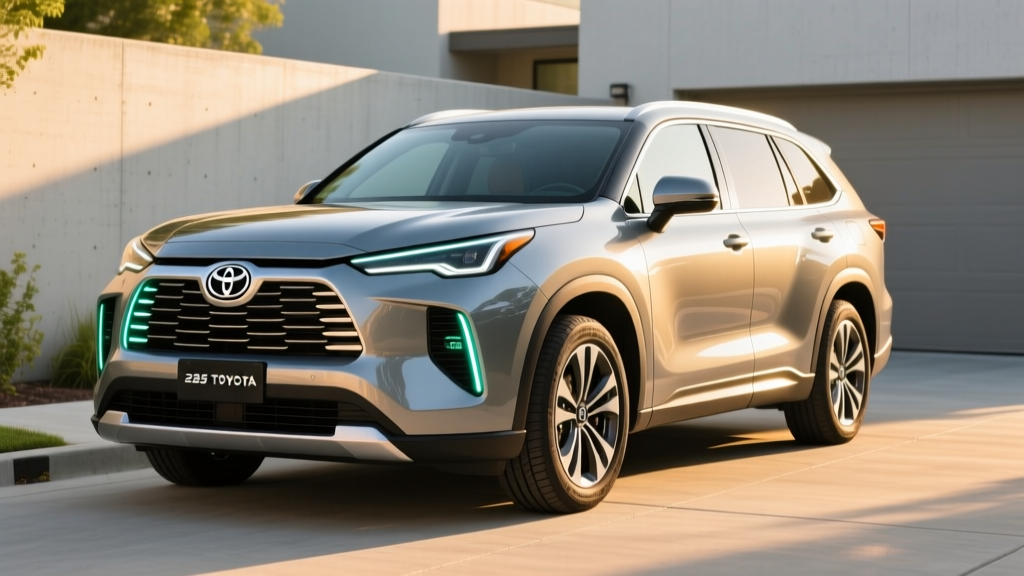
The three-row SUV segment rarely delivers impressive fuel economy, but the Toyota Grand Highlander Hybrid challenges that norm. If you're researching Grand Highlander hybrid miles per gallon figures to decide whether this electrified family hauler makes financial sense, you've found the right data-driven breakdown. We'll cover every powertrain option, EPA estimates versus real-world results, and the total ownership picture for the 2026 model year.
Grand Highlander Hybrid MPG: The Official EPA Numbers
The 2026 Toyota Grand Highlander Hybrid comes in two distinct powertrain flavors, and their fuel economy figures diverge significantly. The standard hybrid uses Toyota's fourth-generation hybrid system with a 2.5-liter four-cylinder engine, while the Hybrid MAX pairs a turbocharged 2.4-liter engine with a more powerful electric motor setup for performance-oriented driving. Here's exactly what the EPA rates them at:
| Powertrain | City MPG | Highway MPG | Combined MPG | Drivetrain |
|---|---|---|---|---|
| 2.5L Hybrid (AWD) | 36 | 32 | 34 | AWD (eAWD) |
| 2.5L Hybrid (FWD) | 37 | 34 | 36 | FWD |
| Hybrid MAX (AWD) | 27 | 28 | 27 | AWD |
Source: EPA Fuel Economy
The standard hybrid's 36 MPG combined (FWD) is exceptional for a vehicle with over 97 cubic feet of maximum cargo volume and seating for up to eight. For context, the non-hybrid Grand Highlander with its turbocharged 2.4-liter gas engine achieves just 24 MPG combined. That's a 50% improvement in fuel efficiency for the hybrid, which translates directly into fewer fuel stops and lower annual fuel costs.
| Specification | 2.5L Hybrid | Hybrid MAX |
|---|---|---|
| Combined Horsepower | 245 hp | 362 hp |
| Engine | 2.5L I4 + 2 electric motors | 2.4L Turbo I4 + electric motor |
| 0-60 mph | ~7.8 seconds | ~6.3 seconds |
| Towing Capacity | 3,500 lbs | 5,000 lbs |
| EPA Combined MPG | 34-36 MPG | 27 MPG |
| Fuel Tank | 17.1 gallons | 17.1 gallons |
| Total Range | ~580-615 miles | ~460 miles |
| Base MSRP (2026) | $47,290 | $57,705 |
Real-World MPG vs. EPA Estimates: What Owners Actually See
EPA estimates are a starting point, not a guarantee. Toyota's hybrid system has a well-documented tendency to exceed EPA city ratings in real-world stop-and-go driving, because regenerative braking recaptures energy that a conventional gas vehicle wastes as heat. Here's what to expect based on owner reports and independent testing:
City driving (2.5L Hybrid): Expect 35-40 MPG. Short trips with frequent stops maximize regen braking benefits. Drivers who adopt a smooth, anticipatory driving style regularly report 38+ MPG in urban environments. In warmer months with minimal HVAC load, some owners push past 40 MPG on flat city routes.
Highway driving (2.5L Hybrid): Expect 29-33 MPG. This is where hybrids lose their advantage — at sustained 70-80 mph speeds, the gasoline engine runs continuously, and aerodynamic drag dominates. Cold weather, roof cargo boxes, and headwinds further reduce highway efficiency. On a 600-mile road trip at 75 mph in 35°F weather, expect closer to 27-28 MPG.
Hybrid MAX real-world: Expect 24-28 MPG combined. The performance-oriented tuning sacrifices efficiency for responsiveness. Heavy acceleration and highway passing maneuvers engage the turbo engine more aggressively, reducing the electric motor's contribution to overall efficiency.
Real-World Range Reality: The EPA rates the FWD hybrid at ~615 miles of total range (36 MPG × 17.1 gal). In mixed real-world driving (suburban + highway), expect 520-570 miles per tank. In winter conditions with short trips and heater use, that drops to approximately 450-480 miles. The Hybrid MAX delivers roughly 400-440 real-world miles per fill-up.
HEV vs. PHEV vs. EV: Which Grand Highlander Fits Your Life?
A critical clarification: the Toyota Grand Highlander Hybrid is a conventional hybrid (HEV), not a plug-in hybrid (PHEV). You never plug it in. The 1.6 kWh nickel-metal hydride battery charges exclusively through regenerative braking and the gasoline engine. There is no electric-only driving mode of any meaningful distance — the electric motors assist the engine but cannot propel the vehicle alone for more than a mile or two at very low speeds.
This matters because buyers sometimes confuse the Grand Highlander Hybrid with plug-in alternatives like the Toyota RAV4 Prime or the Kia Sorento PHEV, which offer 30-42 miles of electric-only range and qualify for federal tax credits. Here's how the three electrified options compare for a three-row family SUV buyer:
| Factor | Grand Highlander Hybrid (HEV) | Typical 3-Row PHEV (e.g., Sorento PHEV) | Full EV (e.g., Kia EV9) |
|---|---|---|---|
| Plug-in Required? | No | Yes (for max benefit) | Yes (mandatory) |
| Electric-Only Range | N/A (<1 mi) | 30-33 miles | 230-300+ miles |
| Combined MPG / MPGe | 34-36 MPG | 79 MPGe (elec) / 34 MPG (gas) | 85-89 MPGe |
| Federal Tax Credit | None | Up to $7,500* | Up to $7,500* |
| Home Charging Needed | No | Recommended (Level 2) | Essential (Level 2) |
| 3rd Row Usability | Excellent (true 8-seat) | Tight (compact 3-row) | Good (true 3-row) |
| Starting MSRP | ~$47,290 | ~$51,000 | ~$54,900 |
*Federal tax credit eligibility under IRS §30D depends on buyer income limits, vehicle MSRP caps, battery sourcing requirements, and manufacturer sales caps. Verify current rules at IRS.gov before purchasing.
Choose the Grand Highlander Hybrid if:
- You want maximum fuel efficiency without changing your fueling habits (no plugs, no charging apps)
- You need genuine adult-sized third-row seating and best-in-class cargo space
- You drive 15,000+ miles per year and want to minimize fuel costs on a gas-only infrastructure
- You lack access to home or workplace charging
Choose a PHEV alternative if:
- You have home Level 2 charging and a commute under 30 miles round-trip
- You want to drive primarily on electricity for daily errands with gas backup for road trips
- Federal or state tax credits offset the PHEV price premium in your situation
Choose a full EV if:
- You have reliable home Level 2 charging and your typical trips fall within 250 miles
- You want the lowest per-mile fuel cost (~$0.04/mi on home electricity vs. ~$0.13/mi in the hybrid at 34 MPG)
- You prioritize instant torque and zero tailpipe emissions in daily driving
Hybrid MAX: Performance at What MPG Cost?
The Hybrid MAX powertrain exists for buyers who find the standard hybrid's 245 hp insufficient for confident highway merging with a full load. With 362 combined horsepower and a 5,000-pound towing capacity, it transforms the Grand Highlander into a legitimate tow vehicle and performance-oriented family SUV.
But the fuel economy penalty is real: 27 MPG combined versus 34-36 MPG means you'll burn roughly 70-90 additional gallons per year if you drive 15,000 miles annually. At $3.40/gallon, that's $238-$306 more per year in fuel. Over five years, the Hybrid MAX costs approximately $1,200-$1,500 more in fuel alone, on top of its $10,415 higher starting MSRP.
The Hybrid MAX also uses a traditional 6-speed automatic transmission rather than the eCVT found in the standard hybrid, which changes the driving character but slightly reduces the seamless efficiency of Toyota's power-split hybrid system. If towing and acceleration aren't priorities, the standard hybrid is the financially rational choice.
Pricing, Trims, and Tax Credit Eligibility
The 2026 Grand Highlander Hybrid lineup spans five trims for the standard hybrid and two for the Hybrid MAX:
| Trim | Powertrain | MSRP | Federal Tax Credit |
|---|---|---|---|
| XLE (FWD) | 2.5L Hybrid | $47,290 | Not eligible |
| XLE (AWD) | 2.5L Hybrid | $48,890 | Not eligible |
| Limited (AWD) | 2.5L Hybrid | $52,505 | Not eligible |
| Platinum (AWD) | 2.5L Hybrid | $55,855 | Not eligible |
| Nightshade (AWD) | 2.5L Hybrid | $54,105 | Not eligible |
| Limited (AWD) | Hybrid MAX | $57,705 | Not eligible |
| Platinum (AWD) | Hybrid MAX | $61,050 | Not eligible |
Tax credit reality check: The Grand Highlander Hybrid does not qualify for the federal §30D Clean Vehicle Credit. That credit is reserved for plug-in electric vehicles (BEVs and PHEVs) with a minimum battery capacity of 7 kWh and specific critical mineral and battery component sourcing requirements. Since the Grand Highlander Hybrid is a conventional HEV with a small 1.6 kWh battery that cannot be plugged in, it is ineligible regardless of buyer income or MSRP.
Some states offer their own incentives for hybrid vehicles, though these are increasingly rare as state programs shift toward zero-emission vehicles. Check your state's energy or environmental agency for current programs. Toyota also occasionally offers manufacturer cash-back or low-APR financing on hybrid models — check Toyota's current offers page for regional deals.
Battery Warranty, Reliability, and Replacement Costs
Hybrid battery longevity is consistently the top concern among first-time hybrid buyers. Toyota addresses this with one of the strongest hybrid battery warranties in the industry:
Toyota Hybrid Battery Warranty: 10 years / 150,000 miles (whichever comes first) for all 50 states. This covers the hybrid battery pack against defects and capacity loss below a defined threshold. The broader hybrid system (inverter, electric motors, control module) is covered for 8 years / 100,000 miles.
Toyota's hybrid battery track record is among the best in the industry. The 2.5L hybrid system uses a nickel-metal hydride (NiMH) battery pack — a chemistry Toyota has refined over 25+ years since the original Prius. Real-world data shows these packs routinely lasting 150,000-200,000+ miles before any significant capacity degradation. Many first-generation Prius taxis exceeded 300,000 miles on the original battery.
Replacement cost if out of warranty: A new hybrid battery pack for the Grand Highlander runs approximately $3,000-$4,500 installed at a Toyota dealer. Independent hybrid specialists can sometimes source refurbished packs for $1,500-$2,500. Given the 10-year/150,000-mile warranty and the proven longevity of Toyota's NiMH packs, this is a low-probability expense for most owners who follow normal maintenance schedules.
Toyota's Safety Sense 3.0 suite (pre-collision, lane tracing, adaptive cruise, road sign assist) comes standard on every trim, and the Grand Highlander earned top marks from the IIHS. Reliability ratings from Consumer Reports and J.D. Power have historically placed Toyota's hybrid systems at or near the top of their respective segments.
Annual Fuel Cost: The Hybrid Savings Calculator
Let's quantify the fuel savings versus the gas-only Grand Highlander and a key competitor to put the Grand Highlander hybrid miles per gallon data into financial context:
| Vehicle | Combined MPG | Annual Fuel Cost* | 5-Year Fuel Cost | Fuel Savings vs. Gas Model |
|---|---|---|---|---|
| Grand Highlander Hybrid (FWD) | 36 MPG | $1,417 | $7,085 | +$3,540 saved |
| Grand Highlander Gas (Turbo 2.4T) | 24 MPG | $2,125 | $10,625 | Baseline |
| Hyundai Palisade (Gas V6) | 22 MPG | $2,318 | $11,590 | +$4,505 saved |
| Kia Telluride (Gas V6) | 23 MPG | $2,217 | $11,085 | +$4,000 saved |
*Based on 15,000 miles/year and $3.40/gallon regular unleaded. Actual costs vary by region, driving style, and fuel prices. Source: fueleconomy.gov estimates.
The hybrid's $3,000-$4,000 premium over the gas-only Grand Highlander pays for itself in fuel savings within roughly 4-5 years at current gas prices. Factor in the hybrid's typically stronger resale value (Toyota hybrids command a premium on the used market), and the total cost of ownership advantage becomes even clearer. The hybrid also avoids the higher maintenance costs of turbocharged engines over the long term — the 2.5L naturally aspirated Atkinson-cycle engine in the standard hybrid is one of the simplest, most durable powertrains Toyota builds.
Who Should Buy the Grand Highlander Hybrid?
Pros
- Best-in-class MPG for a three-row SUV (34-36 combined)
- Genuine adult-friendly third row with 97+ cu ft max cargo
- No plug-in required — fuel it like a normal gas car
- 10-year/150,000-mile hybrid battery warranty
- Standard AWD available with minimal MPG penalty
- Strong resale value and Toyota reliability reputation
- 580-615 mile total range means fewer fuel stops on road trips
Cons
- No federal tax credit (HEV, not PHEV/BEV)
- Highway MPG drops to ~30 under real-world 75 mph driving
- Hybrid MAX trims push MSRP past $60,000
- eCVT drone under hard acceleration (standard hybrid)
- No electric-only driving capability whatsoever
- Third-row access tighter than some body-on-frame competitors
- Cold-weather fuel economy drops 15-20% on short trips
The Grand Highlander Hybrid is the ideal choice for families who need three usable rows of seating, want to minimize fuel costs without adopting plug-in charging infrastructure, and plan to keep the vehicle 5+ years. It's particularly well-suited to suburban drivers whose mix of stop-and-go school runs and moderate highway driving aligns perfectly with where Toyota's hybrid system excels.
If you need plug-in electric capability for a short commute or want to access federal tax credits, look at PHEV alternatives like the Kia Sorento PHEV or wait for Toyota to potentially introduce a Grand Highlander Prime variant. If maximum efficiency and zero tailpipe emissions are your priority and you have home charging, the Kia EV9 or Tesla Model X offer full-electric three-row options — though at a higher starting price and with range-planning required for longer trips.
Frequently Asked Questions
How many MPG does the Grand Highlander Hybrid get in real-world driving?
The EPA rates it at 36 MPG combined (FWD) and 34 MPG combined (AWD). In real-world mixed driving, most owners report 32-37 MPG. City driving often yields 37-40 MPG thanks to regenerative braking, while sustained highway driving at 75+ mph drops to 29-32 MPG. Cold weather and short trips reduce these figures by 15-20%.
Does the Grand Highlander Hybrid need to be plugged in?
No. The Grand Highlander Hybrid is a conventional hybrid (HEV). Its small 1.6 kWh battery recharges through regenerative braking and the gasoline engine. You fuel it exactly like a standard gas vehicle — just with significantly better mileage.
Does the Grand Highlander Hybrid qualify for a federal tax credit?
No. The federal §30D Clean Vehicle Credit requires plug-in capability and a minimum 7 kWh battery. The Grand Highlander Hybrid is a conventional HEV with a 1.6 kWh battery and no plug, making it ineligible. Only BEVs and qualifying PHEVs can receive the credit. Check IRS.gov for current eligibility rules.
How long will the Grand Highlander Hybrid battery last?
Toyota warranties the hybrid battery for 10 years or 150,000 miles. Real-world data from Toyota's hybrid lineup shows NiMH packs routinely lasting 150,000-200,000+ miles. If replacement is needed out of warranty, expect $3,000-$4,500 at a dealer or $1,500-$2,500 from an independent hybrid specialist.
Is the Hybrid MAX worth the fuel economy trade-off?
Only if you need its 5,000-lb towing capacity or 362 hp for confident loaded highway merging. The 27 MPG combined rating costs roughly $250-$300 more per year in fuel versus the standard hybrid, and the MSRP premium is $10,000+. For most families who don't tow, the standard 2.5L hybrid's 34-36 MPG and 245 hp are more than adequate.
How does the Grand Highlander Hybrid compare to the Toyota Sienna hybrid?
The Sienna minivan (36 MPG combined) is slightly more efficient, offers more interior volume, and starts around $2,000 less. The Grand Highlander Hybrid provides a more SUV-oriented design, available Hybrid MAX performance, and higher towing capacity. If minivan styling isn't a dealbreaker, the Sienna is the more efficient family hauler.