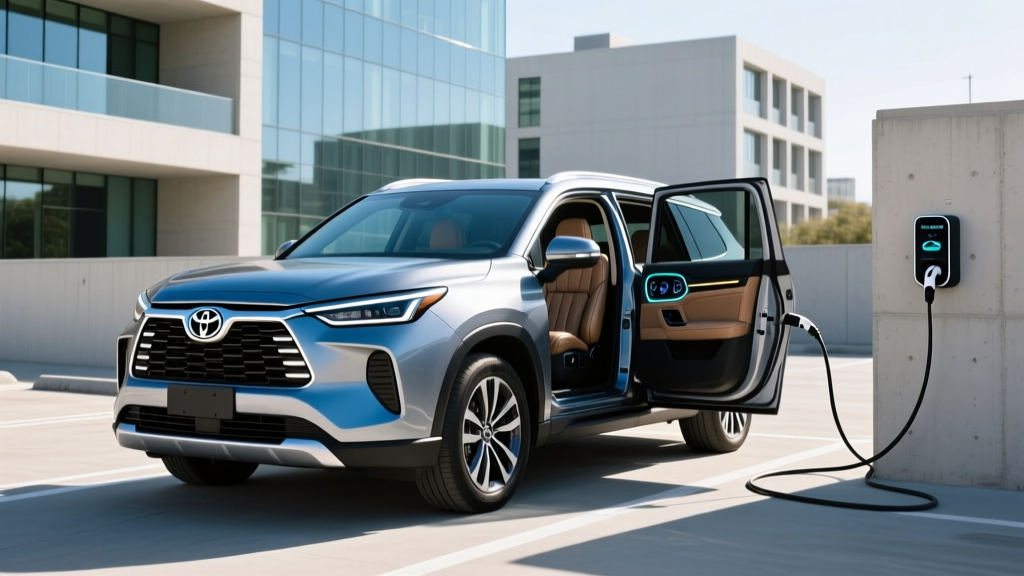
The three-row SUV segment is crowded, but the 2026 Toyota Grand Highlander Hybrid MAX Limited occupies a specific niche: buyers who need three usable rows and cargo space, want the torque and passing confidence of a performance hybrid, and refuse to plug in. The Hybrid MAX powertrain pairs a turbocharged 2.4-liter four-cylinder with electric motors for 362 horsepower — making it the most powerful Grand Highlander variant — while still delivering an EPA-estimated 27 MPG combined.
This guide breaks down everything you need to know before configuring one: real-world fuel economy expectations, how the Hybrid MAX differs from the standard Grand Highlander Hybrid, warranty coverage on that hybrid battery, and whether any tax incentives apply. If you're cross-shopping this against a plug-in hybrid or a full battery-electric SUV, we'll address that decision framework too.
HEV vs PHEV: Where the Grand Highlander Hybrid MAX Fits
Let's clear up a common point of confusion before discussing specs. The Grand Highlander Hybrid MAX is a conventional hybrid electric vehicle (HEV). It does not have a plug, it does not offer electric-only driving range, and you fuel it exclusively at a gas station. The small hybrid battery recharges through regenerative braking and the gasoline engine.
| Attribute | HEV (This Vehicle) | PHEV | BEV (Full EV) |
|---|---|---|---|
| Plug-in charging? | No | Yes | Yes |
| Electric-only range | None (EV assist only) | 20–45 mi typical | 200–400+ mi |
| Gas engine? | Yes | Yes | No |
| Home charger needed? | No | Recommended (Level 2) | Essential |
| Federal tax credit (§30D) | No | Up to $7,500 (if eligible) | Up to $7,500 (if eligible) |
| Best for | No plug access, long trips | Short commutes + road trips | Home charging + daily driving |
Toyota does not currently offer a plug-in hybrid (PHEV) version of the Grand Highlander. If you want a Toyota PHEV with three rows, the closest option is the RAV4 Prime — but it only seats five. For buyers who need three rows and want plug-in capability, competitors like the Jeep Grand Cherokee 4xe or the Mazda CX-90 PHEV are the alternatives to cross-shop.
Powertrain Specs: Turbo Hybrid MAX Performance
The Hybrid MAX powertrain is Toyota's performance-oriented hybrid system, distinct from the standard 2.5-liter naturally aspirated hybrid found in the base Grand Highlander Hybrid. Here's the full spec breakdown:
| Engine | 2.4L turbocharged 4-cylinder + electric motors |
| Combined Horsepower | 362 hp |
| Combined Torque | 400 lb-ft |
| Transmission | 6-speed automatic (Direct Shift) |
| Drivetrain | AWD (standard on Hybrid MAX) |
| 0–60 mph | ~6.3 seconds (est.) |
| Towing Capacity | 5,000 lbs |
| Hybrid Battery | ~1.8 kWh (nickel-metal hydride, sealed) |
| Seating | 7 passengers (standard) / 8 (bench option on some trims) |
| Cargo (behind 3rd row) | ~20.6 cu ft |
| Cargo (max, seats folded) | ~97.5 cu ft |
| Base MSRP (Hybrid MAX Limited) | ~$55,170 |
The 362-hp output and 400 lb-ft of torque give the Hybrid MAX Limited genuine passing authority on two-lane highways and confident merging even when fully loaded with passengers and cargo. The 6-speed automatic replaces the eCVT found in the standard hybrid, which means more traditional shift behavior and a sportier driving feel — at the cost of a slight efficiency penalty.
The 5,000-pound towing capacity is a meaningful advantage over the standard Grand Highlander Hybrid (which tows up to 3,500 lbs) and most unibody three-row crossovers in this class. If you're pulling a small boat or a lightweight camper, the Hybrid MAX is the Grand Highlander variant to choose.
Fuel Economy: EPA Ratings and Real-World MPG
According to fueleconomy.gov, the 2026 Toyota Grand Highlander Hybrid MAX achieves the following EPA-estimated ratings:
| Driving Cycle | EPA Estimate |
|---|---|
| City | 26 MPG |
| Highway | 27 MPG |
| Combined | 27 MPG |
Real-world expectations: In mixed suburban driving with moderate stop-and-go traffic, owners of the Hybrid MAX powertrain (shared with the Crown and Highlander Hybrid MAX in prior years) frequently report matching or slightly exceeding the EPA combined figure — landing in the 26–29 MPG range. Hybrids tend to outperform their EPA city ratings in genuine low-speed, stop-heavy conditions because regenerative braking recaptures energy that a gas-only vehicle wastes as heat.
On sustained highway trips at 75+ mph, expect the number to dip to roughly 24–25 MPG. The turbo engine is working harder at high speeds, and the hybrid system's regenerative advantage diminishes when you're maintaining a constant velocity. Cold-weather driving (below 30°F) typically reduces fuel economy by 5–10% in any hybrid, as the engine runs more frequently to provide cabin heat and maintain battery temperature.
For comparison, the standard (non-MAX) Grand Highlander Hybrid achieves an EPA-estimated 34 MPG combined — a significant 7 MPG advantage. That model sacrifices 122 horsepower and 1,500 lbs of towing capacity to get there. The decision comes down to whether you prioritize performance/towing or maximum fuel savings.
Hybrid Battery Warranty, Lifespan, and Replacement Cost
Hybrid battery longevity is consistently the top concern among first-time hybrid buyers. Here's what Toyota provides:
Toyota Hybrid Battery Coverage
- Warranty: 10 years / 150,000 miles (whichever comes first), applicable in all 50 states
- Hybrid System Components: 8 years / 100,000 miles (inverter, control module, etc.)
- Battery Chemistry: Nickel-metal hydride (NiMH) — proven, mature technology with extensive Toyota field data
Toyota's hybrid batteries have an exceptional track record for longevity. The Prius — Toyota's hybrid benchmark — routinely sees original batteries lasting 150,000–200,000+ miles before meaningful degradation. The Grand Highlander's hybrid battery is relatively small (~1.8 kWh usable) and is managed conservatively by the hybrid control system, which never allows it to fully charge or fully discharge. This shallow-cycling strategy dramatically extends cell life.
If replacement is needed out of warranty: A new OEM hybrid battery pack for a Toyota hybrid of this size typically runs between $2,000 and $4,000 including labor. Third-party refurbished packs are available for $1,000–$2,500. This is a fraction of the cost of replacing a large BEV traction battery ($10,000–$20,000+), because the hybrid battery is small and the NiMH chemistry is inexpensive relative to lithium-ion.
For peace of mind, Toyota's 10-year/150,000-mile warranty covers the vast majority of ownership periods. According to Toyota's official warranty documentation, coverage transfers automatically to subsequent owners if the vehicle is sold within the warranty window.
Pricing, Trims, and Tax Credit Eligibility
The 2026 Toyota Grand Highlander Hybrid MAX is available in two trims: Limited and Platinum. Here's the pricing structure:
| Trim | MSRP (est.) | Key Additions |
|---|---|---|
| Hybrid MAX Limited | ~$55,170 | Leather-trimmed seats, 12.3" touchscreen, panoramic roof, heated/ventilated front seats, 360° camera |
| Hybrid MAX Platinum | ~$59,470 | Head-up display, premium JBL audio, captain's chairs (7-seat), quilted leather, digital rearview mirror |
Federal tax credit eligibility: The Grand Highlander Hybrid MAX does not qualify for the federal §30D Clean Vehicle Credit. Under current IRS rules, the §30D credit is available only for plug-in electric vehicles (PHEVs and BEVs) with sufficient battery capacity. Conventional hybrids like this one are excluded regardless of price or efficiency.
Some states offer their own incentives for high-efficiency hybrids, but these are increasingly rare as state programs shift focus to plug-in vehicles. Check your state's energy office or department of environmental quality for any local rebates — but do not count on one.
Who Should Choose the Grand Highlander Hybrid MAX Limited?
Decision Framework: Is This the Right Three-Row SUV for You?
Choose the Grand Highlander Hybrid MAX Limited if:
- You need a genuine third row for children or occasional adults, plus usable cargo space behind it
- You want 362 hp and 5,000-lb towing without stepping up to a body-on-frame SUV
- You cannot charge at home (apartment, street parking, no garage) and don't want plug-in dependency
- You take frequent long road trips where EV charging infrastructure adds unwanted time
- You value Toyota's long-term reliability reputation and plan to keep the vehicle 8+ years
Consider a PHEV or BEV instead if:
- You have home charging and a short commute — a PHEV like the CX-90 PHEV can do daily miles on electricity
- Fuel cost savings are your top priority — the standard Grand Highlander Hybrid (34 MPG combined) saves ~$400/year more in fuel
- You want to access HOV lanes or qualify for the $7,500 federal tax credit (requires a plug-in vehicle)
- You rarely use the third row and can downsize to a RAV4 Prime or similar PHEV
Pros
- 362 hp / 400 lb-ft — genuinely quick for a three-row family hauler
- 5,000-lb towing capacity exceeds most unibody competitors
- No plug required — fuel at any gas station, no range anxiety
- Toyota's 10-year/150,000-mile hybrid battery warranty
- Usable third-row space with 20.6 cu ft cargo behind it
- AWD standard — competent in rain and light snow
Cons
- 27 MPG combined trails the standard hybrid by 7 MPG
- No federal tax credit eligibility
- ~$55K starting price is steep for the Limited trim
- Turbo 4-cylinder lacks the smoothness of a V6 at idle
- No PHEV option available in the Grand Highlander lineup
- Infotainment learning curve for first-time Toyota users
Reliability Outlook and Safety
Toyota's Hybrid MAX system debuted in the Crown and has since expanded to the Highlander and Grand Highlander lineups. While long-term, high-mileage data specific to the Grand Highlander is still accumulating (the model launched for 2024), the underlying components — Toyota's turbocharged Dynamic Force engine family, the hybrid transaxle, and the NiMH battery management — are well-proven across millions of Toyota hybrid vehicles globally.
The NHTSA and IIHS are the authoritative sources for crash-test ratings. Toyota Safety Sense 3.0 (TSS 3.0) comes standard on all Grand Highlander trims and includes pre-collision braking with pedestrian detection, full-speed adaptive cruise control, lane tracing assist, automatic high beams, and road sign assist. Note that these are SAE Level 2 driver-assistance features — the driver must remain fully engaged with hands on the wheel and eyes on the road at all times.
Frequently Asked Questions
How many MPG does the Grand Highlander Hybrid MAX Limited get?
The EPA rates it at 26 city / 27 highway / 27 combined MPG. In real-world mixed suburban driving, expect 26–29 MPG. Sustained highway driving at 75+ mph typically yields 24–25 MPG. Cold weather reduces these figures by roughly 5–10%.
Does the Grand Highlander Hybrid MAX need to be plugged in?
No. It is a conventional hybrid (HEV), not a plug-in hybrid (PHEV). The battery recharges through regenerative braking and the gasoline engine. You fuel it at a gas station like any other vehicle.
How far can it go on electric-only power?
It cannot. The Hybrid MAX system uses its electric motors to assist the gasoline engine during acceleration and low-speed maneuvering, but it does not offer a dedicated electric-only driving mode or meaningful electric-only range. If electric-only commuting is a priority, look at a PHEV.
Does the Grand Highlander Hybrid MAX qualify for any tax credit?
No. The federal §30D Clean Vehicle Credit applies only to plug-in electric vehicles (PHEVs and BEVs). Conventional hybrids are not eligible. Some states may offer minor incentives for efficient vehicles, but these are uncommon and vary by jurisdiction — check your state's official energy or environmental agency.
Is the hybrid battery reliable, and what does replacement cost?
Toyota's hybrid batteries have an outstanding reliability record, with many lasting 150,000–200,000+ miles. The Grand Highlander's hybrid battery is covered by a 10-year/150,000-mile warranty. Out-of-warranty replacement typically costs $2,000–$4,000 for an OEM pack — far less than a full EV battery replacement.
Hybrid MAX vs standard Grand Highlander Hybrid — which should I pick?
Choose the Hybrid MAX if you need 362 hp, 5,000-lb towing, and a sportier driving feel. Choose the standard hybrid (245 hp, 34 MPG combined, 3,500-lb towing) if fuel economy is your top priority and you don't tow. The standard hybrid also starts at a lower price point.
How does it compare to a three-row EV like the Kia EV9?
The Kia EV9 offers 270–379 miles of EPA range and zero tailpipe emissions, but starts around $55K–$75K, requires home or public charging, and loses range in cold weather and at highway speeds. The Grand Highlander Hybrid MAX eliminates charging dependency and costs less to refuel on road trips, but has higher per-mile fuel costs for daily driving and no tax credit. Your charging access and trip patterns should drive this decision.