Quick Verdict: A Three-Row Hybrid That Prioritizes Space and Efficiency
The Toyota Grand Highlander Hybrid occupies a specific niche: three-row family hauling with genuine fuel economy gains over its gas-only sibling, without the range compromise of a full EV. For 2026, Toyota continues to offer two distinct hybrid powertrains — a conventional hybrid (HEV) and the performance-oriented Hybrid MAX — each with different efficiency profiles. Neither is a plug-in hybrid (PHEV); you never plug this SUV in. The Grand Highlander Hybrid's interior is where this vehicle makes its strongest case, offering adult-friendly third-row space and cargo volume that the standard Highlander Hybrid simply cannot match.
If you're researching the Grand Highlander Hybrid interior alongside its efficiency credentials, this guide covers the cabin layout, real-world fuel economy, powertrain specs, ownership costs, and whether this HEV makes more sense for your household than a PHEV or full battery-electric vehicle.
Grand Highlander Hybrid Interior: Space, Layout, and Cargo
The Grand Highlander's "Grand" designation exists for one reason: interior volume. Toyota stretched the wheelbase and overall length versus the standard Highlander, and the gains show up almost entirely behind the second row.
Seating Capacity and Configurations
The Grand Highlander Hybrid seats seven or eight depending on trim and second-row configuration. Lower trims (LE, XLE) offer an eight-seat bench layout, while Limited and Hybrid MAX trims default to seven seats with second-row captain's chairs. The captain's chairs are the more comfortable choice for long trips and still allow walk-through access to the third row.
Third-Row Usability
This is where the Grand Highlander separates itself from the standard Highlander Hybrid and most midsize three-row competitors. The third row accommodates adults up to roughly 6'0" for trips under an hour without knee-against-seatback discomfort. Third-row headroom measures 37.2 inches, and legroom reaches 33.5 inches — numbers that rival body-on-frame SUVs in a unibody package.
Cargo Volume Behind Each Row
| Area | Cargo Volume (cu ft) |
|---|---|
| Behind third row | 20.6 |
| Behind second row (third row folded) | 57.9 |
| Behind first row (all rear rows folded) | 97.5 |
That 20.6 cubic feet behind the third row is substantial — enough for a full grocery run or multiple carry-on bags with all seats occupied. The standard Highlander Hybrid offers only about 16.1 cu ft in the same measurement, which is the practical reason many families step up to the Grand.
Materials, Tech, and Comfort
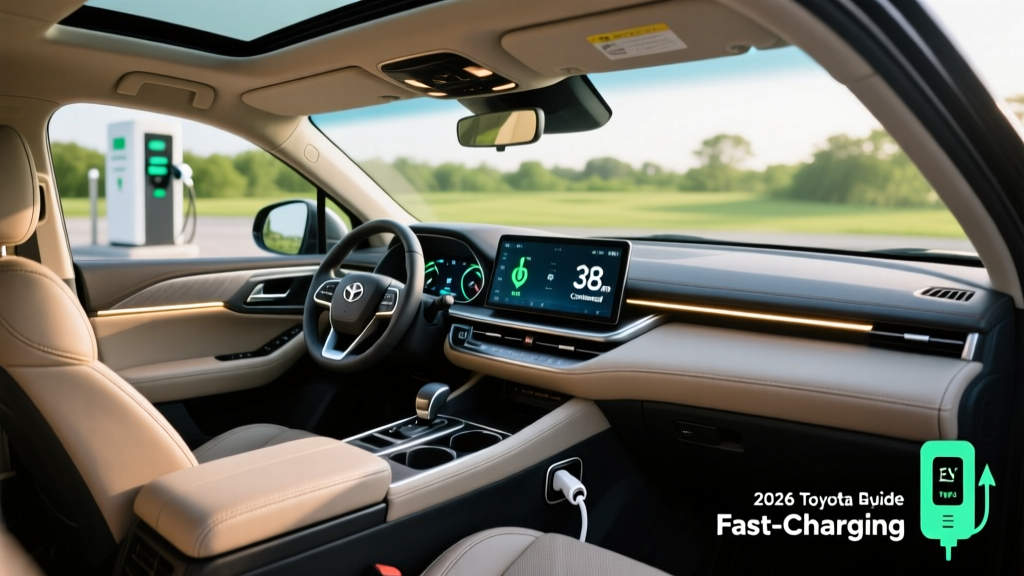
Lower trims use Toyota's SofTex synthetic leather, which holds up well to child seats and spills. Limited and Hybrid MAX trims upgrade to genuine leather. The infotainment system runs Toyota's latest Audio Multimedia interface on a 12.3-inch touchscreen (8-inch on LE), with wireless Apple CarPlay and Android Auto standard across all trims. A 12.3-inch digital driver display is standard on XLE and above. Physical knobs for climate and volume remain — a practical choice that drivers appreciate over fully touchscreen-dependent competitors.
HEV vs. PHEV: What the Grand Highlander Hybrid Is (and Isn't)
Key Distinction: This Is a Conventional Hybrid (HEV)
The Grand Highlander Hybrid is a self-charging hybrid. It uses regenerative braking and its gasoline engine to charge a small battery pack. You never plug it in. It cannot drive on electric-only power for meaningful distances. If you want plug-in electric-only range, you need a PHEV like the Toyota RAV4 Prime or a full BEV like the Kia EV9.
Understanding this distinction matters because buyers often conflate "hybrid" with "plug-in." Here's how the Grand Highlander Hybrid compares to the alternatives:
| Feature | Grand Highlander Hybrid (HEV) | Typical PHEV (e.g., RAV4 Prime) | Full EV (e.g., Kia EV9) |
|---|---|---|---|
| Plug-in required? | No | Yes (Level 1/2) | Yes (Level 2 / DC fast) |
| Electric-only range | ~1 mile (low-speed) | 30-42 miles | 240-300+ miles |
| Total range | ~530-620 miles | ~440-520 miles (gas+electric) | 240-300+ miles |
| Battery size | ~1.6 kWh (NiMH) | ~18.1 kWh (Li-ion) | 77-100 kWh (Li-ion) |
| Federal tax credit | Not eligible | Up to $7,500 (§30D) | Up to $7,500 (§30D) |
| Home charging install | Not needed | Recommended (Level 2) | Essential (Level 2) |
The Grand Highlander Hybrid's advantage is simplicity: no charging infrastructure needed, no range planning, and a lower purchase price than equivalent PHEVs or three-row BEVs. Its tradeoff is that it never runs on grid electricity, so your per-mile fuel cost stays higher than any plug-in option.
Powertrain, Horsepower, and Driving Impressions
Toyota offers two hybrid powertrains in the Grand Highlander for 2026:
| Spec | Hybrid (Standard) | Hybrid MAX |
|---|---|---|
| Engine | 2.5L 4-cylinder + 2 electric motors | 2.4L turbo 4-cylinder + electric motor |
| Combined horsepower | 245 hp | 362 hp |
| Combined torque | 173 lb-ft (engine) + motor torque | 400 lb-ft combined |
| Drivetrain | AWD (electronic rear motor) | AWD (Direct) |
| 0-60 mph | ~7.6 seconds | ~6.0 seconds |
| Towing capacity | 3,500 lbs | 5,000 lbs |
| Transmission | eCVT | 6-speed automatic |
The standard Hybrid powertrain prioritizes smoothness and efficiency. Acceleration is adequate for merging and passing, and the eCVT keeps the engine in its optimal RPM range. The Hybrid MAX trades some efficiency for genuine passing punch and a more traditional transmission feel — the 6-speed automatic avoids the drone that some drivers associate with CVTs under hard acceleration.
Both powertrains use Toyota's electronic on-demand AWD, where an independent rear electric motor engages the rear axle only when traction is needed. This is not a mechanical AWD system with a driveshaft; it's lighter and more efficient, but it won't match the low-traction capability of a body-on-frame SUV with a locking rear differential.
Fuel Economy: EPA Ratings and Real-World MPG
| Powertrain | EPA City | EPA Highway | EPA Combined |
|---|---|---|---|
| Hybrid (AWD) | 36 MPG | 32 MPG | 34 MPG |
| Hybrid MAX (AWD) | 26 MPG | 27 MPG | 27 MPG |
Source: fueleconomy.gov
Real-World MPG vs. EPA Estimates
The standard Hybrid's 34 MPG combined is the number that matters for most buyers, and real-world results often align closely — or even exceed the EPA city figure. Toyota's hybrid system excels in stop-and-go traffic where regenerative braking recaptures energy continuously. In mixed suburban driving with moderate speeds, owners commonly report 33-37 MPG. Highway cruising at 75+ MPH tends to yield 29-31 MPG, slightly below the EPA highway rating, because aerodynamic drag hits a large SUV harder at sustained speed.
The Hybrid MAX's 27 MPG combined is the cost of its 362 hp and 5,000-lb tow rating. In real-world mixed driving, expect 24-28 MPG. If fuel economy is your primary motivation for choosing a hybrid over the gas-only Grand Highlander (which rates 24 MPG combined with the turbo four), the Hybrid MAX's advantage shrinks considerably. The standard Hybrid is the efficiency play; the Hybrid MAX is the performance-and-towing play that still beats the gas model.
Cost-Per-Mile Comparison
At $3.50/gallon regular unleaded and 34 MPG combined, the standard Hybrid costs approximately $0.103 per mile in fuel. The gas-only Grand Highlander (2.4L turbo, 24 MPG combined) costs roughly $0.146 per mile. Over 15,000 annual miles, that's a $645 annual fuel savings with the Hybrid. The Hybrid MAX at 27 MPG costs about $0.130/mile, saving roughly $240/year versus the gas model.
Pricing, Trims, and Tax Credit Eligibility
| Trim | Powertrain | MSRP (2026 est.) |
|---|---|---|
| LE | Hybrid | $43,120 |
| XLE | Hybrid | $46,025 |
| Limited | Hybrid | $51,555 |
| Limited | Hybrid MAX | $54,205 |
| Platinum | Hybrid MAX | $58,775 |
Federal Tax Credit: Not Eligible
The Grand Highlander Hybrid does not qualify for the federal §30D clean vehicle tax credit. That credit applies only to plug-in electric vehicles (BEVs and PHEVs) with sufficient battery capacity and compliant battery sourcing. Conventional hybrids like this one are excluded under current IRS rules.
Some states offer separate hybrid incentives or HOV lane access for hybrids, but these vary widely by jurisdiction. Check your state's DMV or energy office for current programs. Do not assume state incentives mirror federal eligibility.
Battery Warranty, Reliability, and Replacement Cost
Hybrid Battery Warranty
Toyota covers the Grand Highlander Hybrid's battery pack for 10 years or 150,000 miles (whichever comes first), transferable to subsequent owners. This warranty covers capacity loss below a defined threshold and manufacturing defects. The hybrid system components (inverter, electric motors, control modules) carry the same 10-year/150,000-mile coverage.
Long-Term Reliability Track Record
Toyota's hybrid system is among the most proven electrified powertrains on the road. The Prius has accumulated billions of real-world miles since 2000, and the core architecture — planetary gearset eCVT, nickel-metal hydride or lithium-ion battery, permanent magnet motors — has been iteratively refined rather than radically redesigned. The Grand Highlander uses a newer-generation hybrid system, but the fundamental components have deep reliability histories.
The hybrid battery in this vehicle is relatively small (~1.6 kWh) and operates within a narrow state-of-charge window (roughly 40-80% SoC), which significantly reduces degradation stress compared to a full EV battery cycling between 10-90% daily. Most Toyota hybrid batteries outlast the 10-year warranty period without requiring replacement.
Battery Replacement Cost
If replacement is needed outside warranty, a Toyota hybrid battery pack typically costs $2,000-$4,000 for the part, with labor adding $500-$1,000 depending on the service center. Refurbished or aftermarket hybrid batteries are available for $1,000-$2,000. This is dramatically less than a full EV battery replacement ($10,000-$20,000+) because the hybrid battery is far smaller. For context, a single module replacement (rather than the full pack) can sometimes resolve issues for under $500.
Grand Highlander Hybrid vs. Alternatives: Which Fits You?
Choose the Grand Highlander Hybrid if:
- You need three rows with adult-usable third-row space
- You don't have access to home charging (no garage, apartment living)
- You want lower fuel costs without any behavioral change (no plugging in)
- You tow up to 5,000 lbs (Hybrid MAX)
- You prioritize proven reliability over cutting-edge tech
Look at a PHEV or BEV instead if:
- You have home Level 2 charging and want to run on electricity daily
- Your commute is under 40 miles round-trip (a PHEV covers it on electric)
- You want to claim the $7,500 federal tax credit
- You're willing to plan charging stops on road trips (BEV)
- You want the lowest possible per-mile energy cost
The Grand Highlander Hybrid makes the most sense for families who need maximum interior space, drive 12,000-20,000 miles per year in mixed conditions, and lack reliable access to plug-in charging. It's a bridge technology that requires zero infrastructure investment while delivering meaningful fuel savings over a gas-only equivalent. If you do have home charging and a predictable commute, a PHEV like the Chrysler Pacifica Hybrid (minivan) or a three-row BEV like the Kia EV9 will deliver lower operating costs — but at higher purchase prices and with charging logistics to manage.
Pros and Cons at a Glance
Pros
- 34 MPG combined in a three-row SUV with adult-usable third row
- No charging infrastructure required
- 97.5 cu ft maximum cargo volume
- 10-year/150,000-mile hybrid battery warranty
- Strong Toyota reliability and resale value history
- Hybrid MAX offers 362 hp and 5,000-lb towing
Cons
- No federal tax credit eligibility
- Hybrid MAX fuel economy (27 MPG) only marginally better than gas model
- No plug-in variant available — can't run daily commutes on electric
- eCVT drone under hard acceleration (standard Hybrid)
- Higher MSRP than gas-only Grand Highlander ($2,000-$4,000 premium)
- Electronic AWD less capable off-road than mechanical systems
Frequently Asked Questions
How many MPG does the Grand Highlander Hybrid get?
The standard Hybrid AWD achieves an EPA-estimated 36 city / 32 highway / 34 combined MPG. The Hybrid MAX AWD rates 26 city / 27 highway / 27 combined. Real-world results for the standard Hybrid typically fall between 31-37 MPG depending on driving mix, with city-heavy driving yielding the best numbers thanks to regenerative braking.
Does the Grand Highlander Hybrid have a plug-in (PHEV) version?
No. As of the 2026 model year, Toyota does not offer a Grand Highlander Plug-in Hybrid. The vehicle is available only as a conventional hybrid (HEV) in two powertrain configurations. If Toyota introduces a PHEV variant in future model years, it would offer 30-40 miles of electric-only range and qualify for federal tax credits — but that option does not exist today.
Is the Grand Highlander Hybrid reliable, and what does battery replacement cost?
Toyota's hybrid system has one of the strongest long-term reliability records in the industry, with the core architecture proven over 25+ years and billions of miles across the Toyota/Lexus lineup. The hybrid battery is covered for 10 years/150,000 miles. Out-of-warranty replacement typically runs $2,500-$5,000 including labor — far less than an EV battery because the pack is small (~1.6 kWh).
Does the Grand Highlander Hybrid qualify for any tax credit?
No. The federal §30D clean vehicle credit applies only to plug-in vehicles (BEVs and PHEVs) meeting battery sourcing, MSRP, and buyer income requirements. Conventional hybrids are excluded. Check your state's energy or DMV website for any state-level hybrid incentives, which vary by jurisdiction.
How does the Grand Highlander Hybrid interior compare to the standard Highlander Hybrid?
The Grand Highlander adds roughly 6.5 inches of overall length, translating to significantly more third-row legroom (33.5" vs. ~27.7") and cargo space behind the third row (20.6 cu ft vs. ~16.1 cu ft). If third-row passengers or cargo-with-all-seats-up are regular needs, the Grand Highlander's interior advantage is substantial. The dashboard, infotainment, and second-row layouts are largely shared between the two.
Hybrid vs. PHEV vs. EV — which three-row SUV fits my family?
Choose the Grand Highlander Hybrid if you lack home charging access and want maximum simplicity. Choose a PHEV three-row SUV (limited options currently — the Chrysler Pacifica Hybrid minivan is the closest equivalent) if you have home charging and a short commute. Choose a three-row BEV (Kia EV9, Tesla Model X, Rivian R1S) if you have reliable home charging, want the lowest per-mile cost, and are comfortable planning DC fast-charging stops on road trips. Each step toward full electrification lowers operating cost but increases upfront price and charging logistics.