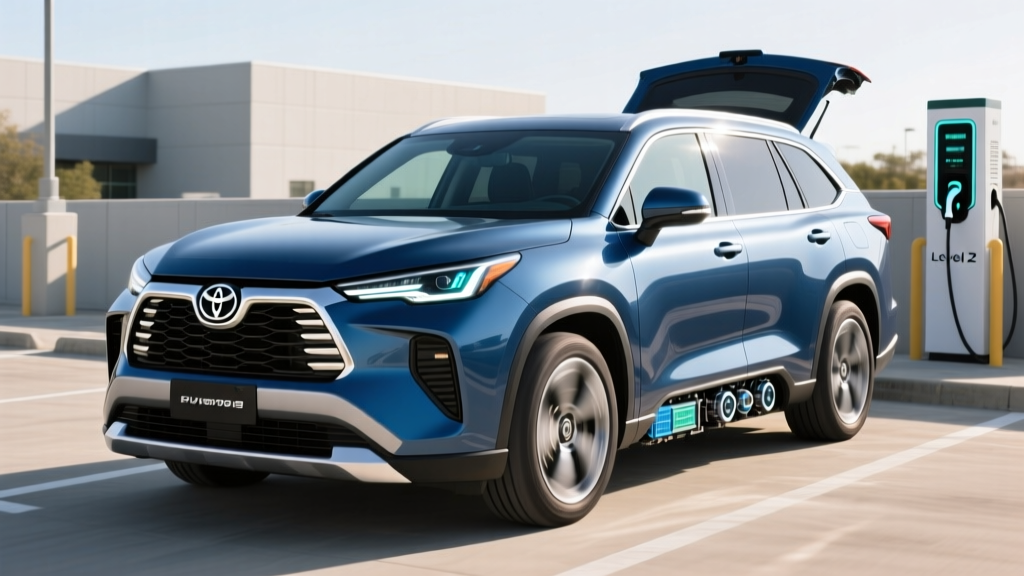
Toyota Grand Highlander Hybrid Horsepower: Two Powertrains, Big Differences
When shoppers search for Grand Highlander hybrid horsepower, they usually don't realize Toyota offers two completely different hybrid systems under this nameplate. For the 2026 model year, the Grand Highlander Hybrid comes in two distinct flavors: the standard Hybrid powertrain producing 245 horsepower, and the performance-oriented Hybrid MAX generating a stout 362 horsepower. Both are conventional self-charging hybrids (HEVs), not plug-ins — meaning you never need to plug them in. They regenerate energy through braking and use a gasoline engine paired with electric motors to boost efficiency.
Understanding which system fits your needs — and what real-world fuel economy to expect — is critical before signing a purchase agreement. This guide breaks down every powertrain number, EPA figure, and ownership cost you need.
HEV vs. PHEV: Where the Grand Highlander Fits
Conventional Hybrid (HEV): The Grand Highlander Hybrid is a traditional HEV. It uses a small battery (roughly 1.6 kWh) that recharges via regenerative braking and the gasoline engine. No plug required. You simply fill it with gas and drive.
Plug-in Hybrid (PHEV): A PHEV like the Toyota RAV4 Prime or Chrysler Pacifica Hybrid has a larger battery (typically 12–18 kWh) that you plug in to charge, delivering 30–45 miles of pure electric driving before the gas engine kicks in. Toyota does not currently offer the Grand Highlander as a PHEV.
Full EV (BEV): A battery-electric vehicle like the Tesla Model X or Kia EV9 has no gas engine at all, relying entirely on a large battery pack (80–110+ kWh) and electric motors.
If you want electric-only commuting without range anxiety on road trips, a PHEV is ideal — but you'll need to look at smaller crossovers or minivans. If you want three-row SUV space with zero lifestyle change from your gas car, the Grand Highlander HEV is one of the most efficient options available.
Grand Highlander Hybrid Powertrain Specs
| Specification | Hybrid (Standard) | Hybrid MAX |
|---|---|---|
| Combined Horsepower | 245 hp | 362 hp |
| Combined Torque | 175 lb-ft (engine) / motor adds low-end torque | 400 lb-ft |
| Gas Engine | 2.5L 4-cylinder | 2.4L turbocharged 4-cylinder |
| Electric Motors | Front + rear (eAWD) | Front + rear (eAWD) |
| Transmission | eCVT (planetary gearset) | 6-speed direct-shift automatic |
| Drivetrain | AWD (electronic on-demand rear) | AWD (torque-vectoring rear) |
| 0–60 mph (est.) | ~7.8 seconds | ~6.3 seconds |
| Towing Capacity | 3,500 lbs | 5,000 lbs |
| Battery Type | Nickel-Metal Hydride / Lithium-ion (~1.6 kWh) | Lithium-ion (~1.6 kWh) |
The standard Hybrid uses Toyota's proven planetary eCVT — there are no traditional gears or belts to wear out. The Hybrid MAX swaps this for a conventional 6-speed automatic, giving it a more familiar driving feel with stepped shifts and stronger acceleration. Both systems route power to all four wheels, but the MAX variant provides more aggressive rear-axle torque distribution for better cornering and towing stability.
EPA Fuel Economy: Grand Highlander Hybrid MPG
| Powertrain | City MPG | Highway MPG | Combined MPG |
|---|---|---|---|
| Hybrid (eCVT, AWD) | 36 | 32 | 34 |
| Hybrid MAX (6AT, AWD) | 27 | 28 | 27 |
Source: EPA Fuel Economy (fueleconomy.gov)
The standard Hybrid's 34 MPG combined is exceptional for a three-row SUV weighing over 4,600 pounds. For comparison, the non-hybrid Grand Highlander gas model achieves just 24 MPG combined. That's a 10 MPG improvement — translating to roughly $500–$700 in annual fuel savings for an average driver covering 15,000 miles per year at $3.40/gallon.
Real-World MPG vs. EPA Estimates
Toyota's hybrid system excels in stop-and-go city traffic where regenerative braking constantly recharges the battery. In real-world testing, owners frequently report 35–38 MPG in city driving, sometimes exceeding the EPA city figure. Highway driving is a different story: at sustained 75+ MPH speeds, aerodynamic drag dominates and the engine does most of the work. Expect 29–31 MPG on the highway, slightly below the EPA sticker.
Cold weather also impacts hybrid efficiency. In sub-freezing temperatures, the engine runs more often to provide cabin heat (since there's no large EV battery to draw from), reducing city MPG by roughly 10–15%. A block heater and heated seats help mitigate this in northern climates.
The Hybrid MAX, tuned for performance, delivers its best numbers on the highway where the turbo engine operates in its efficient range. City driving sees the heaviest penalty since the sportier tuning prioritizes throttle response over fuel sipping. Expect 24–26 MPG city, 27–29 MPG highway in mixed real-world use.
Pricing, Trims, and Tax Credit Eligibility
The 2026 Grand Highlander Hybrid starts at approximately $42,800 MSRP for the base XLE Hybrid trim and climbs to around $55,000+ for a fully loaded Hybrid MAX Platinum. Here's a general breakdown:
- XLE Hybrid (AWD): ~$42,800
- Limited Hybrid (AWD): ~$47,500
- XLE Hybrid MAX (AWD): ~$46,200
- Limited Hybrid MAX (AWD): ~$51,000
- Platinum Hybrid MAX (AWD): ~$55,000
Does the Grand Highlander Hybrid Qualify for a Federal Tax Credit?
No. Under current IRS §30D Clean Vehicle Credit rules, only plug-in electric vehicles (PHEVs and BEVs) with sufficient battery capacity qualify for the federal tax credit of up to $7,500. Conventional hybrids like the Grand Highlander Hybrid do not have the minimum 7 kWh battery capacity or plug-in capability required.
Some states offer their own hybrid incentives — check your state energy office or department of environmental quality for local programs. However, most state incentive budgets have shifted toward full EVs and PHEVs.
Hybrid Battery Warranty & Longevity
Toyota covers the Grand Highlander Hybrid battery with a 10-year / 150,000-mile warranty (whichever comes first), in compliance with California Air Resources Board (CARB) standards that Toyota applies nationwide. This covers defects and capacity loss below a specified threshold.
Real-world lifespan: Toyota's hybrid battery packs — particularly the nickel-metal hydride units used in the standard Hybrid — have a proven track record lasting 200,000–300,000+ miles before significant degradation. The Highlander Hybrid has been on the road since 2006 (two generations), and large-scale fleet data shows battery replacement is rare before 150,000 miles.
Replacement cost (out of warranty): If a hybrid battery does fail outside the warranty window, expect $3,000–$5,000 for a replacement pack plus labor at a dealership. Independent hybrid specialists and refurbished packs can reduce this to $1,500–$2,500.
Grand Highlander Hybrid vs. the Competition
At 245 hp, the standard Grand Highlander Hybrid isn't the most powerful three-row hybrid, but it delivers the best fuel economy in its class. The Hybrid MAX's 362 hp puts it in performance territory that rivals the Mazda CX-90 PHEV (323 hp) while avoiding plug-in complexity. Here's how it stacks up:
| Vehicle | Horsepower | Combined MPG | Base MSRP | Type |
|---|---|---|---|---|
| Toyota Grand Highlander Hybrid | 245 hp | 34 MPG | $42,800 | HEV |
| Toyota Grand Highlander Hybrid MAX | 362 hp | 27 MPG | $46,200 | HEV |
| Kia Sorento Hybrid | 261 hp | 34 MPG | $39,090 | HEV |
| Mazda CX-90 PHEV | 323 hp | 56 MPGe / 25 MPG gas | $50,675 | PHEV |
| Honda Pilot (gas) | 285 hp | 22 MPG | $38,485 | Gas |
The Kia Sorento Hybrid matches the Grand Highlander's MPG at a lower price but offers noticeably less cargo and third-row space. The Mazda CX-90 PHEV delivers electric-only driving (26 miles EPA) and qualifies for a partial federal credit, but starts significantly higher. If you need maximum interior volume with hybrid efficiency, the Grand Highlander Hybrid has no direct equal.
Who Should Choose the Grand Highlander Hybrid?
Choose the Grand Highlander Hybrid If:
- You need genuine three-row space (adults fit in the third row) with hybrid efficiency
- You don't have access to home or workplace charging (no plug needed)
- You want Toyota's proven hybrid reliability with a 10-year battery warranty
- You prioritize low fuel cost over maximum acceleration
- You tow up to 3,500 lbs (standard) or 5,000 lbs (MAX)
- You want a simple ownership experience — gas up and go
Look Elsewhere If:
- You want electric-only commuting — consider a PHEV like the Mazda CX-90 or Chrysler Pacifica
- You want full EV operation — the Kia EV9 or Tesla Model X offers three rows with zero gas
- You need the $7,500 federal tax credit — only PHEVs and BEVs qualify under current IRS rules
- You prioritize sporty handling over efficiency — the Hybrid MAX is quick but still a large crossover
- You want the lowest possible purchase price — the gas-only Grand Highlander starts ~$3,000 less
Decision Framework: HEV vs. PHEV vs. EV
Choose the Grand Highlander Hybrid (HEV) if you want three-row SUV practicality, excellent fuel economy, zero charging hassle, and the lowest total cost of ownership without changing your refueling habits.
Choose a PHEV (e.g., CX-90 PHEV) if you have home charging, commute under 30 miles, want to drive on electricity most days, and still need gas flexibility for road trips.
Choose a full EV (e.g., Kia EV9) if you have reliable home Level 2 charging, your daily driving is under 250 miles, you want the lowest per-mile energy cost, and you're ready to plan around DC fast charging on road trips.
Frequently Asked Questions
How many MPG does the Grand Highlander Hybrid get?
The standard Grand Highlander Hybrid (eCVT, AWD) is EPA-rated at 36 city / 32 highway / 34 combined MPG. The Hybrid MAX is rated at 27 city / 28 highway / 27 combined MPG. Real-world city driving often exceeds EPA estimates by 1–4 MPG in the standard Hybrid due to regenerative braking efficiency.
How much horsepower does the Grand Highlander Hybrid have?
The standard Grand Highlander Hybrid produces 245 combined horsepower from its 2.5L four-cylinder engine and dual electric motors. The Hybrid MAX variant produces 362 combined horsepower using a 2.4L turbocharged engine paired with electric motors and a 6-speed automatic transmission.
Does the Grand Highlander Hybrid need to be plugged in?
No. The Grand Highlander Hybrid is a conventional self-charging hybrid (HEV). It charges its small battery pack through regenerative braking and the gasoline engine. You never plug it in — just fill up with gas as you would with any conventional vehicle.
Is the Grand Highlander Hybrid reliable?
Toyota's hybrid system is one of the most proven in the industry, with over 25 years of continuous refinement since the original Prius. The hybrid battery carries a 10-year/150,000-mile warranty, and fleet data shows these packs routinely last 200,000+ miles. The IIHS awarded the Grand Highlander strong safety scores, further supporting its family-SUV credentials.
What does it cost to replace the Grand Highlander Hybrid battery?
Out of warranty, expect $3,000–$5,000 at a dealership for a new hybrid battery pack with installation. Refurbished or aftermarket packs from independent hybrid specialists typically cost $1,500–$2,500 installed. However, battery replacement before 200,000 miles is uncommon based on historical Toyota hybrid data.
Does the Grand Highlander Hybrid qualify for any tax credits?
No federal tax credit applies. The IRS §30D Clean Vehicle Credit requires plug-in capability and a minimum 7 kWh battery — the Grand Highlander Hybrid's ~1.6 kWh pack does not qualify. Some states or utilities may offer minor hybrid incentives, but most programs have pivoted to PHEVs and BEVs.
How does the Grand Highlander Hybrid compare to a full EV?
A full EV like the Kia EV9 (379 hp, 279–310 miles EPA range) offers lower per-mile energy costs and zero tailpipe emissions but requires home charging infrastructure, costs $10,000–$15,000 more upfront, and demands DC fast-charging planning on road trips. The Grand Highlander Hybrid offers comparable interior space at a lower price with no charging dependency — making it the pragmatic choice for buyers without reliable charging access.