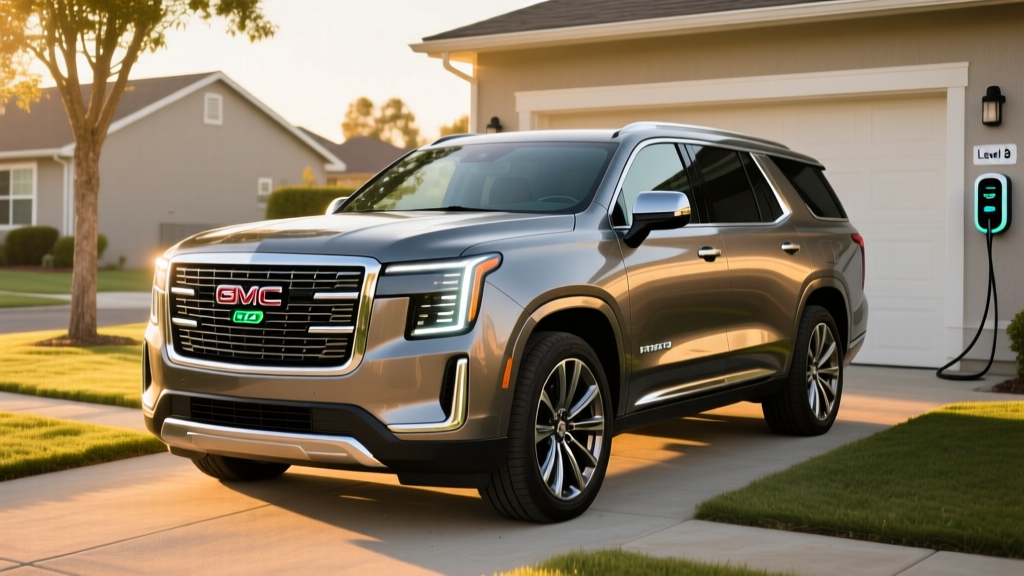
Quick Verdict: Does the GMC Yukon Denali Hybrid Exist in 2026?
If you've been searching for a GMC Yukon Denali hybrid, here's the honest answer: as of the 2026 model year, GM has not released a conventional hybrid (HEV) or plug-in hybrid (PHEV) variant of the Yukon Denali. The full-size Yukon lineup — including the premium Denali and Denali Ultimate trims — continues to offer either the 5.3L EcoTec3 V8, the 6.2L V8, or the 3.0L Duramax Turbo-Diesel inline-six. None of these powertrains incorporate a hybrid electric assist system.
That said, buyer interest in a GMC Yukon Denali hybrid remains strong, with consistent monthly search volume from shoppers hoping to pair the Denali's luxury and three-row space with better fuel economy. This guide breaks down what GM currently offers, what a hybrid Yukon would need to deliver, and which alternatives actually exist for buyers who want an electrified full-size SUV today.
What Powertrains Does the 2026 Yukon Denali Actually Offer?
Before we explore hybrid alternatives, it's worth understanding the current Yukon Denali lineup and its fuel economy baseline. This context matters because any future hybrid variant would need to show a meaningful MPG improvement over these figures.
| Powertrain | Horsepower | Torque (lb-ft) | EPA City | EPA Highway | EPA Combined |
|---|---|---|---|---|---|
| 6.2L V8 (Denali standard) | 420 hp | 460 | 14 MPG | 20 MPG | 16 MPG |
| 3.0L Duramax I6 Diesel | 277 hp | 460 | 20 MPG | 26 MPG | 22 MPG |
The 6.2L V8 delivers strong acceleration and towing capability (up to 8,100 lbs when properly equipped), but its 16 MPG combined is punishing for daily commuting. The Duramax diesel is the efficiency champion of the lineup at 22 MPG combined, and it's the closest thing to an "eco" option GMC currently provides for the Yukon Denali.
For reference, fueleconomy.gov lists the 2025 Yukon Denali 6.2L 4WD at 14/19/16 MPG city/highway/combined, which we expect to carry into 2026 with no major powertrain revisions.
Why GMC Hasn't Offered a Yukon Denali Hybrid (Yet)
GM previously offered a two-mode hybrid system on the Yukon from 2008–2013, pairing a 6.0L V8 with electric motors for a modest bump to roughly 21 MPG combined. That system was heavy, complex, and expensive — adding roughly $7,000 to the sticker price — and was discontinued as GM shifted electrification investment toward its Ultium battery platform for dedicated EVs.
The current GM strategy for full-size SUVs prioritizes:
- Diesel efficiency: The 3.0L Duramax I6 provides a 37% combined MPG improvement over the 6.2L V8 without hybrid complexity.
- Ultium EV architecture: GM's battery-electric investment targets dedicated EV platforms rather than hybridized body-on-frame vehicles.
- Platform constraints: The current T1 platform (shared with Chevy Tahoe/Suburban) was not designed with hybrid battery packaging in mind, making a retrofit costly.
GM has not officially announced a hybrid successor for the Yukon lineup as of early 2026, though industry analysts expect the next-generation T1 platform (projected for the 2028–2029 timeframe) to offer some form of hybrid electrification.
Hybrid vs PHEV vs EV: What Would a Yukon Electrified Variant Look Like?
For buyers researching the GMC Yukon Denali hybrid, it helps to understand the three electrification paths GM could take — and what each would mean for real-world driving.
Conventional Hybrid (HEV)
No plug required. A small battery (1–2 kWh) recharges via regenerative braking and the engine. Expect a 20–30% MPG improvement over the V8 — potentially 20–22 MPG combined. No electric-only range.
Plug-in Hybrid (PHEV)
Plugs in for electric driving. A larger battery (15–25 kWh) provides 25–40 miles of electric-only range before the gas engine engages. Could qualify for partial federal tax credit. Requires home charging access for maximum benefit.
Battery Electric (BEV)
No gas engine. Full Ultium-based EV with 300+ miles range. Zero tailpipe emissions, lowest running costs, but highest upfront price and charging-infrastructure dependency.
For full-size body-on-frame SUVs, a PHEV offers the most practical bridge: enough electric range for school runs and grocery trips, with the gas engine available for towing and road trips. This is the approach Toyota has taken with the Sequoia (hybrid-only) and what Jeep offers with the Grand Cherokee 4xe (PHEV).
Best Electrified Alternatives to the GMC Yukon Denali Hybrid
Since the Yukon Denali hybrid isn't available, here are the closest electrified three-row SUVs that deliver luxury, space, and improved fuel economy today.
| Model | Type | EPA Combined | EV Range (PHEV) | 0-60 mph | Starting MSRP |
|---|---|---|---|---|---|
| Toyota Sequoia TRD Pro | HEV (i-Force MAX) | 22 MPG | N/A | ~6.5 sec | $81,000 |
| Toyota Grand Highlander Hybrid | HEV (Hybrid MAX) | 27 MPG (std) / 24 MPG (MAX) | N/A | 6.0 sec (MAX) | $45,120 |
| Jeep Grand Cherokee L 4xe | PHEV (expected) | TBD | ~26 mi (est.) | TBD | TBD |
| BMW X7 xDrive50e | PHEV | 50 MPGe | 31 mi | 4.7 sec | $108,900 |
| Volvo XC90 T8 Recharge | PHEV | 55 MPGe | 35 mi | 5.0 sec | $79,050 |
Toyota Sequoia: The Closest Hybrid Competitor
The Sequoia is the only body-on-frame, three-row hybrid SUV on the market, making it the most direct substitute for what a Yukon Denali hybrid would be. Its i-Force MAX hybrid powertrain pairs a twin-turbo 3.4L V6 with a 48-hp electric motor integrated into the transmission, producing 437 hp and 583 lb-ft of torque. EPA ratings land at 19 city / 22 highway / 20 combined for 4WD models — a meaningful improvement over the Yukon's V8, though not transformative.
The Sequoia's hybrid battery is a compact 1.87 kWh nickel-metal hydride pack located between the frame rails, preserving cargo space. Toyota's hybrid battery warranty covers 10 years/150,000 miles, which addresses the top concern among hybrid buyers.
Volvo XC90 T8 Recharge: Luxury PHEV Benchmark
For buyers drawn to the Denali's premium positioning, the XC90 T8 Recharge is a strong PHEV alternative. It offers 35 miles of electric-only range from its 18.6 kWh battery, 455 combined horsepower, and genuine luxury appointments. The tradeoff: it's a unibody crossover with less cargo volume and no body-on-frame towing capability (rated at 5,000 lbs vs. the Yukon's 8,100+ lbs).
Hybrid Battery Reliability, Warranty & Replacement Costs
One of the most common concerns for hybrid shoppers is long-term battery reliability. Here's what the data shows across the industry:
- Federal mandate: All hybrid and PHEV batteries must carry a minimum 8-year/100,000-mile warranty (10 years/150,000 miles in CARB states including CA, NY, MA, and others).
- Toyota: 10 years / 150,000 miles on hybrid battery.
- BMW / Volvo: 8 years / 100,000 miles on PHEV battery, with a guaranteed minimum capacity retention of 70%.
- Replacement cost: Hybrid battery replacement typically ranges from $2,000–$4,000 (HEV) or $8,000–$15,000 (PHEV) out of warranty, depending on pack size.
Real-world data from Consumer Reports and iSeeCars indicates that modern hybrid batteries from Toyota and Honda routinely last 150,000–200,000+ miles before significant degradation. PHEV batteries face more stress due to deeper charge/discharge cycles, but larger thermal management systems (liquid cooling in BMW and Volvo) help mitigate wear.
If GM does introduce a Yukon hybrid, expect it to meet or exceed the 8-year/100,000-mile federal warranty standard, with likely coverage extending to 10 years in states that follow California Air Resources Board (CARB) emissions rules.
Federal Tax Credits: Does a Hybrid or PHEV Qualify?
Under current IRS §30D rules for 2026, here's how hybrid tax credit eligibility breaks down:
- Conventional hybrids (HEV): Do NOT qualify for the federal §30D clean vehicle credit. This credit applies only to plug-in vehicles (PHEVs and BEVs) with a minimum 7 kWh battery capacity.
- Plug-in hybrids (PHEV): May qualify for up to $7,500, but must meet all of the following requirements:
- MSRP cap: $80,000 for SUVs, vans, and pickup trucks
- Buyer income cap: $300,000 (joint), $225,000 (head of household), $150,000 (individual)
- Battery sourcing: Critical minerals and battery components must meet phased-in domestic/FHA-partner sourcing thresholds (increasing annually through 2030)
- Final assembly in North America
- Point-of-sale transfer: As of 2024, buyers can transfer the credit to the dealer at purchase, applying it as a down payment reduction rather than waiting for a tax refund.
For full details, see the IRS clean vehicle credits page. Note that eligibility rules change annually — always verify current-year requirements with a tax professional before purchasing.
Who Should Wait for a Hybrid Yukon — And Who Should Buy Now?
Buy Now If:
- You need a three-row SUV immediately and can't wait 2–3 years for a possible hybrid Yukon.
- You're satisfied with the Duramax diesel's 22 MPG combined as a compromise.
- You tow frequently — the Sequoia hybrid and Volvo XC90 PHEV both tow less than the Yukon's 8,100-lb rating.
- You prefer the Denali's specific luxury features, ride quality, and Super Cruise availability.
Wait or Choose an Alternative If:
- Fuel economy is a top priority and you drive 15,000+ miles per year in mixed city/highway conditions.
- You want PHEV capability (electric commuting + gas road trips) — look at the Volvo XC90 T8 or BMW X7 xDrive50e.
- You're open to the Sequoia hybrid and don't need the Denali badge or Super Cruise.
- You can wait for GM's next-gen full-size SUV platform (expected 2028–2029), which may include hybrid options.
Frequently Asked Questions
Does the 2026 GMC Yukon Denali come in a hybrid?
No. The 2026 GMC Yukon Denali is offered with a 6.2L V8 (420 hp, 16 MPG combined) or a 3.0L Duramax turbo-diesel I6 (277 hp, 22 MPG combined). GM has not announced a hybrid variant for the current generation.
What MPG does the GMC Yukon Denali get?
The 2026 Yukon Denali with the standard 6.2L V8 and 4WD gets an EPA-estimated 14 city / 19 highway / 16 combined MPG. The available Duramax diesel improves that to 20 city / 26 highway / 22 combined. Real-world highway driving at 75+ mph may return 1–2 MPG less than the EPA highway estimate.
Did GMC ever make a Yukon hybrid?
Yes. From 2008–2013, GMC offered a two-mode hybrid Yukon with a 6.0L V8 and dual electric motors, rated at approximately 21 MPG combined. It was discontinued due to high cost and low sales volume. No hybrid has been offered since.
What is the closest hybrid alternative to the Yukon Denali?
The Toyota Sequoia (i-Force MAX hybrid, 437 hp, ~20–22 MPG combined) is the closest body-on-frame hybrid SUV alternative. For luxury PHEV buyers, the Volvo XC90 T8 Recharge (35 miles electric-only, 455 hp) and BMW X7 xDrive50e (31 miles electric-only, 483 hp) are strong options, though both are unibody crossovers with lower towing ratings.
Would a Yukon PHEV qualify for a tax credit?
If GM releases a Yukon PHEV, it could potentially qualify for the §30D federal clean vehicle credit of up to $7,500, provided it meets the MSRP cap ($80,000 for SUVs), buyer income limits, battery sourcing requirements, and North American assembly rules. Conventional hybrids (HEVs) do not qualify for this credit.
How much does it cost to replace a hybrid battery?
For conventional hybrids (HEV), battery replacement typically costs $2,000–$4,000 out of warranty. For PHEVs with larger battery packs, replacement can range from $8,000–$15,000. However, most modern hybrid batteries last 150,000–200,000+ miles, and all are covered by a minimum 8-year/100,000-mile federal warranty.
Is the Duramax diesel a good alternative to a hybrid Yukon?
The 3.0L Duramax I6 diesel is the most fuel-efficient option currently available in the Yukon Denali at 22 MPG combined — a 37% improvement over the 6.2L V8. It also delivers 460 lb-ft of torque for strong towing performance. The tradeoff is diesel fuel cost (typically $0.30–$0.60/gallon more than regular unleaded) and DEF fluid maintenance. For buyers who want better MPG without waiting for a hybrid, the Duramax is a compelling choice.
Sources: fueleconomy.gov, IRS §30D Clean Vehicle Credits, GMC official specifications.