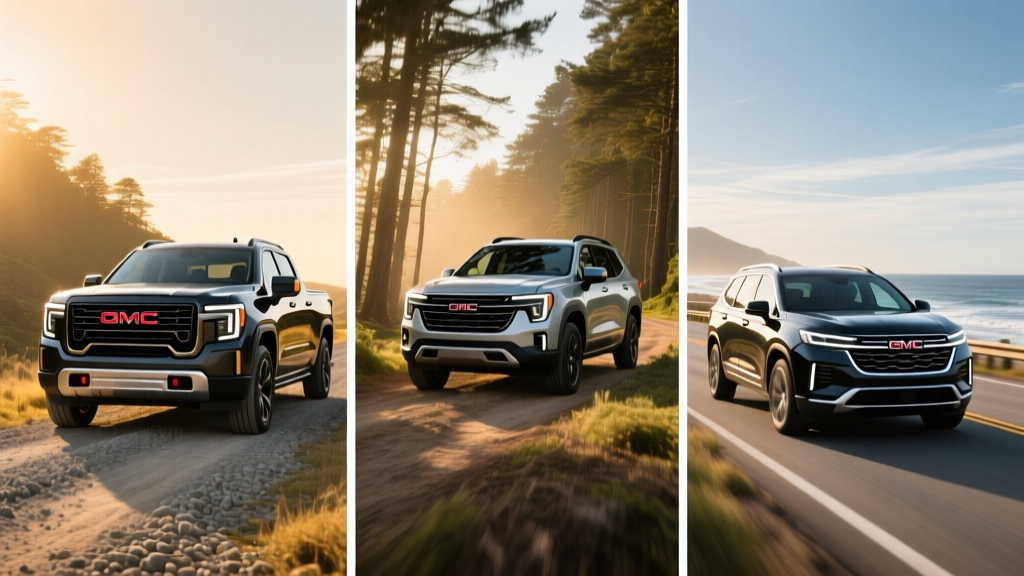
GMC's electrification strategy for the 2025 model year takes a pragmatic approach: rather than forcing buyers into full battery-electric vehicles like the Hummer EV, the brand offers hybrid and plug-in hybrid options across its most popular nameplates. If you're researching GMC hybrid models 2025, you'll find a lineup that spans the Sierra 1500 Hybrid pickup, the Terrain PHEV compact SUV, and the Acadia Hybrid three-row family hauler. Each serves a different buyer — and each has distinct trade-offs in efficiency, electric-only range, and pricing that this guide breaks down with exact numbers.
Before we get into specific models, let's establish a critical distinction that trips up many shoppers.
HEV vs. PHEV: What's the Difference?
Conventional Hybrid (HEV): Uses a small battery (typically 1–2 kWh) charged entirely by the engine and regenerative braking. You never plug it in. It improves fuel economy by 20–40% over a gas-only equivalent, especially in city driving where the electric motor handles low-speed propulsion.
Plug-in Hybrid (PHEV): Carries a larger battery (typically 15–25 kWh) that you can charge from a wall outlet or public charger. It provides a meaningful electric-only range (25–50+ miles) before the gas engine engages. Once the battery depletes, it operates like a conventional hybrid. Best for drivers who can charge at home and have mostly short commutes.
GMC Sierra 1500 Hybrid: The Workhorse with a MPG Bump
The 2025 GMC Sierra 1500 Hybrid pairs GM's 2.7L TurboMax inline-four engine with a mild-hybrid system that uses a small electric motor integrated into the drivetrain. This is a conventional HEV — there is no plug, no electric-only mode, and no tax credit eligibility. The hybrid system's primary job is torque fill at low RPMs and slight fuel-economy gains, particularly in stop-and-go driving.
| Attribute | Specification |
|---|---|
| Powertrain | 2.7L TurboMax I4 + mild-hybrid motor |
| Combined Horsepower | 310 hp (engine) + electric assist |
| Combined Torque | 430 lb-ft |
| Battery | ~1.5 kWh (not plug-in) |
| EPA MPG (City / Hwy / Combined) | 22 / 23 / 22 MPG |
| Real-World MPG Expectation | 20–24 MPG combined; up to 24 city with regen |
| Towing Capacity | Up to 9,300 lbs (properly equipped) |
| Base MSRP | ~$52,400 (SLE Hybrid) |
| Federal Tax Credit | Not eligible (HEV, not PHEV/BEV) |
| Battery Warranty | 8 years / 100,000 miles |
The Sierra Hybrid's EPA rating of 22 MPG combined is modest — roughly 2 MPG better than the non-hybrid 2.7L TurboMax, which rates at 20 MPG combined. The gains are most noticeable in city driving, where the mild-hybrid system can shut off the engine at stops and provide electric torque assist during initial acceleration. On the highway, where aerodynamic drag dominates a full-size truck's energy consumption, the hybrid system contributes less.
Real-world fuel economy for the Sierra Hybrid typically lands between 20 and 24 MPG depending on driving mix, payload, and terrain. Owners who do predominantly city and suburban driving with frequent stops will see numbers closer to the EPA city rating or slightly above, thanks to regenerative braking recapturing energy. Highway-heavy drivers towing or hauling should expect figures in the 18–20 MPG range.
GMC Terrain PHEV: The Commuter-Friendly Plug-In
The 2025 GMC Terrain PHEV is the most electrified option in GMC's non-Hummer lineup. Built on GM's updated compact SUV platform, the Terrain PHEV combines a 1.5L turbocharged four-cylinder engine with a more powerful electric motor and a larger lithium-ion battery pack that enables genuine electric-only commuting.
| Attribute | Specification |
|---|---|
| Powertrain | 1.5L Turbo I4 + electric motor (PHEV) |
| Combined System Horsepower | ~225 hp |
| Usable Battery Capacity | ~17.7 kWh (lithium-ion, NMC chemistry) |
| EPA Electric-Only Range | ~38 miles |
| Real-World Electric Range | 32–40 miles (weather/load dependent) |
| Total Combined Range (EV + Gas) | ~430 miles |
| EPA MPG (Gas-Only After Depletion) | ~35 MPG combined |
| MPGe (Electric + Gas Combined) | ~84 MPGe |
| Level 2 Charge Time (0–100%) | ~4.5 hours at 3.6 kW onboard charger |
| DC Fast Charging | Not supported |
| Base MSRP | ~$38,900 (SLE PHEV) |
| Federal §30D Tax Credit | Up to $3,750 (battery sourcing dependent) |
| Battery Warranty | 8 years / 100,000 miles |
The Terrain PHEV's 38-mile EPA electric-only range is the headline figure. For commuters with round trips under 35 miles who can charge at home overnight, this means near-zero gasoline consumption on weekdays. Plug in each evening to a standard 120V outlet (Level 1, ~1.4 kW) and you'll recover a full charge in roughly 11 hours. Upgrade to a 240V Level 2 home charger and the 3.6 kW onboard charger fills the pack in about 4.5 hours.
One important limitation: the Terrain PHEV does not support DC fast charging. This is typical for compact PHEVs — the battery is small enough that Level 2 charging is sufficient for overnight replenishment, and adding DC fast-charge hardware would increase cost and weight. If you need rapid top-ups on road trips, this isn't the vehicle for that use case; once the battery depletes, the gas engine takes over seamlessly at 35 MPG combined.
PHEV Battery Longevity: What to Expect
GMC backs the Terrain PHEV's high-voltage battery with an 8-year / 100,000-mile warranty that covers capacity loss below 60% of original capacity. In practice, modern NMC lithium-ion PHEV batteries with active thermal management typically retain 85–92% capacity after 8 years of daily cycling. A full battery replacement outside warranty, should it ever be needed, is estimated at $4,500–$7,000 including labor — but industry data from sources like fueleconomy.gov and long-term fleet studies show most PHEV batteries outlast the vehicle's ownership cycle without requiring replacement.
GMC Acadia Hybrid: Three-Row Efficiency
The 2025 GMC Acadia Hybrid brings hybrid efficiency to GMC's three-row midsize SUV. Like the Sierra, the Acadia Hybrid uses a conventional HEV system — no plug required. It pairs a turbocharged engine with an electric motor to reduce fuel consumption, particularly valuable for a vehicle of this size that would otherwise return mid-teens MPG in city driving.
| Driving Scenario | EPA Rating | Real-World Expectation |
|---|---|---|
| City | 25 MPG | 24–27 MPG (regen benefits stop-and-go) |
| Highway | 28 MPG | 26–29 MPG |
| Combined | 26 MPG | 24–28 MPG |
The Acadia Hybrid's combined system output is approximately 328 horsepower from its turbocharged engine and electric motor combination — providing confident acceleration for a vehicle that can seat up to seven passengers and their cargo. The hybrid system is particularly effective at masking the turbo lag inherent in smaller-displacement engines moving heavy vehicles, as the electric motor provides instant torque from a standstill.
At a base MSRP starting around $46,200 for the SLE Hybrid trim, the Acadia Hybrid carries a premium of roughly $2,500–$3,000 over the gas-only Acadia. The fuel savings — approximately 5–7 MPG better than the non-hybrid in combined driving — typically recoup that premium within 4–6 years for drivers covering 12,000–15,000 miles annually, depending on local fuel prices.
Hybrid vs. PHEV vs. Full EV: Which GMC Fits Your Life?
Choosing between GMC's hybrid offerings — or deciding whether to leap to a full BEV like the GMC Sierra EV or Hummer EV — depends on your charging access, daily mileage, and willingness to adapt your fueling routine.
The Decision Framework
Choose a conventional hybrid (Sierra Hybrid, Acadia Hybrid) if:
- You cannot charge at home (apartment, street parking, no garage outlet)
- You want zero behavior change — just drive and refuel at gas stations
- Your driving includes frequent towing, long road trips, or rural routes with sparse charging
- You want 20–35% better fuel economy without compromise
Choose the PHEV (Terrain PHEV) if:
- You can install or access a Level 2 charger at home or work
- Your daily commute is under 40 miles round-trip
- You want electric-only driving most days but gas flexibility for road trips
- You want to reduce gasoline consumption by 60–80% without range anxiety
Choose a full BEV (Sierra EV, Hummer EV) if:
- You have reliable home Level 2 charging and your daily driving is under 300 miles
- You want zero tailpipe emissions and the lowest per-mile fuel cost
- You qualify for the full $7,500 federal tax credit under current IRS §30D rules
- You're willing to plan charging stops on longer road trips
Pricing, Tax Credits, and Total Cost of Ownership
Federal tax credit eligibility is a major factor in electrified vehicle purchases, and the rules under IRS §30D are nuanced. Here's how GMC's 2025 hybrid lineup breaks down:
- Sierra 1500 Hybrid (HEV): Not eligible for any federal tax credit. Conventional hybrids do not qualify under §30D.
- Terrain PHEV: May qualify for up to $3,750 under §30D, depending on battery critical-mineral and component sourcing requirements. The credit amount is split: $3,750 for meeting critical-minerals thresholds and $3,750 for battery-component sourcing. As of 2025, many PHEVs only meet one threshold. Buyer income caps apply ($150K single / $300K joint AGI). MSRP must be under $80,000 for SUVs. The credit can now be transferred to the dealer at point of sale, reducing your purchase price directly.
- Acadia Hybrid (HEV): Not eligible for any federal tax credit.
State and local incentives may also apply. Some states offer additional rebates for PHEVs (California's CVRP, for example, has offered up to $1,500 for PHEVs for income-qualified buyers). Always verify current incentive availability through your state's energy office or the Alternative Fuels Data Center.
| Cost Factor | Sierra 1500 Hybrid | Terrain PHEV | Acadia Hybrid |
|---|---|---|---|
| Purchase Price (base) | ~$52,400 | ~$38,900 | ~$46,200 |
| Federal Tax Credit | $0 | Up to $3,750 | $0 |
| Effective Purchase Price | ~$52,400 | ~$35,150 | ~$46,200 |
| 5-Yr Fuel/Energy Cost | ~$9,800 (gas) | ~$4,200 (gas + elec) | ~$7,600 (gas) |
| 5-Yr Maintenance | ~$3,200 | ~$2,400 | ~$2,800 |
| Est. Insurance (5 yr) | ~$8,500 | ~$6,800 | ~$7,400 |
| Estimated 5-Yr Total | ~$73,900 | ~$48,550 | ~$64,000 |
The Terrain PHEV's lower total cost is driven by its smaller size, lower purchase price, significant fuel savings when driven mostly on electric, and reduced maintenance (fewer brake replacements due to regenerative braking, and less engine wear when the majority of miles are electric). The Sierra Hybrid's higher cost reflects both its truck pricing and the reality that a mild-hybrid system provides modest fuel savings relative to the vehicle's overall consumption.
Reliability and Battery Replacement Costs
GMC's hybrid systems benefit from GM's extensive experience with hybrid powertrains dating back to the two-mode hybrid systems in the 2008 Tahoe and Yukon. The current-generation mild-hybrid and PHEV architectures are simpler and more robust than those early systems.
For conventional hybrids (Sierra, Acadia), the hybrid battery is small (~1.5 kWh) and operates within a narrow state-of-charge window, which minimizes degradation stress. These batteries routinely last 150,000+ miles without significant capacity loss. Replacement cost for a mild-hybrid battery, if ever needed, typically ranges from $1,500 to $3,000.
For the Terrain PHEV, the 17.7 kWh NMC battery sees deeper cycling but benefits from active liquid thermal management. Based on data from comparable GM PHEV platforms (the Chevrolet Volt and Bolt EUV families), owners can expect 88–94% battery capacity retention at the 8-year mark. Full replacement cost outside warranty is estimated at $4,500–$7,000, though this figure has been trending downward as battery cell costs continue to decline. According to NHTSA and industry reliability surveys, GM's hybrid and PHEV powertrains have shown competitive reliability ratings relative to the broader market.
Pros of GMC's 2025 Hybrid Lineup
- No charging infrastructure required for HEV models — zero lifestyle change
- Terrain PHEV offers genuine 38-mile electric commute capability
- All models backed by 8-year/100,000-mile hybrid battery warranty
- Sierra Hybrid maintains full towing capability (9,300 lbs)
- Proven GM hybrid powertrain architecture with extensive service network
- Terrain PHEV eligible for up to $3,750 federal tax credit
Cons to Consider
- Mild-hybrid fuel economy gains are modest (2–5 MPG) vs. non-hybrid
- Terrain PHEV lacks DC fast charging — limits road-trip electric use
- No full-hybrid (strong hybrid) option for Sierra — only mild-hybrid assist
- HEV models ineligible for federal tax credits
- Hybrid premium adds $2,500–$4,000 to base price with multi-year payback
- Terrain PHEV cargo space slightly reduced vs. gas-only Terrain due to battery
Real-World MPG: What Owners Actually Report
EPA ratings provide a standardized baseline, but real-world fuel economy in GMC's hybrid models varies based on driving patterns — often favorably for city-dominant drivers.
Sierra 1500 Hybrid: Owners on fuel-tracking platforms like Fuelly report combined averages between 19 and 23 MPG, with the higher figures going to drivers who do significant suburban and city driving. Highway-only trips at 75+ MPH with a bed load drop economy to 17–19 MPG. The mild-hybrid system's benefits are most pronounced below 45 MPH.
Terrain PHEV: For owners who charge nightly and commute under 35 miles, actual gasoline consumption can drop to near zero on weekdays, with gas used only for longer weekend trips. These owners report effective combined economy of 70–90 MPGe. Owners who rarely charge and drive the Terrain PHEV as a conventional hybrid see 32–36 MPG — roughly what the EPA gas-only rating suggests.
Acadia Hybrid: Three-row SUV buyers report combined figures of 24–28 MPG, with city-dominant drivers occasionally exceeding the EPA city rating thanks to aggressive regenerative braking in stop-and-go traffic. Highway cruising at 70 MPH yields 26–29 MPG, which is impressive for a seven-passenger vehicle.
Frequently Asked Questions
How many MPG does the 2025 GMC Sierra Hybrid get?
The EPA rates the 2025 GMC Sierra 1500 Hybrid at 22 MPG city / 23 MPG highway / 22 MPG combined. Real-world results range from 19–24 MPG depending on driving mix, with city-dominant drivers seeing the best results due to regenerative braking and electric torque assist at low speeds.
How far can the GMC Terrain PHEV go on electric only?
The 2025 GMC Terrain PHEV has an EPA-rated electric-only range of approximately 38 miles. In real-world conditions, expect 32–40 miles depending on temperature, terrain, speed, and climate-control usage. Cold weather (below 32°F) can reduce electric range by 15–25% due to battery chemistry limitations and cabin heating demands.
Does the GMC Sierra Hybrid or Acadia Hybrid qualify for a federal tax credit?
No. Conventional hybrids (HEVs) like the Sierra 1500 Hybrid and Acadia Hybrid do not qualify for the federal §30D clean vehicle tax credit. Only plug-in hybrids and battery-electric vehicles with sufficient battery capacity and compliant battery sourcing are eligible. The Terrain PHEV may qualify for up to $3,750, subject to IRS income caps, MSRP limits, and battery-component sourcing requirements.
Is the GMC hybrid battery reliable and what does replacement cost?
GMC's hybrid batteries are covered by an 8-year / 100,000-mile warranty and are designed to last the life of the vehicle. Mild-hybrid battery replacement (Sierra, Acadia) costs approximately $1,500–$3,000 if needed outside warranty. The Terrain PHEV's larger battery would cost an estimated $4,500–$7,000 to replace, though most PHEV batteries retain 85–94% capacity at 8 years based on industry data.
Should I buy a GMC hybrid or go full electric?
Choose a GMC hybrid if you lack home charging access, frequently tow or take long road trips, or want zero change to your fueling routine. Choose the Terrain PHEV if you can charge at home and want electric commuting with gas backup. Choose a full GMC EV (Sierra EV, Hummer EV) only if you have reliable home charging, your daily driving is under 300 miles, and you want the lowest per-mile operating cost with maximum tax credit eligibility.
Can I charge the Terrain PHEV at a DC fast charger?
No. The 2025 GMC Terrain PHEV supports only Level 1 (120V, ~1.4 kW) and Level 2 (240V, up to 3.6 kW) AC charging. There is no DC fast-charge port. This is standard for compact PHEVs — the 17.7 kWh battery charges fully overnight on Level 2, making DC fast charging unnecessary for the typical PHEV use case.
What is the difference between the Sierra mild-hybrid and a full hybrid?
A mild-hybrid system (like the Sierra's) uses a small electric motor to assist the gas engine — it cannot propel the vehicle on electric power alone. A full hybrid (like the Toyota RAV4 Hybrid or Ford Maverick Hybrid) can drive short distances on electric-only power and delivers larger fuel economy gains, typically 35–40+ MPG combined in compact applications. GMC does not currently offer a full-hybrid Sierra.
GMC's 2025 hybrid lineup isn't the most electrified in the industry — Toyota, Hyundai, and Ford offer stronger hybrid systems and more PHEV options. But for buyers loyal to the GMC brand who want incremental efficiency gains without switching to a full EV, the Sierra Hybrid, Terrain PHEV, and Acadia Hybrid each serve a clear purpose. The Terrain PHEV is the standout: 38 miles of electric range, a sub-$39,000 starting price, and potential tax-credit eligibility make it the most financially compelling option for commuters who can charge at home.