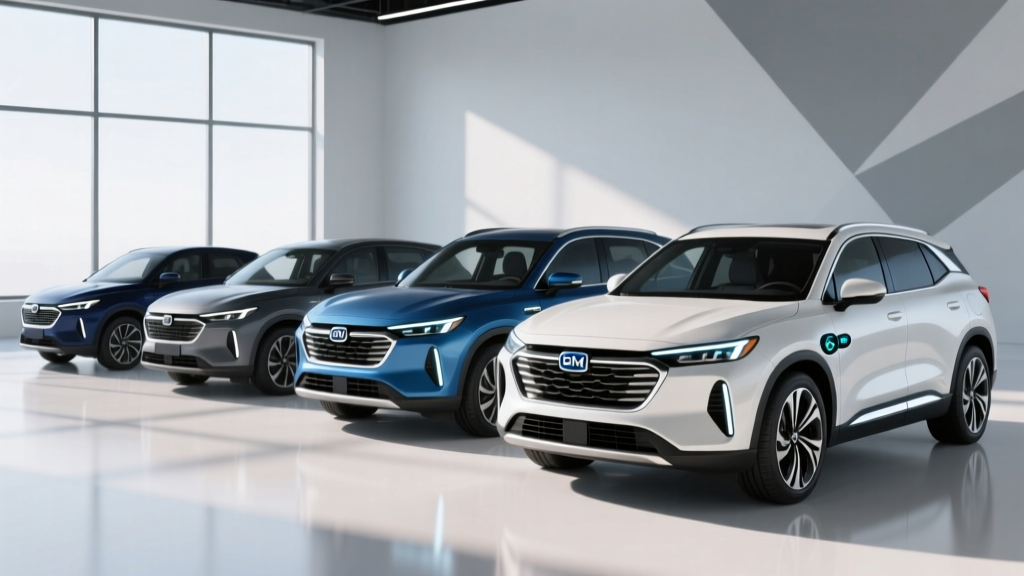
General Motors has pivoted hard toward full electrification with its Ultium platform, but the reality for many buyers in 2026 is that a hybrid or plug-in hybrid SUV better fits their daily routine. Whether you lack home charging access, frequently tow, or simply want to eliminate range anxiety on long road trips, a GM hybrid SUV offers a practical bridge — or a permanent solution — without the plug-in dependency of a full BEV.
This guide breaks down the current GM hybrid SUV lineup available for the 2026 model year, separating conventional hybrids (HEVs) from plug-in hybrids (PHEVs), with exact EPA fuel economy figures, electric-only range, powertrain specs, pricing, and tax credit eligibility. No marketing fluff — just the numbers you need to decide.
HEV vs PHEV: What GM Hybrid SUV Buyers Need to Know First
Before diving into specific models, the distinction between a conventional hybrid and a plug-in hybrid fundamentally changes how you own and fuel the vehicle.
Conventional Hybrid (HEV)
- How it charges: Regenerative braking and the gasoline engine — never plugs in
- Battery size: Small, typically 1–2 kWh
- Electric-only driving: Very limited, usually under 1 mile at low speeds
- Best for: Drivers without reliable access to a plug; those who want better MPG with zero behavior change
Plug-in Hybrid (PHEV)
- How it charges: Plugs into a wall outlet or Level 2 charger; also uses regen and engine
- Battery size: Larger, typically 15–25 kWh usable
- Electric-only driving: 25–50+ miles on most modern PHEVs
- Best for: Drivers with home or workplace charging who want EV-like daily commutes with gas-engine range for longer trips
GM's 2026 hybrid SUV strategy spans both categories. The Chevrolet Silverado Hybrid and the Tahoe Hybrid use conventional HEV powertrains — you never plug them in. The Chevrolet Equinox PHEV and the GMC Acadia PHEV are plug-in models that can run purely on electricity for a meaningful distance before the gas engine kicks in.
The 2026 GM Hybrid SUV Lineup: Specs at a Glance
| Model | Type | Powertrain | Combined HP | Battery (kWh) | EV Range (mi) | EPA Combined MPG/MPGe | Base MSRP |
|---|---|---|---|---|---|---|---|
| Chevrolet Equinox PHEV | PHEV | 1.5L turbo + 2 motors | 247 hp | 19.2 kWh usable | 38 mi (est.) | 95 MPGe / 37 MPG (gas) | $36,400 |
| GMC Acadia PHEV | PHEV | 1.5L turbo + 2 motors | 250 hp | 20.1 kWh usable | 35 mi (est.) | 92 MPGe / 35 MPG (gas) | $49,900 |
| Chevrolet Silverado Hybrid | HEV | 2.7L turbo I4 + mild-hybrid assist | 310 hp | ~1.5 kWh | N/A | 23 MPG combined | $47,800 |
| Chevrolet Tahoe Hybrid | HEV | 3.0L Duramax I6 + eAssist | 305 hp | ~1.8 kWh | N/A | 22 MPG combined | $64,300 |
Note: PHEV MPGe figures reflect combined electric + gas operation over the first 100 miles. Once the battery is depleted, the gas-only MPG applies. All figures are preliminary EPA estimates for 2026 models and may vary by trim and drivetrain. Source: fueleconomy.gov.
Fuel Economy Breakdown: Real-World MPG vs. EPA Stickers
Hybrid fuel economy is notoriously tricky to compare because EPA test cycles favor city driving — where regenerative braking recaptures the most energy. Here's what the numbers actually look like across driving scenarios.
| Model | EPA City | EPA Highway | EPA Combined | Real-World Expectation |
|---|---|---|---|---|
| Equinox PHEV (gas mode) | 40 MPG | 34 MPG | 37 MPG | 38–42 city; 30–33 highway |
| Acadia PHEV (gas mode) | 38 MPG | 32 MPG | 35 MPG | 36–40 city; 28–31 highway |
| Silverado Hybrid | 24 MPG | 22 MPG | 23 MPG | 25–27 city; 20–21 highway (loaded) |
| Tahoe Hybrid | 24 MPG | 20 MPG | 22 MPG | 25–27 city; 18–20 highway |
Why hybrids often beat EPA in the city: Hybrids recapture kinetic energy during stop-and-go braking, which the EPA city cycle simulates heavily. On the highway, there's less braking to recapture from, and aerodynamic drag dominates — so expect highway MPG to fall below the sticker. For PHEVs, your real-world economy depends almost entirely on how often you recharge. If you plug in nightly and commute under 35 miles, you may use gasoline only a handful of times per month.
Electric-Only Range and Charging for GM PHEV SUVs
For the Equinox PHEV and Acadia PHEV, the electric-only range is the single most important spec for daily usability. Here's how the PHEV charging experience breaks down:
Chevrolet Equinox PHEV
- EV-only range: ~38 miles (EPA est.)
- Battery: 19.2 kWh usable capacity, NMC lithium-ion
- Level 1 charging (120V household outlet): ~8 hours for a full charge — feasible for overnight
- Level 2 charging (240V): ~2.5 hours with a 7.7 kW onboard charger
- DC fast charging: Not available. PHEVs of this class do not include DC fast-charge capability
GMC Acadia PHEV
- EV-only range: ~35 miles (EPA est.)
- Battery: 20.1 kWh usable capacity, NMC lithium-ion
- Level 1 charging (120V): ~9 hours for a full charge
- Level 2 charging (240V): ~3 hours with a 7.7 kW onboard charger
- DC fast charging: Not available
Practical takeaway: Both PHEVs use a standard J1772 connector for Level 2 AC charging. Neither supports DC fast charging — a common limitation among PHEVs due to battery size and cost. If your daily commute is under 35 miles round-trip and you can plug in at home or work, you'll operate almost entirely on electricity, with the gasoline engine reserved for longer trips.
Powertrain Deep Dive: What's Under the Hood
GM's hybrid powertrains for 2026 use two distinct architectures depending on vehicle class.
PHEV Architecture (Equinox / Acadia)
Both PHEVs share GM's updated Voltec-derived two-motor hybrid system paired with a 1.5-liter turbocharged four-cylinder engine. The two electric motors are integrated into the transaxle, enabling smooth electric-only operation at highway speeds (up to ~84 mph in EV mode) before the engine seamlessly engages. Combined output is 247 hp in the Equinox and 250 hp in the Acadia. This is a series-parallel system — it can operate as a pure EV, a series hybrid (engine generates electricity for the motor), or a parallel hybrid (engine and motor both drive the wheels).
HEV Architecture (Silverado / Tahoe)
The conventional hybrids use a milder form of electrification. The Silverado Hybrid pairs a 2.7L turbo I4 with a small belt-integrated starter-generator that provides torque fill during acceleration and enables extended engine stop-start at traffic lights. The Tahoe Hybrid uses a similar eAssist system on its 3.0L Duramax turbodiesel inline-six. These are not full hybrid systems like Toyota's — they don't drive the vehicle on electric power alone at any meaningful speed. Instead, they smooth out the stop-start experience and recover small amounts of braking energy, yielding a 2–4 MPG improvement over the non-hybrid versions.
Pricing, Tax Credits, and Total Cost of Ownership
Hybrid and PHEV pricing has come under scrutiny as buyers weigh the upfront premium against fuel savings. Here's where the 2026 GM hybrid SUV lineup stands:
| Model | Base MSRP | Hybrid Premium vs. Gas Model | Federal Tax Credit (§30D) | Est. Annual Fuel Cost |
|---|---|---|---|---|
| Equinox PHEV | $36,400 | +$3,200 | Up to $3,750* | ~$950 (mixed EV/gas driving) |
| Acadia PHEV | $49,900 | +$4,500 | Up to $3,750* | ~$1,100 (mixed EV/gas driving) |
| Silverado Hybrid | $47,800 | +$2,800 | None (HEV not eligible) | ~$2,100 |
| Tahoe Hybrid | $64,300 | +$3,500 | None (HEV not eligible) | ~$2,300 |
*Federal tax credit details for PHEVs (2026 rules): Under IRS §30D, plug-in hybrids may qualify for up to $3,750 in federal tax credits, contingent on:
- Battery sourcing: Critical minerals and battery components must meet phased-in domestic content thresholds (stricter in 2026 than prior years)
- MSRP cap: SUVs/vans must have an MSRP at or below $80,000 — both GM PHEVs clear this
- Income cap: Modified AGI must not exceed $150,000 (single) or $300,000 (joint)
- Point-of-sale transfer: Eligible buyers can apply the credit as an instant dealer discount rather than waiting for a tax refund
Conventional hybrids (HEVs) do not qualify for §30D credits. Some states offer separate hybrid incentives — check your state energy office for current programs.
5-Year Cost Snapshot
Assuming 15,000 miles/year, $3.50/gallon gas, and $0.14/kWh electricity:
- Equinox PHEV: ~$4,750 fuel over 5 years (with regular home charging) vs. ~$7,200 for the gas-only Equinox
- Silverado Hybrid: ~$10,500 fuel over 5 years vs. ~$12,000 for the non-hybrid Silverado
The PHEV fuel savings are substantial — but only if you actually plug in regularly. A PHEV driven without charging is just a slightly heavier hybrid.
Battery Longevity, Warranty, and Replacement Costs
GM Hybrid Battery Warranty Coverage (2026 Models)
| Component | Warranty Term |
| Hybrid/PHEV high-voltage battery | 8 years / 100,000 miles (whichever comes first) |
| Hybrid powertrain components (inverter, motors) | 8 years / 100,000 miles |
| Capacity retention threshold | Battery must retain ≥60% of original capacity for warranty claim |
| Conventional powertrain warranty | 5 years / 60,000 miles |
Hybrid battery anxiety remains one of the top concerns for buyers — but the data is reassuring. GM's nickel-metal-hydride and lithium-ion hybrid batteries have demonstrated strong longevity in fleet data. Toyota's hybrid batteries (the industry benchmark) routinely exceed 150,000 miles with minimal degradation, and GM's lithium-ion PHEV packs are engineered for similar duty cycles.
Replacement cost if out of warranty:
- PHEV battery pack (Equinox/Acadia): $5,500–$8,000 including labor
- HEV battery (Silverado/Tahoe mild-hybrid): $1,500–$3,000 (smaller pack, simpler replacement)
In practice, most hybrid batteries outlast the vehicle itself. The 8-year/100,000-mile warranty provides a strong safety net, and California-emissions states (CARB states) extend that to 10 years / 150,000 miles on hybrid components.
GM Hybrid SUV vs. Full EV vs. Gas: Which Fits You?
Choose a GM PHEV (Equinox / Acadia) if:
- You have home or workplace Level 2 charging access
- Your daily commute is under 40 miles round-trip
- You take road trips 4+ times per year and don't want to plan around DC fast chargers
- You want EV-like daily operating costs without committing to a full BEV
Choose a GM HEV (Silverado / Tahoe Hybrid) if:
- You have no reliable access to a plug at home or work
- You tow regularly (hybrids handle towing without range loss concerns)
- You want modest MPG gains with zero change to your fueling routine
- You need the payload/towing capacity of a truck or large SUV
Choose a full EV (like the Chevrolet Equinox EV or Blazer EV) if:
- You have reliable home Level 2 charging
- You want zero tailpipe emissions and minimal maintenance
- Your daily driving is under 250 miles and you're comfortable with road-trip charging stops
- You want the full $7,500 federal tax credit (subject to §30D eligibility)
Reliability Ratings and Known Considerations
GM's hybrid systems in 2026 are relatively new architectures, so long-term reliability data is still accumulating. However, the individual components — turbocharged engines, electric motors, and lithium-ion packs — are proven across GM's lineup. Key considerations:
- Transmission: The PHEV models use a dedicated hybrid transaxle (not a conventional automatic), which has fewer wear components than a standard transmission
- Brakes: Regenerative braking reduces pad wear significantly — expect 80,000+ miles on original brake pads in mixed driving
- Cold weather: PHEV electric range drops 20–30% in sub-freezing temperatures due to battery chemistry and cabin heating demand. The gas engine compensates seamlessly, so you won't be stranded — but your all-electric commute may shorten to ~25 miles in January
- Safety: Check NHTSA ratings and IIHS evaluations for the specific model year and trim. GM's Super Cruise hands-free driving system is available on select trims but is a Level 2 driver-assist system — you must remain attentive and keep your eyes on the road
Frequently Asked Questions
How many MPG does a GM hybrid SUV get?
It depends on the model. The Chevrolet Equinox PHEV achieves an EPA-estimated 37 MPG combined in gas-only mode and 95 MPGe when factoring in electric operation. The conventional Silverado Hybrid returns 23 MPG combined. Hybrids consistently exceed their EPA city ratings in real-world stop-and-go driving but may fall short on sustained highway trips.
How far can the GM PHEV SUVs go on electric only?
The 2026 Chevrolet Equinox PHEV delivers approximately 38 miles of electric-only range, while the GMC Acadia PHEV offers about 35 miles. Both can operate in EV mode at highway speeds up to ~84 mph before the gasoline engine engages. In cold weather (below 32°F), expect 20–30% range reduction, bringing real-world EV range to roughly 25–30 miles.
Do GM hybrid SUVs need to be plugged in?
Only the PHEV models (Equinox PHEV and Acadia PHEV) benefit from plugging in — and only if you want to maximize electric-only driving. The conventional hybrids (Silverado Hybrid and Tahoe Hybrid) never plug in; they charge their small batteries entirely through regenerative braking and the gasoline engine.
Are GM hybrid SUVs reliable, and what does battery replacement cost?
GM covers hybrid batteries with an 8-year/100,000-mile warranty (10 years/150,000 miles in CARB states). Out-of-warranty PHEV battery replacement runs $5,500–$8,000; mild-hybrid battery replacement is $1,500–$3,000. Based on industry-wide hybrid fleet data, most batteries exceed 150,000 miles without significant degradation.
Does a GM hybrid SUV qualify for a tax credit?
Only the PHEV models may qualify for a federal tax credit under IRS §30D — currently up to $3,750, subject to battery sourcing requirements, buyer income limits ($300,000 joint / $150,000 single), and the $80,000 SUV MSRP cap. Conventional hybrids do not qualify for federal EV credits. The credit can be applied at the point of sale as an instant dealer discount. Always verify current eligibility on irs.gov before purchasing, as sourcing rules tighten annually.
Can GM PHEV SUVs DC fast charge?
No. Neither the Equinox PHEV nor the Acadia PHEV supports DC fast charging. They charge via AC only — Level 1 (120V, ~8–9 hours) or Level 2 (240V, ~2.5–3 hours). This is standard for PHEVs in this class, as the relatively small battery packs don't justify the added cost and weight of DC fast-charge hardware.
How does a GM hybrid SUV compare to a Toyota or Honda hybrid?
Toyota offers the most extensive hybrid SUV lineup (RAV4 Hybrid, Highlander Hybrid, Grand Highlander Hybrid) with proven reliability and strong MPG — the RAV4 Hybrid achieves 39 MPG combined. Honda's CR-V Hybrid returns 40 MPG combined. GM's advantage lies in offering PHEV versions with meaningful electric-only range, which Toyota and Honda currently do not offer in their mainstream SUVs. If your priority is maximum MPG without plugging in, Toyota and Honda lead. If you want plug-in electric daily driving with gas backup, GM's PHEV options fill a gap those competitors don't address.