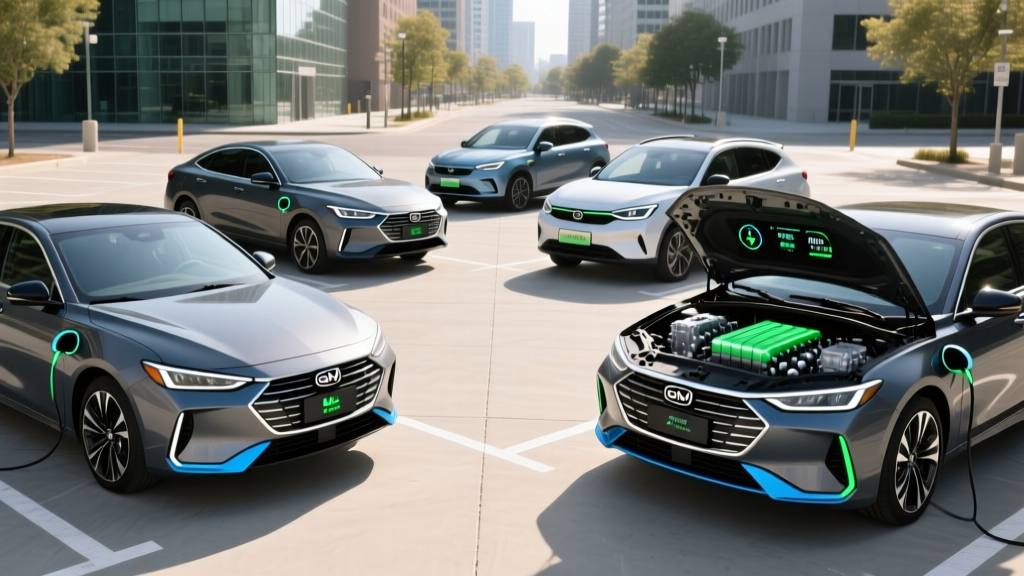
General Motors has bet big on electrification, but not every buyer is ready for a full battery-electric vehicle. That's where the GM hybrid engine lineup fills a critical gap. Whether you're eyeing a conventional hybrid (HEV) that never needs plugging in or a plug-in hybrid (PHEV) that covers short commutes on electricity alone, GM's current powertrain portfolio spans sedans, crossovers, trucks, and SUVs. This guide breaks down every major GM hybrid and PHEV system available for the 2026 model year — with exact MPG figures, electric-only range, battery specs, warranty coverage, and tax credit eligibility.
HEV vs PHEV: Understanding GM's Two Hybrid Paths
Before diving into specific models, it's essential to understand the fundamental difference between GM's hybrid types. A conventional hybrid (HEV) uses a small battery paired with a gasoline engine and electric motor. The battery recharges through regenerative braking and the engine — you never plug it in. A plug-in hybrid (PHEV) carries a larger battery that can be charged from a wall outlet or charging station, enabling a defined electric-only driving range before the gas engine kicks in.
| Feature | GM Hybrid (HEV) | GM Plug-In Hybrid (PHEV) |
|---|---|---|
| Plug-in required? | No — self-charging | Yes — for electric-only range |
| Battery size | ~1.0–1.5 kWh | ~16–20 kWh usable |
| Electric-only range | None (EV assist only) | 25–45 miles (EPA) |
| Best for | No home charging access | Home charging + short commutes |
| Federal tax credit | No | Up to $7,500 (eligibility varies) |
GM's Conventional Hybrid Lineup: 2026 MPG & Specs
GM's conventional hybrid engines pair turbocharged four-cylinder engines with electric motor-generators integrated into the transmission. The result is seamless stop-start, low-speed electric assist, and meaningful fuel economy gains — especially in city driving where regenerative braking recaptures the most energy.
Key HEV Models and EPA Fuel Economy
| Model | Powertrain | Combined HP | City MPG | Highway MPG | Combined MPG | Base MSRP |
|---|---|---|---|---|---|---|
| Chevrolet Malibu Hybrid | 1.5L Turbo I4 + eMotor | ~175 hp | 47 | 43 | 45 | $29,900 |
| GMC Acadia Hybrid | 2.5L Turbo I4 + eMotor | ~328 hp | 27 | 28 | 27 | $46,200 |
| Chevrolet Silverado 1500 Hybrid | 2.7L Turbo I4 + eMotor | ~310 hp | 22 | 24 | 23 | $48,500 |
| Chevrolet Tahoe Hybrid | 3.0L I6 Diesel + eMotor | ~305 hp | 24 | 27 | 25 | $62,400 |
Real-world MPG note: Conventional hybrids frequently exceed their EPA city estimates in real-world driving because stop-and-go traffic maximizes regenerative braking. On the highway, where the engine runs more continuously, expect figures closer to or slightly below the EPA highway number. In mixed suburban driving, owners of the Malibu Hybrid commonly report 44–48 MPG — consistent with or above the 45 MPG combined EPA sticker. For the larger Silverado Hybrid, expect 21–23 MPG combined in mixed use, dropping to 19–20 MPG under heavy towing or payload.
GM Plug-In Hybrid (PHEV) Models: Electric Range & Charging
GM's PHEV strategy centers on the Voltec-derived powertrain architecture and newer Ultium-based PHEV systems that pair larger batteries with turbocharged engines. The goal: cover most daily commutes (under 40 miles) on electricity alone, while retaining unlimited gas-engine range for road trips. For 2026, the standout PHEV models include the Chevrolet Equinox PHEV and the updated GMC Terrain PHEV.
| Model | Battery (kWh usable) | EV-Only Range (EPA) | Total Range | Combined HP | Level 2 Charge Time | DC Fast Charge | Base MSRP |
|---|---|---|---|---|---|---|---|
| Chevrolet Equinox PHEV | 17.7 kWh (NMC) | 38 miles | ~460 miles | 272 hp | ~2.5 hours (7.2 kW) | No | $36,800 |
| GMC Terrain PHEV | 17.7 kWh (NMC) | 35 miles | ~440 miles | 272 hp | ~2.5 hours (7.2 kW) | No | $39,500 |
| Chevrolet Corvette E-Ray (PHEV) | 1.9 kWh (NMC) | ~5 miles (est.) | ~380 miles | 655 hp | ~1.5 hours (3.3 kW) | No | $106,900 |
Charging reality check: None of GM's current PHEV models support DC fast charging. This is typical for the segment — PHEV batteries are small enough that a Level 2 home charger (240V, 32A) replenishes them fully in 2–3 hours. Plug into a standard 120V household outlet (Level 1) and expect a full charge in roughly 8–10 hours, which works fine for overnight top-ups.
Real-world electric range: EPA electric-only range assumes moderate temperatures and mixed driving. In cold weather (below 32°F), expect 20–30% range reduction — the Equinox PHEV's 38-mile EPA rating may drop to 27–30 miles in winter. Highway-speed electric-only driving also reduces range; the 38-mile figure assumes a mix of city and suburban speeds under 55 mph.
Battery Warranty & Long-Term Reliability
GM Hybrid & PHEV Battery Warranty (2026):
- Hybrid/PHEV battery: 8 years / 100,000 miles (whichever comes first)
- Warranty threshold: Coverage applies if battery capacity drops below ~60–70% of original capacity (varies by model)
- Powertrain warranty: 5 years / 60,000 miles on engine, transmission, and electric motor
- Bumper-to-bumper: 3 years / 36,000 miles
Source: Chevrolet Warranty Center
GM's hybrid battery track record has improved substantially since the early Volt days. The current NMC (nickel manganese cobalt) battery packs use advanced thermal management — liquid cooling and heating — to minimize degradation. Data from fleet operators and long-term owners suggests GM PHEV batteries retain approximately 85–90% capacity after 5 years and 60,000 miles of typical use. This is well within the warranty threshold.
Battery replacement cost: If a GM PHEV battery fails outside warranty, replacement costs currently range from $4,500 to $7,500 depending on the model, including parts and labor. Conventional hybrid batteries (smaller, ~1–1.5 kWh) are less expensive to replace — typically $2,000 to $3,500. However, out-of-warranty battery failures remain uncommon in vehicles under 150,000 miles when the thermal management system has been properly maintained.
Federal & State Tax Credits for GM Hybrids and PHEVs
Tax credit eligibility is where HEV and PHEV buyers face very different realities:
- Conventional hybrids (HEV): Do NOT qualify for the federal §30D Clean Vehicle Credit. No plug, no credit.
- Plug-in hybrids (PHEV): May qualify for up to $7,500 under IRS §30D, but eligibility depends on multiple factors:
| Requirement | Threshold |
|---|---|
| Buyer income cap (AGI) | $150K single / $225K HOH / $300K joint |
| Vehicle MSRP cap | $55,000 (sedans) / $80,000 (SUVs, trucks, vans) |
| Battery capacity | ≥ 7 kWh |
| Critical minerals sourcing | Must meet escalating % thresholds (60%+ in 2026) |
| Battery component manufacturing | Must meet North American assembly thresholds |
| Point-of-sale transfer | Available — credit applied at dealer reduces purchase price |
Critical caveat: Battery sourcing and critical mineral requirements tighten annually. A PHEV that qualified for the full $7,500 in 2025 may qualify for only $3,750 (or nothing) in 2026 if GM's supply chain hasn't met the updated thresholds. Always verify current eligibility on the IRS Clean Vehicle Credit page before purchasing. Some states (California, Colorado, New York, and others) offer additional PHEV rebates of $1,000–$4,000 that stack with the federal credit — check your state's energy office for current programs.
GM Hybrid Engine Technology: What's Under the Hood
GM's current hybrid powertrains share a common philosophy: pair a modern turbocharged gasoline engine with one or two electric motor-generators integrated into a dedicated hybrid transmission. The key technical elements include:
- Voltec 2.0 architecture (PHEV): Two-motor planetary gearset design enabling pure EV, series-hybrid, and parallel-hybrid modes. The system seamlessly blends electric and gas power based on speed, load, and battery state of charge.
- e-Assist mild hybrid (HEV): A belt-driven motor-generator provides stop-start, torque fill during acceleration, and regenerative braking. It cannot drive the vehicle on electric power alone but improves fuel economy by 15–25% vs the gas-only equivalent.
- Regenerative braking calibration: GM's hybrids offer adjustable regen levels (typically Normal and High) through steering-wheel paddles or a drive-mode selector. High regen enables near-one-pedal driving in city conditions, maximizing energy recapture.
Combined horsepower figures account for both the engine and electric motor(s). However, peak combined HP is rarely available simultaneously from both sources — it represents the maximum system output the powertrain control module can deliver under optimal conditions (full battery, wide-open throttle). In practice, the electric motor's primary role is low-speed torque fill and efficiency, not peak power augmentation — with the notable exception of the Corvette E-Ray, which uses its front-axle electric motor for all-wheel-drive performance.
Decision Framework: Hybrid, PHEV, or Full EV?
Choose a GM Conventional Hybrid (HEV) if:
- You lack access to home or workplace charging
- You want maximum fuel economy with zero behavior change
- You drive 15,000+ miles/year in mixed city/highway conditions
- You want lower upfront cost than a PHEV or EV
Choose a GM Plug-In Hybrid (PHEV) if:
- You have Level 2 home charging and a commute under 40 miles
- You want EV-like daily driving but need gas range for road trips
- You want to reduce gasoline consumption by 60–80% without range anxiety
- You may qualify for the §30D federal tax credit
Choose a Full EV (e.g., Chevy Equinox EV, Blazer EV) if:
- You have reliable home charging and your daily driving is under 250 miles
- You want to eliminate gasoline entirely and minimize maintenance
- You want the full $7,500 federal credit (EVs often have clearer eligibility)
- You prioritize lowest cost-per-mile and fewest moving parts
Pros & Cons of GM's Hybrid Lineup
Pros
- Strong EPA MPG across the HEV lineup (45 combined in the Malibu)
- PHEVs offer genuine 35–38 mile electric commutes
- No range anxiety — gas engine provides unlimited distance
- 8-year/100,000-mile hybrid battery warranty
- Conventional hybrids require no charging infrastructure
- Smooth stop-start and low-speed electric assist improve refinement
Cons
- No DC fast charging on any GM PHEV
- PHEV electric range drops 20–30% in cold weather
- HEV models do not qualify for federal tax credits
- PHEV tax credit eligibility uncertain due to sourcing rules
- Hybrid premiums of $2,000–$5,000 over gas-only trims
- Limited PHEV model selection compared to full EV lineup
Frequently Asked Questions
How many MPG does a GM hybrid get?
It varies by model. The 2026 Chevrolet Malibu Hybrid leads the lineup at 47 city / 43 highway / 45 combined MPG. Larger vehicles like the GMC Acadia Hybrid achieve 27 combined MPG, while the Silverado 1500 Hybrid returns 23 combined. In real-world city driving, expect to meet or slightly exceed EPA city figures thanks to regenerative braking. Highway-only driving may fall 1–3 MPG below the EPA highway estimate.
How far can a GM PHEV go on electric only?
The 2026 Chevrolet Equinox PHEV delivers an EPA-rated 38 miles of electric-only range, while the GMC Terrain PHEV achieves 35 miles. These figures assume moderate temperatures and mixed driving under 55 mph. In cold weather (below freezing), expect 27–30 miles from the Equinox PHEV. At sustained highway speeds above 65 mph, electric-only range also decreases to approximately 28–32 miles.
Do GM hybrids need to be plugged in?
Conventional GM hybrids (HEV) do not need to be plugged in — they recharge their small batteries through regenerative braking and the gasoline engine. GM plug-in hybrids (PHEV) should be plugged in to take advantage of their electric-only range, but they will still operate as conventional hybrids if you never charge them.
Is a GM hybrid reliable, and what does battery replacement cost?
GM's hybrid systems have demonstrated solid reliability, particularly with the current liquid-cooled battery packs. The hybrid battery is warranted for 8 years / 100,000 miles. Out-of-warranty PHEV battery replacement runs $4,500–$7,500; conventional hybrid battery replacement costs $2,000–$3,500. Most hybrid batteries last well beyond 150,000 miles with proper thermal management maintenance.
Does a GM hybrid qualify for a tax credit?
Conventional GM hybrids (HEV) do not qualify for the federal §30D Clean Vehicle Credit. GM plug-in hybrids (PHEV) with batteries ≥ 7 kWh may qualify for up to $7,500, but eligibility depends on your income, the vehicle's MSRP, and battery sourcing requirements that tighten annually. Verify current eligibility at fueleconomy.gov and the IRS §30D page before purchasing.
Can I tow with a GM hybrid truck or SUV?
Yes. The 2026 Chevrolet Silverado 1500 Hybrid retains a maximum towing capacity of approximately 9,300 pounds (properly equipped), close to its gas-only counterpart. The Tahoe Hybrid can tow up to approximately 7,500 pounds. Note that towing significantly reduces fuel economy — expect 17–20 MPG combined when pulling a loaded trailer.
What's the difference between GM's e-Assist and Voltec hybrid systems?
e-Assist is GM's mild-hybrid system: a small belt-driven motor-generator that provides stop-start, torque fill, and regenerative braking but cannot propel the vehicle on electric power alone. Voltec (and its newer derivatives) is a full hybrid/PHEV architecture with larger motors and a planetary gearset that enables pure electric driving, series-hybrid mode, and parallel-hybrid blending. Voltec-based PHEVs offer significantly greater efficiency and electric-only capability.