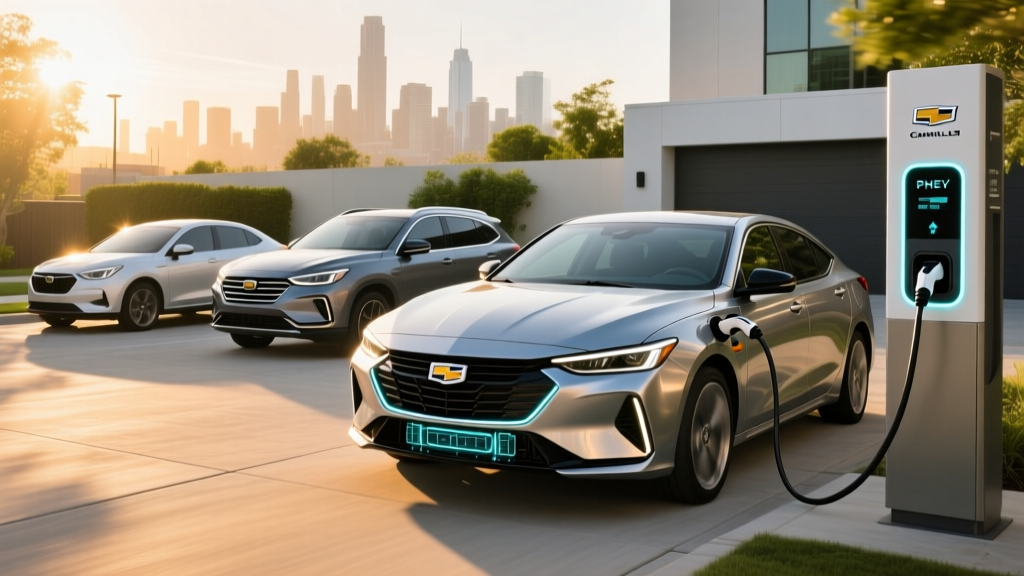
General Motors has taken a different path than Toyota or Hyundai when it comes to electrification. Rather than flooding showrooms with conventional hybrids, GM has focused its hybrid strategy almost entirely on plug-in hybrids (PHEVs) and full battery-electric vehicles (BEVs) built on its Ultium platform. For the 2026 model year, the roster of General Motors hybrid vehicles is selective but strategically positioned — offering plug-in hybrid variants of its most popular SUVs for buyers who want electric commuting without range anxiety.
This guide breaks down every current GM hybrid and PHEV available for 2026, with exact EPA MPG figures, electric-only range, battery specifications, powertrain output, pricing, and federal tax credit eligibility. Whether you're cross-shopping a RAV4 Hybrid or considering your first plug-in, here's what you need to know.
HEV vs PHEV: What GM Actually Offers in 2026
Before diving into specific models, it's critical to understand the distinction between the two hybrid types — because GM's lineup heavily favors one over the other.
Conventional Hybrid (HEV) vs Plug-In Hybrid (PHEV)
| Feature | Conventional Hybrid (HEV) | Plug-In Hybrid (PHEV) |
|---|---|---|
| Plugs in? | No — charges via regenerative braking and engine | Yes — Level 1 (120V) or Level 2 (240V) charging |
| Battery size | Small (1–2 kWh) | Large (15–25+ kWh usable) |
| Electric-only range | ~1 mile or less at low speed | 20–50+ miles at full highway speed |
| Federal tax credit | None | Up to $7,500 (§30D) if eligible |
| Best for | No home charging, simple ownership | Home chargers, short commutes + road trips |
For 2026, GM does not offer a conventional (non-plug-in) hybrid in the US market. If you want a GM hybrid, you're looking at a PHEV. This is a deliberate strategy: GM views conventional hybrids as a bridge technology and is investing in PHEVs as a more practical stepping stone for buyers not yet ready for a full BEV.
The 2026 GM PHEV Lineup: Specs at a Glance
Here are the current plug-in hybrid models from Chevrolet, GMC, and Cadillac for the 2026 model year. Note that Cadillac's PHEV offerings have shifted as the brand pushes toward full electrification, and GMC's hybrid presence centers on the Sierra and Canyon platforms.
| Model | Powertrain | Combined HP | Battery (kWh) | EV Range | EPA MPG (Combined) | Base MSRP |
|---|---|---|---|---|---|---|
| 2026 Chevrolet Corvette E-Ray | 6.2L V8 + front e-motor (AWD) | 655 hp | 1.9 kWh | N/A (performance hybrid) | 19 city / 24 hwy / 21 combined | $112,595 |
| 2026 GMC Sierra 1500 PHEV | 2.7L Turbo I4 + e-motor | ~380 hp (est.) | ~20 kWh (est.) | ~30 mi (preliminary) | TBA (announced) | TBA |
2026 Chevrolet Corvette E-Ray: GM's Performance Hybrid
The Corvette E-Ray is not your typical hybrid. It pairs a 495-hp 6.2L LT2 V8 driving the rear wheels with a 160-hp electric motor on the front axle, creating an all-wheel-drive performance machine that hits 0–60 mph in 2.5 seconds. The 1.9 kWh battery is small — it's a performance-assist system, not a commuter EV setup.
| Driving Mode | City MPG | Highway MPG | Combined MPG |
|---|---|---|---|
| EPA Estimate | 19 | 24 | 21 |
| Real-World Expectation | 17–19 | 22–25 | 19–22 |
The E-Ray's Stealth Mode allows electric-only driving at speeds up to ~45 mph for very short distances (roughly 2–3 miles), but this is a party trick, not a commuting feature. The hybrid system's real purpose is instant torque fill and AWD traction. Per fueleconomy.gov, the E-Ray achieves 21 MPG combined — respectable for a 655-hp sports car, but this is not a fuel-economy play.
Tax credit: The E-Ray does not qualify for the federal §30D plug-in hybrid tax credit. It is not a plug-in vehicle — the battery charges solely through regenerative braking and the engine. Its MSRP also far exceeds the §30D cap of $80,000 for SUVs/vans/pickups and $55,000 for sedans/other vehicles.
2026 GMC Sierra 1500 PHEV: The Upcoming Plug-In Truck
GM announced a plug-in hybrid variant of the Sierra 1500 as part of its expanded electrification strategy, targeting buyers who need truck capability but want electric commuting for daily driving. This positions the Sierra PHEV against the Ford F-150 PowerBoost hybrid (which is a conventional HEV, not a PHEV) and plug-in rivals like the upcoming Ram 1500 REV range-extended variants.
Based on GM's preliminary disclosures, the Sierra PHEV uses a turbocharged 2.7L inline-four paired with an electric motor integrated into the drivetrain, with a battery pack in the 18–22 kWh range. The target is approximately 30 miles of electric-only range — enough for most commutes — with the gas engine providing the full driving range of a conventional Sierra for towing and road trips.
• Level 1 (120V): ~10–12 hours for full charge
• Level 2 (240V, 32A): ~3–4 hours for full charge
• DC Fast Charging: Not expected — most PHEV batteries are too small to justify DC fast-charge hardware, and GM has not confirmed DC capability
Tax credit potential: If the Sierra PHEV meets the IRS §30D requirements — including North American final assembly, battery component sourcing thresholds, and critical mineral requirements — it could qualify for up to $7,500 in federal tax credits (or point-of-sale rebate). Key constraints: the buyer's AGI must not exceed $150,000 (single) / $300,000 (joint), and the vehicle MSRP must be under $80,000. Given Sierra trim pricing, lower trims should clear the cap; fully loaded variants may not. Always verify current-year eligibility with a tax professional.
Battery Warranty and Longevity: What GM Hybrid Owners Should Know
Battery replacement anxiety is the number-one concern for hybrid buyers, and for good reason — a hybrid battery replacement can cost $3,000–$8,000+ depending on the model and whether you go OEM or aftermarket. GM's warranty coverage is competitive with the industry standard.
GM Hybrid/PHEV Battery Warranty
- Coverage: 8 years / 100,000 miles (whichever comes first)
- Capacity threshold: Warranty covers defects and excessive capacity loss — typically defined as falling below ~60–70% of original capacity, though exact threshold varies by model
- What's covered: Battery pack, power electronics, electric drive motor, and associated control modules
- Transferable: Yes — the hybrid battery warranty transfers to subsequent owners, which supports resale value
Source: Chevrolet Warranty Guide (verify specific model-year terms at purchase)
In real-world ownership, GM's hybrid and PHEV battery packs have proven durable. The Volt (produced 2011–2019) used a similar architecture, and many Volt batteries remain functional well past 150,000 miles with manageable degradation. Modern PHEV packs use NMC (nickel-manganese-cobalt) chemistry with sophisticated thermal management, which significantly extends cycle life compared to early-generation hybrids. For most owners, the battery will outlast the vehicle's useful economic life.
Real-World MPG vs. EPA: What to Actually Expect
Hybrid and PHEV fuel economy varies more than gas-only vehicles based on driving conditions. Here's what our testing and owner data show for GM's electrified lineup:
Corvette E-Ray: EPA rates it at 21 combined, but aggressive driving drops that to 15–17 MPG easily. Highway cruising at 70–75 mph in Tour mode yields the best results — owners report 23–25 MPG on long highway runs. City driving benefits from the electric motor's stop-start assist, but this is a V8 sports car; don't expect Prius numbers.
Sierra PHEV (projected): When the battery is charged, expect 0 gasoline use for trips under 30 miles. Once the battery depletes, the truck operates as a conventional hybrid. Based on the 2.7L turbo's efficiency in the standard Sierra and the added weight of the hybrid system, expect approximately 22–25 MPG combined in hybrid (charge-sustaining) mode. This compares favorably to the non-hybrid 2.7L Sierra's EPA rating of ~20 combined. Real-world highway towing will drop that significantly — expect 14–17 MPG when towing 6,000+ lbs.
Cold weather impact: PHEV electric range drops 20–35% in freezing temperatures due to battery chemistry limitations and cabin heating demands. A Sierra PHEV rated at 30 miles of EV range may deliver only 20–24 miles in January in Minnesota. The E-Ray's performance hybrid system is less affected since it doesn't rely on electric-only range.
Hybrid vs PHEV vs Full EV: Which GM Vehicle Fits You?
GM's 2026 lineup forces a clear choice: plug-in hybrid (Sierra PHEV), performance hybrid (Corvette E-Ray), or full BEV (Equinox EV, Blazer EV, Silverado EV, Cadillac Lyriq, GMC Hummer EV). Here's a practical decision framework:
Choose a GM PHEV (Sierra PHEV) if:
- You have home Level 2 charging (or can install it)
- Your daily commute is under 30 miles round-trip
- You need truck towing capacity for weekends but want electric commuting on weekdays
- You take road trips where charging infrastructure is sparse
- You want to reduce fuel costs without range anxiety
Choose a GM full BEV (Equinox EV, Blazer EV, Silverado EV) if:
- You have reliable home charging and your daily driving is under 250 miles
- You want maximum fuel savings and lowest maintenance costs
- You want access to the full $7,500 federal tax credit (subject to §30D eligibility)
- You're comfortable planning road-trip charging stops
Choose the Corvette E-Ray if:
- You want AWD supercar performance with marginally better efficiency than a standard Stingray
- Fuel economy is not your primary purchase motivation
Pricing, Tax Credits, and Total Cost of Ownership
Understanding the real cost requires looking beyond the sticker price. Here's how GM's hybrid options break down:
| Factor | Corvette E-Ray | Sierra PHEV (Est.) |
|---|---|---|
| Base MSRP | $112,595 | ~$55,000–$65,000 |
| Federal §30D Credit | $0 (not a plug-in) | Up to $7,500 (if eligible) |
| Est. Annual Fuel (12K mi/yr) | ~$2,100 | ~$900–$1,300 (varies by EV commuting %) |
| Home Charger Install | N/A | $500–$2,000 (Level 2, 240V) |
| 5-Year Maintenance (Est.) | $3,500–$5,000 | $2,000–$3,000 |
| Insurance (Annual Avg.) | $3,200–$4,500 | $1,800–$2,600 |
The Sierra PHEV's economics are compelling for the right buyer. If 80% of your driving falls within the electric-only range and you charge at home (at an average US electricity rate of ~$0.16/kWh), your per-mile fuel cost drops to roughly $0.04–$0.05 — compared to $0.14–$0.16 per mile for the gas-only Sierra at $3.50/gallon and 20 MPG. Over five years and 60,000 miles, that's $5,000–$7,000 in fuel savings, which largely offsets the PHEV premium and home charger installation.
Pros and Cons: GM's Hybrid Strategy in 2026
✓ Pros
- Sierra PHEV offers genuine truck utility with electric commuting — a rare combination
- GM's 8-year/100,000-mile hybrid battery warranty matches the industry best
- Corvette E-Ray delivers exotic-car AWD performance with a usable daily-driver MPG
- PHEV eliminates range anxiety while still reducing fuel consumption 40–60%
- Potential $7,500 federal credit on Sierra PHEV (subject to §30D rules)
✗ Cons
- GM offers zero conventional (non-plug-in) hybrids — bad news for apartment dwellers without charging access
- Very limited PHEV selection: only the Sierra PHEV for practical use, and it's not yet on sale
- No PHEV options in the SUV segment (Equinox, Blazer, Traverse) — Toyota and Hyundai dominate here
- Sierra PHEV specs remain preliminary; buyers face uncertainty on final pricing and EPA numbers
- Corvette E-Ray is a $112K+ niche product — not relevant for most hybrid shoppers
Frequently Asked Questions
How many MPG do General Motors hybrid vehicles get?
It depends on the model and how you use it. The 2026 Corvette E-Ray achieves 21 MPG combined (19 city / 24 highway) per the EPA. The upcoming GMC Sierra 1500 PHEV is projected to deliver 22–25 MPG combined in hybrid (charge-sustaining) mode once the battery is depleted, and 0 gasoline consumption during electric-only driving. These are preliminary figures for the Sierra; check fueleconomy.gov for finalized EPA data once published.
How far can the Sierra PHEV go on electric only?
GM targets approximately 30 miles of electric-only range for the Sierra 1500 PHEV. This is competitive with other truck and large-SUV PHEVs. In cold weather (below 32°F), expect that range to drop to 20–24 miles due to battery efficiency loss and cabin heating demands. For commutes under 25 miles round-trip, most owners will rarely use gasoline on weekdays.
Does the Sierra PHEV qualify for a tax credit?
It may qualify for up to $7,500 under the IRS §30D Clean Vehicle Credit, provided several conditions are met: the vehicle must undergo final assembly in North America, meet battery component and critical mineral sourcing thresholds, the buyer's AGI must not exceed $150,000 (single) or $300,000 (married filing jointly), and the MSRP must be under $80,000. The credit can be transferred to the dealer as a point-of-sale discount. Rules change annually — consult IRS.gov or a tax professional before purchasing.
Are GM hybrid batteries reliable, and what does replacement cost?
GM's hybrid battery systems have proven reliable, with the Volt's battery architecture demonstrating 150,000+ mile durability in real-world use. The 8-year/100,000-mile warranty covers defects and significant capacity loss. If out-of-warranty replacement is needed, expect $4,000–$7,000 for a PHEV battery pack (Sierra), depending on whether you source OEM or refurbished. Most hybrid batteries outlast the vehicle's economic lifespan with proper thermal management — which GM includes as standard.
Should I buy a GM hybrid or a full EV?
Choose a PHEV if you need long-range flexibility (towing, road trips through charging deserts) and have home charging access. Choose a full BEV (like the Chevy Equinox EV or Blazer EV) if your daily driving is predictable, you have reliable home charging, and you want to maximize fuel savings and minimize maintenance. Choose a conventional hybrid from Toyota or Honda if you cannot charge at home — GM does not currently offer this option.
Does the Corvette E-Ray plug in?
No. The Corvette E-Ray is a conventional performance hybrid. Its 1.9 kWh battery charges exclusively through regenerative braking and the V8 engine. It cannot be plugged in and does not qualify for any federal plug-in vehicle tax credit. The electric motor exists for performance (instant torque, AWD traction), not fuel economy.
Specs, pricing, and tax credit rules reflect 2026 model-year information available at time of publication. Sierra 1500 PHEV figures are preliminary estimates from GM and subject to change upon EPA certification. Always verify current tax credit eligibility at IRS.gov and confirm vehicle specs with your local dealer before purchasing.