If you own an electric vehicle or plug-in hybrid and are researching high-efficiency water heating, you've likely encountered the GE Hybrid Hot Water Tank — a heat pump water heater (HPWH) that uses roughly one-third the electricity of a conventional resistance-element tank. For EV owners already managing Level 2 home charging loads, understanding how a hybrid water heater fits into your home's electrical ecosystem is essential before you commit to an installation.
This guide covers what the GE Hybrid Hot Water Tank actually does, how its energy consumption interacts with EV charging, what electrical panel capacity you'll need for both, and whether the efficiency gains justify the upfront cost. We'll also clarify the terminology: in water-heater language, "hybrid" means a heat pump paired with resistance backup elements — not a vehicle powertrain.
What Is a GE Hybrid Hot Water Tank?
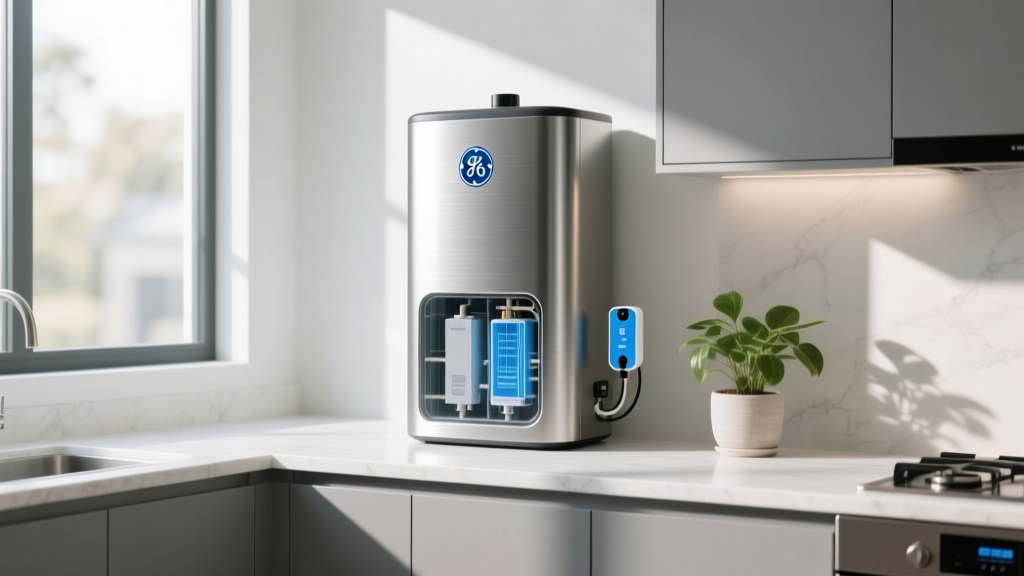
A GE Hybrid Hot Water Tank is a heat pump water heater that extracts ambient heat from the surrounding air and transfers it into stored water, similar to how a refrigerator works in reverse. It carries an Energy Star certification and typically achieves a Uniform Energy Factor (UEF) between 3.35 and 3.55 — meaning it delivers 3.35 to 3.55 units of hot water energy for every unit of electricity consumed. A standard electric resistance water heater has a UEF of roughly 0.90 to 0.95.
The "hybrid" designation refers to the dual heating system:
- Heat pump mode: The compressor runs to efficiently heat water, drawing roughly 500–700 watts during normal operation.
- Electric resistance mode: Backup heating elements (typically 2,000–4,500 watts) activate during high-demand periods or when ambient temperatures drop below the heat pump's effective range.
- Hybrid mode: The unit automatically switches between heat pump and resistance based on demand and conditions.
GE offers these units primarily in 50-gallon and 80-gallon capacities. The 50-gallon model is the most common residential choice and is the focus of most efficiency claims.
How Does a Hybrid Water Heater Compare to Conventional Electric Tanks?
| Specification | GE Hybrid (Heat Pump) 50-Gal | Standard Electric 50-Gal |
|---|---|---|
| Uniform Energy Factor (UEF) | 3.35–3.55 | 0.90–0.95 |
| Estimated Annual Energy Cost | ~$110–$130 | ~$400–$500 |
| Heat Pump Wattage (normal) | ~500–700W | N/A |
| Resistance Element Wattage | ~2,000–4,500W | ~4,500W |
| Circuit Requirement | 240V / 30A dedicated | 240V / 30A dedicated |
| First-Hour Delivery (gallons) | ~65–72 gal | ~60–68 gal |
| Typical Installed Cost | $1,800–$2,800 | $900–$1,400 |
| Energy Star Certified | Yes | Rarely |
The annual energy cost difference is significant. According to Energy Star, a certified heat pump water heater can save a household of four roughly $300–$400 per year compared to a standard electric tank. Over a 10-year lifespan, that's $3,000–$4,000 in savings — more than enough to offset the higher purchase price.
EV Charging and the GE Hybrid Hot Water Tank: Panel Capacity Considerations
This is where the topic becomes directly relevant to EV and PHEV owners. If you're running a Level 2 home charger (typically a 240V / 40A or 48A circuit drawing 7.7–11.5 kW), you're already adding a substantial continuous load to your electrical panel. Adding a hybrid water heater on its own 240V / 30A circuit means another potential 7.2 kW draw when the resistance elements activate.
Here's the practical breakdown:
- 200A panel (most modern homes): Usually sufficient for a Level 2 EV charger and a hybrid water heater simultaneously, provided other major loads (electric oven, dryer, HVAC) aren't all running at peak draw. A licensed electrician should perform a load calculation per NEC Article 220.
- 100A panel (older homes): Likely insufficient for both without a panel upgrade. You may need a 200A service upgrade, which typically costs $1,500–$3,000 depending on your utility and local requirements.
- Load management solutions: Some smart panels and EV chargers (like the Emporia VUE with Span panel integration, or the Wallbox Pulsar Plus with load-balancing features) can dynamically shed or throttle loads to prevent panel overload without requiring a service upgrade.
Installation Requirements and Costs
Installing a GE Hybrid Hot Water Tank involves several considerations that differ from a standard tank swap:
| Item | Requirement / Cost Range |
|---|---|
| Space requirement | ~700–1,000 cubic feet of surrounding air (or louvered door for smaller spaces) |
| Ambient temperature range | 35°F–120°F for heat pump operation |
| Condensate drain | Required — heat pump produces condensate like an AC unit |
| Electrical circuit | 240V / 30A dedicated breaker |
| Unit cost (50-gallon) | $1,100–$1,500 |
| Installation labor | $500–$1,200 |
| Panel upgrade (if needed) | $1,500–$3,000 |
| Total typical install | $1,800–$2,800 (without panel upgrade) |
The space requirement matters. Heat pump water heaters need adequate airflow to extract heat. A tight, sealed utility closet won't work without ventilation modifications. Garages, basements, and larger utility rooms are ideal locations. The unit also produces a low hum (roughly 49–55 dB) during heat pump operation — comparable to a modern dishwasher — which is worth considering if the unit is near living spaces.
Federal Tax Credits and Rebates for Hybrid Water Heaters in 2026
The GE Hybrid Hot Water Tank qualifies for federal energy-efficiency credits under the Inflation Reduction Act, but these are distinct from the IRS §30D clean vehicle credit that EV buyers use.
- IRC §25C Energy Efficient Home Improvement Credit: Up to 30% of the cost (including installation), capped at $2,000 per year for qualified heat pump water heaters. For a $2,200 installed system, that's a $660 credit. This credit resets annually — you can claim it in a different tax year than your EV credit.
- Utility rebates: Many electric utilities offer $300–$800 rebates for Energy Star-certified heat pump water heaters. Check your local utility's efficiency program.
- IRA §25C point-of-sale: As of 2026, some provisions allow direct-pay or point-of-sale rebates for income-qualified households, though availability varies by state and program enrollment.
Hybrid Water Heater vs. EV Charging: Operating Cost Synergy
Pairing a GE Hybrid Hot Water Tank with EV home charging can amplify your electricity savings, especially if your utility offers time-of-use (TOU) rates:
- Off-peak scheduling: Both your EV and water heater can be programmed to run during off-peak hours (typically 10 PM – 6 AM) when electricity rates are lowest. The GE unit's built-in scheduling allows you to set heat pump operation windows.
- Solar integration: If you have rooftop solar, midday excess generation can pre-heat water (the GE unit can be set to a higher temperature setpoint during solar hours), effectively using water as a thermal battery.
- Demand response: Some utilities include HPWHs in demand-response programs, offering bill credits for allowing the utility to briefly pause the compressor during grid peaks — similar to smart EV charging programs.
For a household charging a PHEV like the Toyota RAV4 Prime (which adds roughly 8–12 kWh per charge cycle) and running a hybrid water heater (~2–3 kWh/day in heat pump mode), the combined daily electric load increase is manageable on most 200A panels and often offset by the elimination of gasoline for short commutes.
Reliability, Warranty, and Lifespan
Real-world lifespan data from Consumer Reports and plumbing industry surveys suggest heat pump water heaters last 10–15 years with proper maintenance — comparable to conventional electric tanks. The primary maintenance requirement is annual air-filter cleaning (a washable mesh filter on the unit's intake) and periodic condensate drain line inspection.
The most common failure points are the compressor (covered under the 10-year parts warranty) and the anode rod, which should be inspected every 3–5 years and replaced if depleted to prevent tank corrosion. Replacement anode rods cost $20–$50 and are a straightforward DIY or plumber task.
Is the GE Hybrid Hot Water Tank Right for Your Electrified Home?
Choose the GE Hybrid HPWH if:
- You have a 200A electrical panel with available capacity
- Your water heater is in a garage, basement, or room with adequate airflow
- You want to reduce water heating costs by 60–70%
- You're already electrifying your home (EV, heat pump HVAC, induction cooking)
- You live in a moderate-to-warm climate where the heat pump runs efficiently year-round
Consider alternatives if:
- You have a 100A panel with no room for an upgrade
- The water heater is in a small, sealed closet without ventilation options
- You're in a very cold climate where the heat pump rarely operates efficiently (below 35°F ambient)
- You need the fastest possible hot water recovery (tankless or standard resistance may recover faster in high-demand scenarios)
Frequently Asked Questions
Does the GE Hybrid Hot Water Tank require a special electrical circuit?
Yes. It requires a dedicated 240V / 30A circuit — the same specification as a standard electric water heater. If you're replacing a conventional electric tank, the existing circuit usually works. If you're switching from gas, you'll need a new circuit run by a licensed electrician.
How does a hybrid water heater affect my EV charging setup?
In heat pump mode, the GE unit draws only 500–700W — roughly the same as a household refrigerator. This minimal load rarely conflicts with Level 2 EV charging. The resistance elements (up to 4,500W) only activate during high-demand recovery, and even then, a 200A panel can typically handle both loads simultaneously with proper load calculation.
What's the payback period compared to a standard electric tank?
With a typical installation cost premium of $900–$1,400 over a standard electric tank and annual energy savings of $300–$400, the payback period is roughly 3–5 years. After the §25C tax credit (up to $2,000), the effective payback can be as short as 1–3 years depending on your local electricity rates and hot water usage.
Can I install a GE Hybrid Hot Water Tank myself?
While the plumbing connections are similar to a standard tank, the electrical work requires a licensed electrician for the 240V circuit and any panel modifications. Most jurisdictions require a permit and inspection. DIY installation may void the warranty and create safety and insurance liability issues. This is especially important if you're coordinating the install alongside EV charger wiring.
Does this qualify for the same tax credit as my EV?
No. The GE Hybrid Hot Water Tank qualifies for the IRC §25C Energy Efficient Home Improvement Credit (up to 30%, capped at $2,000/year), which is a separate provision from the §30D New Clean Vehicle Credit. You can claim both in different tax years, and they have independent limits. Always verify current eligibility at IRS.gov or with a tax professional.