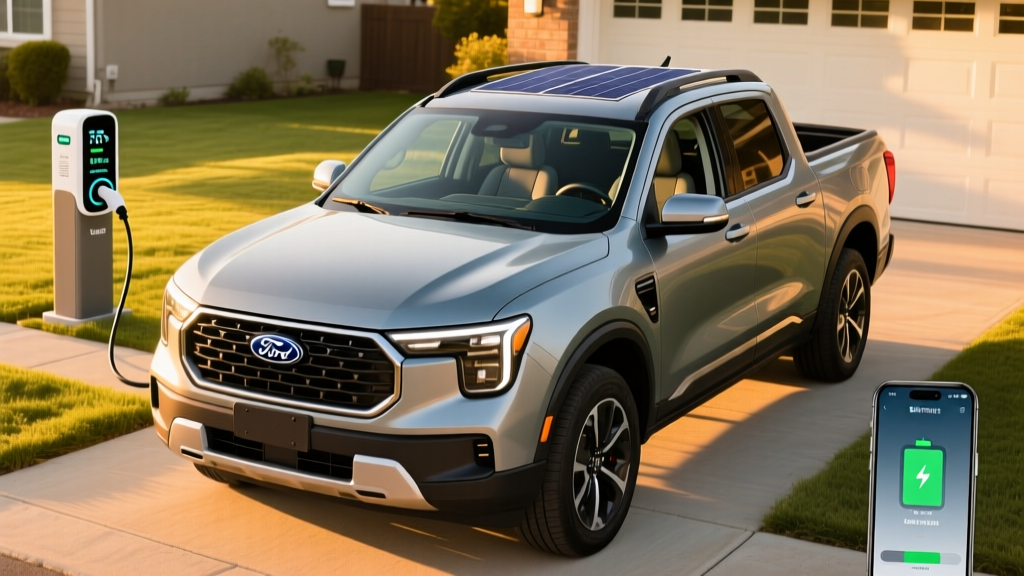
The Ford Maverick hybrid has carved out a unique niche since its 2022 debut: a compact pickup that sips fuel like a midsize sedan while still hauling 1,500 pounds of payload. For the 2026 model year, Ford continues to offer the Maverick Hybrid with its proven 2.5-liter Atkinson-cycle four-cylinder and electric motor combo — a powertrain that requires no plug, no range anxiety, and no lifestyle adjustment from a traditional gas truck.
If you've been searching for a maverick truck hybrid that balances utility with genuine fuel savings, this guide breaks down every number that matters — EPA MPG, real-world efficiency, battery longevity, pricing by trim, and whether any federal tax credits apply.
HEV vs PHEV vs EV: Where the Maverick Hybrid Fits
Before diving into specs, it's worth clarifying what the Maverick Hybrid actually is — and what it isn't. The Maverick uses a conventional hybrid (HEV) powertrain. It charges its small battery through regenerative braking and the gas engine. You never plug it in. There is no electric-only driving range beyond low-speed creeping.
This distinguishes it sharply from plug-in hybrids (PHEVs) like the Toyota RAV4 Prime or Ford Escape PHEV, which carry larger batteries (15–20+ kWh), offer 30–42 miles of electric-only range, and require regular plug-in charging to realize their efficiency advantage. It also differs from a full battery-electric vehicle (BEV) like the Ford F-150 Lightning or Rivian R1T, which eliminates gasoline entirely but demands access to home or public charging infrastructure.
| Attribute | HEV (Maverick Hybrid) | PHEV (e.g., RAV4 Prime) | BEV (e.g., F-150 Lightning) |
|---|---|---|---|
| Plug-in required? | No | Yes (for full benefit) | Yes (mandatory) |
| Electric-only range | None (motor assists engine) | 30–42 mi typical | 230–350+ mi |
| Home charging needed? | No | Recommended (Level 2) | Essential (Level 2) |
| Best for | No charging access, want MPG gains | Short commute + home charging | Full electrification, home charging |
| Federal tax credit | Not eligible (§30D is BEV/PHEV only) | Up to $7,500 (if eligible) | Up to $7,500 (if eligible) |
Fuel Economy: EPA Ratings and Real-World MPG
The headline number for the 2026 Maverick Hybrid remains compelling for a pickup: the EPA rates the front-wheel-drive (FWD) hybrid at 42 MPG city / 33 MPG highway / 37 MPG combined. Opting for all-wheel drive (AWD), which Ford made available on the hybrid starting with the 2025 refresh, drops those figures slightly to approximately 38 city / 31 highway / 34 combined due to the added mechanical drag of the rear drivetrain.
| Drivetrain | City MPG | Highway MPG | Combined MPG | Fuel Tank | EPA Est. Range |
|---|---|---|---|---|---|
| FWD Hybrid | 42 | 33 | 37 | 16.5 gal | ~610 mi |
| AWD Hybrid | 38 | 31 | 34 | 16.5 gal | ~561 mi |
Source: fueleconomy.gov (search 2026 Ford Maverick Hybrid).
Real-World MPG: What Owners Actually See
Like most hybrids, the Maverick Hybrid tends to exceed its EPA city rating in stop-and-go traffic because regenerative braking recaptures energy that a gas-only truck would waste as heat. Owners on Fuelly and Ford forums frequently report 43–46 MPG in urban and suburban driving.
Highway efficiency tells a different story. At sustained 70–80 MPH speeds, aerodynamic drag dominates, and the hybrid system offers less advantage. Expect 30–32 MPG on the highway in real-world conditions — slightly below the EPA sticker. Cold weather (below 35°F) can knock 3–5 MPG off combined figures because the engine runs more often to heat the cabin and because battery chemistry is less efficient at low temperatures.
Powertrain and Performance Specs
The Maverick Hybrid pairs a 2.5-liter Atkinson-cycle inline-four with a permanent-magnet electric motor integrated into Ford's eCVT (electronic continuously variable transmission). Combined system output is 191 horsepower. The gas engine alone produces roughly 162 HP and 155 lb-ft of torque, while the electric motor adds supplemental torque for acceleration from stops and low-speed maneuvering.
| Specification | Detail |
|---|---|
| Engine | 2.5L Atkinson-cycle I-4 |
| Electric Motor | Permanent-magnet synchronous (integrated in eCVT) |
| Combined Horsepower | 191 HP |
| Transmission | eCVT (power-split device) |
| Drivetrain Options | FWD standard; AWD available |
| 0–60 MPH (est.) | ~8.5 seconds (FWD) |
| Max Payload | ~1,500 lbs |
| Max Towing | 2,000 lbs (hybrid); 4,000 lbs with 2.0L EcoBoost gas only |
| Hybrid Battery | ~1.1 kWh lithium-ion (self-charging, no plug) |
The 0–60 time won't impress anyone coming from the 250-HP EcoBoost gas Maverick (which hits 60 in roughly 6.5 seconds), but the hybrid's electric-motor torque fill makes it feel responsive around town. The trade-off is towing: the hybrid is limited to 2,000 pounds, half what the turbocharged gas engine can manage with the 4K Tow package. If you regularly tow a boat or camper, the hybrid isn't your truck.
Pricing by Trim and Tax-Credit Eligibility
For 2026, the Maverick Hybrid is available across multiple trims. Pricing reflects the hybrid powertrain as an option on most trims (it's standard on certain configurations). Approximate MSRPs based on Ford's latest pricing:
- XL Hybrid (FWD): ~$28,490
- XLT Hybrid (FWD): ~$30,690
- Lariat Hybrid (FWD): ~$34,890
- Lobo Hybrid (performance-oriented, gas only — not hybrid eligible)
- Tremor Hybrid (AWD): ~$38,590
- Lariat Luxury Hybrid (AWD): ~$40,000+
Adding AWD to the hybrid typically costs $1,500–$2,000 depending on trim. Destination charges add approximately $1,595.
Does the Maverick Hybrid Qualify for a Federal Tax Credit?
No. The Maverick Hybrid is a conventional HEV — it does not plug in and has no meaningful electric-only range. The federal §30D Clean Vehicle Credit applies only to battery-electric vehicles (BEVs) and plug-in hybrids (PHEVs) that meet specific battery-capacity, critical-mineral sourcing, MSRP cap ($80,000 for trucks), and buyer income limits. Since the Maverick Hybrid carries only a ~1.1 kWh battery and cannot be plugged in, it does not qualify for any portion of the $7,500 federal credit.
Some states offer separate incentives for conventional hybrids, but these are uncommon and vary by jurisdiction. Check your state's energy office or Alternative Fuels Data Center for current local programs. The hybrid's value proposition is fuel savings, not incentive-driven price reduction.
Battery Warranty, Reliability, and Replacement Costs
The Maverick Hybrid's lithium-ion battery pack is small (~1.1 kWh usable), operates within a narrow state-of-charge window (Ford's battery management system avoids deep discharge or full charge to maximize longevity), and benefits from Ford's extensive hybrid experience dating back to the 2005 Escape Hybrid.
• 8 years / 100,000 miles (150,000 miles in California and states adopting CARB emissions standards)
• Covers capacity loss below a defined threshold and manufacturing defects
• Hybrid system components (eCVT, electric motor, inverter) also covered under the 8-year powertrain warranty
How Reliable Is the Maverick Hybrid?
Ford's 2.5L hybrid powertrain has been in service since the 2020 Escape Hybrid and shares architecture with the Toyota-influenced power-split design Ford has refined since 2005. The eCVT has no traditional gears, belts, or clutches to wear — it's a planetary gearset, which is mechanically robust. Consumer Reports and J.D. Power data on the Maverick platform show average to above-average reliability ratings, with the hybrid variant generally outperforming the EcoBoost turbo in long-term dependability because it eliminates the turbocharger, has fewer high-pressure fuel system components, and uses regenerative braking (which reduces wear on the friction brake pads — many hybrid owners report 80,000+ miles on original brake pads).
Battery Replacement Cost
If the hybrid battery fails outside warranty, replacement cost at a Ford dealer typically runs $2,500–$4,000 including labor for the Maverick's small pack. This is significantly less than BEV battery replacements ($8,000–$20,000+) because the pack is small and accessible. Independent hybrid specialists often offer refurbished packs for $1,500–$2,500. Given the 8-year/100,000-mile warranty coverage and the proven longevity of Ford's hybrid batteries (many Escape Hybrids have exceeded 200,000 miles on original packs), unplanned replacement is rare.
Who Should Buy the Maverick Hybrid vs. Gas, PHEV, or Full EV?
- You want a pickup truck but commute in city/suburban traffic where hybrid efficiency shines
- You lack access to home or workplace charging (apartment, street parking)
- You drive 12,000–15,000 miles/year and want to minimize fuel cost without plugging in
- Your towing needs stay under 2,000 pounds
- You want 500+ miles of total range per tank for road trips without charging stops
- You need 4,000-lb towing capacity
- You drive mostly highway miles where the hybrid advantage shrinks
- You want maximum payload or off-road capability (Tremor with EcoBoost)
- You have home Level 2 charging and a short commute (<35 miles)
- You want electric-only daily driving with gas backup for road trips
- You qualify for the §30D federal tax credit (income and sourcing requirements met)
- You have reliable home Level 2 charging
- You want zero tailpipe emissions and minimal maintenance
- Your daily driving is under 250 miles and you can plan road-trip charging
- You qualify for the $7,500 federal credit and want lower operating costs
5-Year Fuel Cost Comparison
At 15,000 miles/year and $3.40/gallon regular unleaded:
| Vehicle | Combined MPG / MPGe | Annual Fuel/Energy Cost | 5-Year Fuel Cost |
|---|---|---|---|
| Maverick Hybrid (FWD, 37 MPG) | 37 MPG | ~$1,378 | ~$6,892 |
| Maverick Gas (2.0T AWD, 26 MPG) | 26 MPG | ~$1,962 | ~$9,808 |
| F-150 Lightning (BEV, home charging avg $0.14/kWh) | 70 MPGe | ~$840 | ~$4,200 |
The hybrid saves roughly $2,900 over five years compared to the gas Maverick — enough to offset the hybrid powertrain premium on lower trims. The BEV saves even more on fuel, but requires charging infrastructure and a higher purchase price (though partially offset by the $7,500 tax credit if eligible).
Pros and Cons at a Glance
- 42 MPG city EPA — best-in-class for any pickup
- No plug-in required; works with existing gas-station infrastructure
- 610+ mile total range per tank (FWD)
- Reduced brake wear from regenerative braking
- 8-year/100,000-mile hybrid battery warranty
- Competitive starting price (~$28,490 XL Hybrid)
- AWD now available on hybrid trims
- 2,000-lb max towing (half of EcoBoost)
- ~8.5-second 0–60; not a performance truck
- No federal tax credit (HEV, not PHEV/BEV)
- Highway MPG drops to low 30s in real-world driving
- Small rear seat; crew-cab-only limits cargo flexibility vs midsize trucks
- Cold weather reduces hybrid efficiency by 5–10%
Frequently Asked Questions
How many MPG does the Maverick truck hybrid get?
The 2026 Maverick Hybrid FWD is EPA-rated at 42 city / 33 highway / 37 combined MPG. The AWD hybrid rates approximately 38 / 31 / 34. Real-world city driving often exceeds EPA figures (43–46 MPG), while sustained highway driving typically yields 30–32 MPG.
Does the Maverick Hybrid need to be plugged in?
No. The Maverick Hybrid is a conventional HEV. Its ~1.1 kWh battery charges through regenerative braking and the gasoline engine. You fuel it exclusively at gas stations — no charging cable, no home charger installation required.
Is the Maverick Hybrid reliable, and what does a battery replacement cost?
Ford's 2.5L hybrid powertrain has been in production since 2020 (Escape Hybrid) and uses a proven power-split eCVT design. The hybrid battery is covered by an 8-year/100,000-mile warranty (150,000 miles in CARB states). Out-of-warranty replacement runs $2,500–$4,000 at a dealer, though failures before 150,000+ miles are uncommon based on historical Ford hybrid data.
Does the Maverick Hybrid qualify for any federal tax credit?
No. The IRS §30D Clean Vehicle Credit applies only to plug-in electric vehicles (BEVs and PHEVs) with battery packs of at least 7 kWh. The Maverick Hybrid's ~1.1 kWh pack and lack of plug-in capability make it ineligible. Check your state's incentive programs for any hybrid-specific rebates, though these are rare.
Can I tow with the Maverick Hybrid?
Yes, but with a 2,000-pound limit — sufficient for a small utility trailer, a pair of dirt bikes, or a light pop-up camper. If you need 4,000-lb towing (boat, travel trailer), you'll need the 2.0L EcoBoost gas engine with the 4K Tow package. The hybrid is not available with that package.
Hybrid vs PHEV vs EV — which Maverick buyer profile fits each?
The hybrid suits buyers without charging access who want maximum MPG from a pickup. A PHEV (not currently offered in the Maverick lineup) would suit short-commute drivers with home charging who want electric-only daily driving. A full EV truck (F-150 Lightning, Rivian R1T) suits drivers with home charging who want zero tailpipe emissions and lower operating costs, accepting higher upfront cost and road-trip charging planning.
How does AWD affect Maverick Hybrid fuel economy?
Adding AWD reduces combined MPG by approximately 3 MPG (from 37 to 34 combined EPA). The trade-off is improved traction in rain and snow, which many buyers in northern climates consider worthwhile. The AWD hybrid uses a rear-mounted electric motor rather than a mechanical driveshaft, which preserves the flat load floor.
Pricing and specs reflect 2026 model-year information available at time of publication. Federal tax credit rules under IRS §30D are subject to change; consult irs.gov or a tax professional for eligibility. Fuel economy figures sourced from fueleconomy.gov. Safety ratings: check NHTSA and IIHS for the latest crash-test results.